
Email: ainlbusshelter@gmail.com | WhatsApp: +86-18800607527
Views: 217 Author: Ainl Bus Shelter Publish Time: 2026-09-19 Origin: Site


Content Menu
● What Is a Solar Bus Shelter?
● Solar Bus Shelter vs Conventional Shelter at a Glance
● Why Solar Bus Shelters Support Green Transportation Projects
>> Reduced Dependence on Grid Expansion
>> Safer Waiting Conditions After Dark
>> Better Passenger Comfort and Transit Confidence
● Where Conventional Shelters Remain a Practical Choice
● The Lifecycle Cost Question: Look Beyond the Purchase Price
● Solar System Design: The Difference Between a Feature and a Reliable Solution
>> Step 1: Identify Every Electrical Load
>> Step 2: Estimate Daily Energy Demand
>> Step 3: Consider Local Solar Conditions
>> Step 4: Size Battery Storage for Real Conditions
>> Step 5: Design for Maintenance, Not Just Installation
● Accessibility and Passenger Flow Must Come First
● Materials and Structural Durability Matter
● How to Choose the Right Shelter for Your Project
● A Practical Example: Which Option Fits Best?
>> Location A: A New Suburban Transit Corridor
>> Location B: A Dense Downtown Interchange
● The Future of Bus Shelters Is Hybrid, Durable, and Passenger-Centered
● Build a Smarter Transit Stop With Ainl
>> 1. What is the main difference between a solar bus shelter and a conventional shelter?
>> 2. Can a solar bus shelter work at night?
>> 3. Can solar bus shelters support digital advertising screens?
>> 4. Are solar bus shelters suitable for cloudy climates?
>> 5. What maintenance does a solar bus shelter require?
>> 6. Can a solar bus shelter be customized for a city project?
>> 7. Does a solar bus shelter replace the need for grid power in every project?
A solar bus shelter is no longer only a place where passengers wait for public transport. It can function as a self-powered public-service unit that combines weather protection, LED lighting, passenger information, charging, advertising, and city-brand communication. By contrast, a conventional bus shelter usually relies on nearby grid power—or offers no electrical functions at all.
For green transportation projects, the comparison is not simply solar panels versus no solar panels. The real decision concerns lifecycle cost, installation constraints, passenger safety, power resilience, digital-service readiness, maintenance planning, and the long-term image of a city or transit network. For municipalities, developers, transit operators, outdoor media companies, and EPC contractors, selecting the right shelter system can affect both project performance and public perception for years.
A well-engineered solar-powered bus shelter can provide a practical alternative where grid extension is expensive, street excavation is difficult, or a project requires visible low-carbon infrastructure. However, success depends on correct solar-system sizing, structural design, battery selection, local weather analysis, accessibility planning, and realistic expectations about the electrical loads that the shelter must support.
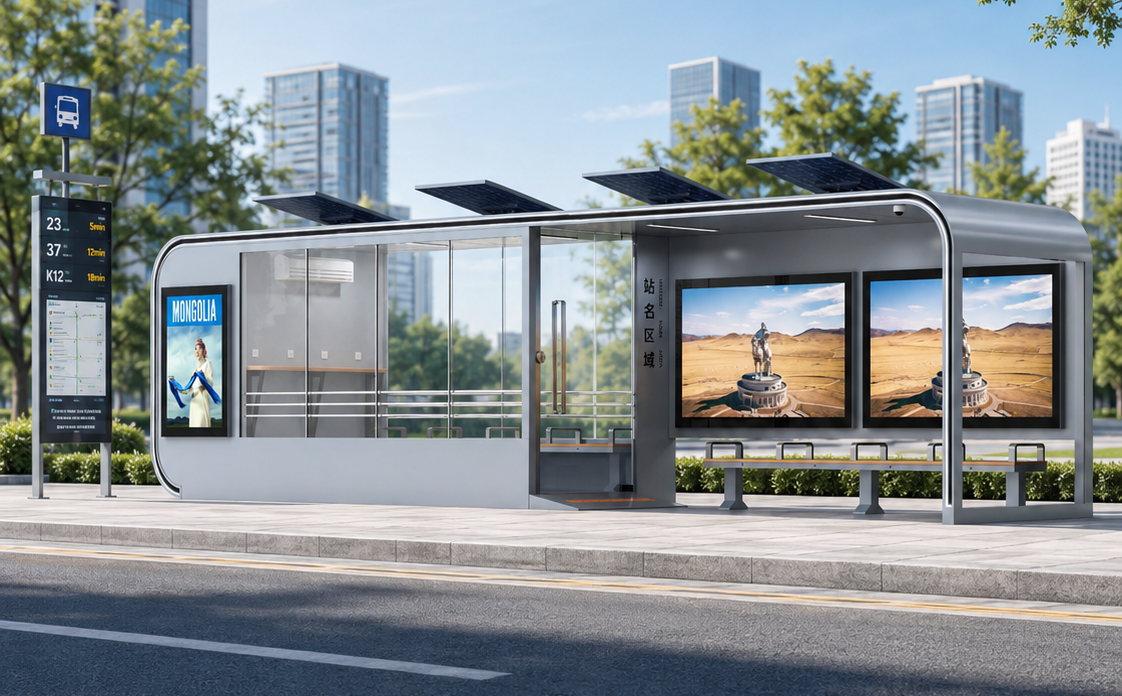
A solar bus shelter is a transit waiting facility with an integrated photovoltaic power system. The solar panels collect daylight energy, while a controller manages charging and discharge. The stored electricity is typically held in batteries and used to power selected loads, such as:
- LED lighting
- USB or Type-C charging ports
- Passenger information displays
- Advertising light boxes
- Digital signage
- Security cameras
- Emergency call buttons
- Wi-Fi equipment
- Environmental sensors
- Smart-city communication devices
The shelter remains a physical public facility first. It still needs to provide protection from rain, sun, wind, and other outdoor conditions. But the integrated energy system allows it to deliver services without depending entirely on a conventional electrical connection.
A conventional shelter, in comparison, is usually a steel, aluminum, glass, stainless-steel, or composite structure designed mainly for weather protection and passenger seating. It may include a static advertising panel, route map, trash bin, or basic lighting. If lighting or digital equipment is installed, it generally requires trenching, cabling, electrical approvals, utility coordination, and an ongoing electricity supply.
The best choice depends on the site, project goals, budget structure, public-service requirements, and local maintenance capacity. The following comparison highlights the practical differences that project decision-makers should evaluate.
| Comparison Area | Solar Bus Shelter | Conventional Shelter |
|---|---|---|
| Power source | On-site photovoltaic generation with battery storage | Grid electricity, or no power system |
| Installation requirements | Can reduce dependence on trenching and grid connection | Often needs cabling, excavation, utility coordination, and electrical works |
| Lighting capability | Solar-powered LED lighting can operate after dark when properly designed | Lighting depends on grid availability and local electrical infrastructure |
| Suitable locations | Remote stops, parks, campuses, suburban roads, new developments, scenic areas, temporary projects | Mature urban areas with easy and low-cost grid access |
| Passenger services | Can support lighting, charging, information displays, sensors, and selected smart devices | Usually limited unless grid power and communications are installed |
| Energy operating cost | Solar-generated electricity can reduce recurring grid-energy consumption | Ongoing electricity charges may apply where powered features are installed |
| Resilience | Can continue serving designed loads during certain grid outages | Electrical services may stop during grid failures |
| Initial equipment cost | Usually higher due to PV modules, batteries, controllers, and integrated electrical equipment | Often lower for a basic unpowered structure |
| Design complexity | Requires solar-resource analysis, load calculation, battery autonomy planning, and maintenance design | Requires structural, accessibility, drainage, and grid-electrical planning where applicable |
| Sustainability visibility | Strong visual link to clean mobility and public-energy innovation | Less visible connection to renewable-energy targets |
A solar solution is not automatically the right answer for every stop. A small, heavily shaded shelter beneath dense trees or high-rise buildings may not receive enough sunlight for demanding loads. Similarly, a conventional grid-connected solution can remain cost-effective at major urban hubs where existing power infrastructure is close by and excavation is straightforward.
The key is to match the shelter type to the site rather than selecting a product based only on appearance or a short-term purchase price.
Green transportation is about more than electric buses, bicycles, and rail systems. The passenger journey begins before boarding. A dark, uncomfortable, inaccessible, or poorly maintained stop can reduce confidence in public transport, even when the vehicle fleet itself is modern.
A thoughtfully designed solar-powered bus shelter helps extend sustainability principles into the waiting environment.
In many projects, the difficult part is not placing the shelter structure. It is bringing electricity to the site.
Traditional power connections can involve road cutting, trench excavation, cable protection, utility applications, inspections, reinstatement of pavements, and coordination among multiple contractors. In a busy commercial district, historic streetscape, campus, resort, park, or suburban corridor, these activities may create cost, delay, traffic disruption, and permitting complications.
A solar bus shelter does not eliminate all site work. Foundations, anchoring, drainage, accessibility surfaces, and structural installation are still essential. However, it can reduce the need for a dedicated grid connection for selected shelter functions.
This is particularly valuable when a project includes:
- New bus routes in developing areas
- Stops along rural or suburban roads
- Transit facilities in parks, campuses, airports, ports, or industrial zones
- Temporary or phased infrastructure projects
- Locations where road excavation is restricted
- Municipal upgrades with limited electrical infrastructure
- Sites where visual and environmental disruption must be minimized
NASA's POWER project has highlighted solar-powered transit applications, including bus-stop lighting designed to improve visibility and comfort for passengers.
Lighting is one of the most immediate benefits that passengers notice. A well-lit shelter can improve the visibility of seating, route information, entry areas, pavement edges, and nearby pedestrian paths. It can also make a stop feel more welcoming during early-morning and evening travel periods.
However, lighting quality matters more than simply adding a lamp. Poor placement can create glare, dark corners, reflections on glass, or insufficient illumination at the boarding zone.
Good shelter-lighting planning should consider:
- Uniform light distribution across seating and standing areas
- Clear visibility of route maps and passenger information
- Low glare for approaching drivers, cyclists, and pedestrians
- Illumination of access paths leading to the shelter
- Safe boarding visibility near the bus-door area
- Durable outdoor-rated fixtures for rain, heat, dust, vibration, and corrosion
- Battery autonomy for cloudy periods and seasonal changes
Transit design guidance from Seattle emphasizes that riders need to see approaching buses, board conveniently, and benefit from safe, well-lit shelters. It also identifies seating, weather protection, accessibility, and unobstructed boarding as core shelter considerations.
For a solar shelter, the lighting system must be designed around actual available energy—not ideal laboratory conditions. This means calculating the energy consumed each night, expected solar generation by season, battery capacity, controller efficiency, panel orientation, local shading, and reserve power requirements.
Passengers judge a transit system through everyday details. They notice whether there is a seat, whether they can see the arriving bus, whether the shelter protects them from heavy rain, whether the space feels safe at night, and whether information is easy to read.
A solar bus shelter can improve the waiting experience by supporting useful, low-power services, including:
- Automatic LED lighting
- Real-time arrival information
- Illuminated route maps
- Emergency communications
- Low-power charging points
- Digital public notices
- Environmental or weather alerts
- Advertising screens that help fund the facility
These functions should never compromise the shelter's fundamental role. A stylish display screen is not more important than a dry seating area, clear wheelchair access, a visible bus approach, or a safe path to the vehicle door.
A strong design hierarchy is simple:
1. Safe access and boarding
2. Weather protection and passenger comfort
3. Clear transit information
4. Reliable lighting
5. Optional smart services
6. Advertising and city-brand features
When the hierarchy is reversed, shelters can become visually impressive but less useful to the people who depend on them.
A conventional shelter is not an outdated product by definition. In the right setting, it can be a highly effective, economical, and durable public facility.
For example, a high-frequency urban transit hub may already have robust grid access, existing street lighting, fiber communications, underground ducting, and a maintenance team familiar with electrical equipment. In that environment, a grid-connected shelter may deliver higher continuous power capacity for large displays, multiple advertising panels, high-brightness screens, extensive CCTV coverage, or more demanding climate-control equipment.
A conventional shelter may be preferable when:
- Existing grid power is immediately available
- The site receives limited sunlight because of dense shading
- The project needs high continuous electrical loads
- The operator requires 24-hour power for large digital media
- Battery maintenance is not suitable for the local operating model
- The project budget prioritizes the lowest initial structure cost
- Solar modules would conflict with heritage, visual, or planning requirements
The important point is that a conventional shelter should still meet modern public-facility expectations. It should be structurally sound, corrosion-resistant, accessible, easy to clean, appropriately illuminated, and designed for local weather.
A basic shelter that fails to protect passengers from rain, lacks accessible circulation space, blocks the boarding area, or deteriorates quickly is not a good value merely because it cost less at procurement.
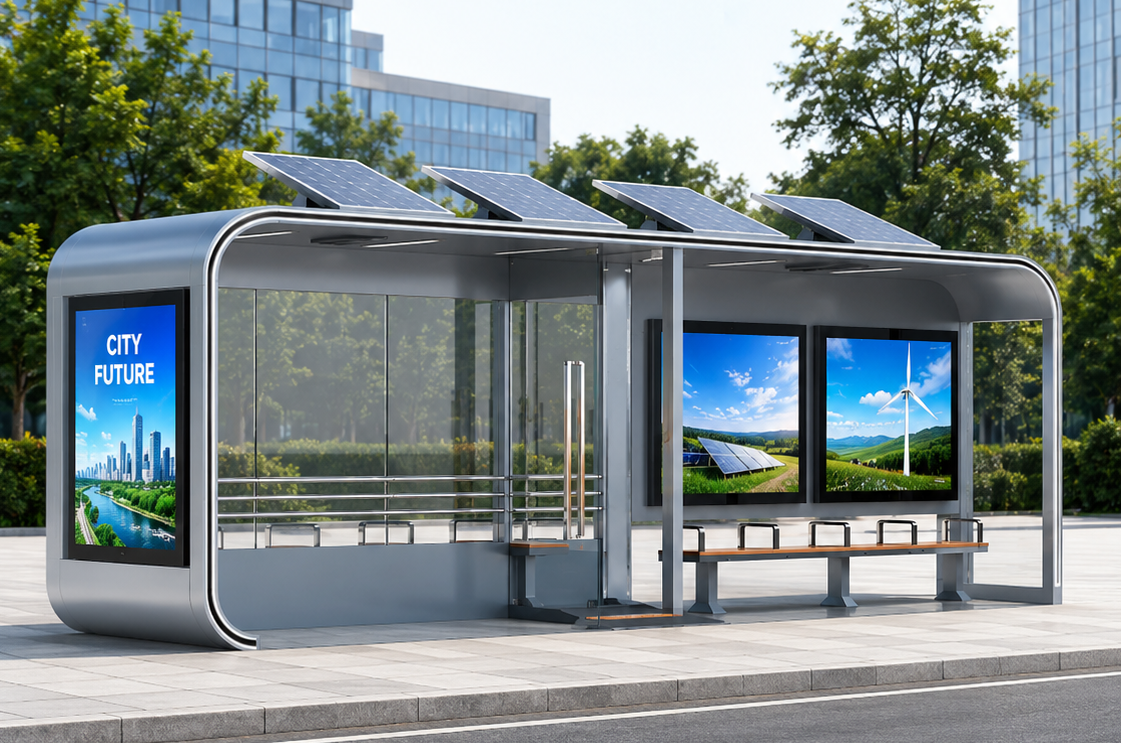
Procurement teams often compare shelters using initial unit price alone. That approach can produce misleading results because the product purchase is only one portion of the project cost.
A more realistic evaluation examines the total cost of ownership over the intended service life.
For a conventional electrically powered shelter, cost categories may include:
- Shelter fabrication and transport
- Foundations and civil works
- Utility applications
- Cable trenching and ducting
- Electrical connection work
- Road or pavement reinstatement
- Inspection and commissioning
- Monthly or annual electricity charges
- Repairs to cables, luminaires, displays, and electrical components
- Future upgrades to communications or digital systems
For a solar bus shelter, key cost categories may include:
- Shelter fabrication and structural installation
- Photovoltaic modules
- Mounting systems
- Charge controller and protection equipment
- Battery bank or energy-storage system
- LED lighting and smart devices
- Energy monitoring
- Battery replacement planning
- Periodic panel cleaning where required
- Inspection of seals, wiring, mounting points, and electrical enclosures
The decision should therefore use a project-specific lifecycle model. A solar shelter can be especially attractive where civil and electrical connection costs are high. A conventional shelter may be more economical where a reliable grid connection already exists at the exact site and the project needs large, continuous power loads.
Project teams can use the following framework:
Whole-Life Cost=Initial Product Cost+Installation Cost+Energy Cost+Maintenance Cost+Replacement Cost
This formula is simple, but it forces the right discussion. It moves the decision away from "Which shelter is cheaper to buy?" toward "Which solution creates the best long-term value at this location?"
Not every shelter with a panel on the roof is a reliable solar bus shelter. The performance of the system depends on engineering discipline.
From a manufacturing and project-delivery perspective, the most common mistake is underestimating actual energy demand. A shelter may operate LED lighting successfully but struggle after a large display, charging ports, CCTV camera, network router, and advertising light box are added later.
Before selecting solar equipment, project stakeholders should define the electrical load list.
Create a realistic list of required components, including:
- Interior and exterior lighting
- Route-map backlighting
- Passenger-information display
- Digital advertising screen
- Camera system
- Network router
- Emergency intercom
- USB charging ports
- Sensors
- Decorative lighting
- Control system and standby consumption
Every device should have a rated power, expected daily operating hours, and priority level.
The basic calculation is:
Daily Energy Demand (Wh)=∑(Device Power in W×Operating Hours)
For example, if a shelter uses 40 W of LED lighting for 10 hours each night, the lighting demand is:
40×10=400 Wh/day
If other components consume another 300 Wh/day, the shelter requires approximately 700 Wh/day before allowing for electrical losses and reserve capacity.
Solar panels do not generate the same output every day. Performance changes according to:
- Seasonal sunlight variation
- Roof direction and tilt
- Nearby buildings
- Trees and future tree growth
- Dust, snow, bird droppings, and pollution
- Module temperature
- Local climate
- Shading at different hours of the day
A site that appears sunny at noon may be heavily shaded in the morning or afternoon. For this reason, a proper site review should include year-round shading considerations rather than a quick visual inspection.
Battery capacity should be based on expected low-sunlight periods, critical loads, depth-of-discharge limits, temperature conditions, and the desired number of autonomous operating days.
A smart design also prioritizes essential loads. During extended cloudy weather, the controller can maintain safety lighting and emergency functions while limiting non-essential loads such as decorative lighting, charging ports, or advertising brightness.
A public facility will be exposed to rain, wind, dust, heat, vandalism, and constant use. Therefore, solar components should be accessible for inspection but protected against unauthorized tampering.
A reliable system should include:
- Lockable electrical compartments
- Weather-resistant cable routing
- Corrosion-resistant fasteners
- Clear maintenance access
- Component labeling
- Surge and over-current protection
- Remote energy monitoring where appropriate
- Replaceable modular components
- A documented inspection schedule
A green transportation project cannot be considered fully successful if the shelter is difficult for older passengers, wheelchair users, parents with strollers, visually impaired riders, or people carrying luggage to use.
The shelter's location, internal layout, entrance, seating, display placement, and boarding clearance all affect usability.
Transit design standards commonly emphasize a clear route to the shelter, unobstructed boarding areas, and adequate space for mobility devices. SMART's design standards specify that shelters should not block boarding or alighting zones, should maintain a clear path of travel, and should provide clear floor space for riders using wheelchairs, scooters, and other mobility aids.
For practical project planning, avoid the following mistakes:
- Installing columns where passengers need to board
- Placing advertising panels in the main pedestrian route
- Reducing wheelchair turning space to add extra seating
- Positioning route maps too high or too low
- Designing a narrow entrance that creates congestion
- Using highly reflective glass that obscures visibility
- Adding roof structures that block the view of approaching buses
- Allowing rainwater to drain into the passenger waiting area
A solar roof should be integrated without compromising these basic requirements. Panels, wiring, and support members should not create a heavier, darker, or more visually obstructive shelter.
Solar equipment adds weight, wind exposure, and electrical complexity. That makes structural design especially important.
The shelter frame must support not only the roof itself, but also photovoltaic modules, mounting rails, snow loads where relevant, wind loads, signage, lighting fixtures, and possible future upgrades. The supporting structure should be engineered for the target project location and local codes.
For long-term public use, buyers should evaluate:
- Steel grade and wall thickness
- Galvanizing or corrosion-protection treatment
- Powder-coating quality
- Welding consistency
- Anchor-bolt and foundation design
- Glass or polycarbonate safety performance
- Roof drainage
- Fastener quality
- Electrical enclosure protection
- Resistance to wind, rain, dust, UV exposure, and vandalism
Ainl's manufacturing capability is relevant here because an integrated facility can coordinate structural fabrication, sheet-metal precision processing, coating, electrical testing, assembly, and customization within a controlled production process. For complex municipal or outdoor-advertising projects, this integration can reduce the risk of disconnects between the structure supplier, electrical supplier, finish provider, and smart-device integrator.
With 16 years of experience in public facilities and outdoor advertising products, Ainl can support tailored solar bus shelter solutions covering shelter dimensions, structural configuration, colors, screen options, lighting systems, solar-power schemes, and city-brand elements. The company's production resources—including precision sheet-metal processing, large-scale coating capability, electrical testing, and research-and-development support—are particularly useful for OEM and ODM projects that require both visual consistency and field durability.
The best procurement decision begins with the site and the service objective, not the catalog image.
Use this practical checklist before specifying a solar bus shelter or conventional shelter.
1. Define the passenger volume.
Estimate peak waiting numbers, average dwell time, passenger demographics, and whether seating, leaning rails, or a larger covered area are required.
2. Review the physical site.
Check pavement width, road geometry, bus-door position, pedestrian flow, drainage, underground utilities, nearby trees, buildings, and visibility of approaching buses.
3. Clarify the service functions.
Decide whether the shelter needs lighting only, or whether it must also support displays, charging, cameras, advertising, Wi-Fi, sensors, or emergency communications.
4. Assess solar availability.
Evaluate roof orientation, seasonal sun exposure, shading, weather patterns, and available panel area.
5. Calculate the energy budget.
Size the solar panels and battery based on actual loads, operating hours, reserve requirements, and electrical losses.
6. Set durability requirements.
Match materials, coating systems, electrical protection, glass type, and structural engineering to the local climate and vandalism risk.
7. Protect accessibility and boarding.
Maintain a clear pedestrian route, accessible waiting area, visible boarding zone, and usable space for mobility devices.
8. Plan maintenance from day one.
Identify who will inspect the structure, clean panels, service batteries, repair displays, replace lights, and respond to damage.
9. Build city identity into the design.
Integrate approved colors, logos, route identity, wayfinding graphics, advertising formats, and architectural character without reducing passenger usability.
10. Compare whole-life value.
Include installation, power, maintenance, replacement, and expansion costs—not only the initial shelter price.
Consider two hypothetical locations.
The stop is beside a newly developed residential district. There is no nearby electrical supply, and installing grid power would require road excavation and utility coordination. Passenger volume is moderate, but early-morning and evening lighting is important.
In this situation, a solar bus shelter is likely the stronger option. The energy system can prioritize LED lighting, an illuminated route map, a small passenger-information display, and limited charging capability. The shelter should use a durable steel frame, corrosion-resistant finish, integrated battery cabinet, solar roof, and easy-to-maintain electrical design.
The stop is located beneath tall buildings. It serves high passenger volumes and needs several high-brightness digital screens, continuous CCTV, extensive communications equipment, and long operating hours. Existing grid infrastructure is already adjacent to the site.
In this situation, a conventional grid-connected shelter may be more practical. Solar panels could still be added as a supplementary feature, but they may not provide sufficient energy because of shade and high continuous demand.
The lesson is clear: solar power should be selected because it fits the operational reality, not only because it looks innovative.
The direction of public transport infrastructure is moving toward facilities that do more than provide a roof and bench. Cities increasingly expect bus shelters to support safety, accessibility, information access, energy efficiency, public communication, and local identity.
Recent projects show how solar-powered upgrades can be applied at scale. The University of Wisconsin–Madison reported solar-panel integration on 20 campus-managed bus shelters in 2023, with additional shelter upgrades planned in later phases. The project connected solar-powered improvements with safer, more convenient, and more sustainable campus transportation.
For project owners, the goal should not be to install the most complicated shelter possible. The goal should be to deliver the most reliable public-service asset for the location.
A successful solar bus shelter is:
- Structurally secure
- Weather resistant
- Accessible
- Easy to maintain
- Appropriately illuminated
- Correctly sized for its energy demand
- Visually consistent with the city
- Prepared for future smart-service upgrades
Choosing between a solar bus shelter and a conventional shelter requires more than comparing exterior styles. It requires a clear understanding of site conditions, passenger needs, available power, structural loads, long-term maintenance, branding requirements, and project budget.
Ainl provides customized public-facility and outdoor-advertising solutions for transportation, municipal, commercial, and smart-city projects. From steel structures and precision sheet-metal fabrication to powder coating, electrical integration, display configuration, lighting systems, solar-power solutions, and city-brand customization, Ainl can help turn a project concept into a durable, field-ready shelter system.
Contact Ainl to discuss your solar bus shelter project, request a customized technical proposal, or develop an OEM/ODM solution tailored to your city, transit route, commercial site, or public-infrastructure tender.
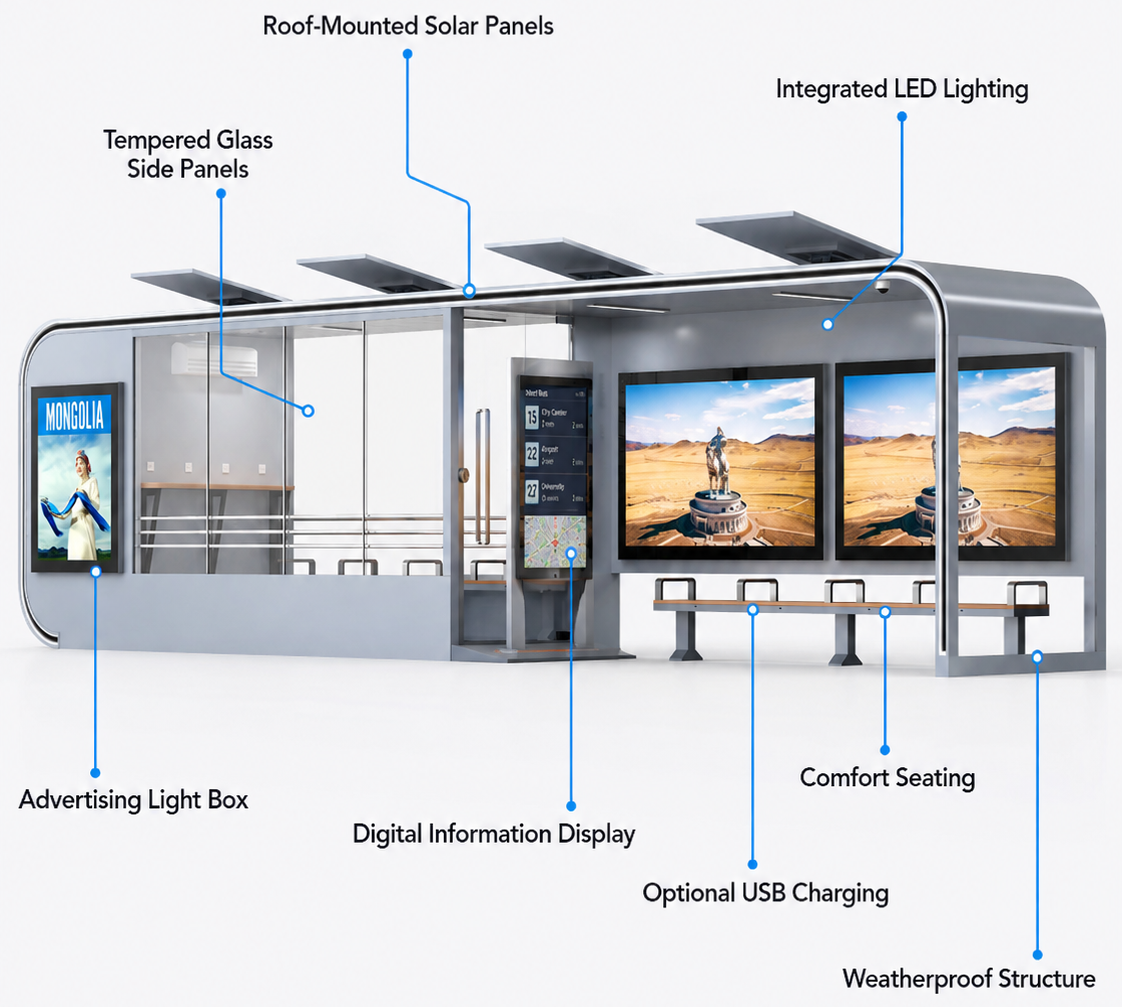
A solar bus shelter generates electricity through integrated photovoltaic panels and stores energy in batteries for lighting and selected smart functions. A conventional shelter normally relies on grid electricity for powered equipment or operates without electrical features.
Yes. Solar energy collected during the day is stored in a battery system and used at night. The actual operating time depends on the solar-panel capacity, battery size, weather conditions, lighting load, screen load, and system-control strategy.
They can support selected digital advertising screens if the power system is designed for the screen's energy demand. Large, high-brightness screens with long daily operating hours may require larger solar arrays, more battery storage, grid backup, or a hybrid energy solution.
They can be suitable, but the solar system must be designed around local solar resources and low-sunlight periods. This may require larger panels, greater battery capacity, reduced energy loads, intelligent load prioritization, or grid backup.
Maintenance typically includes inspection of the structure, anchors, roof drainage, solar panels, wiring, controller, battery system, lights, screens, glass panels, and protective coating. Panels may also need cleaning where dust, pollution, snow, or bird droppings reduce energy generation.
Yes. Customization can include dimensions, frame structure, roof style, color, materials, seating, glass type, lighting, solar configuration, advertising panels, LED displays, route maps, logos, and other city-brand elements.
No. It is highly effective for low- to moderate-power applications and sites where grid connection is costly or difficult. For high-load locations with large screens, continuous communications systems, or limited sunlight, a grid-connected or hybrid solution may be more appropriate.
1. Seattle Office of Planning and Community Development. "[Transit-Friendly Design Guidelines]."
2. NASA POWER. "[Accessible Solar Data Drives Everyday Transit Applications]."
3. Suburban Mobility Authority for Regional Transportation. "[SMART Bus Stop Design Standards Manual]."
4. University of Wisconsin–Madison Office of Sustainability. "[Solar-Powered and Ahead of the Curve: Shaping Campus as a Living Lab]."
5. City of Charlotte Area Transit System. "[Enhanced Bus Shelter Featuring Solar Lighting]."
6. Ainl Group. "[Solar-Powered Bus Shelters: A Practical Guide to Smarter, Safer Transit Stops]."


