
Email: ainlbusshelter@gmail.com | WhatsApp: +86-18800607527
Views: 299 Author: Ainl Bus Shelter Publish Time: 2026-11-17 Origin: Site


Content Menu
● What Makes an Air-Conditioned Bus Shelter Different?
● How Does the Bus Shelter Air-Conditioning System Work?
>> 1. Indoor Air Passes Across a Cold Evaporator Coil
>> 2. The Compressor Raises Refrigerant Pressure
>> 3. The Outdoor Condenser Releases Heat
>> 4. An Expansion Device Restarts the Cycle
● How Does the Shelter Keep Cool When Doors Open?
>> Reduce Heat Gain Before Adding Cooling Capacity
>> Design Entrances Around Real Passenger Movement
● How Are Ventilation, Humidity, and Air Quality Managed?
>> Balance Fresh Air With the Cooling Load
>> Control Moisture Without Excessive Cooling
● How Much Cooling Capacity and Electricity Are Required?
● Can Solar Panels Power an Air-Conditioned Bus Shelter?
● What Does Dubai's Experience Show?
● How Should Buyers Test an Air-Conditioned Bus Shelter?
>> Test Under Representative Conditions
>> Verify Safety and Maintainability
● How Ainl Approaches Customized Shelter Development
>> Can an air-conditioned bus shelter stay cool in extreme heat?
>> Does every air-conditioned shelter need to be fully enclosed?
>> Can the same equipment provide winter heating?
>> How often does the system need maintenance?
>> Can an existing bus shelter be retrofitted?
>> What is the most important purchasing consideration?
An air-conditioned bus shelter works by removing heat and moisture from an enclosed waiting area and releasing that heat outdoors. A refrigeration system cools the indoor air, fans distribute it around passengers, and controls adjust operation as conditions change. Insulation, solar-control glazing, well-managed entrances, and ventilation help the system maintain comfort without wasting unnecessary energy.
However, creating a comfortable bus stop involves more than installing an air conditioner inside a glass enclosure.
From our manufacturing perspective at Ainl, the shelter structure, cooling equipment, electrical systems, and passenger experience must be designed together. Drawing on our 16-year focus on public facilities and outdoor advertising products, this article explains the technology and the practical questions buyers should resolve before specifying a project.
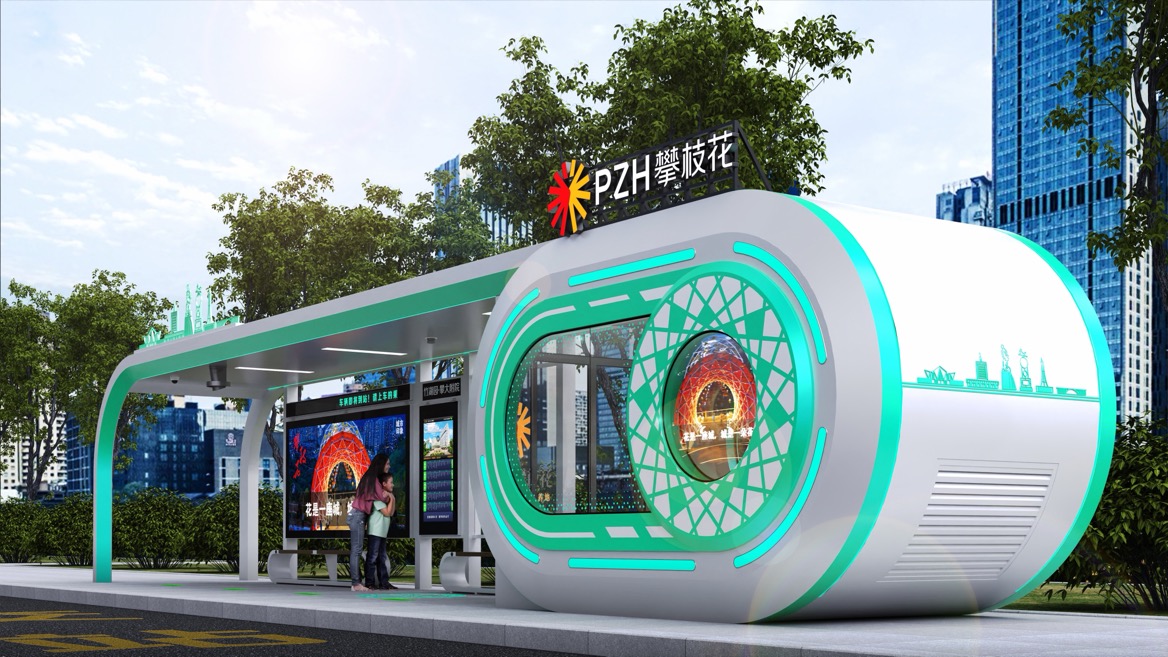
A conventional bus shelter mainly provides shade and protection from rain. An air-conditioned bus shelter adds an enclosed or partially enclosed, mechanically cooled waiting space.
Its performance depends on several coordinated components:
| Component | Main function | Design consideration |
|---|---|---|
| Structural enclosure | Separates the waiting area from outdoor conditions | Strength, weather resistance, and visibility |
| Roof and glazing | Limit incoming heat | Insulation, shading, and solar control |
| Cooling system | Transfers indoor heat outdoors | Capacity under local design conditions |
| Ventilation system | Introduces outdoor air | Occupancy, pollution exposure, and humidity |
| Doors and controls | Manage access and operation | Accessibility, safety, and heat infiltration |
| Drainage and electrical systems | Support dependable operation | Condensate disposal, protection, and service access |
An open-sided shelter with a cooling outlet is not equivalent to an enclosed, climate-controlled waiting room. Without boundaries that limit outdoor air exchange, maintaining a consistent indoor temperature becomes much more difficult.
Most mechanically cooled shelters use the same basic vapor-compression refrigeration process found in conventional air conditioners. Refrigerant circulates through a closed circuit, absorbing heat indoors and rejecting it outside.
A fan draws warm shelter air across the evaporator coil. Refrigerant inside the coil absorbs heat, lowering the air temperature before the fan returns it to the waiting area.
When the coil surface is below the air's dew point, water vapor condenses on it. This removes moisture as well as heat.
The resulting condensate must drain safely away from entrances, electrical equipment, and pedestrian routes.
The compressor draws in refrigerant vapor and increases its pressure and temperature.
This prepares the refrigerant to release heat to the warmer outdoor environment. The compressor consumes electricity, making its efficiency and operating conditions important to the shelter's energy use.
At the condenser, outdoor airflow carries away the collected indoor heat plus the heat associated with compressor operation.
Condenser placement matters. A unit hidden behind a decorative panel can lose performance if the panel restricts airflow or causes hot discharge air to recirculate.
Its exhaust should also be directed away from waiting passengers and ventilation intakes.
Refrigerant passes through an expansion device, which reduces its pressure before it returns to the evaporator.
The cycle repeats while cooling is required. Variable-capacity equipment can adjust output as demand changes, although actual efficiency depends on equipment selection, controls, installation, and maintenance.
Door openings create one of the biggest differences between a bus shelter and a typical indoor room. Passengers enter frequently, sometimes in groups immediately before a bus arrives.
Each opening can allow hot, humid air inside and conditioned air outside.
Our design priority is to reduce the cooling load before selecting larger equipment. Useful measures include:
- An insulated roof that limits heat transfer.
- External shading suited to the site's orientation.
- Glazing selected for appropriate solar-control performance.
- Sealed joints and carefully detailed frame connections.
- Doors that close reliably without obstructing access.
Clear glass supports visibility, but its thermal performance varies. Buyers should assess solar heat gain and insulation values rather than choosing glazing by appearance alone.
Automatic or self-closing doors can reduce unnecessary opening time. They must still accommodate wheelchair users, mobility aids, luggage, and peak boarding activity.
Air curtains may help limit air exchange in suitable layouts, but they are not substitutes for enclosure design. Their effectiveness depends on wind, opening geometry, installation, and adjustment.
A practical specification should test how the shelter recovers after realistic door openings—not only how cold it becomes when empty.
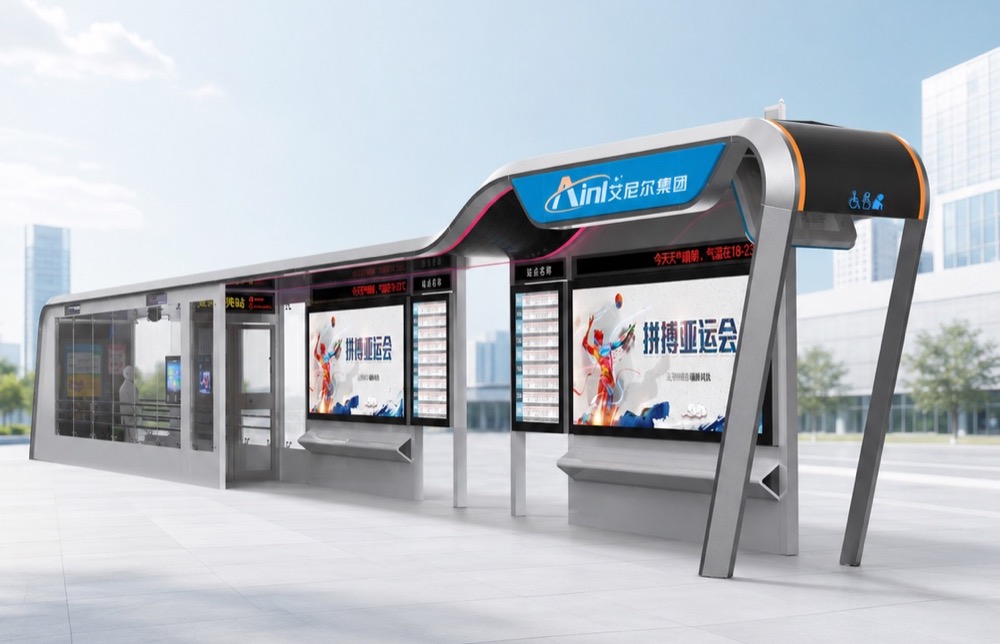
Ventilation and cooling perform different jobs.
An air conditioner may recirculate indoor air without supplying enough outdoor air for occupants. Likewise, a filter does not replace ventilation.
An enclosed bus shelter therefore needs a defined outdoor-air strategy based on its use and applicable local requirements.
Outdoor air brings additional heat and, in humid climates, additional moisture. The system must account for both.
Designers should consider:
- Expected and peak occupancy.
- Outdoor temperature and humidity.
- Nearby traffic exhaust and other pollutants.
- Air-intake and discharge locations.
- Filter resistance and replacement access.
Carbon dioxide monitoring can support occupancy-related ventilation control, but it does not measure every pollutant. Sensor readings should inform a broader ventilation strategy.
A lower thermostat setting does not automatically solve a humidity problem.
Oversized equipment may cool the space quickly and stop before removing sufficient moisture. Good selection considers both sensible cooling, which lowers temperature, and latent cooling, which removes moisture.
Condensate drainage, door infiltration, and operating schedules also influence the result.
There is no universal air-conditioner size for every shelter. Floor area alone is an inadequate basis for equipment selection.
A project-specific cooling-load assessment should include:
1. Heat entering through the roof, walls, and glazing.
2. Solar exposure throughout operating hours.
3. Passenger occupancy and activity.
4. Outdoor air introduced through ventilation.
5. Infiltration caused by doors and construction gaps.
6. Heat from lighting, screens, and other equipment.
Cooling capacity is not the same as electrical input.
For illustration, a system delivering 6 kW of cooling at a coefficient of performance of 3 would require approximately 2 kW of electrical input at that operating point. If it maintained that input for 10 hours, it would consume approximately 20 kWh.
This is an explanatory example, not a shelter specification or guaranteed daily consumption. Outdoor conditions, cycling, auxiliary equipment, and door activity change the actual result.
Buyers should request performance data at the intended outdoor design temperature, not rely only on nominal capacity.
Solar panels can support an air-conditioned bus shelter, but full solar operation requires a site-specific energy assessment.
The roof must generate enough usable electricity for cooling, ventilation, lighting, displays, and system losses. Available roof area, shading, climate, and operating hours all matter.
Three configurations are worth evaluating:
| Power arrangement | Potential application | Main limitation |
|---|---|---|
| Grid-connected | Sites with dependable utility access | Ongoing electricity charges |
| Solar-assisted grid supply | Projects seeking to offset purchased electricity | Solar output varies throughout the day |
| Solar with battery storage | Sites needing stored energy or limited grid dependence | Battery cost, space, maintenance, and autonomy requirements |
A solar-powered lighting system should not be presented as proof that the same roof can operate continuous air conditioning.
At Ainl, solar supply options can form part of OEM/ODM development. Cooling demand and available generation should be assessed before making an off-grid commitment.
Dubai offers a useful operational example.
In a statement dated May 30, 2025, its Roads and Transport Authority reported 893 air-conditioned bus shelters across 622 locations. The announcement described proactive inspections, corrective maintenance, cleaning, and checks on real-time information displays.
These figures describe that published operational update, not a current inventory or the size of a separate construction program.
For buyers, the important lesson is operational: a cooled shelter requires an ongoing service system.
Maintenance access, fault reporting, cleaning responsibilities, and spare-parts availability deserve attention during procurement—not after installation.
The same announcement also highlighted wheelchair spaces and directional information. Thermal comfort must work alongside accessible circulation and clear passenger guidance.
A useful acceptance test checks the complete passenger environment, not just the air leaving a cooling outlet.
The following framework is our recommended procurement approach, rather than a report of completed Ainl field trials.
Agree on outdoor conditions, occupancy assumptions, operating hours, and door-opening patterns before testing.
Record:
- Temperature at multiple occupied positions.
- Relative humidity during operation.
- Recovery after repeated door openings.
- Electrical consumption over a defined period.
- Noise near seating and neighboring properties.
- Condensate discharge and drainage performance.
Sensor placement matters. A temperature sensor beside the supply grille can show a satisfactory reading while passengers elsewhere remain uncomfortable.
Check accessible entry, door operation, emergency exit arrangements, electrical protection, and service isolation against local requirements.
Simulate a cooling fault or power interruption. Operators need a safe response that does not leave passengers relying on an overheated enclosure.
Also confirm that technicians can replace filters, clean coils, and service equipment without dismantling major structural sections.
Ainl's manufacturing resources include approximately 150,000 square meters of factory space, provincial-level software and hardware research facilities, CNC sheet-metal processing, a large coating center, and electrical testing capabilities.
These resources support coordinated development of the enclosure, equipment mounting, cable routes, advertising modules, and maintenance access.
OEM/ODM options include dimensions, structure, colors, screen configurations, lighting, solar supply arrangements, and city-branding elements.
However, manufacturing capability does not replace local engineering approval. Structural loads, electrical rules, ventilation requirements, accessibility, and installation conditions must be confirmed for each destination.
For a project-specific proposal, send Ainl your site location, layout, peak occupancy, operating schedule, power availability, and preferred equipment features. Request a coordinated concept covering cooling assumptions, utility needs, service access, and customization scope—not simply a shelter price.
Yes, if the enclosure and cooling system are designed for the actual conditions. Performance depends on solar exposure, outdoor temperature, occupancy, ventilation, and door activity. No single indoor temperature can be guaranteed for every site.
Not necessarily. Some projects combine an enclosed cooled section with outdoor shaded seating. However, maintaining room-like conditions in an open-sided structure is difficult because outdoor air continuously mixes with the cooled air.
A suitable reversible heat pump can provide cooling and heating. Buyers should verify heating capacity at local winter design conditions, including defrost behavior and any backup-heating requirements.
Intervals depend on dust, pollution, operating hours, and manufacturer instructions. Filters, coils, drains, doors, and electrical components need planned inspection. Dusty roadside locations may require more frequent attention than cleaner environments.
Sometimes. Feasibility depends on structural capacity, enclosure performance, electrical supply, drainage, ventilation, available space, and accessibility. Adding an air conditioner to an unsuitable open shelter may deliver poor comfort and high operating costs.
Evaluate whole-system performance. A well-designed enclosure, correctly selected equipment, safe ventilation strategy, and maintainable layout are more useful than an impressive cooling-capacity figure alone.
1. [U.S. Department of Energy — Home Cooling 101]. Technical basis for the refrigeration cycle, heat transfer, moisture removal, and distinctions between cooling methods. [energy]
2. [U.S. Department of Energy — Guide to Home Heating and Cooling]. Background on air-conditioning efficiency and heat pumps; building-level principles are adapted here to shelter design, not presented as shelter-specific test results. [energy]
3. [U.S. Department of Energy — Evaluating Moisture Control of Variable-Capacity Heat Pumps in Mechanically Ventilated, Low-Load Homes], August 2, 2024. Supports the discussion of coordinated temperature, humidity, airflow, and variable-capacity operation; the research concerns homes rather than bus shelters. [energy]
4. [Dubai Roads and Transport Authority — The Full Readiness of Air-Conditioned Bus Shelters for Summer Season], May 30, 2025. Source for the dated shelter inventory, preventive maintenance activities, display checks, and accessibility features. [rta]
5. [U.S. Department of Energy — Pump Up Your Savings with Heat Pumps], May 30, 2023. Explains reversible heat transfer for heating and cooling. [energy]


