
Email: ainlbusshelter@gmail.com | WhatsApp: +86-18800607527
Views: 237 Author: Ainl Bus Shelter Publish Time: 2026-10-28 Origin: Site


Content Menu
● Why Source Smart Recycling Bins from China?
>> An established combination of metal fabrication and connected hardware
>> Current industry evidence supports a more operational buying approach
● How These Suppliers Were Selected
● Supplier Comparison: Product Focus, Capacity, MOQ, and Certification
● Top 10 Smart Recycling Bin Manufacturers and Suppliers in China
>> 1. Ainl — A Custom-Manufacturing Option for Integrated Public Facilities
>> 2. Wonderful / Marine Dancer — A Broad Outdoor Smart-Bin Portfolio
>> 3. HD Outdoor Facility — Public Recycling Stations with Project Customization
>> 4. Luoyang Moha / Magic Box IoT — Solar and Connected Waste-Collection Equipment
>> 5. INCOM / INCOM TOMRA — Beverage-Container Recovery Specialists
>> 6. KeGoo — Reverse Vending Machines with Stated Export Applications
>> 7. World Lucky Technology — Tailored Recycling Automation
>> 8. Cornerstone Smart Recycling — Multi-Stream Collection Solutions
>> 9. Vortexinfo — Connected Waste Systems and Platform Integration
>> 10. Sinoware — An Adjacent Option for Indoor Touchless Bins
● Technical Buying Guide: What to Specify Before Requesting Prices
>> Define the function before choosing the cabinet
>> Specify materials by component
>> Evaluate complete-machine compliance
>> Build a credible quality-control plan
● The Overlooked Procurement Trap: Buying Hardware but Renting Control
● How to Verify the Factory, Approve Samples, and Plan Delivery
>> Step 1: Resolve the supplier's legal identity
>> Step 2: Conduct a process-based factory review
>> Step 3: Approve a production-representative sample
>> Step 4: Freeze the approved configuration
>> Step 5: Prepare transport and installation together
● Conclusion: Choose a Partner for the Operating System, Not Just the Purchase Order
● FAQs
>> 1. How can we verify whether an ISO certificate has expired or been suspended?
>> 2. Is CE marking on the controller or power supply enough?
>> 3. How do we compare suppliers when most do not publish a numeric MOQ?
>> 4. How can we prove solar operation will work at our site?
>> 5. How do we prevent a successful sample from becoming a different mass-produced product?
Choosing a Smart Recycling Bin manufacturer is not simply a matter of comparing cabinet prices. The supplier must deliver an outdoor structure that survives its installation environment, electronics that remain serviceable, and software that continues working after the initial deployment.
For procurement teams, the most useful starting point is verification: factory identity, engineering capability, quality-control records, realistic production schedules, and model-specific compliance documentation.
China offers several different sourcing options, from custom street-furniture manufacturers to connected recycling-station developers and reverse vending machine specialists. These are related categories, but they are not interchangeable. A solar-powered public bin, a bottle-return machine, and an indoor touchless container solve different operational problems.
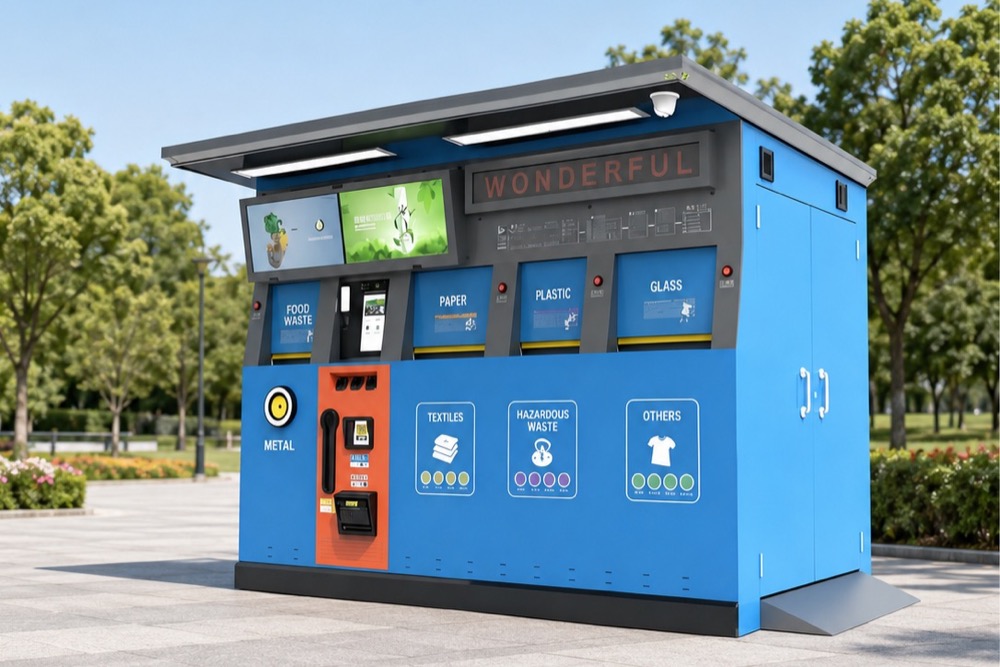
A Smart Recycling Bin combines several supply chains: sheet-metal fabrication, surface finishing, sensors, controllers, displays, communications modules, power systems, and software.
The suppliers examined here illustrate two useful sourcing concentrations. Jiangsu offers public-facility fabrication and outdoor equipment manufacturers, including Ainl and Wonderful. Shenzhen and the surrounding Pearl River Delta offer connected-device and reverse vending machine suppliers, including KeGoo and World Lucky. For buyers, the practical advantage is access to different engineering specializations rather than a single standardized product category.
These advantages matter most when a project requires more than a standard catalog model: a different collection-container size, a city-specific enclosure, a localized interface, or integration with an existing waste-management platform.
The World Bank published *What a Waste 3.0: Global Snapshot of Solid Waste Management Toward Circularity until 2050* on March 20, 2026. The report draws on publicly accessible information from 217 countries and economies and 262 cities, covering waste generation, collection, treatment, disposal, financing, and institutional arrangements.
Its relevance to procurement is straightforward: a bin is one component of a collection system. Equipment specifications should therefore reflect local waste composition, collection practices, maintenance resources, and operating costs.
This report is not a Smart Recycling Bin market-size study, and its figures should not be presented as smart-bin sales or manufacturer market shares. Similarly, China's customs statistics provide official trade context, but broad mechanical and electrical export categories do not isolate Smart Recycling Bins.
This shortlist uses public company information and product documentation to assess relevance. It does not represent factory visits, independent product testing, or a financial audit.
The selection framework considers six areas:
| Evaluation area | What a procurement team should examine |
|---|---|
| Product relevance | Whether the supplier offers connected recycling equipment, public collection facilities, reverse vending machines, or a clearly identified adjacent category |
| Manufacturing evidence | Fabrication processes, assembly capabilities, production facilities, and the relationship between the brand and contracting factory |
| Engineering capability | Structural design, electronics, firmware, software integration, power management, and maintainability |
| Quality and compliance | Inspection records, traceability, current management-system certificates, and product-specific conformity evidence |
| Commercial suitability | Customization scope, prototype process, communication responsibilities, warranty terms, and production scheduling |
| Lifecycle support | Spare parts, remote diagnostics, software access, documentation, and replacement-component availability |
Two limitations deserve attention.
First, factory floor area is not the same as annual Smart Recycling Bin output. A diversified industrial group may manufacture several unrelated product lines.
Second, "smart" can mean anything from a sensor-operated lid to connected fill-level monitoring, weighing, user identification, compaction, or automated material recognition. Buyers should define the required functions before comparing quotations.
"Not publicly disclosed" means that the reviewed information did not establish a reliable figure. It does not mean the supplier lacks the capability.
| Supplier | Main product focus | Public capacity or manufacturing evidence | Public MOQ position | Certification and verification position |
|---|---|---|---|---|
| Ainl | Customized public facilities and integrated outdoor enclosures | Published sheet-metal, steel-structure, assembly, and project-customization capabilities; smart-bin output not disclosed | Not publicly disclosed | Company identifies high-tech status; obtain current certificates and model-specific product documents |
| Wonderful / Marine Dancer | Connected sorting stations, solar compactors, recycling kiosks | Website advertises 12,000+ annual capacity, but other figures on the same page differ | Small trial orders described as acceptable; numeric MOQ not stated | Advertises CE, RoHS, FCC, ISO 9001, ISO 14001, and ISO 45001; verify scope and current validity |
| HD Outdoor Facility | Public recycling stations and outdoor waste facilities | Factory supply and OEM/ODM services advertised; annual output not disclosed | Not publicly disclosed | Model-specific compliance documents require confirmation |
| Luoyang Moha / Magic Box IoT | Solar compacting bins and connected collection systems | Manufacturer listing describes R&D and IoT product development; output not disclosed | Not publicly disclosed | Verify legal entity, factory relationship, and product documents |
| INCOM / INCOM TOMRA | Beverage-container recovery and reverse vending solutions | Public descriptions identify machine development and solution provision; factory output not disclosed | Not publicly disclosed | Confirm the exact supplier entity, machine origin, and conformity documentation |
| KeGoo | PET bottle and aluminum-can reverse vending machines | Shenzhen company with a separately listed Dongguan factory address | Not publicly disclosed | Request configuration-specific documentation |
| World Lucky Technology | Customized reverse vending machines and recycling-management systems | Manufacturer listing and specialized product range; annual output not disclosed | Not publicly disclosed | Request current certificates and complete-machine test evidence |
| Cornerstone Smart Recycling | Multi-stream recycling and food-waste systems | Public development milestones and deployment history; factory output not disclosed | Not publicly disclosed | Verify the manufacturing partner and deployment-specific documents |
| Vortexinfo | Connected waste-management equipment and integrated platforms | Public hardware catalog includes dual- and four-compartment smart bins | Not publicly disclosed | Confirm manufacturing responsibility and export compliance |
| Sinoware | Indoor touchless bins; adjacent product category | Published 8–60L smart-bin range; annual output not disclosed | Not publicly disclosed | Indoor sensor-bin evidence does not establish outdoor suitability |
Supplier-specific information above comes from the reviewed company pages and product listings; it should be reconfirmed during quotation and supplier qualification.
Company background: Ainl's published history traces its predecessor to 2008, the establishment of Jiangsu Ainl Urban Furniture Technology to 2012, and the group company to 2014. Its website describes integrated design, steel-structure processing, sheet-metal manufacturing, assembly, and project customization.
Core advantage: Ainl is relevant when a recycling unit must match a wider public-space program, such as bus shelters, information displays, street furniture, lighting, or city-branded facilities. Buyers can evaluate it as a potential value-oriented manufacturing partner for coordinated projects rather than assuming it is a standardized recycling-software vendor.
OEM/ODM scope: Published customization options include dimensions, structure, materials, colors, displays, lighting, solar-power options, and city-branding elements. These capabilities provide a useful foundation for project-specific Smart Recycling Bin development.
Market focus: Transportation, municipal, commercial, and smart-city projects. A reliable country-by-country sales breakdown was not established from the reviewed page.
For smaller brands and regional integrators, the practical attraction is the possibility of consolidating enclosure design and related public facilities with one supplier. However, sample-order flexibility, response times, software integration, and dedicated engineering support should be agreed rather than assumed.
Buyer checkpoint: The reviewed company page does not establish a detailed Smart Recycling Bin model range. Ask Ainl for a current product sheet, a live functional demonstration, software ownership details, and a written division of responsibility between in-house development and third-party modules.
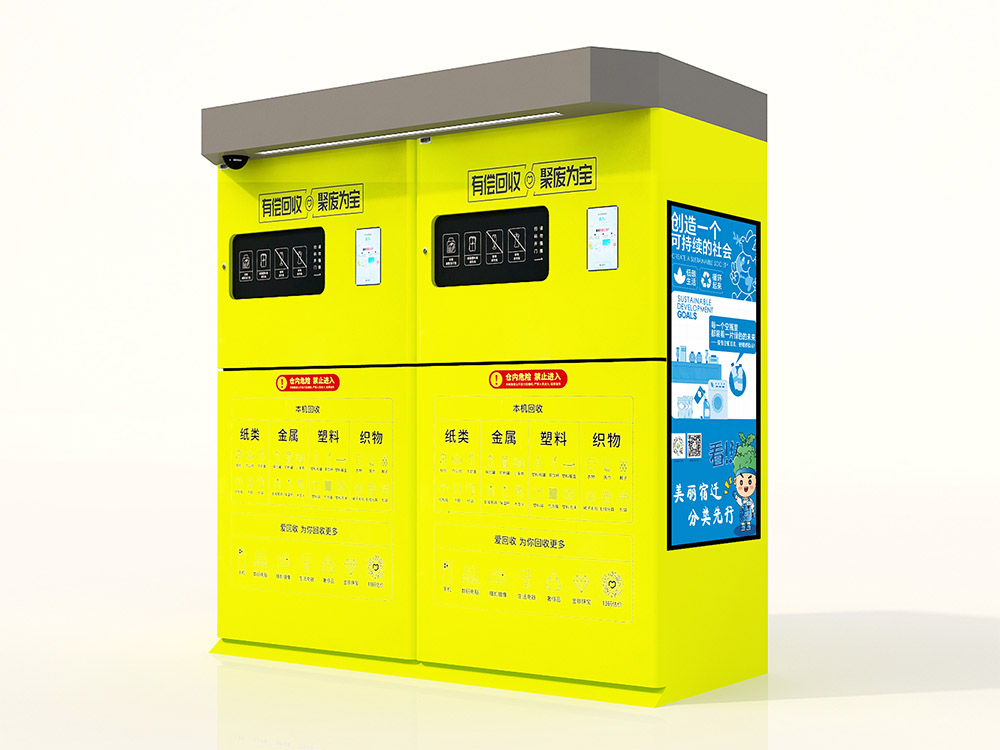
Company background: Wonderful's website states that the business was founded in 1997 and identifies its headquarters in Xuzhou, Jiangsu. Its Marine Dancer range includes connected sorting stations, solar compactors, bottle-recycling machines, and paper-recycling cabinets.
Core advantage: The product portfolio spans multiple public collection scenarios. Published examples include multi-compartment stations, QR-code access, weighing rewards, fullness alerts, solar power, and cloud management.
OEM/ODM scope: The company advertises customization of hardware, software, language, interfaces, appearance, and functional requirements.
Markets: The website identifies Europe, the Middle East, Australia, and the United States among its served regions.
Buyer checkpoint: Some published figures conflict, including annual output and geographic coverage. Treat the advertised 12,000+ annual capacity as an unverified supplier claim until the factory explains whether it refers to total group output, all bin categories, or the specific model being purchased.
Company background: HD's public materials identify Chongqing-based operations, although reviewed pages use different English company names. The exact establishment year was not established from the reviewed sources.
Core advantage: HD publishes a public Smart Recycling Bin range that includes 120L and 240L configurations and larger multi-container stations. Its offering is relevant to public-space buyers who need defined collection capacities and customized station layouts.
OEM/ODM scope: Advertised services include aperture design, RAL color matching, interface programming, and adaptations for local project requirements.
Markets: HD states that its products sell in more than 30 countries and regions, without a detailed sales distribution in the reviewed information.
Buyer checkpoint: Resolve the legal name on the business license, quotation, bank account, certificates, and warranty. Then confirm which sensors, communications functions, and software services are included in the quoted configuration.
Company background: A manufacturer listing names Luoyang Moha Technology, while its company description refers to Luoyang Magic Box IoT Technology. The reviewed source did not establish a founding year or fully resolve this naming relationship.
Core advantage: The published product description covers solar-powered compacting bins, photovoltaic bins, weighing-based collection, recycling systems, and cloud platforms.
OEM/ODM scope: The range suggests potential relevance to projects combining physical collection hardware with monitoring and power-management functions. The exact customization boundaries require a written proposal.
Markets: A reliable breakdown of principal export markets was not publicly established.
Buyer checkpoint: Ask for the Chinese business license and clarify the relationship between the English names before paying a deposit. For solar models, request an energy budget covering the controller, communications module, actuators, display, and compactor under the intended operating conditions.
Company background: Public descriptions trace INCOM's establishment to 2003. INCOM TOMRA's public company profile identifies it as a Chinese–Norwegian joint venture established in March 2016 to promote, sell, and service reverse vending machines.
Core advantage: This is a more relevant category for beverage-container collection and deposit-return applications than for general street litter.
OEM/ODM scope: Public descriptions support packaged reverse vending solutions. Buyers should not assume that unrestricted private-label manufacturing, firmware changes, or open software integration are available without negotiation.
Markets: The joint venture describes a China base and a global commercial orientation, although the reviewed material does not establish current regional sales shares.
Buyer checkpoint: Confirm whether the contracting company is the manufacturer, distributor, service provider, or system operator for the selected machine. Request details on accepted containers, recognition rules, reconciliation, and local scheme compatibility.
Company background: Shenzhen Ke Goo Intelligence lists an establishment date of December 2019 and identifies a factory location in Dongguan.
Core advantage: KeGoo specializes in reverse vending machines for PET bottles and aluminum cans. This makes it relevant to retailers, recovery operators, and projects requiring controlled container acceptance.
OEM/ODM scope: The company advertises customized reverse vending solutions and offers different machine configurations.
Markets: Its website identifies the UK, Europe, Australia, and Hong Kong among served markets.
Buyer checkpoint: Test the machine with the actual container library expected in the destination market. Include damaged labels, partly filled bottles, crushed containers, and rejected materials. Agree on acceptance accuracy, transaction speed, and anti-fraud behavior before production approval.
Company background: World Lucky's website describes more than ten years of relevant experience, but the reviewed pages did not establish an exact legal incorporation year.
Core advantage: Its range includes customized reverse vending machines and recycling-management solutions. A manufacturer listing describes configurations using barcode matching, image recognition, weight measurement, and metal detection.
OEM/ODM scope: Tailored automation, collection workflows, user rewards, and software development are central to its published positioning.
Markets: The reviewed material did not establish a dependable ranking of principal export destinations.
Buyer checkpoint: Separate existing, demonstrated functions from proposed development. Require a configuration matrix identifying what is standard, optional, newly developed, or dependent on third-party services.
Company background: Cornerstone Smart Recycling states that it was established in Hong Kong in 2018. Its milestones include reverse vending deployments and the development of IoT-enabled food-waste smart recycling bins in 2020.
Core advantage: The company is relevant to projects that need an integrated collection workflow across multiple material streams, including food waste.
OEM/ODM scope: Public information supports solution development and deployment. Ownership of the production facility and the extent of private-label manufacturing require confirmation.
Markets: Hong Kong and overseas projects are identified in its company description.
Buyer checkpoint: Establish who manufactures the equipment, who owns the design, and who provides field service. A capable solution provider can be valuable, but buyers should not automatically treat a project integrator as a factory owner.
Company background: Vortexinfo states that it was founded in 2005. Its public hardware catalog includes smart recycling equipment and dual- and four-compartment smart bins.
Core advantage: Its positioning is relevant to buyers integrating collection equipment into a wider digital waste-management system rather than purchasing isolated cabinets.
OEM/ODM scope: Customization responsibilities, hardware manufacturing arrangements, and third-party integration options need project-level confirmation.
Markets: The reviewed public pages describe extensive city-level deployments, but do not provide a dependable export-market distribution.
Buyer checkpoint: Request interface documentation, data-export examples, and an explanation of hosting arrangements. Confirm that the proposed deployment can operate with the destination country's network environment and the buyer's data-governance requirements.
Company background: Sinoware states that it has manufactured trash cans and household products since 2000. Its published smart-bin range covers approximately 8–60L capacities.
Core advantage: Sinoware is relevant to indoor facilities, offices, hospitality procurement, and private-label sensor-bin programs—not as a direct substitute for an outdoor connected recycling station.
OEM/ODM scope: Its catalog includes different capacities, finishes, colors, and sensor-operated designs. Multi-stream recycling arrangements and connectivity require separate confirmation.
Markets: The reviewed page describes global customers but does not establish principal country-level sales shares.
Buyer checkpoint: A touchless lid does not prove fill-level monitoring, automated sorting, outdoor protection, or cloud connectivity. Include Sinoware only when the tender permits this simpler indoor category.
A useful request for quotation should distinguish among:
- Touchless opening.
- Fill-level monitoring.
- User identification through cards, codes, or applications.
- Weighing and reward calculation.
- Bottle and can recognition.
- Compaction.
- Automatic material sorting.
- Remote diagnostics and fleet monitoring.
Do not accept "smart recycling" as a complete specification. Ask suppliers to demonstrate each required function and identify its limitations.
Avoid descriptions such as "premium stainless steel" without a grade, thickness, and component schedule.
For exposed stainless parts, ask the supplier to quote the proposed grade and explain its suitability for the installation environment. Where coastal exposure or frequent washing is expected, require a specific corrosion-control proposal rather than assuming one material suits every site.
For coated steel, define:
- Substrate and thickness tolerances.
- Pretreatment process.
- Coating system and finish.
- Treatment of welded edges and concealed surfaces.
- Acceptance criteria for coating adhesion and corrosion testing.
- Repair procedures for transport or installation damage.
Material verification should follow the consequence of failure. For a large municipal order, consider independent material checks rather than relying solely on a decorative finish or supplier label.
CE marking is not a generic quality award. The manufacturer must identify applicable requirements, complete the relevant conformity assessment, maintain supporting technical documentation, and issue an EU Declaration of Conformity where required.
A Smart Recycling Bin may combine radio equipment, electrical components, batteries, displays, and moving mechanisms. The applicable requirements depend on the finished configuration and destination market.
Request:
1. The exact model and configuration covered.
2. The signed declaration identifying applicable legislation.
3. Supporting test reports and technical documentation.
4. Evidence that material or component changes are controlled.
5. Identification of the responsible manufacturer.
An enclosure fitted with individually CE-marked components does not automatically establish conformity of the complete product. EU guidance explicitly distinguishes component responsibility from the responsibility of the party placing the finished product on the market.
RoHS documentation should likewise be relevant to the supplied electrical and electronic configuration. Do not treat a certificate thumbnail as proof that every customized version is covered.
The inspection plan should cover more than appearance.
| Inspection stage | Suggested checks |
|---|---|
| Incoming materials | Material identity, thickness, critical component models, and traceability |
| Fabrication | Dimensions, weld condition, mounting points, door alignment, and sharp edges |
| Surface treatment | Coverage, adhesion, finish consistency, and concealed-area treatment |
| Electrical assembly | Wiring identification, protection arrangements, connections, and service access |
| Functional testing | Sensors, locks, weighing, communications, alarms, and operating modes |
| Final acceptance | Approved configuration, accessories, software version, labels, and packaging |
Agree on pass/fail criteria before placing the order. Otherwise, "inspection passed" may describe a standard that the buyer never approved.
A less visible commercial risk is not the steel cabinet. It is dependence on the supplier's cloud account.
A machine can arrive fully paid for while still depending on a supplier-controlled server, activation service, application, or communications subscription. If those services change, the buyer may retain the enclosure but lose important functions.
Treat this as a contractual risk to investigate, not as an accusation against any supplier listed here.
Before approval, establish:
- Who owns device credentials and administrator access.
- Whether equipment can be transferred to another operator.
- Which functions continue during a network outage.
- Whether transaction records synchronize after reconnection.
- Whether the buyer can export its data.
- What happens when the software subscription expires.
- Whether replacement controllers require paid activation.
- What support remains available if the original platform is discontinued.
Make offline behavior part of sample acceptance. Disconnect the network and observe the actual result instead of accepting a verbal assurance.
Match the business license, quotation, payment beneficiary, certificates, and warranty issuer.
Where different entities handle manufacturing, exporting, and software, document their responsibilities. This is particularly important when a website uses several English company names.
Ask to see fabrication, coating or subcontractor controls, assembly, testing, finished-goods storage, and rejected-material handling.
For capacity verification, request a schedule for your specific model, current order loading, critical-component lead times, and expected weekly completion. A large building is not evidence that the required electronics or final-test resources are available.
The sample should use the intended controller, sensors, power system, software, finish, and mechanical arrangement.
An illustrative functional test plan can include:
- Repeated opening and closing under expected operating conditions.
- Fill detection with irregularly shaped waste.
- Weighing checks across the intended range.
- Power interruption and recovery.
- Network interruption and synchronization.
- Cleaning access and liner replacement.
- Safe behavior during jams or faults.
Define the duration, number of cycles, and acceptance thresholds according to the project. Do not describe a short demonstration as a durability test.
Record the bill of materials, drawings, software version, component models, and approved sample photographs.
Require written approval before substitutions. This reduces the risk that a convincing prototype is followed by production units using different sensors, batteries, coatings, or controllers.
Request packed dimensions, gross weight, lifting points, center-of-gravity guidance where relevant, and a container-loading proposal.
For battery-equipped products, ask the supplier and freight forwarder to confirm the applicable transport documentation and handling requirements for the actual battery configuration.
Before dispatch, confirm foundations, anchoring, electrical connections, connectivity, unloading access, and commissioning responsibilities. Compare landed and installed cost—not only the factory price.
The right supplier depends on the job.
Ainl is worth evaluating for customized public-facility projects requiring coordinated structures, finishes, displays, lighting, and branding. Dedicated smart-bin suppliers may better suit ready-developed connected stations, while reverse vending specialists address controlled bottle-and-can recovery.
For an Ainl project discussion, prepare the installation environment, collection streams, container sizes, required smart functions, power arrangement, destination market, and expected order quantity. Request a documented proposal covering the enclosure, electronics, software responsibilities, sample acceptance, production controls, and after-sales support.
That creates a stronger basis for a long-term partnership than a price comparison built around an undefined "smart" feature list.
Search using the exact legal company name and certificate information, then compare the address, scope, standard, issuing body, and current status.
IAF CertSearch supports verification of accredited management-system certification and identifies statuses including active, suspended, and withdrawn. If a record cannot be resolved, contact the issuing certification body directly rather than concluding from a logo or scanned certificate alone.
Also confirm that the certificate covers the relevant manufacturing site and activity. A valid management-system certificate is not product certification.
No. It does not by itself establish conformity of the complete Smart Recycling Bin.
The finished product requires an assessment of its applicable requirements. EU guidance states that the party placing the complete product on the market must take responsibility for the whole product even where components already carry CE marking.
Ask for documentation identifying the complete machine and its supplied configuration.
Separate three commercial questions:
- What is the minimum quantity for an existing model?
- What engineering or setup charge applies to customization?
- What minimum batch is needed for a particular finish, enclosure, or electronic configuration?
Request quotations for the same specification at pilot, initial rollout, and repeat-order quantities. A nominal one-unit MOQ can still carry substantial engineering charges, while a higher production MOQ may include development work.
Require a site-specific power budget rather than a generic "solar-powered" claim.
The proposal should identify the intended duty cycle, communications behavior, display schedule, actuator or compactor demand, battery assumptions, and available charging conditions.
Agree on low-energy behavior: which functions stop first, how faults are reported, and whether users can still deposit materials safely. Validate the agreed operating scenario during the pilot.
Use a signed configuration baseline.
Attach the approved drawings, bill of materials, critical component list, software version, inspection criteria, and sample identification to the purchase agreement. Require written approval for substitutions.
Then inspect production units against that baseline, including concealed components. An external appearance check will not reveal every change in electronics, battery specification, or material thickness.
- World Bank — *What a Waste 3.0*, published in March 2026, for current global waste-management data and procurement context. [openknowledge.worldbank]
- United Nations Environment Programme — *Global Waste Management Outlook 2024*, for wider waste-system and circularity analysis; retain its actual publication year when citing it. [unep]
- General Administration of Customs of China — official export tables, useful for broader trade context but not a standalone Smart Recycling Bin market-size measure. [english.customs.gov]
- European Union — official CE-marking guidance and manufacturer responsibilities. [europa]
- European Union — official guidance on signing a Declaration of Conformity and responsibility for complete products. [europa]
- IAF CertSearch — management-system certification verification and status checking. [iafcertsearch]


