
Email: ainlbusshelter@gmail.com | WhatsApp: +86-18800607527
Views: 231 Author: Ainl Bus Shelter Publish Time: 2026-11-20 Origin: Site


Content Menu
● SMD vs MIP vs COB: The Essential Differences
● What Is SMD LED Display Technology?
>> Why SMD Remains Relevant for Outdoor Advertising
>> SMD Limitations to Evaluate
● What Is MIP LED Display Technology?
>> How MIP Differs from Conventional SMD
>> Where MIP Offers Practical Value
● What Is COB LED Display Technology?
>> COB Advantages for Close-Viewing Displays
>> COB Maintenance Requires a Clear Service Plan
● Which LED Packaging Technology Is Best for Outdoor Displays?
>> Start with the Installation, Not the Acronym
>> Brightness and Sunlight Readability
>> Weather Protection and Structural Safety
● Three Project Scenarios: Where the Decision Changes
>> Scenario 1: A Roadside Advertising Billboard
>> Scenario 2: A Pedestrian-Level Smart-City Information Display
>> Scenario 3: A Premium Retail Entrance
● Compare Five-Year Ownership Cost, Not Purchase Price
● A Practical LED Display Acceptance Checklist
● How Ainl Approaches Custom Outdoor Display Projects
● Specify the Right Display with Ainl
>> Is COB Better Than SMD for Outdoor Advertising?
>> What Is the Main Difference Between MIP and COB?
>> Does COB Packaging Make a Display Waterproof?
>> Which Technology Is Easiest to Maintain?
>> Do MIP and COB Always Consume Less Electricity?
>> Do These Packaging Choices Apply Directly to LCD Displays?
SMD vs MIP vs COB is more than a comparison of LED packaging technologies. For outdoor advertising displays, the choice affects image quality, maintenance, environmental protection, and operating costs. However, no packaging method can compensate for an unsuitable enclosure, inadequate cooling, or poor installation planning.
At Ainl, we approach this decision from a complete-system perspective. Our 16 years in outdoor advertising products and smart-city public facilities inform a practical principle: select the display around its location, audience, and maintenance conditions—not simply its technology label.
This guide compares all three technologies and explains which questions matter most before specifying an outdoor LED advertising display.
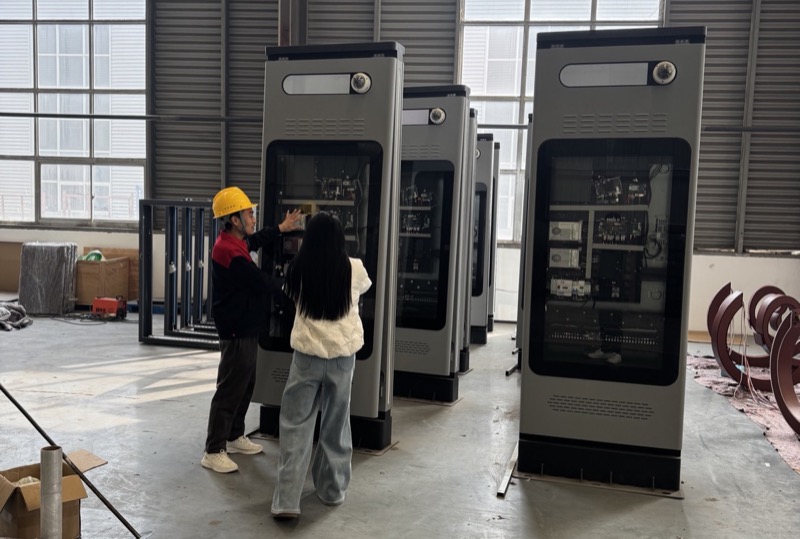
The main distinction is where and how the LED chips are packaged before they become part of the display module.
| Comparison factor | SMD | MIP | COB |
|---|---|---|---|
| Basic construction | Packaged LEDs mounted onto a circuit board | Small LED chips assembled into packages before board mounting | Bare LED chips bonded directly to the module substrate and collectively encapsulated |
| Main procurement strength | Established supply and service ecosystem | Fine-pitch performance with package-level screening opportunities | Integrated surface protection and fine-pitch capability |
| Typical project fit | Outdoor advertising and many general-purpose displays | Premium fine-pitch commercial installations | Close-viewing commercial and control-room displays |
| Surface protection | Depends on package, coatings, and module design | Depends on package and surface treatment | Encapsulation provides a continuous protective surface |
| Maintenance approach | Module replacement; component repair where supported | Module replacement; package repair where supported | Module replacement on site; specialist repair where supported |
| Outdoor suitability | Widely available in outdoor-rated products | Must be verified for the specific product | Must be verified for the specific product |
| Price comparison | Often competitive in conventional outdoor applications | Depends on pitch, scale, and specifications | Depends on pitch, scale, and specifications |
These are selection tendencies, not universal performance rankings. Compare products at equivalent pixel pitch, brightness, environmental rating, and warranty coverage.
SMD means surface-mounted device. In a conventional full-color LED display, red, green, and blue LED chips are typically incorporated into a package that is soldered onto a printed circuit board.
The packaged components form the pixels that produce the image.
SMD offers an established manufacturing and maintenance ecosystem. Buyers can evaluate a broad range of outdoor products, module formats, and service arrangements.
For roadside billboards, commercial façades, and large public-information screens, this availability can be more valuable than selecting the smallest possible pixel pitch.
As a documented example, ROE Visual's Black Quartz specifications list SMD configurations, 5,000-nit calibrated maximum brightness, and outdoor protection. This demonstrates that SMD can support demanding outdoor applications; those specifications should not be generalized to every SMD display.
Depending on its construction, an SMD display face may be vulnerable to handling damage. As pixel spacing decreases, package dimensions, placement accuracy, and repair access also become more demanding.
For public-facing installations, assess:
- Exposure to accidental contact.
- Protective coatings or other surface treatments.
- Replacement-module availability.
- Access for cleaning and maintenance.
The relevant question is not whether SMD is outdated. It is whether the proposed SMD product meets the project's requirements.
MIP commonly refers to Micro LED in Package, although some suppliers use Mini LED in Package terminology.
Small LED chips are assembled into packages before those packages are mounted onto the display board. This allows package-level testing and sorting before final module assembly.
Because terminology varies, request the actual package architecture and chip specifications rather than relying on the acronym alone.
MIP is relevant when fine detail, close viewing, and image consistency carry significant commercial value.
For example, ROE Visual's Denali uses MIP technology at a 0.78 mm pixel pitch. It illustrates a real fine-pitch implementation—not a minimum pitch or guaranteed performance level for the entire category.
Potential applications include premium retail interiors, presentation spaces, and detailed information displays.
MIP should not automatically be described as cheaper, more efficient, or more reliable than COB. These outcomes depend on manufacturing quality and product design.
Ask suppliers to clarify:
- Whether their MIP product is approved for outdoor operation.
- Its sustained brightness and operating-temperature limits.
- Whether local package repair is supported.
- How replacement modules are calibrated.
An impressive indoor demonstration does not establish outdoor suitability.
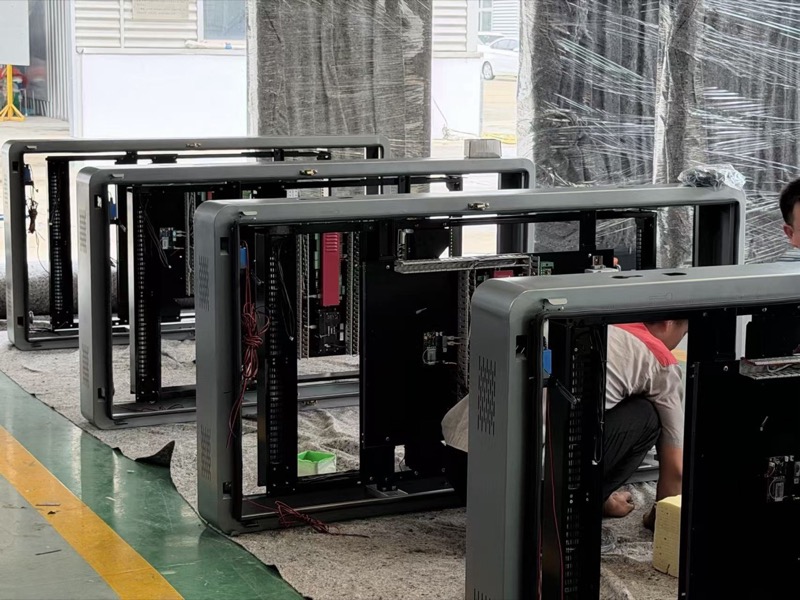
COB means chip-on-board. Bare LED chips are bonded directly onto the module substrate and then encapsulated together.
This differs from mounting conventional, individually packaged LEDs onto the board.
Many current fine-pitch COB products use flip-chip construction. However, COB and flip-chip describe different aspects of the design and should not be treated as interchangeable terms.
Collective encapsulation creates a continuous surface over the LED chips. Depending on the product, this can improve resistance to contact and contamination while supporting dense pixel arrangements.
COB therefore deserves consideration for displays that people view closely or may accidentally touch.
Its chip-to-board construction can also support effective thermal pathways. Nevertheless, the finished display's cooling performance still depends on its substrate, electronics, enclosure, and operating conditions.
The claim that COB displays cannot be repaired is too absolute.
A practical distinction separates on-site module replacement from specialist component-level repair. Absen's KLCOB V2 manual, for example, describes front removal and replacement of faulty modules.
Before purchasing, establish who performs repairs, where they occur, and how quickly replacement modules can arrive.
For conventional outdoor advertising, SMD is often a sensible starting point because outdoor-rated options and service arrangements are well established.
For close-viewing applications, MIP and COB merit evaluation where their fine-pitch capabilities provide a visible benefit.
However, neither should be selected for an exposed street installation without product-specific environmental evidence.
Maximum brightness alone does not determine daytime visibility. Reflections, screen orientation, ambient light, contrast, and thermal behavior also influence readability.
Request:
- Calibrated operating brightness.
- Brightness behavior at the specified ambient temperature.
- Automatic dimming capability.
- A demonstration using representative advertising content.
A display that looks excellent indoors may behave differently under direct sunlight.
Surface encapsulation is not equivalent to a weatherproof display cabinet.
Outdoor qualification must account for module joints, rear covers, connectors, cable entries, and service openings. Check front and rear ingress-protection ratings separately.
Wind loading, support structures, foundations, and maintenance access require their own engineering assessment. Packaging technology does not establish structural safety.
The following scenarios illustrate selection logic; they are not claimed Ainl installations.
The audience views the display from a distance. The priorities are legibility, daylight performance, uptime, and economical servicing.
Start by evaluating outdoor SMD options. A finer-pitch alternative needs to justify its additional cost through a visible benefit at the actual viewing distance.
People approach closely to read maps, transport updates, or public notices.
Evaluate resolution alongside contact protection, glare, accessible service doors, and enclosure temperature. Fine-pitch MIP or COB may be appropriate, but only where the complete product is qualified for the installation environment.
A sheltered entrance and an exposed pavement location create different requirements, even when the intended content is identical.
For sheltered, close-viewing installations, fine-pitch image quality may dominate. For exposed locations, environmental protection and thermal management can become the deciding factors.
Total ownership cost includes more than display hardware:
> Five-year cost = equipment + installation + electricity + maintenance + spare parts + access costs + downtime impact.
Use measured average power under agreed content and brightness settings when estimating electricity costs. Maximum rated power serves a different purpose, including electrical-system planning.
For maintenance, include travel, lifting equipment, permits, labor, and replacement-module calibration.
A less expensive screen can become costly when a simple repair requires a road closure. Conversely, premium packaging may deliver little financial value where viewers cannot perceive its resolution advantage.
The strongest comparison uses identical assumptions for operating hours, electricity tariffs, service response, and warranty exclusions.
Before approving production or shipment, use an agreed test plan.
1. Define the site: viewing distance, orientation, climate, mounting position, and operating hours.
2. Fix the comparison baseline: active dimensions, resolution, brightness, and environmental requirements.
3. Test representative content: include small text, dark images, gradients, and moving advertisements.
4. Inspect thermal performance: agree on ambient conditions, test duration, and acceptable behavior.
5. Demonstrate servicing: remove and replace a module using the proposed installation access.
6. Review supporting documents: obtain applicable test reports, installation drawings, warranty terms, and maintenance instructions.
7. Confirm spare-part continuity: document compatibility, calibration procedures, lead times, and repair responsibilities.
This process turns broad technology claims into verifiable purchasing criteria.
Ainl combines outdoor display integration with public-facility manufacturing. Our capabilities include a provincial-level hardware and software research center, CNC sheet-metal processing, large-scale coating facilities, and an electrical testing laboratory.
Our manufacturing footprint covers more than 260 mu, with approximately 150,000 square meters of factory buildings.
For buyers, these capabilities support coordinated development of the enclosure, structure, finish, lighting, and display configuration.
OEM/ODM requirements can include:
- Product dimensions and structural layout.
- Colors, coatings, and city-branding elements.
- Screen configuration and service access.
- Integrated lighting.
- Solar-power feasibility.
Solar integration requires a site-specific energy budget; feasibility depends on display consumption, operating hours, available solar resource, and battery requirements.
Our stated qualifications include national high-tech enterprise recognition, Grade III steel-structure and municipal construction contracting qualifications, three-system certification, and Level III safety-production standardization. Project teams should verify the scope and validity of documents relevant to their procurement.
Ainl can help coordinate the display configuration with its enclosure, supporting structure, finish, lighting, and maintenance requirements.
Send your installation location, screen dimensions, nearest viewing distance, operating schedule, and customization brief. Request a project-specific proposal that explains the recommended configuration, required environmental evidence, service approach, and optional solar-power assessment.
Not automatically. COB offers integrated encapsulation and fine-pitch potential, while SMD has an established outdoor product ecosystem. Compare complete products under equivalent site and performance requirements.
MIP uses packages assembled before board mounting. COB bonds bare chips directly to the module substrate and encapsulates them collectively. Their manufacturing and service approaches therefore differ.
No. Encapsulation protects the display surface, but outdoor suitability also depends on cabinet joints, connectors, rear access, and documented environmental ratings.
SMD often benefits from familiar repair practices, but serviceability is product-specific. Front access, spare modules, technician capability, and repair turnaround can matter more than packaging alone.
No. Power consumption depends on brightness, LED efficiency, driver design, content, and operating conditions. Request comparable measurements rather than accepting a category-wide efficiency claim.
No. This comparison concerns direct-view LED displays. LCD advertising displays use a different image-forming architecture and require a separate assessment of backlighting, sunlight readability, and thermal design.
1. CNLC. "SMD vs MIP vs COB: Understanding LED Display Packaging Technologies for Better Project Decisions." August 15, 2025. Original comparison used as the editorial starting point; categorical cost and performance rankings are not treated as universal. [cnlcdisplay]
2. Absen. "Analysis of Micro LED Large Screen Display Technology—Chip and Encapsulation Structure." Technical background on packaged LEDs, direct chip bonding, and collective encapsulation. [absen]
3. ROE Visual. "Denali—Innovation Meets Visual Performance." Manufacturer documentation for a 0.78 mm MIP display and its packaging approach. [roevisual]
4. ROE Visual. "Black Quartz" product page and technical brochure. Product-specific evidence for outdoor SMD construction, calibrated brightness, and environmental specifications. [roevisual]
5. ROE Visual. "Outdoor Use of LED Screens." Guidance on weather exposure, ingress protection, temperature, and structural considerations. Its temporary-installation guidance does not replace site-specific engineering for permanent structures. [roevisual]
6. Absen. "KLCOB V2 Series User Manual." Documentation of front module removal, replacement, and maintenance procedures. [absen]
7. Absen. "Everything You Need to Know About Absen's Warranty." Reference for distinguishing remote support, return-for-repair arrangements, and on-site service. [absen]


