
Email: ainlbusshelter@gmail.com | WhatsApp: +86-18800607527
Views: 268 Author: Ainl Bus Shelter Publish Time: 2026-11-15 Origin: Site


Content Menu
● What Does an IP Rating Mean for Outdoor Displays?
● IP56 vs IP65 vs IP66 vs IP67: Comparison Table
>> IP56 vs IP65: Neither Is Better in Every Respect
>> IP65 vs IP66: The Difference Is Water-Jet Protection
>> IP66 vs IP67: Jets and Immersion Are Different Tests
● Which IP Rating Should You Choose for Outdoor Advertising Displays?
● Three Outdoor Display Risks an IP Rating Does Not Resolve
>> 1. Condensation Inside the Cabinet
>> 2. Salt Corrosion and Material Compatibility
>> 3. Heat Management and Sunlight Exposure
● How to Verify an Outdoor Display IP Test Report
>> Step 1: Confirm the Exact Model and Configuration
>> Step 2: Establish the Protection Boundary
>> Step 3: Review the Test Conditions and Results
>> Step 4: Check the Installed Accessories
>> Step 5: Define Change Control
● Installation and Maintenance: Protect the Rating You Purchased
● A Practical Specification Example for a Coastal Advertising Kiosk
● How Ainl Supports Customized Outdoor Display Projects
● Specify the Environment Before You Specify the Number
>> Is IP65 Waterproof Enough for an Outdoor Display?
>> Does IP67 Include IP66 Protection?
>> Can an IP66 Display Be Pressure-Washed?
>> Does a Higher IP Rating Prevent Condensation?
>> Can Customization Affect a Display's IP Rating?
Choosing between IP56, IP65, IP66, and IP67 outdoor display ratings is not simply a matter of selecting the largest number. For outdoor LED advertising displays and LCD digital signage, the right enclosure must match the actual exposure: airborne dust, wind-driven rain, cleaning water, or temporary immersion.
Our approach at Ainl is to start with the installation environment, then define the enclosure, cooling system, cable entries, and maintenance requirements together. A waterproof rating matters, but it is only one part of a dependable outdoor display.
This guide explains what these four ratings mean, where their differences matter, and what buyers should verify before approving a display specification.
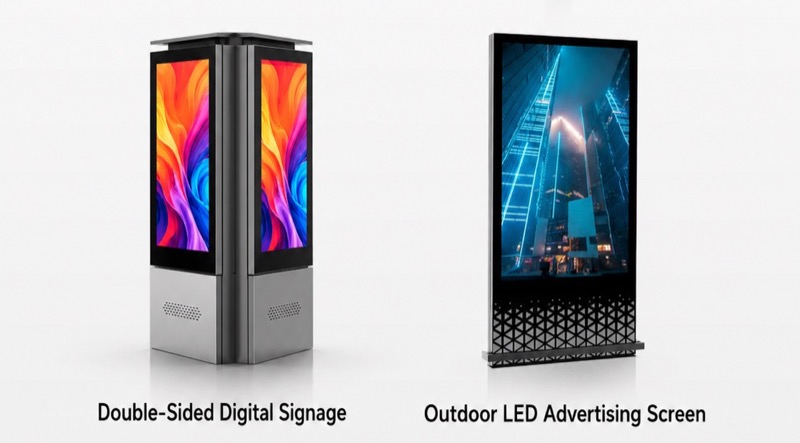
An IP rating classifies the protection an enclosure provides against access to hazardous parts, solid foreign objects, and harmful water ingress. The classification and associated test methods are defined in IEC 60529.
The two digits describe different forms of protection:
- The first digit identifies protection against solid objects and dust.
- The second digit identifies protection against water under specified test conditions.
For the ratings discussed here, the first digit is either 5 or 6.
A dust-protected enclosure, identified by 5, may allow limited dust entry, provided it does not interfere with satisfactory operation or impair safety. A dust-tight enclosure, identified by 6, does not permit dust ingress under the specified test.
The water digit must be interpreted separately. It does not describe corrosion resistance, sunlight durability, impact resistance, or operating temperature.
| Rating | Dust protection | Water protection | Main purchasing consideration |
|---|---|---|---|
| IP56 | Dust-protected | Powerful water jets | Strong jet protection, but not dust-tight |
| IP65 | Dust-tight | Water jets | Useful where dust exclusion and water-jet resistance are required |
| IP66 | Dust-tight | Powerful water jets | Relevant where stronger jet exposure is a defined requirement |
| IP67 | Dust-tight | Temporary immersion | Relevant where temporary submersion is a specified risk |
These are enclosure classifications, not universal guarantees of outdoor suitability. Always confirm which parts of the display are covered and how the tested configuration compares with the delivered product.
IP56 offers the higher water-jet classification of these two ratings. IP65 offers the higher dust classification.
That distinction matters when comparing outdoor advertising screens for different environments. A dusty industrial location and a relatively clean location exposed to stronger water spray do not necessarily need the same enclosure specification.
Avoid treating the two-digit code as a single numerical score.
Both ratings specify dust-tight protection. IP66 adds resistance to powerful water jets rather than the water jets covered by IP65.
However, IP66 does not authorize unrestricted pressure washing. Cleaning pressure, nozzle distance, water temperature, exposure duration, and detergents must remain within the manufacturer's instructions.
IP67 addresses temporary immersion, not automatic compliance with the powerful-water-jet requirements of IP66.
If a project needs both capabilities, request evidence for both classifications, potentially expressed as IP66/IP67.
The familiar description "one meter for 30 minutes" is a simplified explanation of IPX7. The actual immersion arrangement depends on enclosure dimensions and the standard's conditions. For a large advertising kiosk, ask for the documented test setup rather than relying on that shorthand.
Begin with a site survey, not a preferred number. Identify how water and dust can reach the display during normal operation, cleaning, storms, and maintenance.
| Installation scenario | Specification starting point | Additional checks |
|---|---|---|
| Sheltered urban advertising kiosk | Assess IP56 or IP65 against actual exposure | Rear access, cable routes, dust conditions |
| Exposed roadside display | Assess IP65 or IP66 | Wind-driven rain, drainage, mounting arrangement |
| Dust-heavy industrial site | Prioritize dust-tight construction | Cooling design and service procedures |
| Location exposed to stronger cleaning jets | Assess IP66 | Approved cleaning method and nozzle limits |
| Site with temporary immersion risk | Assess IP67 and any separate jet requirement | Flood depth, duration, electrical safety |
| Coastal promenade | Select ingress protection for actual exposure | Salt corrosion, coatings, fasteners, condensation |
These are planning guidelines, not automatic approvals. Site conditions, local requirements, and product-specific test evidence determine the final specification.
For flood-prone sites, raising the display and electrical connections may be more practical than relying on immersion resistance alone. An immersion classification does not establish that a complete installation is safe to operate underwater.
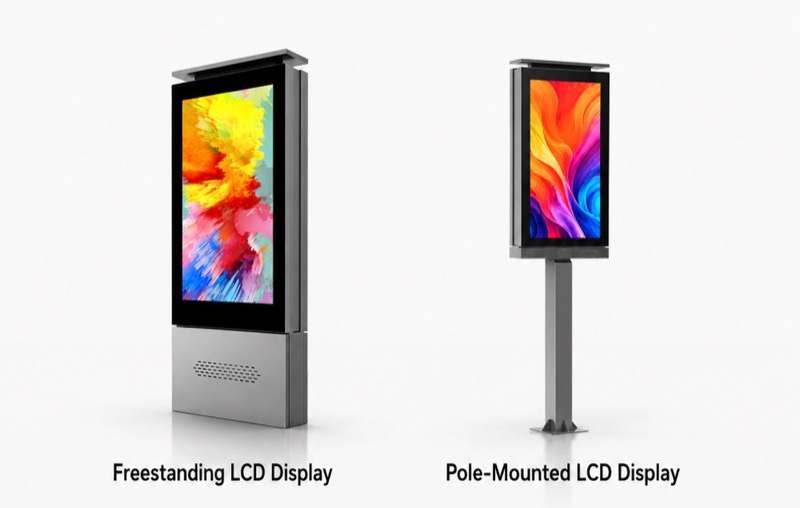
A cabinet can resist external water entry yet still develop internal condensation when temperature changes cause moisture to condense on cooler surfaces.
This is particularly relevant when evaluating outdoor LCD advertising displays with temperature-sensitive electronics and protective glass.
Ask the manufacturer to explain:
- How internal humidity is managed.
- Whether heaters or dehumidification are needed.
- How pressure changes are accommodated.
- Whether ventilation components maintain the specified protection.
Do not interpret visible internal moisture as proof of a failed rain seal without investigating its source.
An IP rating does not establish resistance to salt-laden coastal air.
For seafront projects, examine the cabinet material, coating preparation, exposed edges, hinges, fasteners, and electrical connections. Request corrosion-test evidence appropriate to the proposed materials and environment.
A high ingress rating cannot compensate for a coating system or hardware selection that is unsuitable for the location.
Increasing enclosure sealing can change how a display dissipates heat. Outdoor performance therefore depends on the complete thermal design, not just the gasket arrangement.
For LCD products, discuss backlight heat, solar loading, protective glass, and the cooling system. For LED products, review module, power-supply, and cabinet heat management.
Ask for the operating-temperature limits of the complete assembly and the conditions under which those limits were verified.
A catalogue badge is a starting point, not sufficient purchasing evidence. Before approving production, use this five-step checklist.
Check that the report identifies the proposed product or clearly establishes why the tested construction applies to it.
Cabinet dimensions, door layouts, cooling openings, and cable-entry arrangements can affect ingress protection.
Ask whether the rating covers:
- The complete display enclosure.
- The front face only.
- Individual LED modules.
- A separate electrical compartment.
- External connectors and junction boxes.
A front-rated screen does not establish equivalent protection for an exposed rear service compartment.
Request the report number, test date, laboratory identity, standard used, classification, and outcome.
For immersion requirements, confirm the depth arrangement and duration. For jet requirements, confirm that the relevant jet test was performed.
Cable glands, blanking plugs, vents, locks, and connectors must be suitable for the completed assembly.
A rated component does not automatically make the entire cabinet equally rated. Its installation and interaction with surrounding parts matter.
Agree which modifications require engineering review or further testing.
Adding a reader, antenna, solar connection, illuminated logo, or new cable opening can change the original protection arrangement. Confirm these details before production, not after delivery.
Laboratory testing evaluates a defined enclosure configuration. Installation errors and neglected maintenance can undermine that protection.
Use a documented handover checklist:
1. Confirm mounting orientation and required clearances.
2. Route cables to discourage water tracking into entry points.
3. Verify gland tightening and unused-opening seals.
4. Inspect door-gasket seating and latch engagement.
5. Keep designed drainage routes unobstructed.
6. Record the approved cleaning procedure.
7. Establish inspection intervals based on site exposure.
After servicing, technicians should check for trapped cables, debris on sealing surfaces, damaged gaskets, and incomplete door closure.
Never add drainage holes without approval. A well-intentioned modification can create a new ingress path and invalidate the original construction basis.
Consider an illustrative project: a freestanding LCD advertising kiosk on a coastal promenade, exposed to airborne salt, rain, and periodic cleaning. This is a planning example, not a reported customer installation.
Instead of specifying only "IP67 waterproof display," divide the requirement into separate questions:
- Does the cabinet need dust-tight construction?
- What jet exposure will cleaning create?
- Is temporary immersion genuinely expected?
- What coating and hardware system addresses salt exposure?
- How will internal moisture and heat be managed?
- Which maintenance tasks are necessary to preserve performance?
This produces a clearer purchasing document. It also prevents spending on immersion capability while overlooking corrosion resistance or access-door sealing.
Ainl is a Chinese manufacturer and solution provider with 16 years of experience in outdoor LED/LCD advertising displays, smart-city public facilities, and related outdoor advertising products.
Our manufacturing facilities cover more than 260 mu, approximately 17 hectares, with around 150,000 square meters of factory buildings. Supporting resources include a provincial-level software and hardware research center, CNC sheet-metal precision-processing facilities, a large coating center, and an electrical testing laboratory.
As a national high-tech enterprise, Ainl supports OEM/ODM customization covering dimensions, structures, colors, screen configurations, lighting, solar-power options, and city-branding elements.
For each project, the required ingress classification should be agreed alongside the proposed configuration and supporting verification. Manufacturing capabilities or corporate qualifications should never substitute for product-specific test evidence.
The right outdoor display rating matches the real hazard: dust, water jets, temporary immersion, or a combination. Long-term reliability also depends on corrosion protection, thermal management, installation, and maintenance.
Send Ainl your installation location, display dimensions, environmental conditions, cleaning method, and customization requirements. Request a proposal that defines the enclosure protection boundary, supporting test documentation, and maintenance requirements alongside the display configuration.
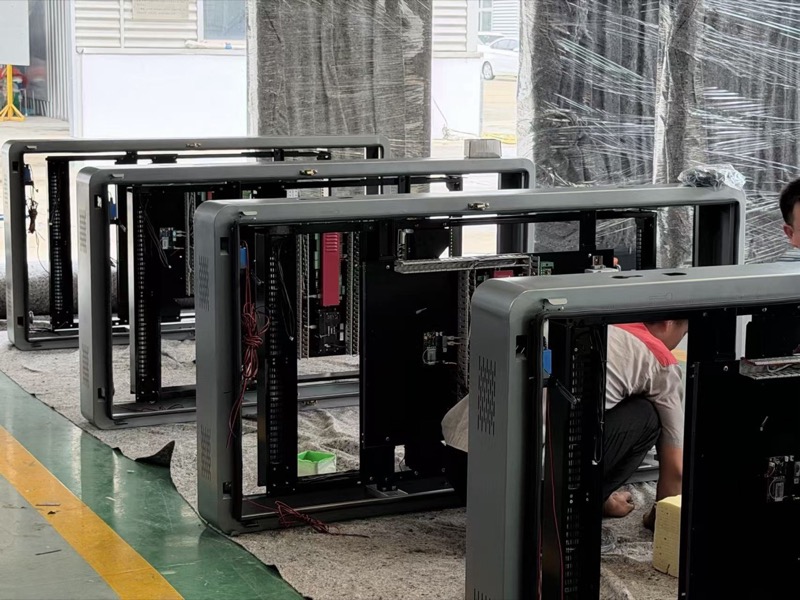
IP65 provides dust-tight protection and resistance to water jets under specified conditions. Whether it is suitable depends on exposure, installation, cleaning practices, and the rest of the enclosure design. It does not cover temporary immersion.
IP66 has the higher dust-protection classification. Both share the same water digit, indicating powerful-water-jet protection. Confirm that the claimed rating applies to the complete configuration being purchased.
Not automatically. Temporary immersion and powerful-water-jet resistance require different testing. Where both are required, request documentation demonstrating both rather than assuming that the larger final digit covers everything.
Do not assume so. Commercial pressure washers may exceed the conditions represented by the rating. Follow the manufacturer's approved cleaning instructions, including nozzle distance, pressure, temperature, and chemical restrictions.
No. Ingress protection does not establish condensation control. Internal moisture management requires separate consideration of humidity, temperature changes, ventilation, heating, and the enclosure's thermal design.
Yes. Changes to doors, dimensions, cooling openings, cable entries, or accessories can alter ingress performance. Ask the manufacturer to confirm the applicability of existing evidence and identify any additional verification required.
1. CNLC Display. "How to Distinguish IP56, IP65, IP66, and IP67? | A Complete Guide to Waterproof Ratings for Outdoor Displays." July 16, 2025. Original article used as the starting point for restructuring and identifying technical clarification needs; CNLC product claims have not been transferred to Ainl. [cnlcdisplay]
2. International Electrotechnical Commission. "Ingress Protection (IP) Ratings." Official explanation of the two-digit classification, its scope, and the role of IEC 60529 testing. [iec]
3. International Electrotechnical Commission. "IEC 60529:1989+AMD1:1999+AMD2:2013 CSV — Degrees of Protection Provided by Enclosures (IP Code)." Governing standard reference for classification and test requirements. Project acceptance should use the applicable standard and the actual product test report. [webstore.iec]
4. International Electrotechnical Commission. "Ingress Protection (IP) Ratings Guide." Official comparison of dust protection, water jets, powerful water jets, and temporary or continuous immersion categories. [iec]
5. TÜV SÜD. "Ingress Protection (IP) Testing — IEC 60529." Independent testing-provider explanation of enclosure assessment and ingress-protection testing. [tuvsud]
6. TÜV SÜD. "Light of the Future." Technical brochure identifying ingress, humidity, temperature-rise, ultraviolet, and salt-mist testing as separate considerations for relevant outdoor electrical products. [tuvsud]
7. International Electrotechnical Commission. "IEC 62208 — Empty Enclosures for Low-Voltage Switchgear and Controlgear Assemblies: General Requirements." Supporting context distinguishing ingress protection from separate corrosion and environmental requirements; not presented as an outdoor-display certification standard. [webstore.iec]


