
Email: ainlbusshelter@gmail.com | WhatsApp: +86-18800607527
Views: 228 Author: Ainl Bus Shelter Publish Time: 2026-10-19 Origin: Site


Content Menu
● Why Source Bus Shelters for the Canadian Market?
● How These Bus Shelter Suppliers Were Selected
● Top Bus Shelter Manufacturers and Suppliers to Consider
>> 1. Ainl — China-Based OEM/ODM Option for Custom Canadian Projects
>> 2. Daytech Limited — Toronto Manufacturer with Established Transit Shelter Experience
>> 3. Enseicom — Montreal-Based Supplier for Shelters and Advertising Structures
>> 4. Monarch Structures — Custom Shelters and Turnkey Project Delivery
>> 5. Provincial Sign Systems — Canadian Supplier for Transit Shelter and Digital Signage Programs
● Comparison: Capacity, MOQ, and Certification Transparency
● Technical Buyer's Guide: What to Put in a Bus Shelter Specification
>> Specify Materials by Grade and Measurable Properties
>> Treat Coating as a Process, Not a Colour
>> Require Site-Specific Structural Engineering
>> Separate Electrical Acceptance from CE and RoHS Claims
>> Design Accessibility Around the Installed Site
● Common Procurement Problems—and How to Avoid Them
● An Often-Overlooked Procurement Trap: Replacement Geometry
● Factory Verification, Sampling, and Logistics
>> Verify the Actual Manufacturing Scope
>> Approve a Representative First Article
>> Compare Delivered and Installed Cost
● Conclusion: Select the Manufacturing Model That Fits the Project
● FAQs
>> 1. How Can I Check Whether a Supplier's ISO Certificate Is Still Valid?
>> 2. Does CE Marking Make an Electrically Equipped Shelter Acceptable in Canada?
>> 3. Can One Shelter Design Be Used Across Several Canadian Cities?
>> 4. How Should Solar-Powered Shelters Be Evaluated?
>> 5. What Should a Long-Term Shelter Warranty Include?
Choosing a bus shelter supplier for a Canadian project requires more than comparing roof designs and unit prices. Procurement teams must assess structural engineering, corrosion protection, manufacturing consistency, electrical approvals, replacement-part availability, and the supplier's ability to deliver repeat orders without changing critical specifications.
Canada offers established manufacturers with experience serving transit agencies, municipalities, and outdoor advertising programs. Companies in Ontario, Quebec, and British Columbia provide different combinations of aluminum fabrication, custom metalwork, signage integration, and installation support. Daytech, Enseicom, and Monarch illustrate this regional manufacturing base. These locations should be understood as supplier concentrations—not a formally defined national bus shelter manufacturing cluster.
This guide examines five manufacturers relevant to Canadian procurement: four Canadian businesses and one China-based OEM/ODM alternative, Ainl. The comparison focuses on verifiability: what suppliers publicly document, what buyers should request, and where project-specific validation remains necessary.
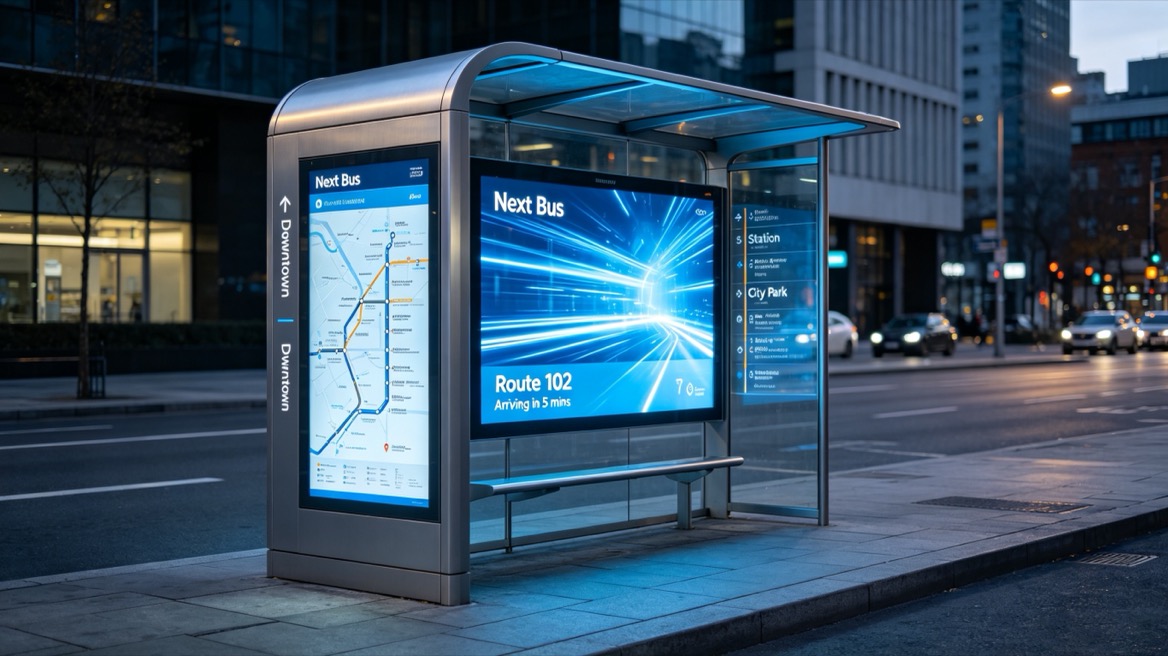
Canadian suppliers can offer practical advantages when projects require local coordination, site installation, and ongoing maintenance. Daytech describes capabilities spanning design through installation; Monarch offers engineering, manufacturing, project management, and installation; Enseicom serves North American projects from its Montreal-area manufacturing base. These are useful starting points, although actual geographic service coverage must be confirmed in each quotation.
Recent transport data also provides context for procurement decisions. Statistics Canada's December 2025 urban public transit release reported 1.55 billion passenger trips during 2025, down 2.4% from 2024 and equivalent to 82.2% of 2019 ridership. These figures measure transit usage—not bus shelter sales, manufacturing output, or market share. They support a discussion of transport infrastructure demand but should not be presented as a Canadian shelter market valuation.
For buyers, the implication is practical: procurement should justify expenditure through site need, passenger protection, maintainability, and whole-life cost rather than relying on a generic market-growth forecast.
International sourcing can also merit consideration where a project involves customized structures, coordinated street furniture, or integrated advertising equipment. However, imported shelters still require destination-specific engineering, electrical acceptance where applicable, and a workable local installation arrangement.
The shortlist uses publicly available company information and the business details supplied by Ainl. No factory visits, production audits, independently witnessed tests, or comparative price negotiations were performed.
The assessment considers six procurement dimensions:
| Selection criterion | Evidence buyers should request |
|---|---|
| Manufacturing capability | Factory address, equipment list, production-flow explanation, subcontracting disclosure |
| Engineering and development | Structural drawings, design-change controls, material specifications, integration responsibilities |
| Quality control | Inspection and test plan, incoming-material checks, coating records, assembly and electrical inspection records |
| Delivery reliability | Order-specific production schedule, bottleneck analysis, packing plan, shipment milestones |
| Compliance documentation | Current management-system certificates, applicable structural documentation, electrical approval evidence |
| Lifecycle support | Spare-parts list, replacement drawings, warranty exclusions, service coverage, maintenance instructions |
A supplier's factory size or company age can help establish context, but neither proves available production capacity. Similarly, a quality-management certificate does not replace product-specific engineering or approval.
Where annual bus shelter output, minimum order quantity, or current certification status is not publicly documented in the reviewed sources, this article identifies the gap instead of assigning an estimate.
Location: Jiangsu, China
Manufacturing heritage: Predecessor established in 2008; Ainl urban furniture company established in 2012; group established in 2014
Market orientation: Municipal, transportation, commercial, and smart-city projects, with an expanding international focus
Ainl manufactures bus shelters alongside smart electronic bus stop signs, outdoor LED/LCD advertising displays, smart seating, and other public facilities. Its published capabilities include product design, steel structure processing, sheet metal manufacturing, assembly, and project customization.
This integrated product range makes Ainl relevant to buyers who want a coordinated shelter, advertising display, lighting package, and city-branded street furniture rather than an isolated structure.
Its documented OEM/ODM scope includes:
- Shelter dimensions, appearance, and structural configuration.
- Material and colour options.
- Advertising and passenger-information displays.
- Lighting and solar-power options.
- City branding and complementary public facilities.
- Installation guidance and project-related after-sales support.
According to the company information supplied for this article, Ainl reports approximately 150,000 square metres of factory buildings across more than 260 mu of land, supported by research, sheet metal processing, coating, and electrical testing facilities. These are company-provided figures, not independently audited bus shelter production-capacity measurements.
Ainl's website also identifies National High-tech Enterprise recognition. Its published figure of more than 1,000 steel structure building sets annually relates to a subsidiary's broader steel structure operations; it should not be represented as annual bus shelter capacity.
For smaller brands, distributors, and project contractors, Ainl is worth evaluating when deep customization matters more than choosing a fixed catalogue model. However, competitive cost, flexible order acceptance, and communication speed should be demonstrated through an actual quotation, drawing-review cycle, and pilot order—not assumed from factory scale.
Procurement checkpoint: Request the current certificates behind the company's stated management-system credentials, a project-specific Canadian engineering plan, approved component documentation, and a detailed landed-cost quotation. Chinese construction qualifications do not substitute for Canadian project requirements.
Location: Toronto, Ontario
Established: Manufacturing roots date to 1907; involvement in transit shelters began in the 1970s
Primary markets: Canada and the United States
Daytech offers transit shelters, bicycle shelters, canopies, covered walkways, advertising displays, solar lighting, and related street furniture. Its website reports more than 60,000 installed products across North America. That figure covers its product portfolio and should not be read as annual output or exclusively as bus shelter installations.
The company's manufacturing approach emphasizes aluminum components, proprietary extrusions, CNC machining, and interchangeable elements. It also describes custom design using three-dimensional modelling.
For procurement teams, this makes Daytech a relevant candidate where a standard shelter family needs adaptation rather than complete redesign. Its published approach also warrants investigation for programs that prioritize assembly consistency and repeatable replacement parts.
Custom manufacturing scope includes adapted standard designs, community-specific appearance, custom fabrication, and integration with its broader shelter and signage offering. Public information establishes customization capability, but private-label OEM terms and ownership of proprietary designs require a separate commercial agreement.
Procurement checkpoint: Request a component interchangeability schedule and confirm whether parts remain compatible across different shelter generations. The reviewed sources do not establish a standard MOQ or annual bus shelter capacity.
Location: Montreal, Quebec
Established: 1982
Primary markets: North America and the Caribbean
Enseicom manufactures street furniture, bus and rapid transit shelters, signage, billboards, and advertising structures. Its website reports more than 100,000 square feet of manufacturing and storage space near downtown Montreal.
Its portfolio is particularly relevant to projects where passenger shelters and outdoor advertising structures need to be considered together. The company describes work across LRT, BRT, public-space improvement, and commercial developments, with project involvement extending from concept to installation.
Potential customization areas include shelter configuration, protective structures, coordinated street furniture, and advertising or signage integration. Buyers should distinguish these documented project capabilities from a formal private-label OEM/ODM program, which needs direct confirmation.
Enseicom's combination of shelter and advertising fabrication may suit agencies, contractors, and media operators seeking coordinated procurement. Nevertheless, the shelter structure, electrical assembly, advertising display, and maintenance arrangement should each have clearly assigned responsibilities.
Procurement checkpoint: Ask for comparable cold-climate installations, detailed coating specifications, display-access drawings, and confirmation of which installation and service tasks are provided directly versus subcontracted.
Location: Richmond, British Columbia
Business heritage: Lucid Management Group founded in 1999; Delta Steel founded in 1960; Monarch brand introduced in 2020; businesses became a single company in 2024
Primary markets: North America
Monarch combines shelter and street furniture experience with structural metal fabrication. Its published services cover design, engineering, manufacturing, project management, and installation. Its website identifies transit and bicycle shelters as a core business alongside structural steel work.
This background makes Monarch relevant when a bus shelter must fit within a broader architectural or public-realm project. Its services include client-led design development, material selection, and customized products tailored to a community's requirements.
Its product information also emphasizes modular shelter options and low-maintenance designs. These features merit closer examination where future expansion, coordinated street furniture, or phased site development forms part of the procurement brief.
Custom service scope includes concept development, engineering, fabrication, logistics coordination, and installation. As with other project-based fabricators, ownership of drawings, repeat-order rights, and private-label arrangements should be negotiated explicitly.
Procurement checkpoint: Confirm service coverage for the destination city, responsibility for foundations, and the availability of replacement glazing, roof panels, and connection hardware.
Location: Pickering, Ontario
Established: 1977
Primary market orientation: Canadian branding, signage, and transit-related programs
Provincial Sign Systems describes itself as a Canadian-owned manufacturer and installation provider supplying signage, digital signage, transit shelters, street furniture, billboards, and related structures. Its company profile reports an 85,000-square-foot manufacturing facility. This is a self-reported facility figure rather than audited annual shelter capacity.
Its listed products include digital transit shelter advertising cabinets, outdoor LED/LCD displays, interactive systems, and wayfinding solutions. That combination makes it a relevant candidate when the primary challenge involves advertising technology and branded infrastructure rather than only a basic passenger enclosure.
Its customization scope includes architectural signage, branded structures, digital advertising equipment, and design-to-commissioning support. Buyers should confirm whether a proposed contract covers the complete shelter, only the advertising assembly, or an integrated system assembled with strategic suppliers.
Procurement checkpoint: Request responsibility schedules for the shelter frame, screens, electrical approval, content management, connectivity, commissioning, and maintenance. A signage-focused proposal should not leave structural or civil-work obligations undefined.
The table separates published manufacturing indicators from information that must be obtained during qualification.
| Supplier | Published scale indicator | Annual bus shelter capacity | MOQ | Certification and approval position |
|---|---|---|---|---|
| Ainl | Approximately 150,000 m² of factory buildings, according to company-supplied information | Not established by reviewed public information | Request a written project quotation | National High-tech Enterprise status is company-published; current management-system certificates and Canadian project approvals require verification. |
| Daytech | Company reports 60,000+ installed products across North America | Not established | Not established | Request current certificates and product-specific engineering or electrical evidence. |
| Enseicom | Company reports 100,000+ ft² of manufacturing and storage space | Not established | Not established | Request current certificates and project-specific compliance documentation. |
| Monarch | Integrated design, fabrication, project management, and installation services | Not established | Not established | Confirm applicable fabrication credentials, engineering responsibilities, and installation requirements. |
| Provincial Sign Systems | Company profile reports an 85,000-ft² manufacturing facility | Not established | Not established | Confirm approvals for the exact electrical assembly and scope of structural supply. |
"Not established" does not mean a supplier lacks capacity or certification. It means the reviewed evidence does not support a dependable numerical or certificate-status claim.
For a fair comparison, issue the same drawings, quantities, delivery location, acceptance criteria, and warranty requirements to every bidder.
Avoid descriptions such as "premium steel," "heavy-duty aluminum," or "marine-grade finish" unless the contract defines what those terms mean.
For steel and aluminum components, request:
- Exact material grade and applicable material standard.
- Nominal wall thickness and permitted tolerance.
- Mill certificates linked to production batches.
- Welding and connection details.
- Fastener material and corrosion-protection requirements.
- Approved procedures for material substitutions.
For glazing, specify the required safety-glass construction, thickness, edge treatment, retention method, and replacement dimensions. For polycarbonate alternatives, define the sheet construction, UV protection, cleaning limitations, and warranty conditions.
These are recommended procurement controls, not universal specifications. The final material selection should follow the structural design, exposure conditions, and local authority requirements.
A finish sample shows appearance, but not necessarily durability.
Ask the supplier to document surface preparation, pretreatment, galvanizing where specified, primer, topcoat chemistry, film-thickness limits, curing requirements, and repair procedures.
Pay particular attention to welds, cut edges, anchor plates, drainage openings, and connections between dissimilar metals. Request inspection records tied to the production batch rather than relying only on a generic coating brochure.
A "Canada-ready" label is not an engineering calculation. The National Research Council's structural guidance addresses snow, rain, wind, seismic effects, solar-panel-related roof loading, and drift conditions affecting canopies and small roofs.
Require the designer to establish the code edition adopted by the relevant jurisdiction, applicable municipal requirements, site exposure, roof configuration, foundation design, and connection details.
Do not assume that publication of a newer national model code means every province or municipality has adopted it for the project.
A shelter fitted with lighting, advertising screens, heaters, batteries, or solar controls needs a clearly defined electrical approval pathway.
Technical Safety BC states that electrical equipment must carry acceptable evidence of approval, such as a recognized certification mark or an applicable approval label. Its incident guidance explicitly notes that a CE mark is not recognized as electrical product approval in British Columbia. Requirements must be checked with the authority having jurisdiction at the installation site.
CE documentation and RoHS-related material declarations may be useful supporting documents where relevant, but neither should be accepted as proof that a complete shelter installation satisfies Canadian electrical requirements.
Likewise, do not confuse management-system certification with approval of the finished electrical assembly.
Shelter accessibility depends on the full passenger route, not just the opening between two posts.
Review the sidewalk approach, clear waiting space, boarding area, seating position, gradients, surface condition, and obstructions created by advertising cabinets.
Ontario's public-space guidance addresses accessible exterior paths, slopes, firm and slip-resistant surfaces, and related features. Ontario also maintains separate transportation accessibility requirements. The applicable obligations should be checked for the specific site and organization.
| Procurement problem | Recommended control |
|---|---|
| Thinner material substituted after sample approval | Lock the bill of materials and inspect incoming batches against drawings |
| Attractive finish with an undefined coating system | Approve a written coating specification and measurable acceptance limits |
| Generic snow-load claim without site calculations | Require project-specific engineering and clear responsibility for foundations |
| Approved electrical components assembled into an unassessed system | Confirm approval requirements for the completed assembly before production |
| Low purchase price followed by expensive maintenance | Compare replacement glazing, proprietary parts, servicing access, and freight |
| Delivery date excludes installation readiness | Separate drawing approval, manufacturing, shipment, clearance, civil works, and commissioning milestones |
These controls should be incorporated into the purchase agreement and inspection plan rather than left as informal email assurances.
One useful procurement safeguard is to audit replacement-part geometry before approving a visually distinctive design.
A shelter may look economical at purchase but use unique glazing sizes, proprietary retainers, concealed fasteners, or access arrangements that make routine repairs difficult. Daytech's emphasis on interchangeable components and Monarch's modular product approach demonstrate why maintainability deserves attention alongside appearance.
Before releasing production, request a replacement drawing pack covering:
1. Glass and roof-panel dimensions.
2. Retainers, gaskets, fasteners, and part numbers.
3. Required removal clearances.
4. Access to lighting drivers, controllers, and screens.
5. Safe replacement procedures.
6. Spare-part pricing and expected availability.
7. Rights to obtain replacement parts from an alternative fabricator.
A practical acceptance test is to ask the supplier to demonstrate the removal and replacement of a glazing panel and an electrical service component on the approved prototype.
Do not describe this as a proven industry-wide hidden defect. It is a design-for-maintenance checkpoint that can reveal costs a product rendering does not show.
A useful factory audit follows one product through material receipt, cutting, forming, welding, finishing, assembly, inspection, and packing.
Identify outsourced operations and ask who controls their quality. Then compare the proposed production schedule against the supplier's current workload, bought-in component lead times, and coating or assembly bottlenecks.
For a large program, request customer references for comparable shelters—not simply unrelated metalwork.
A recommended approval sequence is:
1. Agree on the technical specification and responsibility matrix.
2. Approve drawings, materials, and purchased components.
3. Review finish and glazing samples.
4. Build a representative full-size shelter.
5. Check dimensions, assembly, servicing access, drainage, and electrical documentation.
6. Record changes and approve the final production configuration.
7. Conduct pre-shipment inspection against that configuration.
A small colour sample cannot establish structural fit, panel replacement access, or installation tolerances.
For imported shelters, request a packing drawing, shipping dimensions, package weights, lifting points, container-loading plan, and damage-inspection procedure.
Ask a Canadian customs broker to confirm classification, origin documentation, duties, taxes, and any product-specific import measures. Do not assume every shelter has the same classification or import treatment.
The commercial comparison should include engineering, approvals, freight, unloading, foundations, installation, commissioning, and an initial spare-parts package—not only the factory price.
Daytech is a relevant candidate for established aluminum shelter systems; Enseicom for shelter and advertising-structure integration; Monarch for custom, coordinated project delivery; and Provincial Sign Systems for transit-related branding and digital signage programs. Their published capabilities provide a basis for qualification—not a substitute for project-specific due diligence.
Ainl offers a China-based alternative for buyers evaluating customized shelters, integrated public facilities, and OEM/ODM development. Its value should be tested through a common specification, documented engineering responsibilities, a representative prototype, and a delivered-cost comparison.
To request a project-specific proposal from Ainl, prepare the installation city, quantities, shelter dimensions, site drawings, advertising requirements, electrical configuration, branding files, and target delivery date. Ask for an itemized technical offer, customization schedule, compliance-document list, and first-article approval plan before committing to production.
Obtain the complete certificate, including legal entity name, factory address, certificate number, standard, scope, issuing body, and validity dates.
Search IAF CertSearch using the company name or certificate number. Review active status, scope, issuing certification body, and accreditation information. If the record is unavailable or inconsistent, contact the issuing body directly rather than relying on a logo or scanned document alone.
Also confirm that the certificate covers the actual manufacturing site and relevant activities.
No. CE marking alone does not establish Canadian electrical acceptance. Technical Safety BC explicitly identifies CE marking as unrecognized for electrical product approval in British Columbia and describes recognized evaluation and approval routes..pdf)
Before placing the order, ask the destination authority and qualified electrical professional what approval route applies to the complete shelter assembly.
Potentially, but each installation needs engineering review. Snow, wind, exposure, foundations, adjacent structures, and optional equipment can affect the design.
NRC guidance specifically addresses structural loading and conditions such as roof-mounted solar panels and canopy drift. A standard product family can simplify procurement, but it does not eliminate site-specific verification.
Request a location-specific energy assessment rather than accepting a panel wattage as proof of performance.
The proposal should state daily equipment consumption, operating hours, winter assumptions, battery usable capacity, temperature limitations, autonomy target, shading allowance, and maintenance requirements.
Require the supplier to separate the energy demand of basic lighting from that of digital displays or other continuous loads. Treat the final configuration as an engineering deliverable, not a catalogue accessory.
Request separate coverage terms for the structure, finish, glazing, lighting, displays, batteries, and controllers.
The contract should identify responsibility for diagnosis, replacement parts, freight, removal, reinstallation, and on-site labour. It should also define vandalism exclusions, maintenance obligations, response procedures, and spare-part availability.
A longer warranty is not necessarily more useful if the buyer must fund overseas freight and all local repair work.
- Statistics Canada — "Urban public transit, December 2025": annual ridership figures and recovery context. [www150.statcan.gc]
- National Research Council Canada — Structural Commentaries for the National Building Code of Canada 2020: structural loading and design guidance. [nrc.canada]
- Government of Ontario — Integrated Accessibility Standards: transportation and public-space requirements. [ontario]
- Government of Ontario — How to Make Public Spaces Accessible: practical public-space accessibility guidance. [ontario]
- Technical Safety BC — Approved Certification Marks for Electrical Products: electrical approval requirements and accepted evidence. [technicalsafetybc]
- IAF CertSearch — Accredited management-system certificate verification. [iafcertsearch]
- Project for Public Spaces — Bus Shelters: passenger-oriented shelter planning considerations. [pps]


