
Email: ainlbusshelter@gmail.com | WhatsApp: +86-18800607527
Views: 215 Author: Ainl Bus Shelter Publish Time: 2026-10-27 Origin: Site


Content Menu
● Digital Bus Shelter vs Static Bus Shelter: Key Differences
● Which Bus Shelter Advertising Format Attracts More Attention?
>> Digital Bus Shelters Offer Creative Flexibility
>> Static Bus Shelters Provide Uninterrupted Presence
>> Viewing Time Changes the Comparison
● What Industry Research Actually Tells Us
● Digital vs Static Bus Shelter Advertising Costs
>> Separate Advertiser Costs from Infrastructure Costs
>> Evaluate Total Cost of Ownership
>> Calculate Break-Even Revenue Before Buying Screens
● Reliability: Where Manufacturing Quality Affects Advertising Performance
>> Check the Complete Outdoor Assembly
>> Specify Readability, Not Just Resolution
● Measurement: How to Compare Advertising Performance Fairly
>> Match the Metric to the Campaign Objective
● Sustainability and Solar Power: Avoid Simple Assumptions
● When a Hybrid Bus Shelter Strategy Performs Better
● Choosing an Ainl Bus Shelter Configuration
>> Is Digital Bus Shelter Advertising Always More Effective?
>> Can a Static Bus Shelter Be Illuminated?
>> Can Digital Bus Shelters Work Without Internet Access?
>> Are Digital Bus Shelters Suitable for Solar Power?
>> Which Format Is Better for Local Businesses?
>> What Should Buyers Request Before Ordering?
A digital bus shelter performs better when advertisers need flexible scheduling, contextual messages, and frequent campaign updates. A static bus shelter often performs better when the priority is continuous visibility, exclusive panel presence, and simpler operation. The right choice depends on location, audience behavior, operating costs, and how advertising results are measured.
From our manufacturing perspective at Ainl, the most useful comparison is not simply "screen versus poster." It is how each format combines advertising exposure with reliable public infrastructure. A high-resolution display cannot compensate for poor sightlines, and an attractive printed panel cannot rescue an unsuitable location.
This guide compares both formats from the perspectives of advertisers, media operators, and municipal buyers.
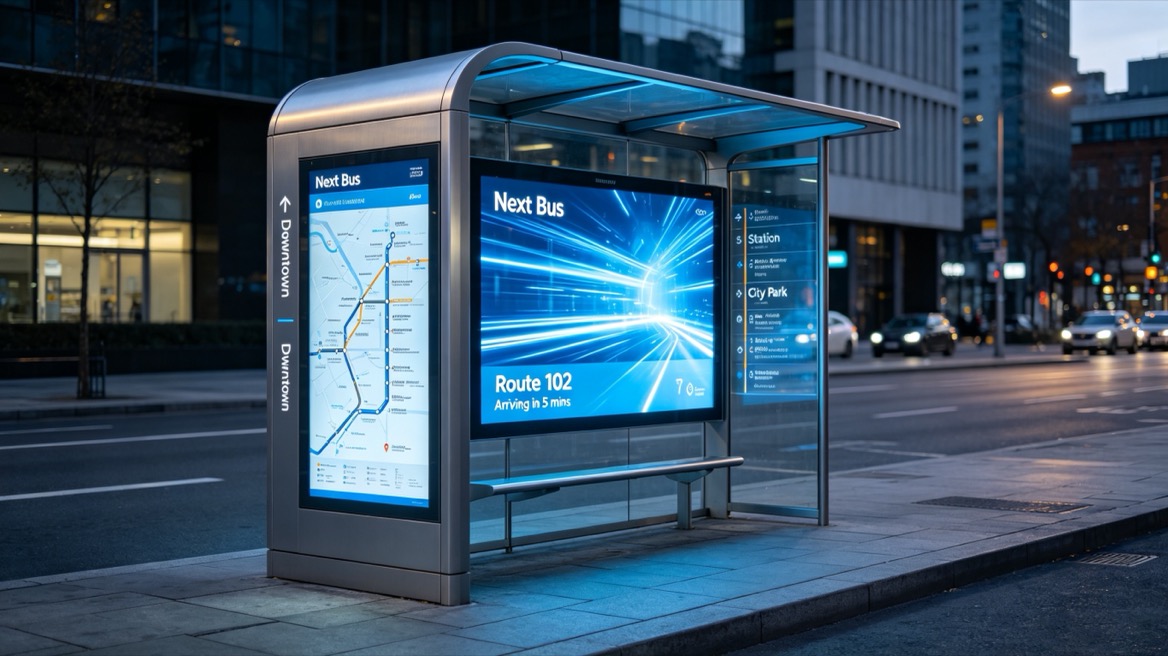
A digital bus shelter uses an electronic display to deliver advertising content. Depending on the installed hardware, software, connectivity, and local permissions, it can support scheduled creative, remote updates, and contextual campaigns.
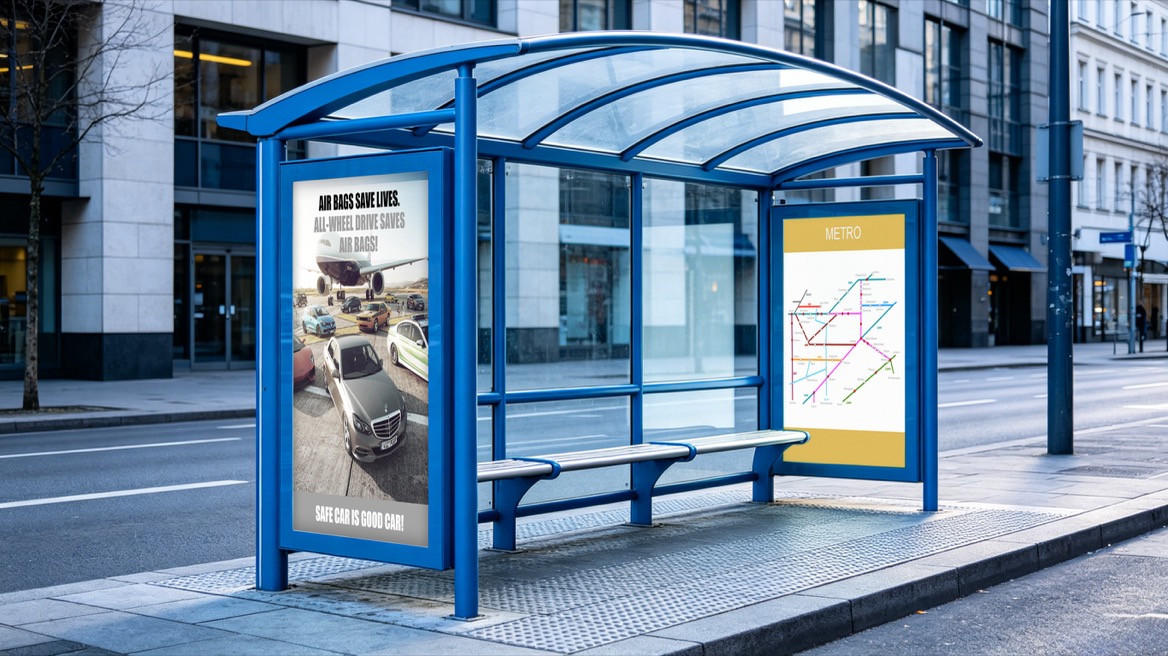
A static bus shelter displays printed advertising, usually within a poster case or illuminated lightbox. Its message remains visible until someone physically replaces the artwork.
Importantly, "static" does not mean unlit, and "digital" does not automatically mean interactive.
| Comparison factor | Digital bus shelter | Static bus shelter |
|---|---|---|
| Advertising content | Electronic images; animation where permitted | Printed posters or graphics |
| Updates | Remote changes with a suitable management system | Physical replacement |
| Advertiser presence | Commonly shared through a content loop | Usually exclusive to one advertiser per panel |
| Scheduling | Supports time-based campaigns | Message remains unchanged |
| Initial investment | Typically higher for comparable installations | Typically lower |
| Operating requirements | Power, display maintenance, software, and potentially connectivity | Cleaning, poster replacement, and lighting maintenance |
| Best-fit campaigns | Frequent promotions and contextual messages | Sustained local awareness |
| Main commercial risk | Unsold slots and technical downtime | Unsold panels and replacement costs |
Neither format guarantees better campaign results. Performance depends on the complete installation and media plan.
Digital bus shelter advertising allows brands to change messages without printing and distributing new posters.
A restaurant could promote breakfast during the morning commute and dinner offers later. A retailer could schedule different creative around opening hours. Weather-responsive campaigns are also possible when the content platform has the necessary data integration.
However, digital flexibility only creates value when someone manages it. Repeating one generic image for months leaves much of the technology's capability unused.
Movement also requires restraint. Animation may attract attention, but road-safety rules, viewing conditions, and local permissions can restrict its use.
A static poster does not disappear between other advertisers' messages. That continuous presence can benefit simple, location-specific campaigns.
Examples include:
- A supermarket promoting its nearby entrance.
- A property development building neighborhood awareness.
- A public-service campaign requiring a consistent message.
- A local business advertising one memorable offer.
From a planning perspective, static advertising is especially compelling when the message stays relevant for the entire booking period.
Consider a hypothetical digital loop containing six advertisers, each receiving ten seconds. Every advertiser occupies one-sixth of the loop.
A pedestrian passing briefly may not encounter a particular advertisement. Someone waiting several minutes has more opportunities to see it.
This does not mean digital delivers one-sixth of static performance. It means the comparison must consider audience dwell time, loop length, repetition, and visibility—not simply the number of people passing the shelter.
An OAAA-commissioned Harris Poll surveyed 1,023 U.S. adults aged 18–64 in April 2024. It reported that 73% viewed digital out-of-home advertising favorably and that 76% of recent viewers reported taking action because of a digital out-of-home advertisement.
Those findings support the potential of digital outdoor advertising. They do not establish that a digital bus shelter outperforms a static shelter by a particular percentage.
Three limitations matter:
1. The research covered digital out-of-home advertising broadly, not bus shelters alone.
2. The responses were self-reported rather than a controlled measurement of incremental sales.
3. The findings describe a U.S. survey population, not every international market.
For buyers, the practical lesson is straightforward: industry research can justify testing a format, but local campaign evidence should guide investment.
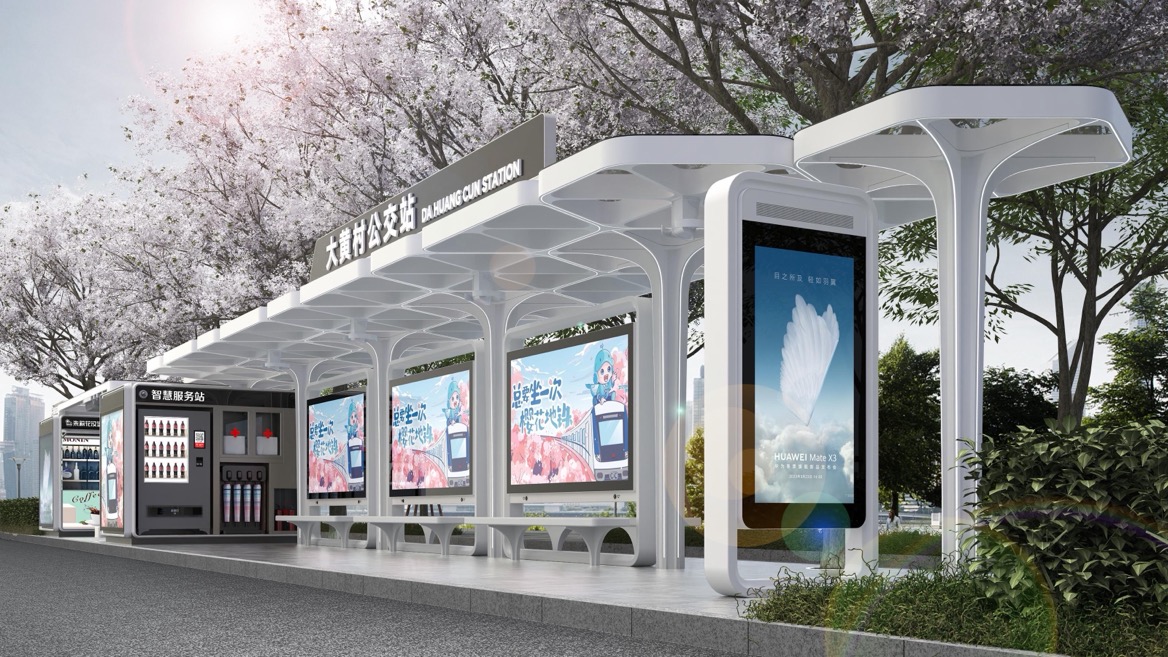
An advertiser purchasing four weeks of exposure faces a different decision from a municipality or operator purchasing the shelter.
Advertisers should compare:
- Media booking charges.
- Creative production and adaptation.
- Printing and installation where applicable.
- Share of time and campaign duration.
- Measurement and reporting services.
Infrastructure buyers must additionally consider foundations, electrical connections, permissions, freight, installation, maintenance access, and replacement parts.
A low equipment quotation is not necessarily a low installed project cost.
For digital bus shelters, the operating budget may include electricity, connectivity, content-management subscriptions, cooling, cleaning, display repairs, and technical support.
For static shelters, recurring costs may include printing, poster installation, lighting, cleaning, and repairs to glazing or access mechanisms.
Use a consistent evaluation period and calculate:
TCO = acquisition + installation + operation + maintenance + replacements − residual value.
Avoid assigning one universal lifespan or energy figure to either format. Screen specifications, operating hours, climate, lighting configuration, and service practices materially change the outcome.
Consider an illustrative project where digital equipment adds $12,000 in installed cost compared with a static alternative.
Spread across a five-year planning period, that represents $200 per month before financing. If additional operating and service costs total $150 monthly, the digital option needs $350 more monthly contribution to cover those differences.
This is a simplified planning example, not an Ainl quotation or market benchmark. Taxes, financing, downtime, and revenue-sharing arrangements would require separate treatment.
The important question is whether realistic paid occupancy—not theoretical slot capacity—supports the investment.
Advertising equipment must remain readable and serviceable outdoors.
A digital screen that overheats or fails loses scheduled exposure. A static lightbox with water ingress, damaged graphics, or failed lighting also loses advertising value.
Request project-specific evidence covering:
- Structural design and applicable wind loads.
- Corrosion protection appropriate to the location.
- Water and dust protection for relevant enclosures.
- Electrical safety and grounding.
- Thermal management.
- Vandal resistance and safe glazing.
- Maintenance access and component replacement.
An enclosure rating alone does not validate the entire shelter installation. Foundations, cable entries, ventilation, and installation workmanship also matter.
For digital bus shelter displays, assess daytime readability, nighttime dimming, reflections, viewing angles, and expected viewing distance.
A higher pixel count does not automatically produce a more effective advertisement.
For static panels, inspect print quality, color consistency, lighting uniformity, and glare. In both formats, actual site conditions matter more than an attractive indoor product photograph.
Digital systems can record scheduled content and playback events. These records help verify delivery, but a playback is not proof that a person saw the advertisement.
Likewise, footfall near a static shelter does not mean everyone noticed its poster.
| Objective | Useful measure | Important limitation |
|---|---|---|
| Build awareness | Exposed-versus-control brand survey | Requires appropriate sampling |
| Generate visits | Incremental store visits | Location data and attribution have limitations |
| Drive response | Unique QR scans or offer redemptions | Captures only observable responders |
| Verify delivery | Playback logs or installation records | Delivery is not attention |
| Compare efficiency | Cost per incremental outcome | Requires a credible baseline |
QR codes can be used on either format. Their effectiveness depends on safe scanning conditions, audience interest, and a useful destination—not whether the advertisement is printed or electronic.
Before a large rollout:
1. Select comparable sites with similar pedestrian activity and visibility.
2. Use equivalent offers and clear creative.
3. Record digital loop length, scheduling, and uptime.
4. Keep campaign periods and measurement methods consistent.
5. Compare incremental outcomes alongside total costs.
Where practical, rotate formats or treatments between locations. This helps distinguish format effects from the influence of a particularly strong site.
Digital advertising eliminates routine poster printing, but adds electronic equipment and operating electricity.
Static advertising requires printed materials and replacement visits, while illuminated static panels also consume power.
Consequently, neither format should automatically be described as more sustainable. Compare material choices, electricity use, maintenance travel, repairability, and end-of-life arrangements within the same assessment boundary.
Solar-powered bus shelters require particular care. A system suitable for lighting or passenger information may not support a large advertising display for the same operating hours.
Before specifying solar power, establish:
- Daily electrical demand.
- Local solar availability and shading.
- Battery autonomy requirements.
- Seasonal operating conditions.
- Backup power and reduced-operation strategies.
Solar feasibility should follow an energy calculation, not a general product label.
Digital and static advertising can complement each other.
JCDecaux describes campaigns combining digital street furniture with static enhancements, including bus shelter takeovers. The underlying approach is useful: digital content supplies variation, while printed surfaces maintain a persistent visual identity.
A hybrid shelter might combine:
- A digital advertising display.
- A fixed advertiser or city-branding panel.
- Separate passenger information.
- Permanent route identification and accessibility signage.
Essential passenger information should remain usable even when an advertising system is unavailable.
For many projects, the better decision is not choosing one format across an entire city. It is assigning each format to locations where its benefits justify its costs.
Ainl's company profile describes 16 years of experience developing, manufacturing, and selling smart city public facilities and outdoor advertising products.
Its stated manufacturing resources include approximately 150,000 square meters of factory space, provincial-level software and hardware research facilities, CNC sheet-metal processing, coating facilities, and electrical testing capabilities.
For buyers, those capabilities are relevant to customization and production coordination. However, company qualifications should not replace destination-specific engineering checks or product documentation.
A practical OEM/ODM brief should define shelter dimensions, structural requirements, colors, display configuration, lighting, power arrangements, maintenance access, and city-branding elements.
For a project-specific proposal, send Ainl your installation location, site photographs, audience profile, preferred advertising model, power availability, and customization requirements. Request digital, static, or hybrid options against the same technical scope so that pricing and operating assumptions remain comparable.
No. Digital offers scheduling and creative flexibility, while static provides continuous panel presence. Location, viewing time, creative quality, and campaign objectives determine which performs better.
Yes. Static advertising commonly uses illuminated poster cases or lightboxes. Compare lighting quality, operating hours, and maintenance requirements rather than assuming static panels are unlit.
Some systems can play locally stored content without a continuous internet connection. Remote updates, monitoring, and data-triggered campaigns depend on the system's connectivity and software configuration.
Potentially, but feasibility depends on the complete electrical load, sunlight, shading, battery capacity, and required operating hours. Lighting-only and screen-equipped shelters need different energy assessments.
Static can suit a consistent nearby offer. Digital can suit changing promotions or time-specific messages. Compare the actual booking price, exposure conditions, and measurable response before deciding.
Request drawings, material specifications, applicable test documentation, electrical details, maintenance procedures, warranty terms, spare-parts arrangements, and a clear installation scope. Digital projects also need software, connectivity, and display-service details.
1. Out of Home Advertising Association of America. "New Study Finds Digital Out of Home Advertising Surpasses Other Media in Driving Favorability and Action Among Consumers." Research conducted by The Harris Poll, April 2–9, 2024; 1,023 U.S. adults aged 18–64. Basis for the survey findings and methodology discussed above. [oaaa]
2. JCDecaux. "Trends in Out-of-Home." Background on static and digital outdoor formats, street furniture, audience measurement, and contextual advertising capabilities. [jcdecaux]
3. JCDecaux North America. "Combined Digital and Static Outdoor Ads Accelerate Impact." April 30, 2026. Industry examples of combining digital street furniture with static bus shelter enhancements; an operator perspective rather than independent comparative proof. [jcdecauxna]
4. AdQuick. "Street Furniture Advertising: Plan, Buy & Measure." Background on bus shelter formats, scheduling capabilities, and campaign measurement methods. Vendor-specific pricing and campaign results were not used as universal benchmarks. [adquick]


