
Email: ainlbusshelter@gmail.com | WhatsApp: +86-18800607527
Views: 264 Author: Ainl Bus Shelter Publish Time: 2026-11-14 Origin: Site


Content Menu
● Why Source Air-Conditioned Bus Shelters from China?
>> What Current Industry Data Cannot Tell Buyers
● How These Manufacturers Were Selected
● Manufacturer Comparison: Capacity, MOQ, and Certification
● The Top 10 Air-Conditioned Bus Shelter Manufacturers in China to Evaluate
>> 1. Ainl — A Customization-Focused Partner for Integrated Public Facilities
>> 2. YEROO — A Direct Candidate for Enclosed AC Shelter Projects
>> 3. Shanghai Rusuu Precision M&E — A Candidate for Digitally Integrated Waiting Rooms
>> 4. Shanghai ZEMSO Urban Furniture Technology — A Candidate for Modular Enclosed Designs
>> 5. Jiangsu Lantecity Intelligent Equipment — A Candidate for Configurable Waiting-Room Layouts
>> 6. Jiangsu Hanbang Intelligent System Integration — A Candidate for Display-Led Municipal Projects
>> 7. Jiangsu Aert Advertising Equipment — A Candidate for Municipal Design Adaptation
>> 8. Guangzhou Huasheng Metal Materials — A Candidate for Metalwork-Intensive Shelter Programs
>> 9. Jiangsu Yubang Electronic Technology — A Candidate for Advertising-Oriented Enclosed Shelters
● Technical Buyer's Guide: What to Specify Before Requesting Prices
>> Define the Operating Conditions Before the Cooling Capacity
>> Specify Materials Component by Component
>> Treat CE and RoHS as Applicable Compliance Requirements, Not Marketing Badges
● The Often-Missed Procurement Trap: Accepting the AC Unit Instead of the Shelter
● Factory Verification, Samples, and Delivery Planning
>> Verify the Factory and the Contracting Entity
>> Use a First-Article Approval Process
>> Compare Delivered Project Cost
● Conclusion: Select the Partner That Can Prove Whole-System Performance
>> 1. How Can I Check Whether a Manufacturer's ISO Certificate Has Expired?
>> 2. Does a CE Certificate for the Air Conditioner Cover the Complete Bus Shelter?
>> 3. Can a Solar Roof Power an Air-Conditioned Bus Shelter All Day?
>> 4. How Can Buyers Detect Material Substitution Before Shipment?
An air-conditioned bus shelter is more than a steel structure with a cooling unit. It is a compact public building that must combine structural safety, thermal comfort, accessible entry, outdoor electrical protection, passenger information, and straightforward maintenance.
For procurement managers, choosing the right manufacturer means looking beyond attractive renderings and low quotations. Factory capabilities, engineering documentation, quality-control procedures, delivery planning, and after-sales responsibilities determine whether a shelter remains useful after installation.
China offers a broad sourcing base for this category, combining metal fabrication, architectural glazing, outdoor displays, electrical integration, and customized street furniture. Manufacturers in Suqian, Jiangsu, and the Guangzhou–Foshan area appear repeatedly in public supplier and product listings, giving buyers several potential production partners within established manufacturing locations.
This guide presents ten manufacturers and project suppliers worth investigating. It distinguishes companies with publicly listed air-conditioned shelters from broader bus shelter manufacturers whose cooling integration requires further verification.
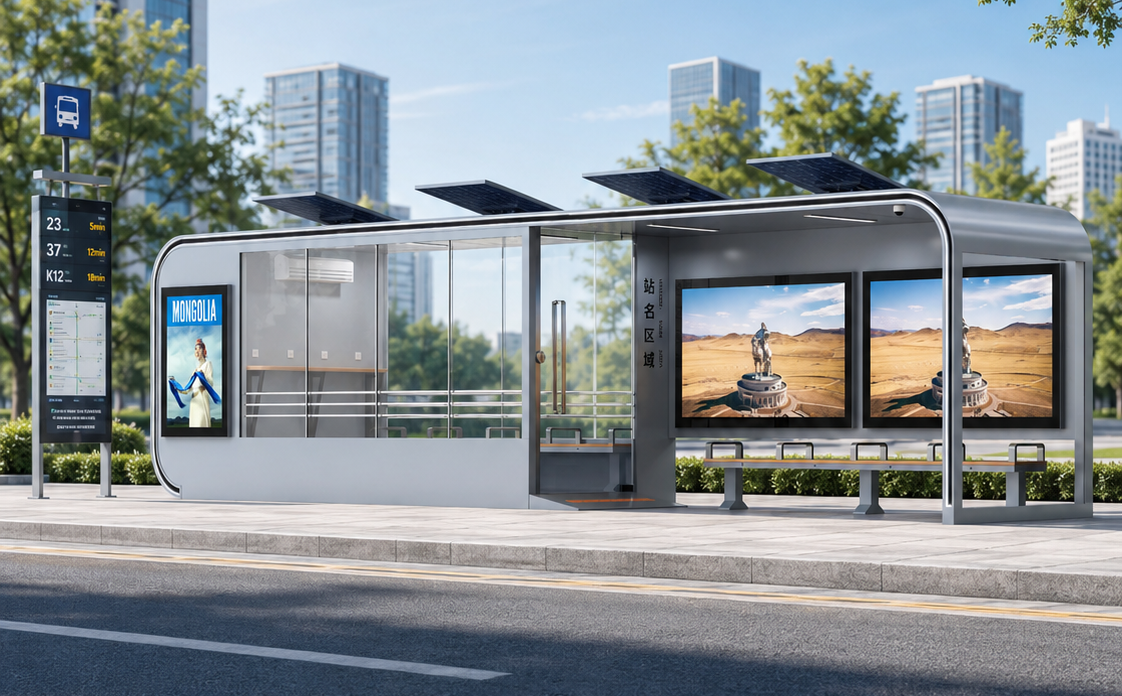
China's public transport infrastructure provides a substantial domestic application environment for passenger waiting facilities and intelligent transport equipment.
A national-scale transport dataset published in 2026, based on June 2025 data, integrated bus networks from 350 cities and metro networks from 46 cities across mainland China, Hong Kong, Macao, and Taiwan. Its approximately 3.375 million kilometers of bus operational routes indicate the breadth of the network studied—not physical road mileage, shelter installations, or demand for air-conditioned shelters.
For international buyers, the practical attraction is the ability to source several connected systems through one project:
- Structural frames, roofing, seating, and glazing.
- Advertising light boxes and passenger information displays.
- Electrical cabinets, lighting, and control systems.
- Customized exterior finishes and municipal branding.
- Enclosed waiting rooms with project-specific cooling integration.
Ainl and YEROO publicly describe combinations of structural manufacturing, electronic integration, and customized bus shelter development. That breadth can simplify coordination, although it does not eliminate the need to validate each subsystem.
Public transport statistics should not be presented as air-conditioned bus shelter market statistics. The sources reviewed do not establish a reliable 2025 or 2026 production total, export value, or market-share ranking for this narrow product category.
The 2025 report *New Modes of Urban Public Transport in China* discusses changing transport service models, including on-demand buses. It is useful planning context, but it does not measure the market for climate-controlled shelters. Likewise, government reporting on overall transport growth is not evidence of shelter export growth.
A credible sourcing decision therefore needs supplier-level evidence rather than a broad market-size headline.
This shortlist uses a procurement-oriented screening framework rather than an undisclosed scoring formula.
| Screening dimension | Evidence buyers should request | Why it matters |
|---|---|---|
| Product relevance | Enclosed shelter drawings, cooling layouts, completed installations | Separates genuine climate-controlled capability from ordinary shelters |
| Factory capability | Equipment list, factory audit, production records, subcontractor map | Shows who manufactures and who integrates |
| Engineering competence | Structural calculations, thermal assumptions, electrical diagrams | Reduces interface and installation risks |
| Quality control | Incoming inspection, welding checks, coating records, final test sheets | Supports repeatability across multiple units |
| Compliance | Current management certificates and applicable product documentation | Prevents reliance on unrelated certificates |
| Delivery stability | Approved schedule, material lead times, production-slot confirmation | Connects promised delivery to actual resources |
| Customization and support | Drawing revisions, spare-parts plan, warranty responsibility matrix | Supports long-term operation |
Not every company below has equally detailed public documentation. Missing information is identified rather than replaced with assumed production figures or certifications.
Facility area is not annual shelter capacity. A one-set marketplace MOQ also does not necessarily include engineering, tooling, shipping, installation, or a fully operational cooling system.
| Manufacturer | Public capacity information | Public MOQ indication | Certification information and verification status | Air-conditioned shelter evidence |
|---|---|---|---|---|
| Ainl | Approximately 150,000 m² of manufacturing facilities; annual AC shelter output not disclosed | Obtain project quotation | National High-Tech Enterprise and management-system claims; verify current certificates | Broad smart shelter capability; request AC-specific references |
| YEROO | Annual AC shelter output not reliably established | Selected listings show one piece or set | Obtain model-specific documents and current management certificates | Dedicated AC shelter offering |
| Shanghai Rusuu | Annual output not disclosed | Selected listings show one set | Current certificates require direct verification | Dedicated AC shelter category |
| Shanghai ZEMSO | Marketplace profile lists 35,000 m² plant area | Selected listings show one set | Supplier audit status is not product certification | Multiple enclosed AC product listings |
| Jiangsu Lantecity | Annual output not independently established | Listings vary by model, including one or two sets | Current certification scope requires verification | Multiple air-conditioned waiting-room listings |
| Jiangsu Hanbang | Annual AC shelter output not disclosed | Obtain quotation | Profile lists ISO 9001, ISO 14001, and ISO 45001; verify validity | Smart shelter capability; confirm complete AC scope |
| Jiangsu Aert | Annual output not disclosed | Obtain quotation | National High-Tech Enterprise claim; obtain supporting records | Broader shelter manufacturer; AC capability requires confirmation |
| Guangzhou Huasheng | Public facility figures conflict; audit required | Obtain quotation | Legacy ISO references are insufficient evidence of current status | Smart AC shelter advertising appears in listings |
| Jiangsu Yubang | Annual output not disclosed | Selected listings show one set; other pricing uses square meters | Obtain current certificates and reports | Fully enclosed AC shelter listing |
| Dongguan Space | Annual AC shelter output not disclosed | Obtain quotation | Obtain relevant current documentation | Enclosed AC shelter listing |
Sources for the comparison include official company pages and supplier listings. Figures and minimum orders remain supplier-reported unless otherwise stated.
Ainl is based in Suqian, Jiangsu. Its company introduction states a founding year of 2010, aligning with the supplied description of 16 years of experience in 2026. Its history also references a predecessor established in 2008 and later group entities, so buyers should distinguish brand history from the legal entity signing the contract.
The company reports approximately 150,000 m² of manufacturing facilities, a provincial-level software and hardware research center, CNC sheet metal processing, a large coating center, and an electrical testing laboratory. Its published services cover structural fabrication, electrical integration, assembly, inspection, and project support.
Ainl's most relevant positioning is a potentially cost-conscious engineering partner for distributors, contractors, and smaller brands needing substantial customization—not simply a standard catalog shelter. Its stated OEM/ODM scope includes dimensions, structural design, materials, colors, displays, lighting, solar configurations, seating, and city branding. However, comparative pricing advantages and communication speed should be tested through an actual quotation and drawing-review cycle rather than assumed.
- Establishment: 2010 stated in the company introduction.
- Markets: Chinese municipal and public-space projects, with international clients explicitly targeted; export-market shares are not published.
- Customization strength: Broad structural, visual, electrical, and smart-system integration.
- Buyer verification priority: Obtain completed climate-controlled shelter references, thermal design assumptions, HVAC responsibility, and an agreed acceptance test.
One editorial correction is important: the supplied Chinese description says more than 260 mu, whereas the English company page says more than 260 acres. These are different units. This article uses the separately stated manufacturing floor area and avoids repeating the inconsistent land figure.
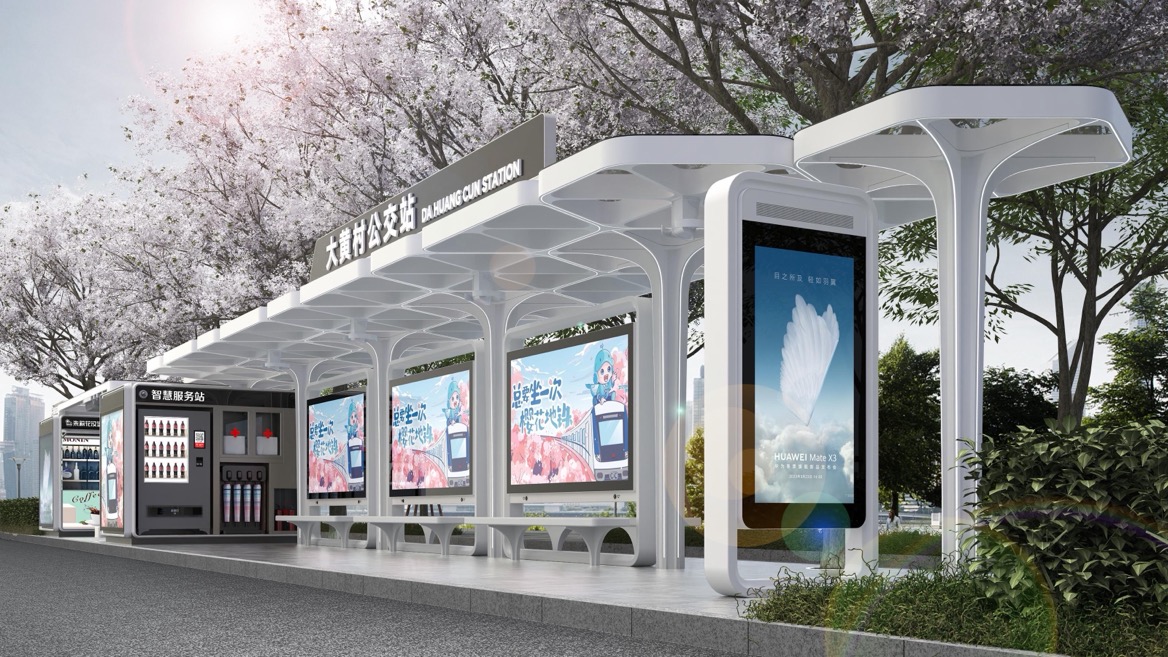
YEROO's official shelter range explicitly includes air-conditioned bus shelters. It describes galvanized steel, tempered glass, advertising integration, and customized shelter development, with addresses in Guangzhou and Foshan. A separate product page specifically markets enclosed AC shelters using galvanized steel.
A supplier listing states that YEROO was established in 2000. Buyers should nevertheless confirm the establishment date and responsibilities of the particular YEROO entity issuing the contract, because multiple similarly branded legal entities appear in public listings.
- Establishment: 2000 according to a supplier profile.
- Markets: International transit and outdoor-advertising procurement; country-by-country sales distribution is not established in the reviewed sources.
- Customization strength: Enclosure geometry, structural materials, advertising panels, and associated shelter systems.
- Buyer verification priority: Confirm which HVAC unit, glazing, doors, controls, and commissioning services are included in the quoted configuration.
YEROO is particularly relevant when the buyer wants to start with an existing AC shelter product concept rather than develop an enclosure entirely from scratch.
Shanghai Rusuu maintains a dedicated AC bus shelter category. Listed configurations include enclosed shelters, regional-style customization, advertising light boxes, cloud software, and solar-related options.
The reviewed evidence does not establish its legal founding year reliably. Marketplace tenure should not be converted into a company establishment date.
- Establishment: Not verified from the reviewed sources.
- Markets: Overseas customers are explicitly addressed; principal export destinations are not disclosed.
- Customization strength: Enclosure styling, route-information functions, digital advertising, and control integration.
- Buyer verification priority: Separate physical shelter manufacturing, software licensing, HVAC supply, and long-term platform support.
Rusuu deserves consideration where passenger information and remote management are important. Buyers should establish who owns access credentials and whether recurring software fees apply.
ZEMSO publicly lists closed AC shelters, including galvanized steel structures and customized configurations. Marketplace descriptions mention modular combined designs and aluminum light-box components. A supplier directory records an establishment date of April 28, 2007, and a plant area of 35,000 m²; these remain profile-level information requiring verification.
- Establishment: 2007 according to a marketplace supplier directory.
- Markets: International public-transport procurement is targeted; leading destination markets are not independently established.
- Customization strength: Shelter length, passenger capacity, enclosure configuration, and advertising integration.
- Buyer verification priority: Identify the actual production location, contracting entity, subcontractors, and material grade for every exposed component.
A useful due-diligence point is that ZEMSO listings offer alternative material grades. Buyers should not assume every quoted component uses the same stainless steel specification.
Lantecity lists multiple air-conditioned shelters with closable waiting rooms, tempered glass enclosures, route displays, and alternative passenger-space arrangements. Public minimum orders vary between models, including one and two sets.
One supplier FAQ claims factory operations since 2014 and exports to more than 60 countries. Those statements should be verified against the legal entity's business registration and shipment references; marketplace account age is a separate measure.
- Establishment: Factory operation since 2014 is claimed; legal-entity founding date requires verification.
- Markets: More than 60 export countries claimed, without a substantiated market breakdown.
- Customization strength: Dimensions, shape, materials, colors, glass-room layouts, and route-information features.
- Buyer verification priority: Confirm whether advertised prices cover the entire shelter or a limited module, and whether site assembly preserves weather sealing.
Hanbang combines intelligent displays, digital signage, smart urban products, and bus station equipment. Its supplier profile records an establishment date of November 22, 2013, and lists ISO 9001, ISO 14001, and ISO 45001 management-system certifications.
- Establishment: 2013 according to its supplier profile.
- Markets: Municipal infrastructure and international sourcing channels; principal geographic markets are not disclosed.
- Customization strength: Digital signage, passenger information, light boxes, and multifunction shelter integration.
- Buyer verification priority: Establish whether Hanbang assumes responsibility for the complete enclosed, cooled shelter or only its structure and electronics.
Hanbang belongs on a broader project shortlist, but the reviewed evidence is stronger for smart shelters than for independently documented, complete AC installations.
Aert states that it was founded in 2014 in Suqian. Its public profile describes a national high-tech enterprise offering design, production, installation, operation, and maintenance services for smart shelters and urban street furniture.
Its range includes municipal shelters, cultural-tourism styles, solar rural shelters, electronic bus stop signs, and other outdoor facilities.
- Establishment: 2014, supplier-stated.
- Markets: Municipal, transport, and cultural-tourism applications; export destinations are not specified.
- Customization strength: Architectural appearance, local cultural styling, signage, and associated street furniture.
- Buyer verification priority: Request AC-specific engineering, completed references, and enclosure-performance evidence before treating it as a proven climate-controlled shelter supplier.
Aert may be suitable when visual integration with the surrounding streetscape is a major tender requirement.
Huasheng has a long-established public presence in bus shelters, advertising light boxes, kiosks, and metal structures. However, public sources conflict on its founding year: some state 1993, while others state 1989. The legal business registration should resolve this before publication in a tender or supplier approval record.
Supplier material describes Chinese and overseas markets, while marketplace listings also advertise smart air-conditioning shelter concepts. These establish product relevance, not verified cooling performance.
- Establishment: Conflicting public claims of 1989 and 1993.
- Markets: China and overseas markets, including Asian destinations; detailed export distribution requires confirmation.
- Customization strength: Metal structures, advertising assemblies, kiosks, and coordinated street furniture.
- Buyer verification priority: Resolve conflicting factory-size and company-history claims, then validate a complete AC shelter configuration.
Jiangsu Yubang lists smart solar shelters, digital advertising light boxes, and fully closed air-conditioned shelters with tempered glass and decorative laser-cut screens. Some listings use per-set pricing, while others use square-meter units.
- Establishment: Not verified; marketplace account duration is not sufficient evidence.
- Markets: Export sourcing channels are visible, but principal destination markets are not established.
- Customization strength: Advertising surfaces, decorative panels, glass enclosures, and smart shelter configurations.
- Buyer verification priority: Obtain a dimensioned drawing and itemized bill of materials that reconcile the pricing unit with a complete installed shelter.
This is especially important when comparing a square-meter advertisement with another supplier's complete per-unit quotation.
Dongguan Space appears in a supplier directory with an enclosed air-conditioned shelter described as customizable and using tempered glass. The same directory provides lead-time indications, but these should not be interpreted as a guaranteed schedule for a newly engineered AC shelter.
- Establishment: Not verified from the reviewed evidence.
- Markets: International supplier-directory exposure; principal markets are not disclosed.
- Customization strength: Listed enclosure shape and glass configuration; the full OEM/ODM scope requires direct confirmation.
- Buyer verification priority: Audit actual shelter fabrication, structural engineering, HVAC integration, and completed project references.
Among the ten candidates, this company requires particularly careful capability validation because the reviewed public evidence is limited.
A quotation should state the assumptions behind the design:
- Maximum outdoor temperature and humidity.
- Solar exposure and shelter orientation.
- Design occupancy.
- Door-opening frequency and duration.
- Required occupied-zone temperature.
- Fresh-air and ventilation requirements.
- Daily operating hours.
- Available electrical supply.
These are proposed procurement requirements, not claims that every shortlisted supplier already meets them. Put them into the request for quotation so suppliers price the same operating problem.
Avoid accepting a cooling-unit capacity as proof of passenger comfort. Require an agreed test method for the complete enclosure.
Descriptions such as "stainless steel shelter" or "galvanized structure" are incomplete. Supplier listings demonstrate that different steel and stainless steel options can be offered within the same product category.
The purchase specification should identify:
1. Frame grade, section dimensions, and minimum wall thickness.
2. Corrosion-protection system and coating inspection requirements.
3. Glazing composition, safety requirements, and replacement method.
4. Roof insulation and weatherproofing details.
5. Fastener materials and dissimilar-metal isolation.
6. Drainage routes and accessible service openings.
Require inspection records tied to the approved bill of materials rather than a generic statement that premium materials are used.
CE marking is not a universal factory quality certificate. The manufacturer must identify the applicable European product rules, prepare technical documentation, and issue the required declaration of conformity. Not every product is subject to the same legislation or assessment route.
For a shelter containing lighting, displays, controls, and HVAC equipment, ask a qualified compliance specialist to map the requirements for the supplied configuration. Do not assume a certificate for one display or cooling unit covers the entire integrated installation.
RoHS concerns restrictions on hazardous substances in applicable electrical and electronic equipment; it is not a general structural durability or cooling-efficiency certification. Supporting documentation must match the actual equipment and materials being supplied.
The most useful insider-style safeguard is contractual: test the complete shelter, not merely the cooling equipment.
A cooling unit can operate correctly while passengers remain uncomfortable because of solar gain, frequent door openings, poor air distribution, or uncontrolled leakage. The procurement risk is an interface gap: the enclosure supplier, HVAC vendor, and installer may each argue that their own component works.
Specify one responsible integrator and a whole-shelter acceptance protocol covering:
- Outdoor test conditions and agreed solar exposure.
- Temperature measurements at occupied positions.
- A representative door-opening cycle.
- Pull-down time after startup.
- Electrical consumption over the test period.
- Condensate drainage and water-leak checks.
- Access for filter replacement and servicing.
This is a recommended purchasing method, not a reported failure rate or a claim about any company listed above. Its purpose is to prevent a component warranty from being mistaken for a passenger-comfort guarantee.
Before paying a deposit, reconcile the business license, quotation, bank beneficiary, manufacturing address, and certificate holder.
Request a live production walkthrough or independent audit showing actual cutting, welding, coating, wiring, and assembly activities. Ask which operations are subcontracted and who controls their inspection.
For certified management systems, ISO recommends checking accredited certification through IAF CertSearch or directly with the relevant certification and accreditation bodies.
For a customized project, the "sample" should normally be a defined first article or representative mock-up, not a small finish swatch alone.
Approve the following before releasing the remaining production quantity:
- Final drawings and foundation interfaces.
- Material and finish samples.
- Door operation and accessibility.
- Electrical diagrams and labeling.
- Cooling and control operation.
- Service access and replacement clearances.
- Packing and reassembly instructions.
Record deviations in writing and identify whether approval applies to appearance, function, or both.
Use a complete scope comparison rather than the lowest product line price:
> Shelter structure + glazing + HVAC + electrical integration + engineering + packing + transport + import charges + foundations + installation + commissioning + operating and maintenance provisions.
For shipment planning, require packing drawings, module dimensions, lifting points, glass protection, component identification, and an agreed assembly sequence.
If the shelter ships partially dismantled, define who restores seals, completes electrical connections, checks refrigerant-related work where relevant, and signs off commissioning. Do not leave those responsibilities to informal coordination after arrival.
The strongest air-conditioned bus shelter supplier is not necessarily the company with the largest factory claim or the lowest marketplace price. It is the partner that can convert site conditions into a documented design, manufacture consistently, demonstrate complete-system performance, and support maintenance after delivery.
Ainl merits consideration for buyers seeking flexible OEM/ODM development across structures, finishes, displays, lighting, and smart public-facility systems. Its published manufacturing and customization capabilities provide a basis for technical discussions; AC-specific engineering and project evidence should form part of that evaluation.
To begin a project review with Ainl, submit the installation location, shelter dimensions, passenger capacity, climate conditions, operating hours, display requirements, and target delivery schedule. Request an itemized proposal covering the enclosure, cooling system, power arrangement, compliance documentation, installation interfaces, and acceptance tests.
Search the legal company name or certificate details in IAF CertSearch. Check the current status, expiry date, certified site, certification body, and scope—not just the logo and issue date on a PDF.
If the record cannot be confirmed, contact the issuing certification body and relevant accreditation body directly. ISO itself does not issue supplier management-system certificates.
Not automatically. CE obligations depend on the applicable legislation and the product or assembly being placed on the market.
Ask for the compliance assessment covering the supplied configuration, including the manufacturer's declaration of conformity where required. A component document is evidence about that component, not automatic proof that all integration work complies.
Do not accept an unconditional answer. Require an hourly energy assessment using the proposed location, cooling demand, operating schedule, available roof area, shading, battery capacity, and any grid backup.
Several shortlisted suppliers advertise solar-related options, but the presence of a solar option is not evidence that continuous cooling is included or feasible for every configuration.
The supplier's proposal should distinguish solar-assisted lighting and electronics from solar-powered HVAC operation.
Agree on a material inspection plan before production. Require traceable purchase records, grade certificates where applicable, section-thickness checks, and appropriate independent testing for disputed or critical materials.
Tie acceptance to specific components. For example, a stainless steel seating panel does not establish the grade of the frame, fasteners, door hardware, or concealed brackets.
This is particularly relevant where suppliers offer several material alternatives in the same product family.
Name a lead integrator in the contract and attach a responsibility matrix covering the structure, glazing, doors, cooling equipment, controls, software, installation, and commissioning.
Require a fault-reporting process, response commitments, remote diagnostic arrangements, and a spare-parts list. Clarify who pays freight, labor, and local service costs for each failure category.
The objective is one accountable coordination route, even when several manufacturers supply components.
- Ainl company background, facilities, history, and customization services. [ainlgroup]
- YEROO official shelter range and enclosed AC shelter product information. [yeroo]
- YEROO establishment claim in a supplier listing. [cnyeroo.en.made-in-china]
- Shanghai Rusuu official AC shelter category. [rusuusmart]
- ZEMSO product descriptions and supplier-directory information. [made-in-china]
- Lantecity product configurations, minimum orders, and supplier claims. [alibaba]
- Hanbang supplier information and listed management certifications. [made-in-china]
- Aert company profile and product scope. [made-in-china]
- Huasheng company-history claims and conflicting establishment dates. [gzhsgm.goldsupplier]
- Yubang enclosed shelter and advertising product listings. [alibaba]
- Dongguan Space supplier-directory product information. [made-in-china]
- *China Public Transport Operation Network Dataset (CPTOND-2025)*, published in 2026 using June 2025 data. [pmc.ncbi.nlm.nih]
- *New Modes of Urban Public Transport in China*, 2025 report. [changing-transport]
- State Council of China: transport-sector reporting for 2025; broader sector context, not shelter export statistics. [english.www.gov]
- European Union: official CE marking requirements. [europa]
- ISO: certification and verification guidance. [iso]
- IAF CertSearch: accredited certification verification database. [iafcertsearch]


