
Email: ainlbusshelter@gmail.com | WhatsApp: +86-18800607527
Views: 243 Author: Ainl Bus Shelter Publish Time: 2026-08-19 Origin: Site


Content Menu
● What Is a Solar-Powered Bus Shelter?
● Why Solar Bus Shelters Matter for Modern Cities
● 1. Improve Passenger Comfort and Convenience
● 2. Strengthen Nighttime Visibility and Perceived Safety
● 3. Reduce Dependence on Grid Connections
● 4. Support Lower-Impact Public Infrastructure
>> A lower-impact procurement checklist
● 5. Create New Value Through Smart City Integration
● How to Size a Solar Bus Shelter System
>> Step 1: List every electrical load
>> Step 2: Calculate daily energy demand
>> Step 3: Design for the worst solar season
>> Step 4: Select battery autonomy
>> Step 5: Decide what remains essential
● Choosing the Right Manufacturing Partner
>> Questions to ask before ordering
● Build a Shelter That Works Beyond Day One
● FAQs
>> What is a solar-powered bus shelter?
>> Can a solar bus shelter operate without a grid connection?
>> How long can the battery power a solar bus shelter?
>> Are solar-powered bus shelters suitable for rainy or cloudy regions?
>> What can be customized on a solar bus shelter?
>> Do solar bus shelters require maintenance?
>> Can digital advertising screens be installed in a solar bus shelter?
A solar-powered bus shelter turns an ordinary waiting area into a reliable, passenger-focused public facility. By combining photovoltaic panels, battery storage, LED lighting, USB charging, and optional digital displays, it can provide essential services without requiring a conventional grid connection at every installation site.
For municipalities, transit operators, developers, and outdoor media companies, solar bus shelters are not simply a visual upgrade. They are a practical way to improve passenger comfort, support nighttime visibility, extend services to hard-to-wire locations, and create a stronger city image through customized smart infrastructure.
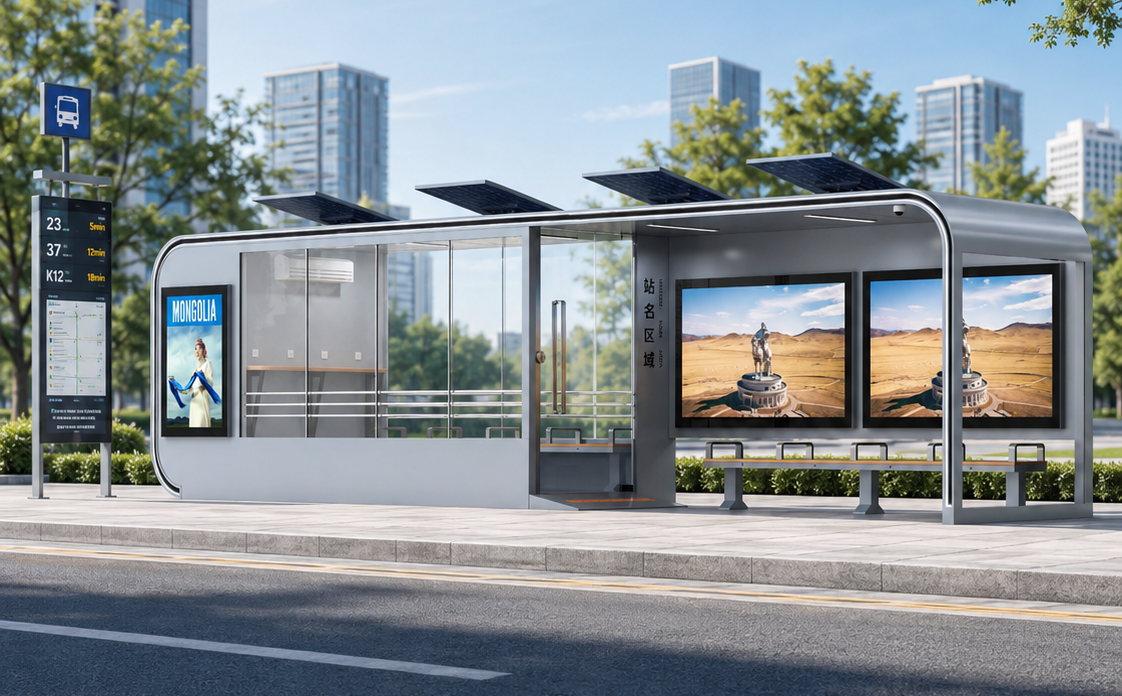
A solar-powered bus shelter is a transit shelter equipped with an integrated solar energy system. During daylight hours, rooftop or independently mounted photovoltaic panels collect solar energy. A controller manages that energy and stores it in batteries, which then power selected equipment after sunset or during low-light conditions.
Typical configurations may include:
- High-efficiency solar panels
- Battery energy storage
- LED interior and exterior lighting
- USB or Type-C charging ports
- Passenger information displays
- Digital advertising screens
- CCTV cameras or emergency communication devices
- Wi-Fi, sensors, and environmental monitoring equipment
- Illuminated route maps and branded signage
The exact system should be designed around the site—not selected as a one-size-fits-all package. Local sunlight conditions, shade, passenger volume, operating hours, required electrical loads, and maintenance expectations all affect the right specification.
A well-designed solar bus shelter can work as a self-contained public-service node, especially where trenching cables or connecting to the electrical grid would be costly, disruptive, or impractical.
Public transport infrastructure has a direct effect on how passengers experience a city. A poorly lit, uncomfortable, or outdated stop can make waiting feel inconvenient and insecure. By contrast, a clean, well-lit shelter with accessible amenities signals that the transit system values its users.
Solar power adds another layer of flexibility. It enables cities to improve bus stop functionality without depending entirely on local utility infrastructure.
NJ TRANSIT, for example, introduced a solar-powered shelter in Cherry Hill featuring LED lighting, a battery system, motion sensing, and USB charging. The project demonstrates how solar energy can support practical passenger amenities in a compact transit structure.
Passengers often wait at bus stops while checking schedules, communicating with family, navigating routes, or working on mobile devices. A shelter with reliable lighting and charging access can make that waiting time more useful and less stressful.
- USB and Type-C charging ports for phones and small devices
- LED lighting for reading schedules and navigating the stop after dark
- Real-time route information displays where network connectivity is available
- Seating and weather protection designed for local climate conditions
- Accessible layouts that support wheelchair users, elderly passengers, and parents with strollers
These features are especially valuable at transfer stations, commercial districts, hospitals, schools, airports, tourist areas, and late-night transit corridors.
However, convenience must be engineered responsibly. Charging ports, lighting fixtures, displays, and wireless devices all consume power. The system should therefore be calculated based on actual daily load rather than installed simply because a feature looks attractive in a rendering.
A bright, clearly visible transit stop can improve the passenger experience after dark. Lighting helps people identify the shelter, read route information, locate seating, and remain aware of their surroundings.
Solar-powered LED systems can provide targeted illumination without the need for continuous grid electricity. Motion sensors and programmed dimming can further reduce unnecessary power consumption while maintaining visibility when people approach the shelter.
| Design factor | Why it matters |
|---|---|
| Lighting level | Helps passengers read information and navigate safely |
| Uniformity | Reduces harsh shadows and poorly lit corners |
| Color rendering | Makes faces, signage, and surroundings easier to recognize |
| Motion sensing | Extends battery runtime by activating brighter light when needed |
| Fixture protection | Supports reliable operation in rain, dust, heat, and vandalism-prone locations |
| Maintenance access | Makes inspections and component replacement safer and faster |
For waiting areas, lighting quality matters as much as brightness. Poorly positioned fixtures can create glare, deep shadows, or reflected light on glass panels and digital screens. A professional layout should direct light toward the usable passenger area while minimizing unnecessary spill.
The NJ TRANSIT installation used high-intensity LED lighting and a motion sensor to help manage battery use, showing how operational controls can be built into a compact shelter system.
One of the strongest reasons to choose a solar-powered bus shelter is installation flexibility. In many projects, the cost of civil work can exceed the cost of the shelter's electrical equipment.
Traditional grid-connected installations may require:
1. Excavation and trenching.
2. Cable routing and electrical connections.
3. Permits and coordination with utility providers.
4. Surface restoration after construction.
5. Ongoing electricity billing and meter management.
A solar-powered solution can reduce dependence on these steps when the intended electrical load is suitable for an off-grid design. This is particularly useful for rural routes, newly developed districts, park-and-ride locations, scenic roads, industrial parks, campuses, and temporary transit facilities.
That does not mean every shelter should be fully off-grid. In dense urban areas with high energy demand—such as shelters with large digital displays, air conditioning, multiple advertising screens, or continuously connected equipment—a hybrid configuration may be more appropriate.
A practical supplier should be able to discuss both standalone and grid-assisted options rather than treating solar power as an automatic answer for every site.
Solar power is not impact-free. Panels, batteries, metal structures, electronics, transportation, and installation all require materials and energy. The more accurate argument is that photovoltaic electricity generally has substantially lower life-cycle greenhouse-gas emissions than fossil-fuel electricity generation.
Research compiled by the National Renewable Energy Laboratory found that solar photovoltaic systems have life-cycle emissions far below coal-fired electricity. The International Energy Agency Photovoltaic Power Systems Programme likewise notes that much of a PV system's environmental impact occurs during manufacturing, while electricity generation during operation has very low emissions.
For city projects, the environmental value of a solar bus shelter becomes stronger when it is paired with durable construction and long service life.
- Specify corrosion-resistant metalwork for local climate conditions.
- Use durable coatings suitable for UV exposure, humidity, salt spray, or industrial pollution.
- Select replaceable LED drivers, batteries, controllers, and charging modules.
- Design roof geometry to reduce standing water and facilitate cleaning.
- Consider modular components that can be repaired instead of replacing the full shelter.
- Use energy-efficient loads before increasing panel and battery capacity.
- Plan for responsible battery replacement and recycling.
In other words, a sustainable shelter is not defined only by the solar panel on its roof. It is defined by how long the structure lasts, how efficiently it uses energy, and how easily it can be maintained.
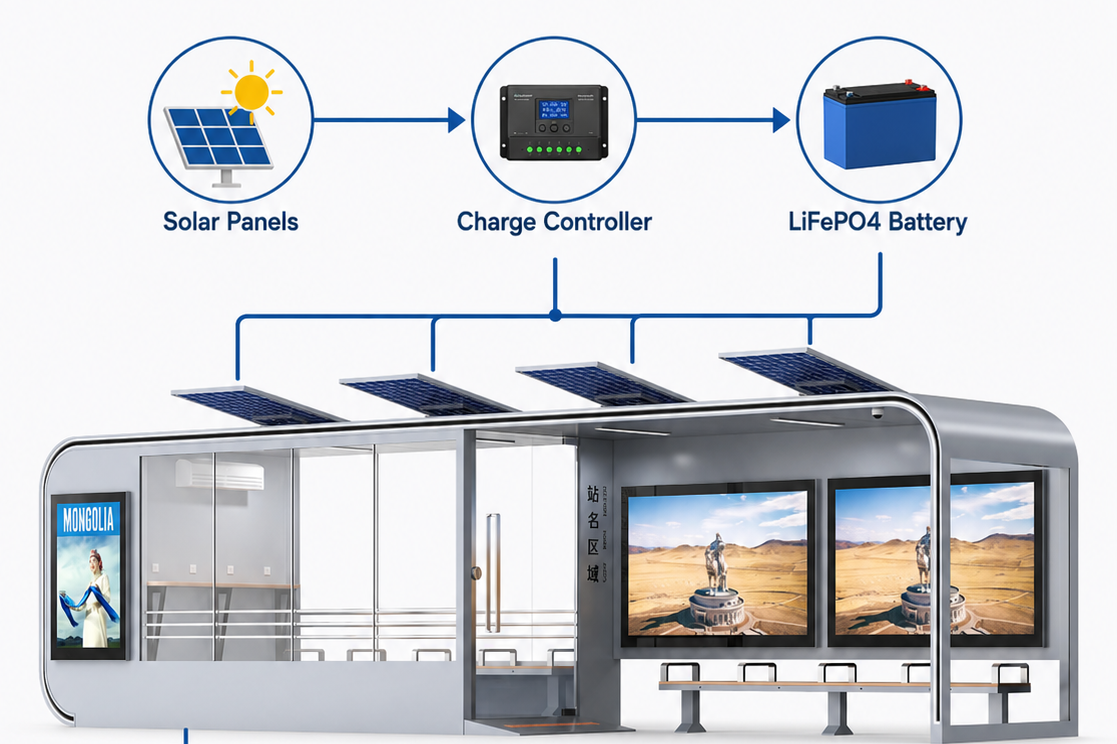
A solar bus shelter can serve as a platform for more than lighting. With the right electrical design, communications strategy, and enclosure protection, it can support a range of city-facing functions.
- Passenger information displays
- Public Wi-Fi equipment
- Outdoor digital advertising screens
- Environmental sensors for temperature, air quality, or noise
- CCTV camera systems
- Emergency call buttons
- Traffic and pedestrian counting sensors
- City branding and tourism information
- QR-based route maps and public-service guidance
For outdoor advertising operators, a solar shelter can also create a more flexible advertising asset. The structure can integrate illuminated poster cases, LCD displays, or digital signage while preserving clear sightlines and comfortable passenger space.
The key is prioritization. A small shelter roof has limited solar collection area. Adding a large display, multiple chargers, cameras, and networking equipment without recalculating the energy budget can lead to poor performance.
The most common planning mistake is choosing solar panels first and defining the loads later. A better approach starts with how the shelter will actually operate.
Create a clear power inventory, including:
- LED lights
- Charging ports
- Digital displays
- Advertising screens
- Cameras
- Routers and communication modules
- Sensors
- Emergency systems
- Control electronics
For each device, identify its wattage, expected daily operating hours, standby consumption, and peak load.
The basic calculation is:
Daily energy demand (Wh)=Power (W)×Operating time (h)
For example, two 15 W LED fixtures running for 10 hours consume:
2×15×10=300 Wh per day
The total design load should include controller losses, battery charging losses, wiring losses, and a safety margin for real-world operation.
A shelter that performs well in summer may fail during winter or extended rainy periods. System design should consider the lowest expected solar resource, not just annual averages.
The local environment also matters:
- Nearby trees and buildings can create shade.
- Dust, snow, leaves, and bird droppings can reduce panel output.
- High temperatures can affect battery and panel performance.
- Coastal sites may require stronger corrosion protection.
- Vandalism risk may affect panel mounting, cable routing, and enclosure design.
A study of photovoltaic bus shelters in Ávila, Spain, highlights that urban shading and surrounding built environments are important factors in assessing solar potential on these types of structures.
Battery autonomy refers to how long the system can support essential loads when solar generation is low. The right number of backup days depends on climate, site importance, and the loads being supported.
For example, a basic lighting-only shelter may require a different reserve capacity from a major transit hub with security cameras, information screens, charging ports, and digital advertising.
When battery capacity falls, the system should not necessarily shut down completely. Smart controls can prioritize critical services.
A practical operating hierarchy could be:
1. Safety lighting.
2. Emergency communication or security systems.
3. Passenger information display.
4. Charging ports.
5. Advertising or nonessential visual features.
This type of power-priority logic protects core passenger functions during periods of low solar generation.
A solar-powered bus shelter is a multidisciplinary product. It combines structural engineering, sheet-metal fabrication, corrosion protection, electrical design, battery integration, outdoor lighting, signage, and public-space usability.
When selecting a manufacturer, buyers should look beyond product photographs and request evidence of production capability, customization process, inspection standards, and project support.
- Can the shelter structure be customized for local dimensions, passenger volume, and accessibility requirements?
- Is the solar system sized from actual loads and local sunlight data?
- What battery chemistry, enclosure protection, and safety controls are used?
- Can the supplier provide structural drawings, wiring diagrams, and component specifications?
- How are solar panels protected from wind, vandalism, and impact?
- Which parts are replaceable during maintenance?
- Can the shelter integrate branding, advertising displays, route maps, and local architectural elements?
- Does the supplier have in-house metal fabrication, coating, electrical testing, and quality-control capability?
- What support is available for installation, commissioning, and after-sales maintenance?
Ainl provides customized solar bus shelter solutions for transport, municipal, commercial, and smart-city projects. With 16 years of manufacturing experience, a large-scale production base, R&D capabilities, CNC sheet-metal processing, coating facilities, and electrical testing resources, the company can support OEM and ODM projects covering shelter dimensions, structural layouts, colors, screens, lighting, solar-power systems, and city-branding elements.
The best solar-powered bus shelter is not the one with the longest feature list. It is the one that delivers dependable service in the actual conditions of its installation site.
Start with passenger needs. Define the required electrical loads. Design for local weather and low-sunlight periods. Specify durable materials. Then integrate smart functions only when the power system, maintenance plan, and project budget can support them.
Ainl can help project owners, transit operators, contractors, and advertising companies develop customized solar bus shelter solutions—from structural design and solar power configuration to lighting, display integration, fabrication, and branded finishes. Contact the Ainl team to discuss your site conditions, technical requirements, and OEM/ODM project goals.
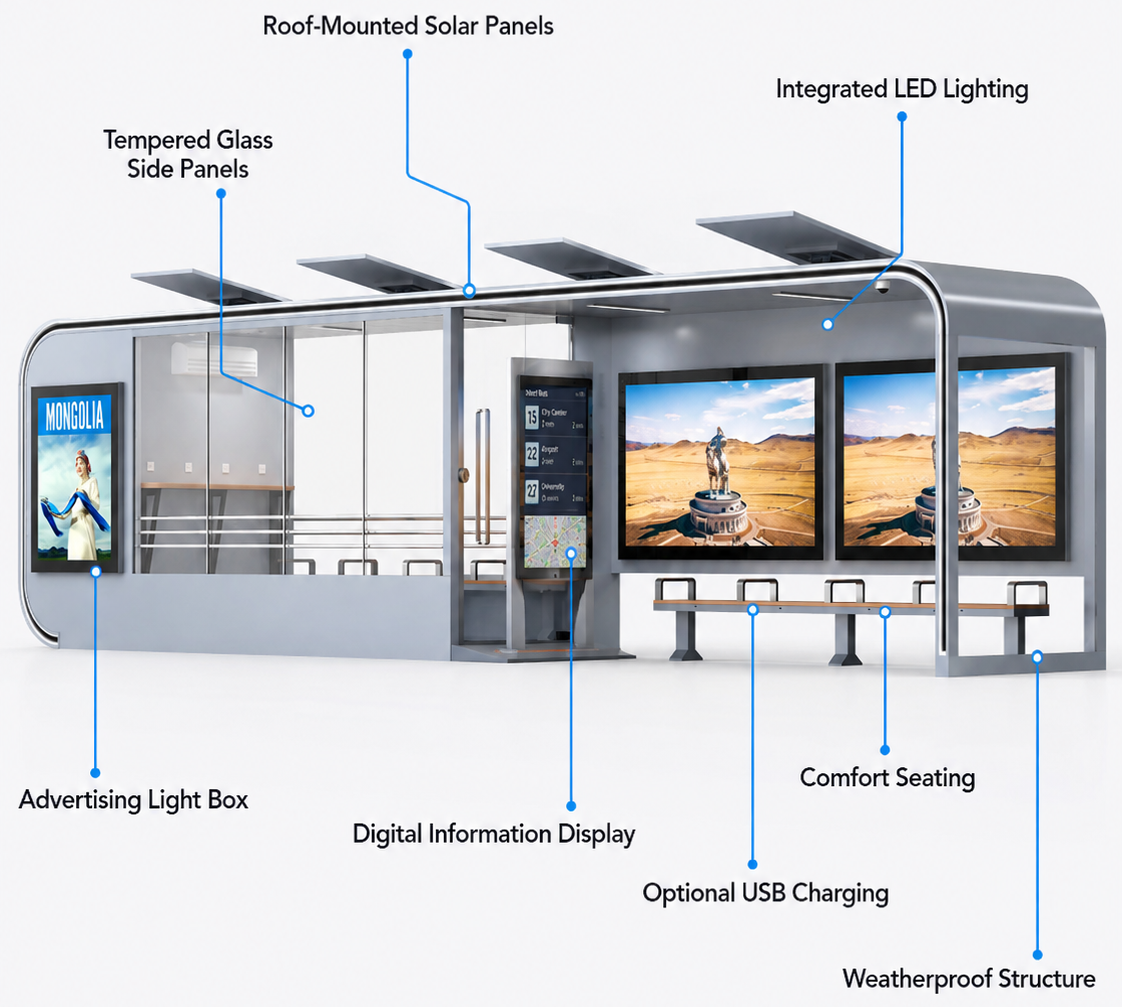
A solar-powered bus shelter uses photovoltaic panels and battery storage to operate selected amenities, such as LED lighting, USB charging ports, passenger information screens, cameras, or digital signage.
Yes, it can operate independently when its solar panels and battery system are correctly sized for the local solar resource and expected electrical load. High-power equipment may require a hybrid or grid-connected design.
Battery runtime depends on total power consumption, battery capacity, weather conditions, seasonal solar availability, and system controls. A lighting-only shelter typically requires less stored energy than one with displays, cameras, charging ports, and advertising equipment.
Yes, but the system must be designed around local weather conditions and low-sunlight periods. This may require larger panels, additional battery capacity, energy-saving controls, or a hybrid power approach.
Common customization options include shelter size, frame material, roof design, colors, seating, glass or panel configuration, lighting, solar-panel arrangement, battery capacity, charging ports, digital screens, advertising displays, route maps, logos, and city-branding graphics.
Yes. Regular checks should cover panel cleanliness, battery condition, lighting performance, charging ports, wiring, controller status, structural fasteners, drainage, glass panels, and protective coatings. Modular components make maintenance and replacement easier.
Yes, but screen power consumption must be carefully calculated. Large or high-brightness displays can require substantial energy, so they may need larger solar arrays, larger batteries, scheduled operation, energy-management controls, or support from the grid.
1. [Handi-Hut — 5 Benefits of Solar-Powered Bus Shelters]
2. [NJ TRANSIT — First Solar-Powered Bus Shelter in Cherry Hill]
3. [National Renewable Energy Laboratory — Life Cycle Greenhouse Gas Emissions from Solar Photovoltaics]
4. [IEA PVPS — Environmental Life Cycle Assessment of Electricity from PV Systems]
5. [MDPI Remote Sensing — Solar Potential Analysis of Bus Shelters in Urban Environments]


