
Email: ainlbusshelter@gmail.com | WhatsApp: +86-18800607527
Views: 298 Author: Ainl Bus Shelter Publish Time: 2026-09-28 Origin: Site


Content Menu
● How the shortlist was assessed
>> 1. Ainl — overseas OEM/ODM option for Portugal
>> 2. Larus Design — Portuguese-made shelters with architectural flexibility
>> 3. Microcubo — site-specific design and metalwork
>> 4. PARTTEAM & OEMKIOSKS — smart-stop technology integration
>> 5. Cabena — municipal street-furniture manufacturing
>> 6. Publifrades — fabrication, kit supply and installation
>> 7. JCDecaux Portugal — advertising-led shelter programmes
● Capacity, MOQ and certification snapshot
● Buyer's guide: from drawing to delivery
>> Specify the shelter before requesting prices
>> Check what "CE" and "RoHS" actually cover
>> Prototype and inspect against a frozen design
>> Protect the order during shipping and installation
● FAQs
>> 1. How can I check whether an ISO certificate has expired or been suspended?
>> 2. Is a CE mark on one component enough for the whole shelter?
>> 3. How do I prevent a material-grade or thickness substitution?
>> 4. Can one prototype prove that a supplier can deliver a citywide programme?
>> 5. What should a smart-shelter warranty cover beyond the frame?
A bus shelter has to do more than keep passengers out of the rain. For a municipality, transport operator, contractor or outdoor advertising company, it is also a long-life structure, a maintenance obligation and, sometimes, a platform for digital services. The right supplier must therefore be able to demonstrate sound fabrication, site-specific engineering and dependable support—not simply present an attractive rendering.
How were suppliers selected? This guide considers evidence of relevant shelter products or projects; manufacturing, design or integration capability; scope for project-specific changes; and the information available to assess quality and delivery. It also identifies what remains unverified. A product catalogue is useful evidence of market participation, but it does not establish annual capacity, a minimum order quantity (MOQ) or compliance for a particular installation.
Portugal is a credible place to begin a European shortlist. Its metalworking sector provides a broader base of fabrication expertise: AICEP, Portugal's trade and investment agency, reported in February 2025 that the sector comprised approximately 15,000 companies, employed more than 200,000 people and generated export revenues above €25 billion. Those are *sector-wide* figures, not bus-shelter sales or a measure of any company in this list. For buyers, proximity to Portuguese project teams, designers and installation sites can also make design review and after-sales coordination easier.
This article covers suppliers serving the Portuguese market, rather than claiming that every company listed manufactures in Portugal. Ainl, presented first as requested, is a China-based OEM/ODM option; the remaining entries illustrate different Portugal-based routes, from locally made shelters to digital integration and advertising-led procurement. "Top" denotes an editorial shortlist by purchasing use case, not a verified ranking by revenue, output or market share.
A useful supplier evaluation begins with the proposed shelter and its installation site. A manufacturer suitable for a small rural stop may not be the right partner for a network of illuminated advertising shelters. Before comparing prices, buyers should apply the same questions to each bid:
| Assessment area | Evidence to request | Why it matters |
|---|---|---|
| Factory and delivery capability | Legal entity, production location, process list, proposed subcontractors, project schedule and references | Separates the contracting party from the firms actually fabricating, coating and installing the shelter |
| Engineering and development | Dimensioned drawings, structural calculations, anchoring details and revision control | Allows the buyer to review the design against local site conditions before production |
| Quality control | Incoming-material records, weld inspections, coating reports, trial-assembly records and final inspection plan | Makes material substitution and assembly problems easier to detect |
| Customization | A written scope for changes to size, layout, materials, branding, screens and power | Distinguishes a genuine engineered variation from a standard model in a different colour |
| Compliance | Documents applicable to the specific structure and electronic modules | Prevents a general certificate from being mistaken for approval of the delivered configuration |
| Lifecycle support | Spare-parts list, access to electrical components, warranty exclusions and replacement-part lead times | Reveals costs and downtime that the initial unit price conceals |
The list below includes companies with different business models. Some offer physical shelter manufacturing; others are more relevant when digital systems, installation or advertising concessions shape the purchase. Buyers should establish who will be contractually responsible for fabrication, conformity documentation, site works and maintenance before treating offers as comparable.
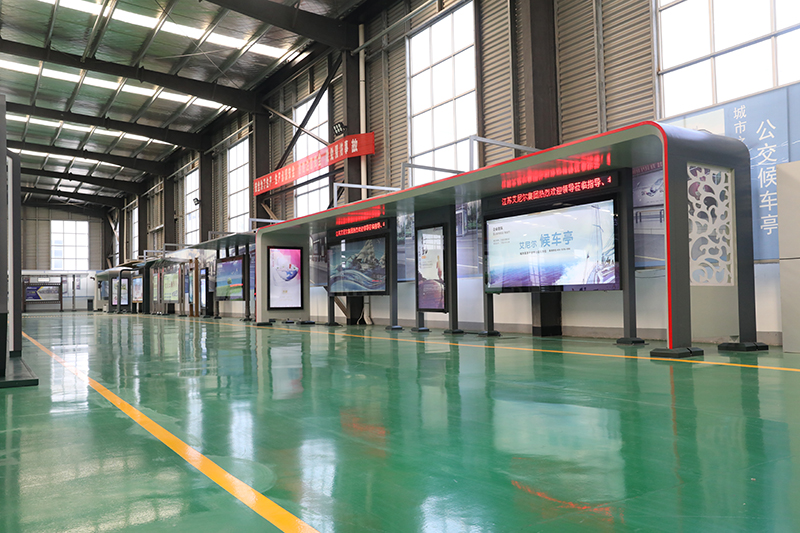
Base: China. Operating history: 16 years, according to the company information supplied for this article. Relevant markets: municipal, transport, commercial and smart-city projects; its current public website addresses international project buyers. Best-fit brief: a customized Bus Shelter or family of shelters requiring coordinated metalwork, seating, lighting, advertising displays and optional digital functions.
Ainl differs from the Portugal-based companies below in an important respect: it is not a Portuguese manufacturer. Its place on this shortlist is as a potential overseas manufacturing partner for Portuguese buyers who can manage importation, local design approval and installation. Presenting it as a domestic factory would mislead a buyer comparing local-content requirements or delivery arrangements.
The company information provided for this article describes approximately 150,000 m² of factory space, research and development facilities, CNC sheet-metal processing, coating capacity and an electrical testing laboratory. It also describes construction-related qualifications and management-system certifications. These are meaningful due-diligence leads, not independently verified production or certification claims in this guide. Buyers should request the current legal-entity documents, certificate numbers and scopes, a factory-process map, and evidence that the quoted production line has available capacity.
Ainl's published product range includes bus shelters, smart bus-stop signs and outdoor LED/LCD advertising displays. Its stated customization scope covers structure and dimensions, colour, glazing and seating layout, lighting, screens, solar options, city branding and installation details. That breadth may be useful to a smaller contractor or regional brand that wants one supplier to develop a coherent product family rather than coordinate separate shelter and display vendors. The practical test of flexibility is whether Ainl provides timely drawing revisions, named engineering contacts and a clear record of who approves each change.
For a Portugal-bound order, request a sample or trial assembly, component-level documentation, Portuguese or English installation instructions as required by the project, and an agreed local service plan. Any claim of a lower purchase price should be assessed against freight, duties, taxes, customs administration, site adaptation and replacement-part logistics—not accepted as a demonstrated total-cost advantage.
Base: Albergaria-a-Velha, Portugal. Founded: 1988. Relevant markets: Portuguese and international public-space projects, working with municipalities, architects and other public-sector stakeholders. Best-fit brief: a shelter that must sit within a wider, visually consistent street-furniture scheme.
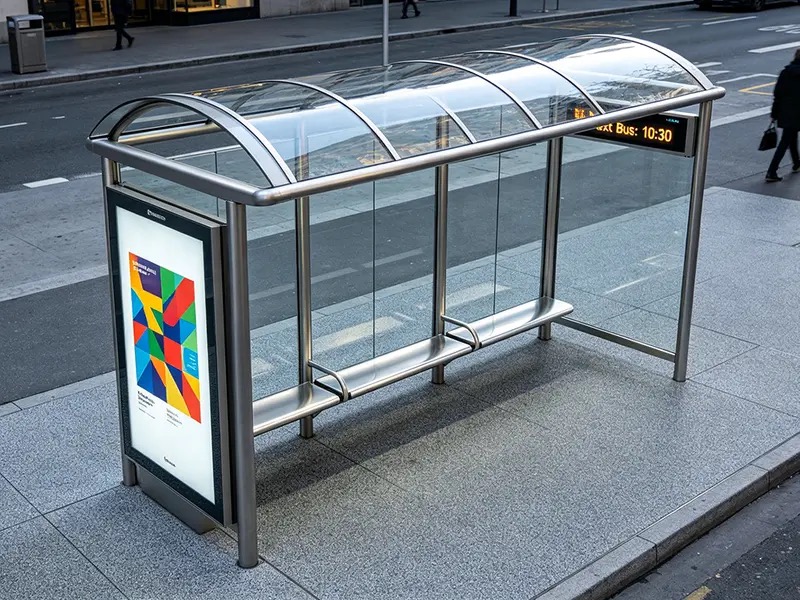
Larus says it designs and produces street furniture in Portugal. Its shelter range uses steel and tempered glass, with options including integrated seating, side panels and advertising displays. The company states that models can be adapted in dimensions, finish and configuration. This makes it worth examining where streetscape appearance matters as much as the basic waiting function—for example, where a transit stop shares a material palette with nearby benches and signage.
For a tender, ask which elements are standard and which require new engineering. A change to roof span, glass arrangement or support positions may affect the structural design and installation method. Obtain a drawing and priced bill of materials for the exact variant, rather than assuming the catalogue model's documentation covers a customized one. Published annual shelter output, MOQ and project-specific certifications should be confirmed directly.
Base: Porto district, Portugal. Active in the Portuguese market since: September 2012. Relevant market evidence: Portuguese municipal work; additional export markets for shelters should be confirmed directly. Best-fit brief: a passenger shelter designed as part of a location-specific public-space improvement.
Microcubo works across street furniture, construction and metalwork and describes a project-by-project approach to customization. Its Lusitano Shelter is a useful case to examine because the company states that Viana do Castelo selected the solution for a programme replacing 80 passenger shelters. That is evidence of a cited municipal application, although buyers should still request a reference covering the exact scope, delivery responsibilities and post-installation performance relevant to their own tender.
Microcubo may appeal to buyers who need a design response to a particular street or neighbourhood rather than a repeated catalogue unit. In the request for quotation, define accessibility clearances, sightlines, bench position, passenger information and maintenance access. Ask who prepares structural calculations and foundations for each site, particularly if several stops have different pavements or exposure conditions. Public information reviewed here does not establish annual shelter capacity or MOQ.
Base: Portugal. Founded: 2000, according to its company information. Relevant markets: the company describes international activity in kiosks and digital solutions; shelter-specific reference locations and responsibilities should be checked. Best-fit brief: a stop where information displays, ticketing interfaces or connected services are central to the project.
PARTTEAM & OEMKIOSKS presents smart stops and shelters alongside self-service bus ticketing and digital-signage products. Its described functions include displays, LED lighting, Wi-Fi, emergency signalling, USB charging, air-monitoring options, solar panels and remote content management. The value proposition is therefore different from that of a shelter supplier focused principally on metalwork: the buyer may be evaluating software operation and field maintenance as much as the physical canopy.
Clarify whether the company will supply and warrant the complete shelter, only the electronic assemblies, or a package involving other fabricators. Require an interface document identifying the enclosure supplier, display ownership, connectivity costs, software support period, cybersecurity responsibilities and procedure when the network is unavailable. Ask for a live demonstration using the proposed information source; a screen working with test content is not proof that real-time transit data will work at launch.
Base: Benavente, Portugal. Established: the company states that it has served the public sector for 44 years; buyers should verify the precise incorporation date if the tender requires it. Relevant market: Portuguese municipalities. Best-fit brief: conventional passenger shelters purchased with other municipal street-furniture items.
Cabena describes its activities as designing, manufacturing and selling street furniture and public-service equipment. Its Citymob range includes passenger shelters. One published shelter specification describes an 80 mm square-section galvanized steel structure with polyester-resin coating and 8 mm tempered-glass panels. That makes Cabena particularly relevant to a buyer who wants to examine an identifiable construction specification, rather than start from a promotional image. The specification belongs to that model; it should not be assumed for Cabena's entire range.
Ask for the current model drawing, coating specification, glass documentation, spare-panel availability and installation method. If the bid allows equivalent products, specify measurable requirements such as steel section, finish and glazing performance so alternatives can be evaluated consistently. Annual shelter output, MOQ and current certificates need direct confirmation.
Base: Portugal. Founding year: not established from the public material reviewed. Relevant market: public-transport passenger shelters; geographic reach beyond documented activity should be confirmed. Best-fit brief: a rural or urban shelter requiring a straightforward fabrication-and-installation discussion.
Publifrades states that it designs, produces and installs passenger shelters. It presents rural and urban examples using combinations of metal, glass, wood and transparent materials; says it has an 800 m² area dedicated to metalworking; and describes both installation teams and the possibility of kit supply. These details are useful for a buyer deciding whether to procure delivered-and-installed units or coordinate installation through a local contractor. An 800 m² production area, however, is not an annual capacity figure.
Its stated in-house model-development function suggests scope for design changes. Request confirmation of the limits: a different roof material may be manageable within an existing design, while a longer unsupported span or new foundation arrangement needs documented engineering review. Check what the kit price includes—especially anchors, glazing fixings, lifting points and site instructions—before comparing it with an installed quotation.
Base of Portuguese operation: Portugal; part of an international group. Founding-year distinction: the group and the Portuguese legal entity should not be treated as having the same establishment date. Relevant market: Portuguese outdoor advertising and street-furniture networks. Best-fit brief: a municipality or media buyer evaluating shelters through a concession or advertising-funded operating model, rather than a conventional factory purchase.
JCDecaux Portugal lists bus shelters among its street-furniture advertising formats. A company release concerning Lisbon describes a concession involving a planned programme of 2,000 shelters and other street-furniture assets. That is evidence of the scale of a *programme*, not evidence that a factory in Portugal manufactures 2,000 shelters per year, or that every unit had been installed when the release appeared.
Include JCDecaux in an evaluation only when the procurement model fits. A concession can involve different ownership, advertising rights, maintenance duties and contract durations from an outright purchase. Ask which party selects the design, owns the structure, pays for power and replacement parts, handles vandalism, and removes or transfers assets at the end of the agreement. OEM/ODM manufacturing scope and local production responsibility should not be assumed from its advertising network.
A comparison table is only useful if its unknowns remain visible. The figures below are publicly identified evidence, not independently audited capacity or certification records. "Not published" is a prompt for an RFQ response, not a negative finding.
| Supplier | Role and production evidence | Annual shelter capacity | Shelter MOQ | Certification position for buyer |
|---|---|---|---|---|
| Ainl | China-based manufacturer; company-provided brief states approximately 150,000 m² of factory space | Not independently verified | Request quotation | Obtain current management-system documents and configuration-specific compliance evidence |
| Larus Design | States shelters are manufactured in Portugal | Not published | Request quotation | Request certificates and technical file applicable to the selected model |
| Microcubo | Street-furniture and metalwork activity; cites an 80-shelter municipal renewal project | Not published | Request quotation | Verify certificates and site-specific engineering documents |
| PARTTEAM & OEMKIOSKS | Portuguese digital-equipment manufacturer offering smart-stop solutions | Shelter-specific output not published | Request quotation | Check both structural and electronic-module documentation, and identify responsible suppliers |
| Cabena | States it manufactures street furniture; publishes a shelter-model material specification | Not published | Request quotation | Request current certificates, material records and model-specific documents |
| Publifrades | States it designs, produces and installs shelters; identifies 800 m² of metalworking area | Not published | Request quotation | Request current certificates and inspection records for the proposed build |
| JCDecaux Portugal | Advertising and street-furniture programme operator; production role depends on contract | Not established from programme size | Contract-dependent | Review concession terms and the actual product manufacturer's documentation |
None of the published information above justifies inventing a units-per-month figure or a "1-set MOQ" for all models. In an RFQ, request separate figures for prototype quantity, first production batch, repeat-order MOQ and realistic output during the proposed delivery window. A supplier may accept one sample yet require a larger run for a custom finish, screen enclosure or replacement glazing.
Give every bidder the same site pack: shelter count and locations, target dimensions, passenger flow, available pavement width, required clear route, roof drainage direction, utility access, ground conditions and any advertising or digital functions. State whether the supplier is pricing design, foundations, delivery, lifting, installation and commissioning. Otherwise, a low factory-gate quote and a fully installed quote can appear comparable when they are not.
Material descriptions should be precise. "Stainless steel," "galvanized steel" and "safety glass" are categories, not complete specifications. Require the proposed steel or aluminium grade and thickness; treatment of welds and cut edges; coating system; glass type and thickness; roof material; fastener specification; and test or inspection records tied to the delivered batch. For a coastal site, have the design team review corrosion exposure and specify suitable protection rather than assuming a finish that performs inland will last equally well by the sea.
The same applies to structural and electrical requirements. Ask an appropriately qualified professional to review wind actions, loading assumptions, connections, anchors and foundations for the actual site and configuration. For lighting or screens, define ingress protection, cable routing, isolation, access for maintenance and who commissions the supply. Solar power needs an energy-budget calculation using the planned equipment and operating schedule; a panel in a rendering does not demonstrate that a display will run through a low-sun period.
Do not treat "CE-certified Bus Shelter" as a complete answer. The European Commission states that CE marking is compulsory only where applicable EU legislation requires it, and must not be affixed to products outside that scope. For construction products, the applicable harmonised specification or assessment route determines the required performance documentation; structural-component requirements may need a separate review from those for a screen or luminaire. RoHS addresses restricted substances in electrical and electronic equipment—not a blanket environmental certificate for an entire steel-and-glass shelter.
Ask the bidder for a compliance matrix listing every supplied item, its manufacturer, applicable rules, declaration or test evidence, and the entity responsible for placing it on the Portuguese market. This is especially important for a shelter assembled from an imported frame, locally sourced glazing and third-party electronics. The project team should confirm the applicable legal route for its particular product and tender; neither a logo nor a generic PDF replaces that assessment.
A practical approval sequence is: agree a dimensioned drawing and bill of materials; review a finish and glazing sample; approve an electrical layout if relevant; inspect a prototype or first-article assembly; then authorize the production batch. Record every approved deviation in a revision-controlled document. Inspect at least the attributes that would be expensive to correct on site: mounting dimensions, roof drainage, fit of replaceable panels, advertising-frame access and packing method.
The easily missed pitfall is interface ownership. A frame, glass panel and display may each pass inspection separately, yet fail together when the glazed panel cannot be removed without disconnecting the screen—or the replacement glass can only be fitted after lifting off the roof. Before accepting the prototype, ask the team to perform a *timed service exercise*: replace one panel, open the electrical enclosure, inspect the drainage route and reassemble the shelter using the proposed site tools. Record who supplies each replacement part and who pays for a return visit if interfaces do not match. This is a proposed purchasing test, not a claim that every supplier has the problem.
For imported shelters, establish the agreed Incoterm, named delivery point, packaging design, crate dimensions, lifting method, insurance responsibility and customs-document owner before paying a deposit. Request a packing list that maps every component to the installation drawing; label left- and right-hand parts unambiguously. Agree which party will resolve damage discovered when crates are opened and how quickly replacement glazing or electronics can arrive.
For Portuguese or overseas supply alike, distinguish factory acceptance from site acceptance. A unit can leave the workshop correctly assembled and still encounter an unsuitable foundation, blocked door swing, poor drainage connection or power location on site. Assign responsibility for the survey, permit checks, civil works, final anchoring, electrical connection and commissioning in the contract—not in an email after the shipment departs.
There is no single right supplier for every Portuguese bus-stop project. Start with the procurement model: a locally made architectural shelter, a site-specific municipal design, a digital information stop, an advertising concession, or an imported OEM/ODM programme with local engineering and installation support. Then compare bidders against the same drawings, evidence requests and total delivered scope.
For a customized Bus Shelter brief, invite Ainl and suitable Portugal-based suppliers to quote against one identical specification. Ask each to identify its actual manufacturing role, proposed materials, design responsibilities, available capacity, MOQ, compliance route, prototype plan and after-sales support. That process offers a more defensible decision than a ranking based on catalogue images or an unverified price claim.

Request the complete certificate showing the legal entity, site, scope, certificate number, certification body and dates. Compare those details with the contracting entity and the processes relevant to your order; a certificate for sales activities at one address does not, by itself, verify fabrication at another. ISO advises buyers to check an accredited certificate through IAF CertSearch or contact the certification or accreditation body directly. For Portuguese entities, the Portuguese accreditation body IPAC also provides accreditation and certified-company resources. ISO itself does not issue certificates.
No. Determine which rules apply to each relevant product and assembly, then request documentation for the delivered configuration. A display's paperwork does not establish the structural performance of its supporting shelter; likewise, structural documentation does not settle electrical conformity. The need for CE marking depends on the applicable legislation, rather than on a seller's general description of the product.
Make the approved bill of materials contractual and identify grades, nominal dimensions, tolerances and finishes on the drawings. Require traceable purchase records and incoming checks for critical items, then agree inspection hold points before coating or glazing conceals them. If alternatives are permitted, require written engineering approval *before* use and an updated drawing, price and warranty statement. A photograph of finished shelters alone cannot verify hidden steel thickness or substrate preparation.
It proves only that the agreed prototype can be made. For a network rollout, ask for a capacity plan by process, named subcontractors, batch inspection criteria, a realistic production schedule and a pilot installation at a representative site. Approve the next batch after checking installation time, passenger accessibility, drainage, spare-part fit and any digital service under operating conditions. The cited 80-shelter Microcubo project, for example, is relevant reference evidence, but a new buyer should still assess its own design and delivery requirements.
Separate warranty terms for the structure, coating, glazing, display, power supply, batteries where used, communications hardware and software support. Define response and replacement times, remote-monitoring obligations, data or connectivity charges, and what happens if a component reaches end of life before the shelter does. Require a wiring diagram and an accessible replacement procedure; otherwise, the least durable electronic module may determine the operating cost of the entire stop.
- [AICEP: Metalworking moulds Portugal's growth (February 2025)] — Portuguese sector-wide export and employment context. [portugalglobal]
- [Eurostat: International trade in goods database] — official trade data for further product- and country-level research; it is not presented here as a bus-shelter market-size estimate. [ec.europa]
- [European Commission: CE marking] and [Construction Products Regulation] — starting points for assessing applicable product rules. [single-market-economy.ec.europa]
- [European Commission: RoHS Directive] — rules relevant to electrical and electronic equipment. [environment.ec.europa]
- [ISO: How to verify certification] and [IPAC: accredited entities] — certificate-checking routes. [iso]


