
Email: ainlbusshelter@gmail.com | WhatsApp: +86-18800607527
Views: 298 Author: Ainl Bus Shelter Publish Time: 2026-10-05 Origin: Site


Content Menu
● How We Evaluate Bus Shelter Manufacturers and Suppliers
>> 1. Manufacturing Capability and Factory Verification
>> 2. Engineering and Product Development
>> 3. Quality Control and Material Documentation
>> 4. Compliance and Certificate Scope
>> 5. Delivery and Long-Term Support
● Why Source Bus Shelters from Italy?
>> What Recent Industry Data Actually Shows
● Five Bus Shelter Suppliers to Consider for Italian Projects
>> 1. Ainl — China-Based OEM/ODM Alternative for Italian Buyers
>>> Company Background and Manufacturing Infrastructure
>>> Core Strengths and Customization Scope
>>> Qualifications and Verification Priorities
>>> Main Markets and Best-Fit Buyers
>> 2. Metalco — Architectural Bus Shelters and Project-Specific Design
>>> Core Strengths
>>> Customization and Project Evidence
>>> Main Markets and Best-Fit Buyers
>> 3. City Design — Serial Urban Furniture with Personalization Options
>>> Core Strengths
>>> Main Markets and Best-Fit Buyers
>> 4. Bellitalia — Concrete and Stone-Aggregate Shelter Solutions
>>> Core Strengths
>>> Customization and Engineering Questions
>>> Main Markets and Best-Fit Buyers
>> 5. Dimcar — Municipal Urban Furniture and Customized Shelter Projects
>>> Core Strengths
>>> Environmental Documentation
● Supplier Comparison: Capacity, MOQ, and Certification Transparency
● Technical Buyer's Guide: Specify the Shelter Before Comparing Prices
>> Materials: Replace Generic Labels with Measurable Requirements
>> Coating: Ask About the Process Sequence
>> Structural and European Compliance
>> Electrical Equipment, Displays, and Solar Systems
● Common Procurement Traps and How to Avoid Them
>> Trap 1: A Correct Sample Followed by Material Substitution
>> Trap 2: An Attractive Price That Excludes Essential Work
>> Trap 3: Compliance Documents for the Wrong Configuration
>> The Overlooked Interface Trap: Who Owns the Anchor Layout?
● Samples, Logistics, and Repeat-Order Planning
>> Use a Prototype to Test Assembly, Not Just Appearance
>> Compare Landed and Installed Cost
>> 1. How Can We Verify Whether a Supplier's ISO Certificate Has Expired?
>> 2. Does Every Bus Shelter Need CE Marking?
>> 3. Can a Factory Reuse Structural Calculations After Increasing Shelter Length?
>> 4. What Evidence Should We Request for Coastal Corrosion Resistance?
>> 5. How Do We Prevent Obsolete Components from Making Shelters Difficult to Maintain?
Choosing a bus shelter supplier is not simply a matter of comparing designs and unit prices. For procurement managers, the more important questions concern structural reliability, manufacturing consistency, documentation, installation support, and the availability of replacement parts.
Italy offers established manufacturers of urban furniture, architectural shelters, and coordinated public-space products. Buyers can source everything from steel-and-glass bus stop shelters to concrete-based structures designed to complement premium streetscapes.
However, an Italian supplier is not automatically the right choice for every project. Municipal contractors, advertising operators, and smaller urban-furniture brands may also benefit from comparing Italian manufacturers with an international OEM partner.

A useful supplier shortlist should go beyond attractive product photography.
The following criteria provide a practical framework for evaluating manufacturers before committing to a sample or production order.
Buyers should establish whether the company manufactures the shelter, outsources key processes, or primarily distributes another producer's products.
Important questions include:
- Where are cutting, welding, coating, and assembly performed?
- Which operations are subcontracted?
- Can the supplier identify the factory responsible for the quoted product?
- Does the proposed delivery schedule account for existing orders?
- Can production records connect finished shelters to material batches?
Factory floor area can indicate infrastructure, but it does not establish monthly bus shelter output. Actual capacity depends on product complexity, coating schedules, staffing, and component availability.
A shelter must suit its installation environment, not merely its catalogue description.
Evaluate whether the supplier can provide project-specific drawings, foundation interfaces, drainage details, electrical layouts, and an agreed route for structural verification.
For digital bus shelters, also investigate service access, heat management, display replacement, and the separation of electrical equipment from water paths.
A credible quality plan should identify inspection stages and acceptance criteria.
For example, procurement specifications can require:
- Incoming material identification.
- Dimensional checks before coating.
- Welding inspection appropriate to the project.
- Coating inspection and recorded acceptance results.
- Glass identification and supporting documentation.
- Electrical testing for powered configurations.
- Final assembly checks against approved drawings.
Do not accept "strict quality control" as a substitute for an actual inspection and test plan.
Company management certificates and product conformity documents serve different purposes.
An ISO management-system certificate does not prove that a particular bus shelter meets structural, electrical, or installation requirements. Similarly, a CE logo is not a universal quality award.
European Commission guidance states that CE marking applies only where relevant harmonized EU legislation requires it. Buyers must determine the correct conformity route for the actual product and configuration.
Ask suppliers to separate design approval, prototype production, batch manufacturing, shipping, and installation responsibilities.
For repeat projects, evaluate spare-part continuity and change-control procedures. A supplier that silently changes hinges, glass dimensions, or display mounting points can create significant maintenance problems across a shelter network.
Italy's relevant advantage lies in the combination of urban design, material expertise, and established public-space product manufacturers.
The shortlisted Italian businesses illustrate two geographic concentrations rather than a single formally defined bus shelter industrial cluster:
- Veneto and northeastern Italy: Metalco and City Design are based in Castelminio di Resana, while Bellitalia is based in Ponte nelle Alpi.
- Apulia and southern Italy: Dimcar describes its origins in the region and its development from craftsmanship into industrial urban-furniture production.
These locations give buyers access to manufacturers with different approaches to steel structures, coordinated street furniture, and concrete-based products.
Italy's Ministry of Foreign Affairs reported that goods exports reached EUR 591.3 billion during the first eleven months of 2025, up 3.1% in value compared with the corresponding period of 2024. Basic metals and fabricated metal products, excluding machinery and equipment, recorded export growth of 8.4%.
These figures provide context for Italy's wider manufacturing and export base. They are not bus shelter market figures and should not be presented as evidence of shelter sales growth.
For a more detailed official research route, Istat's 2026 foreign-trade yearbook provides information updated to 2025, while its foreign-trade resources direct users to official trade databases. A defensible bus shelter export analysis would require identifying appropriate customs classifications and separating shelters from other metal structures.
For procurement managers, the practical lesson is straightforward: use national data to understand the sourcing environment, but use supplier-specific records to assess delivery capability.
Ainl is a Chinese manufacturer and solutions provider specializing in bus stop shelters, smart-city public facilities, and outdoor advertising products.
It is included first as an international sourcing alternative, not as an Italian manufacturer.
According to the company information supplied for this article, Ainl has 16 years of industry experience. Its exact legal incorporation year should be confirmed through corporate registration documents rather than calculated from the experience claim.
The supplied profile describes:
- A site exceeding 260 Chinese mu.
- Approximately 150,000 square meters of factory buildings.
- A provincial-level software and hardware research center.
- CNC sheet-metal processing facilities.
- A large coating center.
- An electrical testing laboratory.
These are company-supplied infrastructure claims, not independently verified bus shelter production figures.
Ainl's stated customization scope includes shelter dimensions, structural configurations, colors, screens, lighting, solar power arrangements, and city-branding elements.
This breadth makes it relevant to buyers who need more than a standard catalogue model.
Potential purchasing scenarios include:
- Smaller urban-furniture brands developing a distinct product range.
- Advertising operators requiring integrated display arrangements.
- Contractors standardizing shelters across multiple sites.
- Municipal projects combining passenger facilities with digital equipment.
Ainl's positioning is most useful when the buyer values engineering flexibility and direct OEM coordination. However, lower cost, faster communication, and suitability for small orders should be tested through an actual quotation and pilot project, not assumed.
The supplied profile states that Ainl is a national high-tech enterprise and holds Grade III steel-structure and municipal-construction contracting qualifications, three-system certification, and Level III safety-production standardization certification.
Buyers should request the exact certificate names, standards, legal entity, issuing organizations, expiry dates, and covered locations.
Chinese qualifications do not automatically establish conformity for a shelter installed in Italy. The project still needs the applicable European product documentation and local engineering approvals.
Ainl's supplied information identifies transportation, municipal, commercial, and smart-city projects as its application sectors. A verified geographic sales breakdown was not available.
For an Italian buyer, Ainl is worth evaluating when extensive customization and total landed cost are central considerations. Begin with a technical brief, document review, and prototype approval before committing to volume production.
Metalco's official history dates its establishment to 1984. Its product range covers urban furniture, including bus shelters, and its history emphasizes industrial development and design-led production.
Metalco is particularly relevant to projects where the shelter must fit a wider architectural language.
Its HUT shelter combines a steel-tube load-bearing frame and roof with a rear wall of laminated glass panels. Its SELF model uses an arch-shaped steel structure supported by monolithic reconstituted-stone elements that also function as seating.
These examples show materially different design approaches rather than interchangeable versions of a generic shelter.
Metalco's published Gorizia terminal project describes the supply of HUT shelters and confirms that a customized version was developed to meet the designers' requirements. This is useful evidence of project-specific adaptation.
However, architectural customization should not be confused with unrestricted private-label manufacturing. Buyers should confirm ownership of drawings, permitted branding changes, and any restrictions on modifying established product designs.
Metalco documents an Italian terminal installation and describes a globally recognized design presence. It is a relevant candidate for architect-led public-space projects and coordinated urban-furniture procurement.
Before ordering, request model-specific structural documentation, finish specifications, installation drawings, and a replacement-parts proposal.
City Design's official website states that the brand was created in 1992 and has completed projects in Italy and abroad. Its base is in Castelminio di Resana, in the province of Treviso.
City Design describes a serial-manufacturing approach with personalization options. This makes it relevant to buyers seeking repeatable urban-furniture products rather than an entirely new design for every installation.
Its STAD shelter uses cantilevered square-steel-tube columns, steel-sheet base plates, and a steel-sheet cover. Buyers can use this published configuration as a starting point for discussing layout, foundations, finishes, and site suitability.
The commercially important distinction is between permitted personalization and structural redesign.
Ask which options are available within the standard product family:
- Color and finish.
- Shelter length or module count.
- Side and rear panels.
- Seating configuration.
- Signage or branding interfaces.
Do not assume that every option is available for every model. Display systems, solar equipment, and private-label branding require separate confirmation.
The company identifies projects in Italy and abroad. Its serial-product approach is relevant to municipalities and contractors seeking consistency across multiple installations.
For larger rollouts, request a fixed bill of materials and written notification requirements for future component changes.
Bellitalia's official history places its origins in the 1960s as a producer of concrete construction products. It moved into urban furniture during the 1980s. The reviewed official source does not establish a precise incorporation year.
Bellitalia offers a distinctive sourcing option for projects where concrete and natural stone aggregates are important to the visual and material specification.
Its history records the introduction of the "precious stones" range in 2006 and the development of its UTC concrete formula in 2015. Those milestones describe the company's broader materials development; they should not be treated as specifications for every shelter.
Its Magnum Evolution L canopy is described as using a base made from reconstituted precious stones or reconstituted granite stones, with a leveling base.
Buyers should investigate available aggregate finishes, layout options, metalwork configurations, and compatibility with adjacent street furniture.
Do not infer open-ended OEM or private-label services from the presence of multiple product finishes. Any bespoke design scope needs written confirmation.
Concrete-based shelter components also require early discussion of transport weights, lifting points, unloading equipment, and site access. These items belong in the quotation, not in an installation-day improvisation.
Bellitalia describes installations in Italy and abroad and an export history extending back to its urban-furniture development. It is relevant to public spaces where material identity and coordinated landscaping products influence the purchasing decision.
Dimcar's official company page uses "Since 1974" and presents a 1974–2025 history. The same page also describes its southern Italian origins more generally, so buyers needing an exact legal founding date should verify registration records.
Dimcar manufactures urban furniture and offers a dedicated bus shelter range for urban and extra-urban stops, schools, stations, parking areas, and other public spaces.
Its company profile states that it operates in Italian and international markets and serves more than 4,000 municipalities. This is a company-reported figure, not an independently audited customer count.
Dimcar describes a team involving designers, engineers, technicians, and production personnel, with customized solutions for public-space projects.
For shelter procurement, establish the exact scope of available adaptation:
- Site-specific dimensions.
- Panel arrangements.
- Seating and passenger-information interfaces.
- Finishes and branding.
- Electrical integration, where offered.
Catalogue breadth does not by itself prove that all configurations share the same structural assessment or conformity documentation.
Dimcar's website promotes DNSH, EPD, and public-procurement-related environmental compliance. Buyers should request the underlying documents and determine which products they cover.
An environmental declaration for one product family should not be assumed to cover an unrelated shelter configuration.
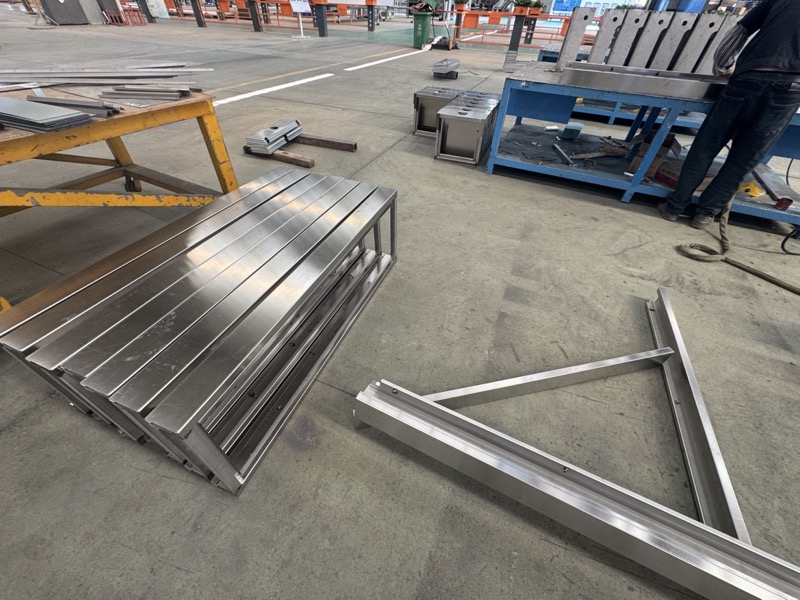
The comparison below distinguishes published information from items requiring a quotation or document review.
"Not disclosed" means no dependable figure was established from the reviewed material. It does not mean the supplier lacks capacity or certificates.
| Supplier | Location and history | Manufacturing capacity evidence | Bus shelter MOQ | Certification or compliance evidence | Primary sourcing focus |
|---|---|---|---|---|---|
| Ainl | China; 16 years' experience according to supplied profile; legal founding year unverified | Approximately 150,000 m² of factory buildings claimed; shelter output not verified | Not supplied; request prototype and batch thresholds | High-tech status, contracting qualifications, and system/safety certifications claimed; verify documents | Deep OEM/ODM customization and integrated smart-city facilities |
| Metalco | Italy; established in 1984 | Industrial production described; shelter units per month not disclosed | Not disclosed | Request current certificates and model-specific conformity package | Architectural shelters and customized public-space projects |
| City Design | Italy; brand created in 1992 | Serial-manufacturing approach described; shelter throughput not disclosed | Not disclosed | Request certificates applicable to the manufacturing site and ordered configuration | Repeatable product families with personalization |
| Bellitalia | Italy; origins in the 1960s | Established concrete-materials production; shelter output not disclosed | Not disclosed | Request relevant material, structural, and conformity documentation | Concrete and stone-aggregate public-space solutions |
| Dimcar | Italy; official history states "Since 1974" | Manufacturing capability described; verified shelter throughput not disclosed | Not disclosed | Environmental claims published; check product scope and current certificates | Municipal shelter ranges and customized urban furniture |
The Italian supplier descriptions in this table derive from their published histories, company profiles, and product pages. None provides a dependable shelter-specific MOQ or directly comparable monthly output figure in the material reviewed.
"Galvanized steel" and "stainless steel" are incomplete purchasing specifications.
The purchase specification should identify the required material grade, section dimensions, wall thickness, surface treatment, and supporting material records.
For coastal or heavily polluted sites, ask the designer and manufacturer to justify the selected material and corrosion-protection system against the actual exposure conditions.
For glass, define the required construction, thickness, dimensions, edge treatment, and evidence of suitability. Do not accept a substitution solely because the replacement panel looks similar.
A quoted "powder-coated finish" does not explain how the underlying steel was prepared or protected.
Require the supplier to describe:
1. Fabrication sequence.
2. Surface preparation.
3. Galvanizing or other corrosion-protection treatment.
4. Coating application.
5. Inspection and repair procedures.
6. Treatment of site modifications.
The acceptance criteria should address difficult areas such as edges, welded joints, concealed surfaces, and damaged coating around installation interfaces.
For structural steel or aluminum components placed on the European market as construction products, EN 1090-1 may form part of the applicable conformity route. RINA describes factory production control, welding requirements, and structural calculations as relevant elements of this framework. Applicability must be established for the actual product and intended use.
For an Italian project, obtain a written responsibility matrix covering:
- Shelter structural calculations.
- Site wind and snow conditions.
- Foundation and anchor design.
- Ground conditions.
- Required permits and local approvals.
- Product documentation and installation inspection.
Do not assume the shelter supplier's calculations automatically cover the foundations.
A smart bus shelter requires a separate review of its electrical and electronic configuration.
The European Commission's RoHS guidance concerns restricted substances in electrical and electronic equipment. It is not a blanket environmental certificate for an unpowered steel shelter. Specific exclusions and exemptions also require assessment.
For powered configurations, request a document matrix identifying the rules applicable to lighting, screens, controls, wireless devices, batteries, and the assembled installation.
For solar options, require an energy balance using the proposed location, operating hours, display consumption, lighting load, and maintenance assumptions. A panel wattage alone does not prove autonomous operation.
A prototype may match the approved specification while later batches use different sections, hardware, or coatings.
Prevention measures include:
- Approving a controlled bill of materials.
- Requiring written authorization for substitutions.
- Checking batch-linked material records.
- Including pre-shipment inspection rights.
- Retaining an agreed reference sample or finish panel.
A low shelter price may exclude foundations, anchor assemblies, wiring, unloading, or installation supervision.
Issue the same scope sheet to every supplier. Separate equipment price from logistics, civil works, commissioning, and maintenance.
A certificate or report may cover a different factory, product family, steel structure, or electrical assembly.
Check the legal entity, manufacturing site, model, issue date, scope, and connection to the ordered design.
A frequently overlooked purchasing risk is the interface between shelter fabrication and civil works.
The shelter manufacturer may supply a base-plate drawing, while the site contractor orders anchors and pours foundations before the drawing reaches final approval.
Even a correctly manufactured shelter can then arrive at an incompatible site.
Avoid this by making the approved foundation interface a production-release document. It should identify:
- Final anchor coordinates.
- Base-plate orientation.
- Finished ground level.
- Required clearances.
- Cable entry locations.
- Drainage relationships.
- Permitted installation adjustments.
Assign one party responsibility for coordinating the manufacturer, structural designer, and civil contractor. This is often more valuable than negotiating a small discount on the shelter itself.
A practical approval process has three stages:
1. Drawing review: confirm layout, interfaces, materials, and responsibilities.
2. Prototype review: assess assembly, panel fit, maintenance access, drainage details, and equipment integration.
3. Production release: approve the final bill of materials, inspection plan, packaging method, and documents.
For large programs, the first installed shelter should also validate the interaction between product and site works.
For overseas sourcing, request quotations that identify the agreed delivery term, packaging, shipment arrangement, insurance responsibilities, and unloading requirements.
Ask whether the shelter ships assembled, partially assembled, or as a kit. Require the supplier to show how glass, coated parts, hardware, and electrical equipment will be identified and protected.
For concrete-based designs, obtain component weights and lifting instructions before selecting unloading equipment.
A useful cost comparison includes purchase price, transport, import-related charges where applicable, foundations, installation labor, commissioning, and anticipated replacement parts.
Italy offers several distinct bus shelter sourcing approaches: Metalco for architectural project integration, City Design for serial product families, Bellitalia for concrete and stone-aggregate solutions, and Dimcar for municipal urban-furniture programs.
Ainl adds a China-based OEM/ODM alternative for buyers seeking extensive customization and integrated smart-city or advertising configurations. Its suitability should be established through the same factory, documentation, prototype, and delivery checks applied to local suppliers.
The strongest long-term partner is not necessarily the company with the broadest catalogue or lowest initial price. It is the supplier that can connect an approved design to controlled manufacturing, clear installation responsibilities, and dependable lifecycle support.
To evaluate Ainl for your next project, submit your proposed shelter dimensions, installation location, quantity, display requirements, lighting arrangement, solar-power expectations, and branding details. Request an itemized quotation, preliminary drawings, certificate package, and prototype plan before approving production.
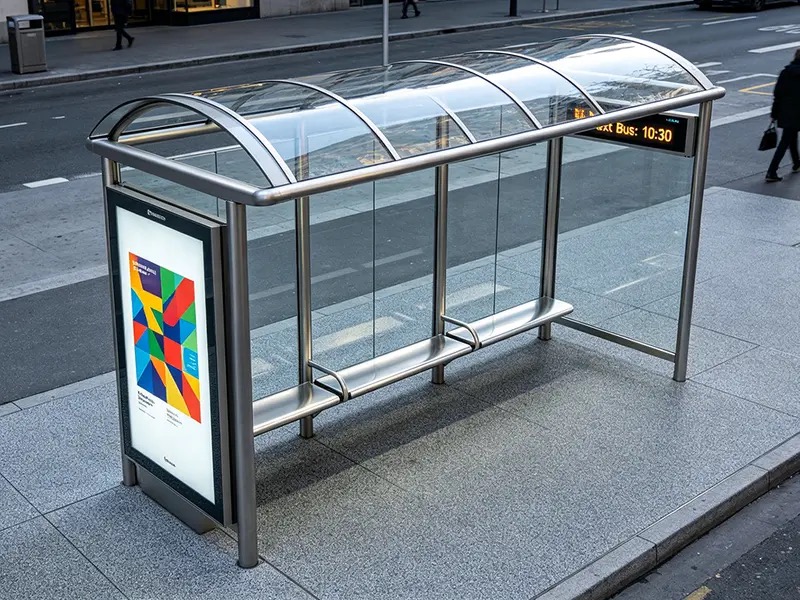
Start with the complete certificate, not a cropped image of the logo.
Check the legal entity, site address, standard, certificate number, scope, issue date, and expiry date. IAF CertSearch provides an online route for checking accredited certification by company name or certificate details.
If a record cannot be found, contact the issuing certification body. Absence from a search result alone should not be treated as definitive proof of invalidity.
No universal answer applies to every shelter.
CE marking is required only where applicable EU harmonized legislation mandates it. Structural construction components and electrical equipment can follow different conformity routes, and the assembled configuration must be assessed appropriately.
Ask the supplier to explain the applicable legal basis and provide the corresponding documents. A generic "CE certificate" is not enough.
Do not accept this without engineering confirmation.
Require the responsible engineer to confirm whether the existing assessment covers the revised dimensions, supports, panels, roof, equipment, and site conditions.
Treat any dimensional change as a controlled design revision. Record whether calculations, foundation drawings, and conformity documents need updating.
Request a project-specific material and finish proposal rather than a general "weatherproof" statement.
The package should identify the substrate, preparation method, protective system, inspection criteria, repair method, and maintenance obligations.
If test reports are supplied, check whether they represent the actual coating system and fabrication details. Agree on how coating damage during transport and installation will be repaired before accepting the warranty.
Include lifecycle support in the original contract.
Request a spare-parts list covering glazing, fixings, lighting drivers, control equipment, seals, and any display-specific components.
Define notification procedures for substitutions and discontinued parts. For digital shelters, establish access to configuration information and clarify who owns the data, software settings, and service credentials.
- Ainl — company profile supplied by the commissioning company; the following page could not be retrieved during research: [ainlgroup]
- Metalco — official company history: "History: Urban Furniture Since 1984." [metalco]
- Metalco — HUT shelter specifications and Gorizia terminal customization example. [metalco]
- City Design — official brand history and STAD shelter description. [citydesign]
- Bellitalia — official history and Magnum Evolution L product description. [bellitalia]
- Dimcar — official company profile and bus shelter range. [dimcar]
- Italian Ministry of Foreign Affairs — "Italian exports grow in the first eleven months of 2025." [esteri]
- Istat — official foreign-trade resources and 2026 yearbook information covering 2025. [istat]
- European Commission / Your Europe — CE marking requirements and conformity procedures. [europa]
- European Commission — RoHS Directive guidance. [environment.ec.europa]
- EUR-Lex — RoHS scope, exclusions, and exemptions. [eur-lex.europa]
- RINA — EN 1090 conformity assessment for structural steel and aluminum components. [rina]
- IAF CertSearch — accredited certification verification platform. [iafcertsearch]


