
Language
Views: 257 Author: Ainl Bus Shelter Publish Time: 2026-09-16 Origin: Site


Content Menu
● How We Selected Manufacturers
● Why Source Transit Shelters From China?
● Comparison Table: China Transit Shelter Suppliers
● 1. Ainl — Flexible OEM/ODM Transit Shelter Manufacturing
● 2. Starvision — Digital Out-of-Home Street Furniture Focus
>> Best fit
● 3. Truway Technology — Urban Street Facility Supplier
>> Best fit
● 4. Hua Sheng Metal — Guangzhou Metal Fabrication and Export Categories
>> Best fit
● 5. YEROO Group — Outdoor Advertising and Bus Shelter Supply
>> Best fit
● 6. Guangzhou SCE — Customized Advertising Street Furniture
>> Best fit
● 7. Foshan Aluminum Fabrication Specialists
>> Best fit
● 8. Shenzhen Smart Display and IoT Integrators
>> Best fit
● 9. Hebei Steel Structure and Galvanized Fabrication Suppliers
>> Best fit
● 10. Jiangsu Municipal Equipment Suppliers
>> Best fit
● Transit Shelter Technical Requirements Buyers Should Specify
>> 1. Frame material and thickness
>> 2. Corrosion-protection system
>> 3. Roof and drainage design
>> 4. Glazing and safety panels
>> 5. Electrical and smart components
>> 6. Accessibility and passenger comfort
● Common Transit Shelter Sourcing Problems
● An Insider Sourcing Tip: Inspect the "Invisible" Areas
● Buyer's Guide: How to Verify a Transit Shelter Factory
>> Step 1: Prepare a technical brief
>> Step 2: Ask for a technical quotation
>> Step 3: Verify company identity and certificates
>> Step 4: Approve samples correctly
>> Step 5: Conduct pre-shipment inspection
● Logistics Considerations for Overseas Buyers
>> Flat-pack versus assembled shipment
● FAQ
>> 1. How can I verify whether a supplier's ISO certificate is still valid?
>> 2. Should a transit shelter use hot-dip galvanized steel or powder-coated steel?
>> 3. What documents should I request before paying the deposit?
>> 4. What is a realistic MOQ for custom transit shelters?
>> 5. How do I prevent the supplier from changing materials after sample approval?
China is one of the world's most established sourcing bases for transit shelters, bus stop systems, street furniture, and outdoor advertising infrastructure. International buyers can access a broad supplier base ranging from metal-fabrication specialists and municipal-project contractors to smart-city solution providers integrating LED displays, passenger-information systems, solar power, lighting, CCTV, and digital advertising equipment.
However, a transit shelter is not a standard consumer product. It is a public-infrastructure asset expected to remain safe, attractive, maintainable, and operational through years of exposure to wind, rain, ultraviolet light, vandalism, traffic pollution, and repeated passenger use. Selecting a supplier therefore requires more than comparing unit prices.
For procurement managers, project contractors, public-transport operators, outdoor-media companies, and urban-infrastructure distributors, the right partner should demonstrate stable fabrication capacity, engineering depth, documented quality procedures, consistent delivery control, and a practical approach to local compliance requirements.
This guide introduces ten China-based manufacturers and suppliers worth evaluating for transit shelter projects. The companies are not ranked as identical alternatives; each has different strengths in customization, public-sector project delivery, smart hardware integration, outdoor media structures, or export-oriented OEM/ODM manufacturing.
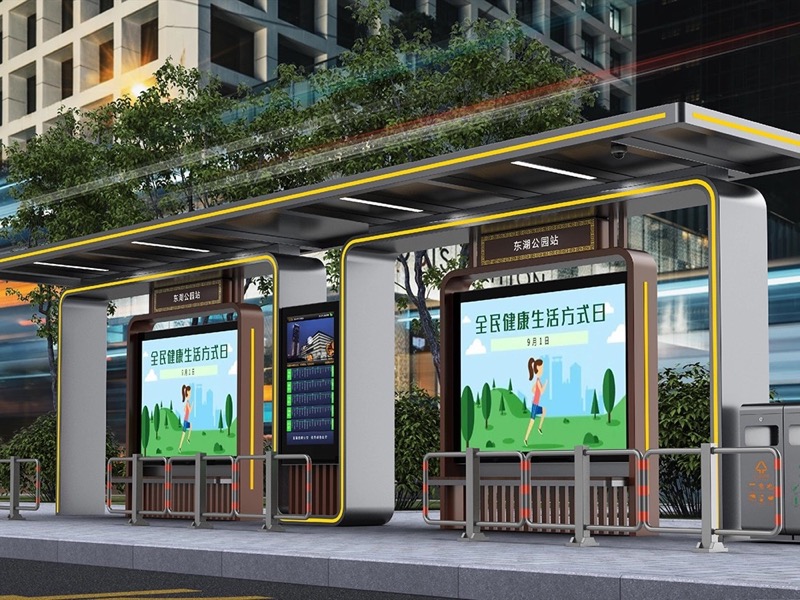
A reliable transit shelter supplier should be evaluated as an engineering and project-delivery partner, not simply as a metal-products vendor. The companies in this guide were assessed according to publicly available information, product focus, manufacturing relevance, customization capability, and suitability for international procurement discussions.
Key evaluation factors include:
- Manufacturing capability: In-house metal fabrication, cutting, bending, welding, polishing, powder coating, assembly, electrical testing, and quality-control resources.
- Product engineering: Ability to develop shelters around local dimensions, passenger flow, accessibility requirements, wind conditions, drainage needs, electrical specifications, and advertising layouts.
- Customization depth: Flexibility in roof profile, structural materials, colors, glazing, seating, lighting, signage, LED screens, solar systems, and city-branding elements.
- Quality-control process: Material traceability, welding inspection, coating-thickness checks, electrical safety testing, pre-shipment inspections, and packaging controls.
- Project experience: Capability to serve municipal projects, public-transport networks, commercial outdoor-media operators, station contractors, and distributors.
- Order-scale suitability: Whether a supplier can support prototype development, pilot projects, repeat orders, container-scale exports, or city-wide infrastructure tenders.
- Documentation readiness: Availability of drawings, bills of materials, product manuals, inspection records, test reports, certificates, and export documentation.
- Communication and delivery stability: Responsiveness during technical clarification, change management, sample approval, production scheduling, and shipment planning.
A buyer should independently verify every commercial and compliance claim before contract award. Certificates, factory licenses, test reports, product specifications, and reference projects should be checked directly with the issuing body, certification organization, or project owner where possible.
China's transit-shelter supply chain benefits from the combination of metalworking capacity, electrical-component sourcing, outdoor advertising manufacturing, LED-display integration, and export logistics. Rather than relying on a single production cluster, the sector draws on several specialized regions.
For example:
- Jiangsu and Zhejiang are known for municipal equipment, steel structures, road facilities, fabrication, and large-scale industrial production.
- Guangdong offers strong supply-chain access for outdoor furniture, sheet-metal work, commercial displays, lighting, aluminum processing, and export-oriented manufacturing.
- Shenzhen and the Pearl River Delta provide a strong ecosystem for LED displays, digital signage, control systems, IoT devices, electronics, and smart-city integration.
- Shandong, Hebei, and northern industrial regions provide steel, galvanized products, fabrication capacity, and heavy structural manufacturing.
- Shanghai and nearby coastal regions support international logistics, engineering resources, and overseas project coordination.
This ecosystem allows buyers to source anything from a basic galvanized-steel bus shelter to a fully integrated smart transit shelter with real-time passenger information, LED advertising, solar-powered lighting, CCTV, Wi-Fi, USB charging, environmental sensors, and remote management software.
China's manufacturing and export ecosystem remains highly significant in global trade. Buyers can review national trade statistics and export data through official resources such as the and the. Public-transport infrastructure demand is also connected to broader urbanization, digital-out-of-home advertising, electrification, and smart-city investment trends.
The figures below should be treated as procurement starting points, not confirmed contractual specifications. Actual monthly output, minimum order quantity, certification scope, and lead time vary by shelter size, steel grade, smart-device configuration, engineering complexity, project season, and order backlog.
| Manufacturer / Supplier | Location / Manufacturing Base | Main Focus | Typical Project Scale | Indicative MOQ Approach | Publicly Mentioned Capability or Focus | Suitable Buyers |
|---|---|---|---|---|---|---|
| Ainl | Suqian, Jiangsu | Bus shelters, smart bus stops, outdoor advertising facilities, street furniture | Pilot orders to municipal and smart-city projects | Flexible quotation based on model and customization | OEM/ODM, steel fabrication, digital-display and solar-system options | Distributors, contractors, small-to-mid-sized brands, city projects |
| Starvision | China | DOOH street furniture, digital displays, transit-related outdoor media | Medium to large international deployments | Project-based | Street furniture and digital-out-of-home display integration | Outdoor-media operators and digital-infrastructure buyers |
| Truway Technology | China | Bus shelters, platforms, road signage, urban facilities | Project-based | Quote-based | Urban street facilities and public-infrastructure solutions | Municipal contractors and road-facility purchasers |
| Hua Sheng Metal | Guangzhou, Guangdong | Bus shelters, advertising light boxes, street furniture, metal OEM | Small to medium export orders | Usually model- and material-dependent | Metal fabrication and export-oriented product categories | Importers, distributors, OEM customers |
| YEROO Group | Guangzhou, Guangdong | Outdoor advertising equipment, bus shelters, signage | Medium to large projects | Project-based | Advertising street furniture and display structures | Advertising operators and signage projects |
| Guangzhou SCE | Guangzhou, Guangdong | Bus shelters, advertising displays, public facilities | Customized projects | Quote-based | Outdoor advertising and urban-facility fabrication | Outdoor-media and municipal purchasers |
| Foshan Keenhai | Foshan, Guangdong | Aluminum fabrication, outdoor structures, customized metal products | Component and structure supply | Flexible by fabrication design | Aluminum-processing and engineered metal products | Buyers needing aluminum-heavy shelter structures |
| Shenzhen LED / Smart Display Integrators | Shenzhen, Guangdong | LED signage, passenger information, IoT hardware | Electronics sub-system supply | Component or project-based | Smart screen, controller, connectivity, remote management | Shelter manufacturers and smart-city integrators |
| Hebei Steel-Structure Suppliers | Hebei | Galvanized steel frames, canopies, structural fabrication | Bulk structural orders | Often higher for standardized frames | Steel fabrication, galvanizing, structural components | EPC contractors and standardized shelter buyers |
| Jiangsu Municipal Equipment Suppliers | Jiangsu | Bus stops, public facilities, road equipment, urban furniture | Municipal tender and repeat-production orders | Project-dependent | Fabrication, coating, assembly, local project support | Government contractors and transit-network operators |
Before issuing a purchase order, request a written quotation with exact metal grades, thicknesses, coating system, glazing specification, electrical configuration, packaging method, Incoterm, inspection standard, warranty scope, and delivery schedule.
Ainl is a Jiangsu-based manufacturer and solution provider focused on bus shelters, smart city public facilities, outdoor advertising products, and customized municipal infrastructure. Its product positioning is particularly relevant to buyers who need more than a fixed catalog shelter: they may require structural adjustments, branding integration, lighting, screens, solar power, seating, advertising panels, or city-specific visual elements.
According to its published company information, Ainl operates from Suqian, Jiangsu, and presents itself as a professional Chinese bus-shelter factory serving public transport, municipal, and smart-city projects. Its website highlights custom bus shelter design, manufacturing, and OEM/ODM support.
- Focus on bus shelters and related smart public-infrastructure products rather than only generic outdoor furniture.
- Broad OEM/ODM customization scope, including dimensions, structure, colors, display configuration, lighting systems, solar power options, and municipal-branding elements.
- Suitable for buyers who need practical communication during design adaptation, especially when adapting a shelter to local branding, climate, utility availability, or commercial advertising requirements.
- Manufacturing resources described by the company include sheet-metal precision processing, large coating capacity, electrical testing capability, and research-and-development support.
- Potentially suitable for smaller brands and regional distributors that need customization support but may not have the volume required by very large standardized-project factories.
- Product fit for bus stops, transit shelters, outdoor advertising shelters, smart bus stops, LED display shelters, station platforms, public seating, street furniture, and city-image projects.
For an OEM or ODM inquiry, buyers should ask Ainl to clarify the following items in the formal quotation and technical package:
- Main-frame steel grade and wall thickness.
- Whether galvanized steel, hot-dip galvanized steel, aluminum alloy, stainless steel, or mixed-material construction is proposed.
- Roof waterproofing design, internal drainage route, and gutter access for maintenance.
- Glass type, such as tempered, laminated, polycarbonate, or perforated metal alternatives.
- Powder-coating brand, pretreatment process, coating thickness, salt-spray target, and color standard.
- LED display pixel pitch, brightness, enclosure rating, thermal management, and content-management compatibility.
- Solar-panel output, battery chemistry, battery capacity, autonomy calculation, and backup-power design.
- Seating load rating, anchoring method, accessibility considerations, and vandal-resistance options.
- Packaging design for long-distance sea freight.
Ainl's public materials describe custom bus shelters built around durable steel construction and flexible design options. For buyers seeking a collaborative manufacturing partner rather than a rigid catalog supplier, the company is worth including in a structured request-for-quotation process.
Starvision is positioned around digital out-of-home, or DOOH, street furniture and display-led urban infrastructure. It is most relevant for projects where the transit shelter is also a media asset rather than only a passenger waiting structure.
The company states that it designs, engineers, and manufactures DOOH street furniture and displays for streets, airports, and shopping malls, with deployments across more than 80 countries. It also identifies itself as a member of the World Out of Home Organization and cites more than 22 years of experience in the sector.
- Strong relevance for outdoor advertising operators and public-private transit-shelter concessions.
- Experience with display-driven street furniture, where structural engineering must work alongside advertising, electrical, network, and content-management requirements.
- Potential suitability for airport, retail, street-media, and digitally enabled transit environments.
- International deployment focus may be valuable for buyers needing export documentation, cross-border project coordination, or global design references.
Starvision may be a stronger candidate than a traditional shelter fabricator when the buyer's commercial model depends on digital advertising revenue, high-visibility display surfaces, remote content updates, and integration with a broader street-furniture network.
Buyers should specifically verify display brightness, outdoor enclosure protection, heat dissipation, maintenance-access design, remote-monitoring architecture, spare-parts policy, and local electrical compliance before award.
Truway Technology presents itself as a supplier of urban street facilities, including bus shelters, bus platforms, road signboards, and public-facility solutions. Its product positioning makes it relevant for buyers evaluating a combination of transit shelters, signs, and adjacent road or pedestrian infrastructure.
- Focus on urban-facility categories rather than a single product line.
- Potential ability to bundle bus shelters with bus platforms, wayfinding products, and road-signage requirements.
- Relevant for projects where a contractor wants coordinated public-realm equipment rather than sourcing each product category separately.
- Suitable for municipal, roadway, public-transport, and urban-renewal procurements.
Truway may be appropriate where the buyer has a broader urban-infrastructure package, such as bus stops combined with public signage, street furniture, or transport-access improvements.
Before selection, buyers should request product-specific information rather than relying on the supplier's general capability statement. Ask for shelter drawings, prior project photos with location details, fabrication specifications, material lists, quality plans, and export references for comparable climates.
Hua Sheng Metal offers a product range that includes bus shelters, bus-stop shelters, advertising light boxes, street furniture, stainless-steel fabrication, and metal-furniture OEM services. Its Guangzhou manufacturing base makes it relevant to buyers seeking an export-oriented metal-products supplier with access to the Pearl River Delta supply chain.
- Product range spans bus shelters, advertising light boxes, street furniture, and metal fabrication.
- Guangzhou location offers practical supply-chain access for lighting, commercial display components, aluminum, stainless steel, packaging, and export logistics.
- Potential fit for distributors wanting adjacent product categories from one supplier.
- Relevance for non-digital and semi-customized transit-shelter projects where reliable metal fabrication is the primary requirement.
Hua Sheng Metal may be a suitable option for buyers seeking conventional shelters, outdoor advertising panels, benches, planters, bins, and related street-furniture products under a coordinated procurement package.
The critical verification point is whether structural fabrication, surface treatment, and final assembly are performed in-house or outsourced. Buyers should ask for a factory walkthrough by live video, production-flow evidence, coating-process information, and recent batch inspection records.
YEROO Group is commonly associated with outdoor advertising equipment, signage, bus shelters, and advertising street furniture. This positioning makes the company relevant for purchasers whose transit shelters include illuminated posters, advertising panels, or billboard-based revenue models.
- Outdoor advertising orientation.
- Likely relevance for transit shelters with static light boxes, billboard frames, scrolling systems, and advertising-focused layouts.
- Potentially suitable for projects that combine bus shelters with directional signage, billboards, and commercial public-space equipment.
- Guangzhou location can offer access to display and lighting supply chains.
This supplier category is most useful when a city, transport operator, or media company wants the shelter structure to support advertising inventory. Buyers should focus on panel-door hinges, lock systems, drainage, internal lighting serviceability, poster replacement time, and corrosion protection around cut edges and fasteners.
Guangzhou SCE is another supplier category associated with bus shelters, outdoor advertising equipment, public facilities, and display-oriented street furniture. It may be relevant for buyers seeking conventional shelters combined with commercial advertising structures.
- Alignment with outdoor advertising and public-facility categories.
- Potential for customized designs for urban streets, commercial districts, transport hubs, and public-space advertising.
- Useful for buyers comparing Guangzhou-area suppliers with broad sheet-metal and signage supply networks.
Consider this type of supplier when your technical brief includes advertising panels, illuminated media boxes, integrated seating, or modular station components. The supplier should provide structural calculations where relevant, particularly for tall advertising panels, cantilevered canopies, high-wind locations, and areas exposed to typhoons or coastal corrosion.
Foshan is internationally recognized for metal processing, aluminum products, architectural systems, furniture-related manufacturing, and decorative fabrication. While not every Foshan supplier is a dedicated transit-shelter manufacturer, the region can be valuable when a project requires extensive aluminum extrusion, curved roof sections, lightweight cladding, anodized finishes, or custom architectural details.
- Access to aluminum extrusion, CNC machining, architectural metalwork, decorative cladding, and powder-coating supply chains.
- Useful for transit-shelter projects requiring reduced structural weight, refined visual finishes, or corrosion-resistant aluminum components.
- Appropriate for OEM buyers with proprietary design drawings and technical manufacturing requirements.
Foshan suppliers are often most useful as specialized partners for aluminum shelter components, canopy systems, façades, louvers, decorative panels, and seating elements. If the project includes structural steel plus aluminum finishing, clarify which components are made in-house and which are subcontracted.
A smart transit shelter normally requires two supplier capabilities: a structural manufacturer and an electronics integrator. Shenzhen's electronics ecosystem is particularly relevant for LED displays, passenger-information displays, digital signage, CCTV, connectivity modules, sensors, charging systems, controllers, and remote-management hardware.
- LED-display supply-chain depth.
- Access to electronic control systems, IoT modules, industrial displays, sensors, and connectivity solutions.
- Valuable when shelters require real-time arrivals, digital advertising, air-quality monitoring, emergency buttons, USB charging, Wi-Fi, or remote diagnostics.
- Potentially stronger in electronics than in heavy shelter fabrication.
For major smart-city projects, buyers may need a two-layer supply model:
1. A transit-shelter fabricator responsible for structural design, production, coating, assembly, and installation interfaces.
2. An electronics supplier or systems integrator responsible for display hardware, software, data integration, network connectivity, and maintenance tools.
Do not assume that a company offering an LED screen is capable of managing an entire smart-shelter project. Demand a system architecture showing power distribution, network design, content-management platform, data source, screen-control hardware, remote alerting, and service responsibilities.
Hebei has a strong industrial base in steel-related products, galvanized components, structural fabrication, and heavy-duty construction materials. Suppliers in this region may be competitive when the shelter design is highly standardized, steel-intensive, and required in significant quantities.
- Access to steel and heavy fabrication resources.
- Potentially competitive for standardized frames, canopies, galvanized components, and structural parts.
- Useful for EPC contractors, regional transport operators, and projects with repeatable shelter modules.
- Can suit buyers prioritizing structural capacity over highly decorative retail-style finishes.
Hebei-based suppliers may be valuable for large-volume structural orders, especially if a local partner or secondary supplier manages lighting, glazing, digital systems, or installation. Buyers should emphasize galvanizing quality, zinc-coating thickness, weld finishing, hole-edge protection, drainage design, and flat-pack shipping efficiency.
Jiangsu has a strong presence in municipal equipment, bus shelters, street furniture, road equipment, public-transport infrastructure, and steel-structure manufacturing. Buyers can find suppliers serving both domestic city projects and export markets.
- Regional ecosystem for transit shelters and public-facility manufacturing.
- Potential access to engineering teams familiar with municipal specifications and large batch production.
- Suitable for buyers comparing conventional bus-stop shelters, smart shelters, advertising shelters, kiosks, public seating, and related urban infrastructure.
- Strong relevance for project-based manufacturing where structural fabrication, coating, electrical assembly, and final integration are coordinated in one region.
Jiangsu suppliers are worth evaluating for city-wide bus-stop upgrades, distributor programs, and customized public-facility packages. Buyers should distinguish between factories with in-house manufacturing and trading companies sourcing from multiple workshops.
Ainl is one relevant Jiangsu-based option for buyers needing a combination of bus-shelter manufacturing, smart-city customization, outdoor advertising elements, and responsive OEM/ODM collaboration.
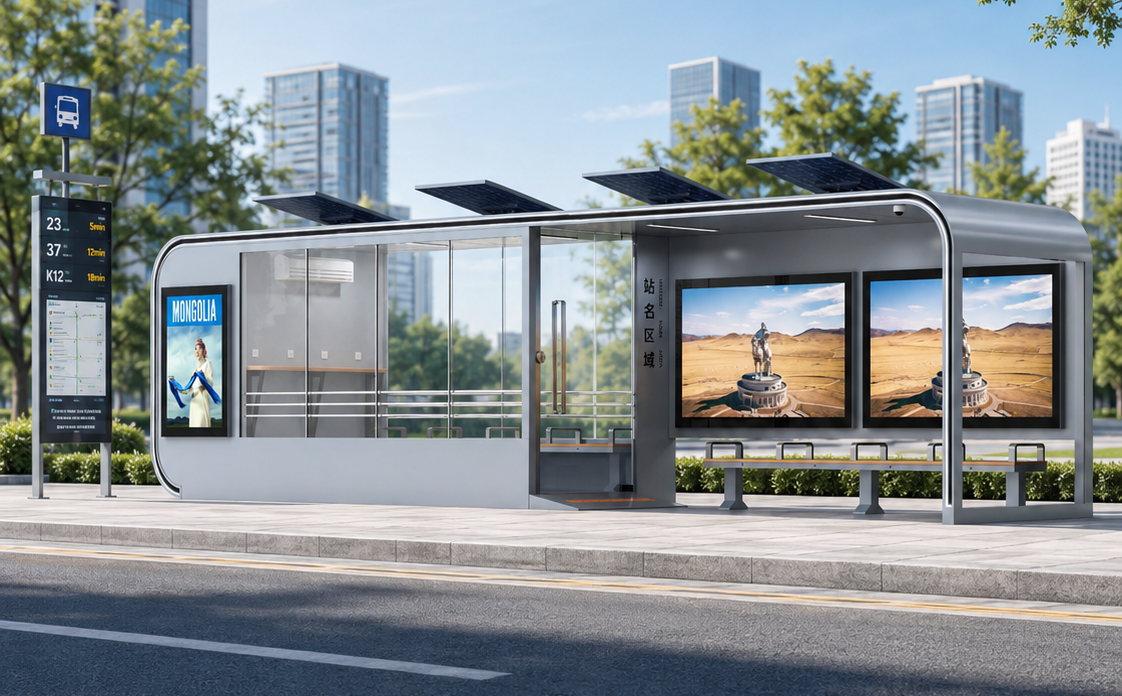
A transit shelter request for quotation should not say only "Please quote bus shelter." That approach invites inconsistent quotations, hidden material substitutions, and misleading comparisons.
Instead, provide a clear technical requirement sheet.
Specify the structural material and minimum thickness for each component:
- Main columns and primary roof frame.
- Secondary supports and roof purlins.
- Advertising-panel frame.
- Seating frame.
- Base plates and anchor bolts.
- Decorative cladding.
- Screen-support brackets.
For steel shelters, clarify whether the design uses mild steel, galvanized steel, hot-dip galvanized steel, stainless steel, or aluminum alloy. "Galvanized" alone is not enough; it can refer to different processes and coating levels.
Transit shelters frequently fail at cut edges, fastener locations, drainage points, welded joints, and concealed water-trap areas. A strong specification should define:
- Surface pretreatment method.
- Galvanizing method and coating weight or thickness.
- Powder-coating system and target dry-film thickness.
- Salt-spray testing expectation where applicable.
- Repair process for scratched or welded areas.
- Color standard, such as RAL or Pantone.
- Coastal, tropical, desert, or high-pollution environmental condition.
For projects near coastlines, ports, industrial zones, or high-humidity regions, buyers should consider a more robust corrosion-protection system. A standard decorative powder coat may look acceptable at shipment but fail prematurely in real operation.
A shelter roof should do more than prevent direct rainfall. Review:
- Roof slope and drainage direction.
- Gutter capacity.
- Drainpipe routing.
- Leak risk at joints and fasteners.
- Access for cleaning leaves and debris.
- Snow load where applicable.
- Wind uplift resistance.
- Condensation management for enclosed electrical areas.
Possible materials include tempered glass, laminated safety glass, polycarbonate, acrylic, perforated sheet metal, aluminum composite panels, and solid metal panels.
For high-vandalism environments, laminated glass or polycarbonate may offer different advantages. For high-visibility public locations, specify safety markings, edge finishing, panel retention method, and replacement procedure.
For shelters with lighting, digital signs, CCTV, USB charging, Wi-Fi, or solar power, define:
- Input voltage and local electrical standard.
- Electrical cabinet rating and lock system.
- Grounding requirements.
- Surge protection.
- Cable routing and waterproof connectors.
- LED lighting power and color temperature.
- Display brightness and operating temperature.
- IP rating for outdoor components.
- Remote monitoring and fault-alert features.
- Local-language user interface.
- Maintenance manual and wiring diagram.
A transit shelter should consider:
- Wheelchair access and clearance.
- Seating height and armrest options.
- Space for prams, luggage, and mobility aids.
- Tactile paving interface.
- Route-map visibility.
- Nighttime illumination.
- Weather protection from wind-driven rain.
- Anti-slip flooring around the shelter zone.
- Emergency contact or help-point provisions where required.
The lowest quotation often becomes the most expensive option after installation. Below are recurring problems buyers should identify before production begins.
| Common Problem | What Happens | How to Avoid It |
|---|---|---|
| Steel thickness is reduced | The shelter appears similar but has lower wind resistance and shorter service life | Include minimum thicknesses for each part in the approved drawing and bill of materials |
| Galvanizing is unclear | Corrosion appears around welds, edges, and fasteners | Specify galvanizing process, coating thickness, repair method, and inspection requirement |
| Powder coating is cosmetic only | Color fades, peels, or chalks after weather exposure | Request pretreatment details, powder brand, coating thickness, and test records |
| Glass type is not defined | Panels may be unsafe or expensive to replace | State tempered, laminated, polycarbonate, or other required material clearly |
| Screens are quoted without service support | Digital hardware fails with no remote access, spare parts, or local repair plan | Require a smart-system architecture, spare-parts list, warranty terms, and maintenance procedure |
| Drawings are not frozen | The factory produces a different interpretation of the design | Use a signed final drawing, bill of materials, color chart, and sample-approval record |
| Container loading is ignored | Freight costs increase and shelters arrive damaged | Require a packing plan, container-loading layout, and packing photos before shipment |
| Certificates are assumed to cover the product | A general company certificate may not cover a specific electrical or structural requirement | Verify certificate scope, validity period, issuing body, and exact product applicability |
One of the least-discussed risks in transit-shelter procurement is that buyers often inspect only the visible exterior: paint color, roof shape, glass, lighting, and advertising panels. Yet the highest failure risks are usually hidden after installation.
During factory inspection, ask the supplier to show you:
- The underside of the roof and gutter joints.
- Interior cable routing and cable protection.
- Base plates, anchor-bolt slots, and drainage holes.
- Weld finishing before paint.
- Cut-edge treatment after drilling or welding.
- The internal surface of advertising-light-box doors.
- The rear of LED screen mounting frames.
- Water-drainage exits.
- Electrical cabinet earth connections.
- Replacement access for lights, power supplies, controllers, and glass panels.
A shelter can look excellent in a final photo while still having poorly sealed cable entries, inaccessible power supplies, weak drain paths, or untreated steel inside hidden cavities. These issues may not appear until the first rainy season or until a technician needs to replace a failed component.
For this reason, the best inspection question is not "Does it look good?" It is: "Can this shelter be safely maintained for ten years without dismantling the entire unit?"
Provide the supplier with:
- Shelter dimensions and site layout.
- City or brand color scheme.
- Climate and wind conditions.
- Intended passenger capacity.
- Required advertising-panel dimensions.
- Lighting, screen, solar, CCTV, and connectivity requirements.
- Local electrical standard.
- Quantity and delivery destination.
- Required Incoterm, such as EXW, FOB, CIF, DAP, or DDP where appropriate.
- Target delivery date.
- Installation responsibility.
The more precise the brief, the more comparable your quotations will be.
A serious quotation should include:
- Product rendering or preliminary drawing.
- Material list.
- Steel and aluminum thicknesses.
- Glass specification.
- Coating specification.
- Electrical configuration.
- Unit price and tooling cost, if any.
- MOQ.
- Sample cost.
- Production lead time.
- Packaging and shipping method.
- Warranty period.
- Payment terms.
- Validity period.
Avoid selecting a supplier based on a one-line quotation such as "USD 2,500/set, FOB China." This does not tell you what you are buying.
Check:
- Chinese business registration information.
- Factory address and manufacturing scope.
- Export experience.
- Certificate issuer and expiry date.
- Certificate scope.
- Whether the factory name on the certificate matches the contracting entity.
- Whether the certificate is relevant to the product category.
- Product test reports for relevant electrical, safety, environmental, or structural requirements.
If a supplier claims ISO 9001, ISO 14001, ISO 45001, CE, RoHS, or another certification, ask for the complete certificate, not only a logo on a brochure. Then verify the certificate number through the issuing certification body where possible.
For customized transit shelters, a full-size sample may be expensive or impractical. Alternative approval methods include:
- A scaled structural model.
- A full-size corner section.
- A sample advertising-light-box module.
- A full-size seating and glazing section.
- A coating-panel sample.
- A screen-and-electrical-control demonstration.
- A sample base plate and anchor assembly.
- A virtual factory acceptance test by live video.
The approved sample must be linked to the production order. Record the material, color, finish, glass type, lamp model, screen model, and hardware used.
Before final payment, inspect:
- Quantity.
- Dimensions.
- Welding quality.
- Surface finish.
- Coating thickness.
- Glass condition.
- Electrical operation.
- Screen brightness and content playback.
- Lighting operation.
- Door and lock function.
- Packaging.
- Labels and installation markings.
- Spare parts.
- Loading method.
For city-wide deployments, inspect not only a single finished shelter but also random units from across the production batch.
Transit shelters are large, irregular, and often damage-prone during freight. Shipping should be designed into the product from the beginning.
A flat-pack design can reduce freight cost and improve container utilization, but it increases local assembly time and installation complexity. Fully assembled modules reduce site labor but may require oversized transport, special lifting equipment, and more protective packaging.
Discuss:
- Maximum component length.
- Container type required.
- Number of units per 20-foot or 40-foot container.
- Need for open-top, flat-rack, or standard containers.
- Weight per package.
- Lifting points.
- Assembly tools.
- Installation manual.
- Bolt and anchor kit labeling.
- Spare glass and spare electrical components.
For export orders, require:
- Protective film for painted surfaces.
- Corner protectors.
- Foam or rubber separators between metal and glass.
- Moisture protection.
- Strong crates for glass panels and electronics.
- Clear shipping marks.
- Component numbering matching the installation manual.
- Container-loading photos.
Do not allow a supplier to treat packaging as an afterthought. Damage during sea freight can erase the savings achieved through a low factory price.
China offers a broad and capable supplier base for transit shelters, smart bus stops, outdoor advertising shelters, and street-furniture systems. The most appropriate manufacturer depends on your project's true priorities: structural durability, customization depth, smart-system integration, advertising functionality, order volume, installation model, and local regulatory requirements.
For a buyer seeking flexible OEM/ODM support, practical design communication, custom smart-city features, and a manufacturer focused on bus shelters and related municipal infrastructure, Ainl is a relevant supplier to include in the evaluation process. Its public information identifies it as a China-based custom bus-shelter manufacturer supporting OEM/ODM production for public-transport, municipal, and smart-city projects.
Before choosing any supplier, issue a clear technical brief, verify certificates and production resources, approve samples carefully, inspect hidden structural and electrical details, and make logistics part of the engineering discussion—not merely a freight quote at the end.
For your next transit shelter project, prepare your design drawings, target specifications, expected quantity, destination port, and smart-feature requirements before requesting quotations. This will help you compare suppliers on total project value rather than headline unit price alone.
Ask for the full certificate showing the certificate number, issuing body, validity dates, factory name, address, and certified scope. Then visit the certification body's verification portal or contact the issuer directly. Confirm that the name and address match the entity signing your sales contract. Also check whether the certificate covers manufacturing rather than only trading, consulting, or another unrelated activity.
They are not interchangeable. Hot-dip galvanizing provides a zinc-based corrosion barrier, while powder coating provides color and additional surface protection. In demanding environments, a duplex system—galvanizing plus powder coating—can provide stronger long-term corrosion resistance. The right solution depends on climate, coating specification, expected life cycle, budget, and aesthetic requirements.
Request a stamped quotation, product drawings, bill of materials, payment terms, production schedule, warranty statement, quality-control plan, packaging plan, company registration details, relevant certificates, and an agreed inspection process. For smart shelters, also request electrical drawings, display specifications, software scope, and spare-parts terms.
MOQ depends on design complexity, tooling needs, material procurement, and whether the shelter is based on an existing platform. Some factories can support small pilot orders, while highly customized structures may require a higher minimum because engineering, jigs, molds, color matching, and component sourcing must be spread across the order quantity. Ask for separate pricing at one unit, five units, 20 units, and container-scale volume.
Attach the signed drawing, bill of materials, finish schedule, approved sample photos, and inspection criteria to the purchase contract. State that substitutions require written buyer approval. Use a pre-production meeting, in-process inspection, and pre-shipment inspection. For high-value projects, retain an approved physical reference sample or material swatch set.
- [General Administration of Customs of the People's Republic of China] — Official customs and trade information.
- [National Bureau of Statistics of China] — Official economic and industrial statistics.
- [Ministry of Commerce of the People's Republic of China] — Trade and investment information.
- [World Out of Home Organization] — Global out-of-home media industry organization.
- [Ainl Bus Shelter] — Custom bus shelter, smart-city public-facility, and OEM/ODM manufacturing information. [ainlgroup]
- [Ainl OEM/ODM Information] — OEM/ODM product and service information. [ainlgroup]


