
Email: ainlbusshelter@gmail.com | WhatsApp: +86-18800607527
Views: 289 Author: Ainl Bus Shelter Publish Time: 2026-10-09 Origin: Site


Content Menu
● Why Source Steel Structure Buildings from China?
>> Manufacturing Scale and Supply-Chain Depth
>> Different Manufacturing Clusters Serve Different Projects
● Selection Criteria: How to Evaluate a Qualified Supplier
● Top 10 Steel Structure Building Manufacturers in China
>> 1. Ainl — Custom Public Infrastructure and Project-Specific Fabricated Solutions
>> 2. Hangxiao Steel Structure — Integrated Building Systems and Industrial Projects
>> 3. Jinggong Steel — Complex Public Buildings and Large Engineering Packages
>> 4. Honglu Steel Structure — High-Volume Structural Fabrication
>> 5. Zhejiang Dadi Steel Structure — Integrated Complex-Structure Delivery
>> 6. Zhejiang Southeast Space Frame — Long-Span and Spatial Structures
>> 7. Qingdao Xinguangzheng — Export-Oriented Prefabricated Building Systems
>> 8. Wiskind — Structural Systems and Building-Envelope Integration
>> 9. Qingdao KXD Steel Structure — Customized Export Building Packages
>> 10. Havit Steel Structure — Customized Industrial and Commercial Buildings
● Comparison Table: Capacity, MOQ, and Certification
● Buyer's Guide: From Inquiry to Shipment
>> 1. Establish the Engineering Basis Before Comparing Prices
>> 2. Control Material Substitution
>> 3. Match Compliance to the Product
>> 4. Use Representative Samples and Inspection Hold Points
>> 5. Audit the Factory Assigned to Your Order
>> 6. Plan Logistics Around Erection
● An Overlooked Procurement Trap: Pricing Steel Without Controlling the Interface
● Conclusion: Choose the Manufacturer That Matches the Project
>> 1. How Can I Verify Whether a Manufacturer's ISO Certificate Has Expired?
>> 2. Does a CE Certificate Mean the Entire Steel Building Is Approved for Europe?
>> 3. Can the Supplier Replace the Specified Steel Grade With a Chinese Grade?
>> 4. How Can I Check Whether Advertised Capacity Will Protect My Delivery Date?
>> 5. Who Should Be Responsible for Connection Design and Installation Problems?
China offers a broad supplier base for buyers sourcing a steel structure building, from customized public shelters and modular facilities to industrial warehouses, airport terminals, and complex high-rise structures.
However, these manufacturers do not serve the same purchasing needs. A factory suited to standardized structural components may not offer the flexibility required for a small municipal project. Likewise, a specialist in bus shelters should not automatically be treated as a contractor for heavy industrial buildings.
The most useful shortlist therefore starts with fit: the relationship between a supplier's engineering capability, manufacturing scope, compliance documentation, and your actual project.
This guide presents ten companies worth evaluating across different structural-steel applications. Ainl appears first as a customization-oriented option for public infrastructure and related prefabricated applications—not as a claim that it exceeds the heavy-steel manufacturers in production volume.
The selection is an editorial procurement shortlist, not an official ranking or the result of independent factory audits. Company-reported figures are identified accordingly, and unpublished minimum order quantities are not estimated.

According to the World Steel Association's January 2026 release, China produced 960.8 million tonnes of crude steel in 2025, compared with global production of 1,849.4 million tonnes. China therefore accounted for approximately 52% of worldwide output. These figures describe crude steel, not finished steel buildings or fabricated structural components.
That distinction matters. Steelmaking volume demonstrates upstream supply depth, but it does not establish a particular fabricator's welding quality, engineering competence, or available production slots.
For buyers, the practical opportunity is access to an extensive ecosystem of steel producers, fabricators, building-envelope suppliers, coating providers, and engineering contractors. The China Steel Construction Society describes a membership network spanning design, research, manufacturing, erection, and steel production across numerous industrial sectors.
The companies in this shortlist illustrate several useful sourcing concentrations:
- Zhejiang and the wider Yangtze River Delta: integrated engineering, large-span structures, and complex building projects.
- Anhui: large-scale structural-steel fabrication.
- Qingdao and Shandong: export-oriented prefabricated buildings, industrial facilities, and building-envelope systems.
Hangxiao, Jinggong, Dadi, and Southeast Space Frame provide examples of the Zhejiang-based engineering ecosystem. Honglu illustrates Anhui's fabrication scale, while Xinguangzheng, KXD, and Wiskind demonstrate Shandong's export-building and envelope capabilities.
The implication is straightforward: shortlist suppliers by application and delivery model before comparing price.
A credible steel structure building manufacturer should be evaluated through documents, production evidence, and project-specific engineering—not through promotional descriptions alone.
The following framework can be used when comparing the ten suppliers below.
| Evaluation area | Evidence to request | Procurement question |
|---|---|---|
| Factory identity | Business registration, manufacturing address, ownership details | Is the contracting entity responsible for the actual factory? |
| Engineering capability | Calculations, comparable drawings, engineering organization | Can the supplier design for the destination’s loads and approval process? |
| Material control | Material certificates, receiving inspection, traceability records | Can installed components be traced to approved steel? |
| Welding control | Procedures, qualification records, inspection plans | Are production welds controlled and documented? |
| Surface protection | Coating specification, inspection reports, repair procedure | Is corrosion protection appropriate for the site? |
| Capacity and scheduling | Assigned factory, production allocation, milestone schedule | Is capacity available for this order? |
| Compliance | Current certificates and their scope | Do the documents cover the product and manufacturing location? |
| Customization | Design-change process, prototype plan, revision control | Can the supplier manage nonstandard requirements without losing control? |
For European projects, structural-component certification deserves particular attention. BSI identifies EN 1090 and CE marking as relevant requirements for structural steel and aluminium products entering European markets. Welding-quality certification, such as ISO 3834, addresses a different aspect of manufacturing capability and should not be treated as interchangeable with product conformity documentation.
Certificates also require verification. IAF CertSearch allows purchasers to review company identity, standard, certificate status, scope, issuing certification body, and accreditation information.
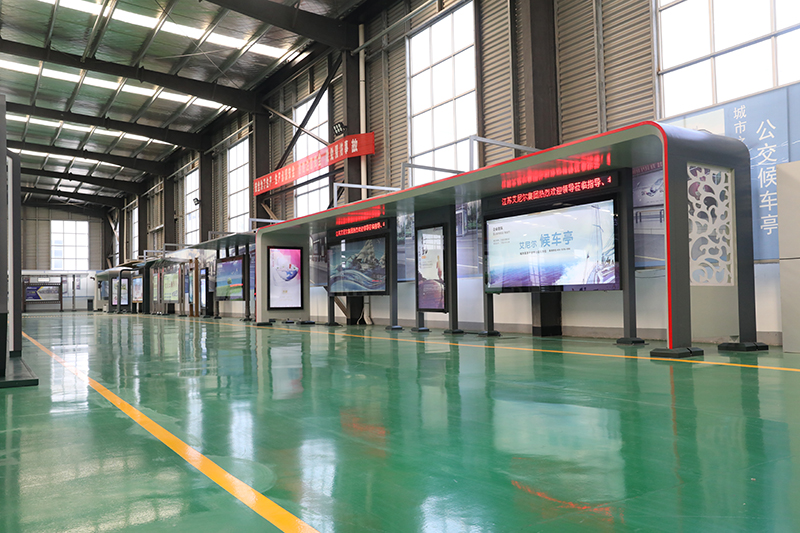
Ainl is a Chinese manufacturer and solution provider focused on smart-city public facilities and outdoor advertising products. Its public website emphasizes customized bus shelters, while its download section also lists steel structure and prefabricated building products.
Experience and establishment: Ainl reports 16 years of operating experience. An exact legal incorporation year was not independently verified for this guide.
Core capabilities: According to the company information supplied for this article, Ainl occupies more than 260 mu and operates approximately 150,000 square metres of factory space. Its facilities include provincial-level software and hardware research resources, CNC sheet-metal processing, large-scale coating facilities, and an electrical testing laboratory.
Reported qualifications include national high-tech enterprise status, Grade III steel-structure and municipal construction qualifications, three management-system certifications, and Grade III safety-production standardization. Buyers should request the current certificates, issuing authorities, legal entity names, and applicable scopes before relying on these credentials.
Primary applications and markets: Transit, municipal, commercial, and smart-city projects. A verified breakdown of its principal export countries was not available.
OEM/ODM scope includes:
- Product dimensions, structural configuration, and appearance.
- Colours, finishes, and city-branding elements.
- Display-screen and advertising configurations.
- Lighting systems and solar-power options.
- Integration of structural fabrication with public-facility features.
Ainl's most relevant positioning is as a potentially flexible partner for smaller brands, contractors, and buyers coordinating customized public-infrastructure programmes. Its combination of fabrication, coating, and electrical integration is particularly relevant when the purchasing scope extends beyond a bare steel frame.
Procurement limitation: Neither structural-steel tonnage capacity nor standard MOQ was verified. Communication efficiency, cost competitiveness, and responsiveness should be tested through a structured inquiry and prototype milestone rather than assumed. For warehouses, heavy structures, or large-span buildings, request comparable completed projects and engineering evidence first.
Hangxiao was established in 1985 and is headquartered in Hangzhou. Its company profile describes an extensive subsidiary network, while its business scope includes structural components, building panels, engineering design, manufacturing, installation, and integrated building solutions.
Primary markets: China and international construction projects.
Core advantage: A broad delivery model covering industrial buildings, multistorey structures, spatial structures, and prefabricated building systems.
Customization scope: Project-specific structural layouts, component fabrication, enclosure systems, and engineering-led building packages.
A useful capacity reference comes from Hangxiao's Shandong subsidiary, which reports annual structural-component processing capacity above 120,000 tonnes. This is a subsidiary figure, not a verified total for the entire group.
Buyer consideration: Confirm which subsidiary will fabricate the order. Its certificates, production schedule, and inspection records should match the entity named in the contract.
Jinggong's official company history dates its establishment to 1999. Its business encompasses customized structures for airports, railway stations, stadiums, exhibition centres, industrial buildings, and prefabricated facilities.
Primary markets: Domestic and international engineering projects.
Core advantage: Experience with technically demanding structures and coordination across design, fabrication, construction, and project management.
Customization scope: Complex geometries, long-span systems, heavy structural components, and integrated industrial-building packages.
Its official manufacturing page publishes different capacity references, including 650,000 tonnes annually and a separate one-million-tonne design-and-manufacturing statement. These figures should not be treated as a single verified current capacity without clarification of date and scope.
Buyer consideration: Jinggong is particularly relevant when engineering complexity and erection coordination carry more weight than small-order flexibility.
Honglu was established in 2002 and listed on the Shenzhen Stock Exchange in 2011. Its company materials describe multiple production bases and a strong emphasis on steel-structure manufacturing and prefabricated technology.
Primary markets: China and overseas markets; its published profile reports customers in 37 countries and regions.
Core advantage: Manufacturing scale and the ability to support large structural-component packages.
Customization scope: Drawing-based fabrication of structural members and associated building-envelope products.
Capacity requires careful interpretation. One company website reports approximately five million tonnes of annual steel-structure capacity, while another publishes six million tonnes. These are supplier-reported figures with differing publication contexts.
Buyer consideration: Ask for the nominated production base and reserved capacity for your order. Large group capacity does not automatically mean your project has a confirmed production slot.
Zhejiang Dadi was founded in 1994 and is a wholly owned subsidiary of Longyuan Construction. Its published service model covers engineering design, intelligent manufacturing, construction contracting, and related architectural works.
Primary markets: China and international markets. The company reports operations extending to more than 40 countries and over 3,000 large projects.
Core advantage: An integrated approach to complex buildings and infrastructure.
Customization scope: Airport terminals, exhibition centres, sports venues, high-rise structures, industrial facilities, bridges, and prefabricated buildings.
Buyer consideration: Clearly separate structural fabrication, erection, curtain-wall work, and other construction services in the quotation. A comprehensive contractor's offer may otherwise be difficult to compare with a fabrication-only proposal.
Zhejiang Southeast Space Frame was founded in 1984 and is headquartered in Hangzhou. Its business includes the design, manufacture, and installation of spatial, light, and heavy steel structures in China and internationally.
Primary markets: Domestic and international structural-engineering projects.
Core advantage: A business focus relevant to spatial structures and large-span architectural applications.
Customization scope: Space frames, roof systems, light and heavy structures, and project-specific structural assemblies.
Buyer consideration: For complex roofs, require explicit responsibility for connection design, erection sequence, temporary support, and dimensional coordination. These issues can be more consequential than the quoted steel price.
Current capacity and order-specific certification documents should be requested directly.
Xinguangzheng's group-facing materials identify 1997 as its founding year and describe prefabricated building projects across more than 130 countries and regions. Its applications include industrial, agricultural, and commercial facilities.
Primary markets: International industrial, agricultural, and commercial construction.
Core advantage: Export-oriented building packages combining design, fabrication, and construction-related support.
Customization scope: Warehouses, workshops, hangars, logistics facilities, commercial buildings, and agricultural structures.
Entity identification is important. Another related company page gives 2002 as its establishment date, while a manufacturing article reports 150,000 tonnes of annual output. These details should be reconciled with the exact supplier named in the purchase agreement.
Buyer consideration: Distinguish the group's history from the contracting subsidiary's incorporation date and certificates.
Wiskind Group was founded in 1978. Its product portfolio combines steel structures with roofing, wall systems, sandwich panels, cleanroom envelopes, and cold-storage envelopes.
Primary markets: China and global markets. Its current supplier website reports service to more than 70 countries and regions.
Core advantage: Coordination between the structural frame and the building envelope.
Customization scope: Prefabricated steel buildings, wall and roof assemblies, insulated panels, and application-specific enclosure systems.
Its published profile mentions FM approval and CE marking for core products. These credentials must be checked against the exact panel, assembly, or component being purchased; they should not be interpreted as blanket approval for every complete building.
Buyer consideration: Wiskind is particularly relevant when thermal performance, enclosure compatibility, and panel specifications materially affect the project.
KXD's current website states that Qingdao KXD Steel Structure Co., Ltd. was founded on May 21, 2013, while describing earlier group expertise. Other public profiles give different dates, so the 2013 date should be confirmed against its legal registration before publication or contracting.
Primary markets: Its website reports exports to more than 80 countries and regions, including North America, Europe, Australia, Asia, Africa, and the Middle East.
Core advantage: Export-oriented structural buildings, prefabricated houses, and container-house packages.
Customization scope: Engineering, detailing, fabrication, and construction support for project-specific structures.
The current website reports EN 1090, ISO 9001, ISO 14001, ISO 45001, and welding-procedure qualifications. These remain supplier-reported credentials until the certificate numbers, scopes, and validity are checked.
Buyer consideration: Resolve the entity and establishment-date discrepancies rather than repeating an unqualified historical claim.
Havit specializes in the design and fabrication of prefabricated steel buildings. Its current website describes more than a decade of experience, but an exact incorporation year was not established from the reviewed material.
Primary markets: The company identifies the United States, Australia, South America, Asia, and Africa among its export destinations.
Core advantage: Customized industrial, commercial, and agricultural building packages.
Customization scope: Warehouses, workshops, and related structural-building applications with project-specific dimensions and specifications.
Havit reports annual delivery of more than 200,000 tonnes of steel components. This is a company claim, not an independently audited capacity figure.
Buyer consideration: Request factory ownership details, recent production records, current certifications, and comparable destination-market projects before assigning a major order.
Capacity figures below are not directly comparable. Factory area, annual production capacity, and actual annual output measure different things.
| Manufacturer | Main purchasing fit | Capacity evidence reviewed | Certification or qualification position |
|---|---|---|---|
| Ainl | Customized shelters and public infrastructure | Approximately 150,000 m² factory space; company-supplied | Company-supplied qualifications; current documents required |
| Hangxiao | Industrial and integrated building systems | Shandong subsidiary reports over 120,000 t/year | Verify nominated subsidiary and export scope |
| Jinggong | Complex and large-span buildings | Official page contains differing capacity references | Obtain factory- and project-specific documents |
| Honglu | High-volume component fabrication | Supplier pages report approximately 5–6 million t/year | Published domestic qualifications; destination requirements need checking |
| Dadi | Integrated complex structures | No current comparable tonnage verified | Request certificates for contracting entity |
| Southeast Space Frame | Spatial and long-span structures | No current comparable tonnage verified | Request current fabrication and project credentials |
| Xinguangzheng | Export prefabricated buildings | Related manufacturing page reports 150,000 t annual output | Confirm group/subsidiary identity and certificate scope |
| Wiskind | Frame-and-envelope packages | No comparable structural tonnage verified | Product-specific FM and CE claims |
| KXD | Customized export packages | No reconciled current capacity verified | Reports EN 1090 and ISO 9001/14001/45001 |
| Havit | Industrial and commercial buildings | Reports over 200,000 t/year delivered | Current certification scope not established |
The table consolidates supplier-published information and the company details supplied for Ainl; it does not represent independent certificate or capacity verification.
For a steel structure building, a quotation without a defined engineering basis is not a reliable comparison.
Your inquiry should specify:
- Project location and intended use.
- Building dimensions, clear span, and required clear height.
- Applicable design code and local approval responsibilities.
- Wind, snow, seismic, crane, and equipment loads.
- Roof and wall systems.
- Corrosion environment and fire-protection requirements.
- Foundations and anchor-bolt interface.
- Delivery scope and installation responsibilities.
Ask suppliers to identify assumptions rather than silently filling gaps.
Do not approve steel through a grade name alone. Specify the governing standard and required mechanical properties, toughness, weldability, thickness tolerances, and inspection documentation.
A proposal describing Q355 as "equivalent" to S355 or another overseas grade still needs technical review. Similar names or nominal strength do not establish complete interchangeability.
A practical purchasing control is to require:
1. Approved material specifications.
2. Mill certificates linked to purchased material.
3. Component-level traceability.
4. A written substitution-approval procedure.
5. Independent testing where the project requires it.
For safety-critical decisions, the project engineer should approve equivalence and testing requirements.
Avoid collecting certificates simply because their names appear in a brochure.
For European structural components, investigate the applicable EN 1090 conformity requirements and relevant execution scope. Review welding controls separately. For integrated electrical products, assess the destination-specific requirements for the electrical equipment rather than treating a structural certificate as sufficient.
Similarly, a manufacturer's management-system certificate is not proof that your particular building design satisfies local permitting requirements.
A complete prototype building may be impractical. A representative assembly can still reveal fabrication and finishing quality.
Depending on the project, request:
- A column-to-beam connection.
- A representative welded section.
- A bolted connection with the specified fasteners.
- A coating sample and inspection record.
- A roof-to-wall interface assembly.
- A complete first article for a customized shelter.
Agree which inspections require approval before production continues. Record who may release each hold point.
A polished headquarters presentation does not establish the condition of the actual production line.
Verify the manufacturing location, outsourced processes, equipment, inspectors, welding records, material storage, coating facilities, and component identification system.
Use a trial order or first-article stage to evaluate communication. Track response time, drawing accuracy, issue resolution, and adherence to the agreed revision process.
Ask suppliers to develop packing and loading plans alongside the fabrication schedule.
Component dimensions affect transport arrangements. Packaging should also support installation: piece marks, bundle lists, fastener identification, and erection drawings should remain consistent.
For destination-market import requirements, involve a customs professional before signing. The United States, for example, has issued trade-remedy determinations concerning certain fabricated structural steel from China; applicability depends on the product and current measures, not merely the supplier's description.
A low price per tonne can conceal a high installed cost.
Two proposals may use different assumptions about connection plates, bolt quantities, bracing, coatings, cladding supports, foundation interfaces, and erection access. The cheaper steel package may shift more work to the local contractor.
A particularly useful control is a responsibility-and-interface schedule covering:
- Connection design.
- Anchor bolts and foundation tolerances.
- Temporary bracing.
- Secondary steel and cladding supports.
- Site welding and touch-up coating.
- Lifting and erection sequence.
- Final drawing approval.
Compare suppliers against the same approved scope, not just the same building footprint.
Also request a loading plan aligned with erection sequence. A shipment can arrive complete yet still cause delays if the first components needed on site are inaccessible inside the containers.
These are procurement controls, not claims that any manufacturer listed here follows poor practices.
China's steel structure building suppliers range from customization-oriented public-facility manufacturers to large fabrication groups and integrated engineering contractors.
Ainl is most relevant when the purchasing brief combines customized public infrastructure, structural fabrication, finishes, lighting, and smart-facility features. Heavy industrial buildings and complex long-span projects require additional evidence of comparable engineering and fabrication capability.
For every supplier, the next step should be the same: submit a consistent technical brief, request current compliance documents, confirm the actual manufacturing entity, and compare the complete delivered scope.
For a customized shelter, municipal facility, or related prefabricated project, send Ainl your drawings, dimensions, installation location, environmental conditions, quantity, and electrical requirements. Request a proposal that clearly defines engineering assumptions, prototype approval, inspection milestones, delivery scope, and exclusions.
Obtain the full certificate and search its number or company name through IAF CertSearch. Review status, scope, company identity, manufacturing locations, issuing body, and accreditation information—not just the expiry date printed on the document.
The database distinguishes active, suspended, withdrawn, and expired certificates. If a record is missing or inconsistent, seek confirmation directly from the issuing certification body; absence alone should not be treated as conclusive proof of fraud.
No. Determine what product, factory, and conformity scope the documentation covers. EN 1090-related documentation for structural components does not by itself resolve every design, fire-safety, foundation, or local permitting obligation for a complete building. BSI's guidance concerns structural steel and aluminium product conformity, which buyers must relate to their actual procurement scope.
Only after the project's technical approval process accepts the substitution.
Require a documented comparison covering the governing standards, strength, toughness, weldability, tolerances, and certificates. Make unauthorized substitutions a contractual nonconformance. Do not leave acceptance to a salesperson's statement that two grades are "the same."
Ask for the assigned factory, reserved production window, material-purchasing milestones, fabrication sequence, inspection dates, and loading schedule.
Separate group capacity from factory capacity and your order's allocation. Include engineering approval and coating time in the programme. A large annual capacity figure is not a shipment commitment.
Define responsibility before ordering.
The agreement should identify who designs and approves connections, who supplies anchor bolts, who checks foundation information, and who manages temporary stability during erection.
It should also describe how site discrepancies are documented and resolved. Photographs alone may be insufficient; measured dimensions, component marks, drawing revisions, and installation records are often needed to determine the cause.
- World Steel Association: "December 2025 crude steel production and 2025 global crude steel production," published January 23, 2026. Provides the latest full-year production figures used in this article. [worldsteel]
- China Steel Construction Society: Association profile and industry membership coverage. [cncscs]
- BSI: Structural steel and aluminium product testing and certification guidance. [bsigroup]
- FORCE Certification: Welding-workshop certification, ISO 3834, and EN 1090 guidance. [forcecertification]
- IAF CertSearch: Certificate search and verification services. [iafcertsearch]
- U.S. Federal Register: Determination concerning certain fabricated structural steel from China. This is a historical trade-remedy source, not a substitute for current customs advice. [federalregister]
- Ainl: Public company overview, product website, and steel-structure download category. Facility details and qualifications in this article were supplied by the company and require document verification. [ainlgroup]
- Hangxiao: Official company overview and Shandong subsidiary manufacturing profile. [hxss.com]
- Jinggong: Official company history and manufacturing information. [600496]
- Honglu: Supplier company profiles containing differing capacity disclosures. [honglusteel]
- Zhejiang Dadi: Official company overview. [en.cnzjdd]
- Southeast Space Frame: Public company profile. [investing]
- Xinguangzheng: Group overview, related company profile, and manufacturing article. [globalsteelconstruction]
- Wiskind: Supplier overview and published professional profile. [wiskindsteelstructure]
- KXD: Current supplier website and conflicting historical profiles. [kxdsteel]
- Havit: Supplier website and manufacturing claims. [havitsteelstructure]


