
Email: ainlbusshelter@gmail.com | WhatsApp: +86-18800607527
Views: 237 Author: Ainl Bus Shelter Publish Time: 2026-10-14 Origin: Site


Content Menu
● Introduction: Why Source Steel Prefabricated Buildings from China?
● How We Selected These Steel Prefabricated Building Manufacturers
● China's Manufacturing Clusters: Where Supplier Strengths Differ
● Top 10 Steel Prefabricated Building Manufacturers in China
>> 1. Ainl — Customized Public Facilities and Compact Modular Buildings
>> 2. Hangxiao Steel Structure — Integrated Structural-Steel Building Solutions
>> 3. Honglu Steel Structure — Large-Volume Steel Fabrication
>> 4. Jinggong Steel Building Group — Complex and International Steel Projects
>> 5. Qingdao Xinguangzheng — Export-Oriented Steel-Building Systems
>> 6. Wiskind — Steel Buildings and Building-Envelope Integration
>> 7. Lida Group — Integrated Camps and Mixed Building Packages
>> 8. GS Housing — Repeatable Modular Accommodation Production
>> 9. CIMC Modular Building Systems — Permanent Volumetric Construction
>> 10. K-HOME — Prefabricated Site Buildings and Modular Project Spaces
● Manufacturer Comparison: Capacity, MOQ and Certification
● Technical Buyer's Guide: What to Specify Before Requesting Prices
>> Define Materials Through the Approved Design
>> Separate Management Certification from Product Compliance
>> Build Quality Checks into the Contract
● Common Purchasing Traps—and How to Avoid Them
>> Material Substitution Hidden Behind a Similar Description
>> A Factory Certificate That Does Not Cover Your Order
>> Low Price Achieved Through Scope Exclusions
>> The Overlooked Insider Check: Who Owns the Connection Design?
● Factory Verification, Samples and International Logistics
>> Verify the Factory Behind the Sales Office
>> Use a Sample Appropriate to the Risk
>> Review Logistics Before Releasing Production
● Match the Manufacturer to the Building
>> 1. How can I verify whether a manufacturer's ISO certificate has expired or been suspended?
>> 2. Can Chinese steel grades automatically replace European or American grades?
>> 3. Does EN 1090 certification mean the complete building has local approval?
>> 4. How can we assess whether a claimed production capacity supports our delivery date?
>> 5. What should a long-term OEM/ODM agreement include beyond unit price?
China offers professional buyers a substantial supply base for steel prefabricated buildings, ranging from industrial warehouses and long-span structures to modular accommodation and compact public-service buildings.
The World Steel Association's World Steel in Figures 2026 reports that China produced 960.8 million tonnes of crude steel in 2025, representing approximately 52.0% of global production. These figures demonstrate the scale of China's upstream steel industry; they should not be confused with the market size or export volume of prefabricated buildings.
For international procurement managers, however, steel availability is only the starting point. A reliable manufacturing partner must translate project requirements into compliant engineering, traceable materials, consistent fabrication and manageable installation.

Supplier selection should begin with project suitability rather than factory size alone. A manufacturer producing enormous quantities of structural steel may be less suitable for a customized public-service station than a smaller, project-focused supplier.
The following criteria guide this shortlist:
1. Manufacturing relevance: Evidence of steel fabrication, prefabricated construction or steel-framed modular-building production.
2. Engineering capability: Support for structural design, detailing, functional integration and project-specific adaptation.
3. Quality-control readiness: The ability to provide material documentation, fabrication records and defined inspection procedures.
4. Compliance transparency: Clear identification of the legal entity, manufacturing site and certification scope.
5. Delivery suitability: Production resources appropriate to the order, supported by an agreed manufacturing and shipment schedule.
6. Customization depth: The ability to adapt dimensions, layouts, finishes, building systems or branding.
Public company information establishes a starting point—not final approval. The capacity figures below are manufacturer-reported unless otherwise stated. Factory area, annual steel tonnage and daily module output measure different things and should not be treated as interchangeable.
Where a reliable minimum order quantity, current certificate or market breakdown was unavailable, this guide identifies the gap rather than inventing a number.
Several regional supply bases appear repeatedly among the manufacturers reviewed.
- Zhejiang is home to Hangxiao and Jinggong, both associated with integrated structural-steel engineering and building projects.
- Shandong contains suppliers such as Xinguangzheng, Wiskind and Lida, covering steel structures, building-envelope systems and integrated accommodation projects.
- Guangdong supports modular-building production, including CIMC's Jiangmen operations and GS Housing's Foshan base.
- Anhui is the headquarters location of Honglu, whose published manufacturing network extends across multiple Chinese provinces.
The practical advantage is supplier specialization. Buyers can shortlist by building type and engineering complexity rather than assuming every Chinese steel-building factory offers the same service.
Establishment: Group predecessor established in 2008; the Ainl urban-furniture company followed in 2012, and Jiangsu Ainl Group in 2014.
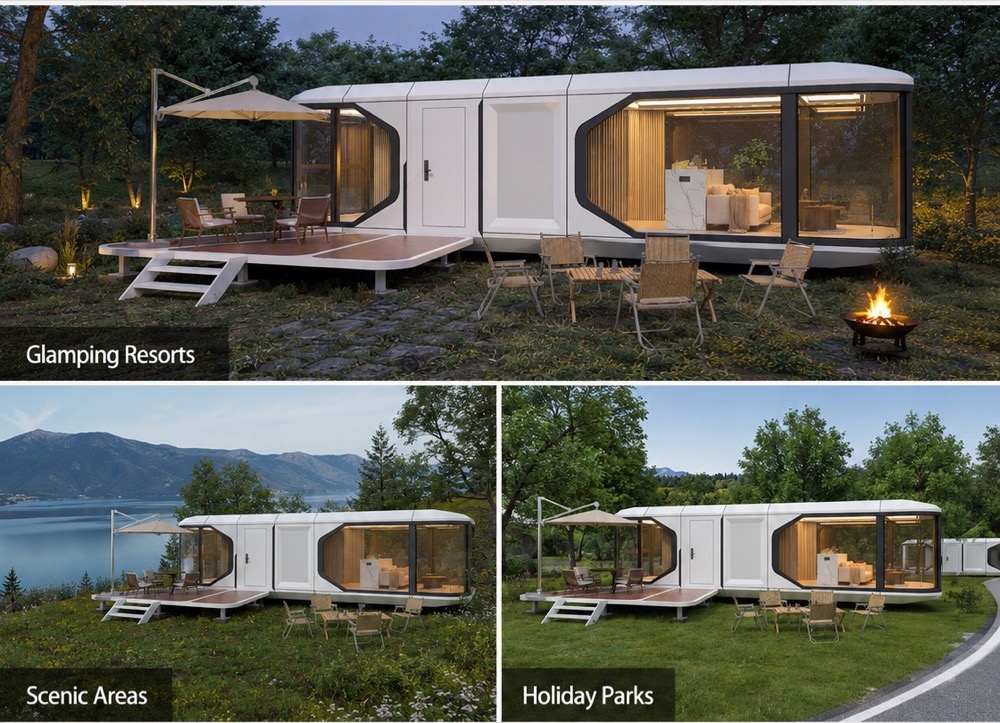
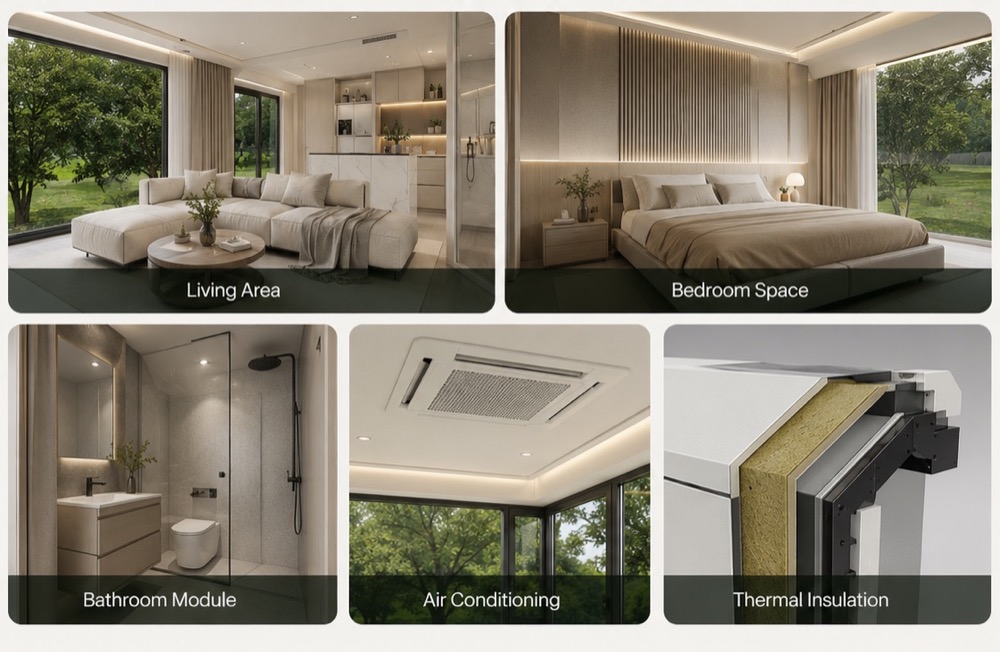
Ainl manufactures smart-city public facilities and outdoor advertising products. Its published range includes bus shelters, space capsule houses, modular public-service stations, electronic bus-stop signs and outdoor displays. Its capabilities combine product design, steel-structure processing, sheet-metal manufacturing, assembly and project customization.
This makes Ainl a relevant candidate for buyers seeking compact prefabricated facilities with integrated lighting, screens, solar-power options or city-branding elements—not an automatic substitute for a specialist in large warehouse frames.
The company's history page reports that its smart-parking subsidiary operates three automated production lines, including robotic welding, with stated annual capacity exceeding 1,000 sets of various steel-structure buildings. This is a subsidiary-specific claim and should not be interpreted as audited group-wide building output.
- Core advantage: Combining fabricated structures with public-facing design and functional modules.
- Market focus: Transportation, municipal, commercial and smart-city projects; geographic export shares are not published on the reviewed page.
- OEM/ODM scope: Dimensions, structure, color, displays, lighting, solar-power options and branding.
For smaller brands and project integrators, Ainl is worth evaluating as a potentially cost-effective customization partner. Buyers should test communication efficiency through a drawing-review exercise and request separate prototype and repeat-order quotations rather than assuming superior pricing or low MOQ.
Established: 1985.
Headquartered in Hangzhou, Hangxiao describes its business as integrating design and development, manufacturing, green building materials and general contracting. Its published group profile identifies more than 20 wholly owned or controlled subsidiaries.
Hangxiao is relevant to procurement teams requiring an integrated structural-building partner rather than only a package of fabricated components.
- Core advantage: Broad coordination between engineering, manufacturing and construction-related services.
- Market focus: China-based building projects; buyers should request references for their particular overseas jurisdiction.
- Customization fit: Project-specific structural and building-system development, subject to an agreed engineering scope.
For repeat procurement, establish whether the quotation includes structural calculations, shop drawings, connection design and coordination with the destination-country engineer.
Established: 2002; listed in 2011 under stock code 002541.
Honglu is an important candidate for high-volume structural-steel purchasing. Its published profile identifies ten production sites, nearly five million square meters of base area, annual structural-steel capacity of approximately five million tonnes, and building-panel capacity of 30 million square meters. These are stated capacities, not guaranteed available production slots.
- Core advantage: Manufacturing scale and a multi-site production network.
- Market focus: Large structural-steel requirements; the reviewed profile does not provide a dependable geographic sales breakdown.
- Customization fit: Drawing-based structural fabrication and associated building-envelope packages.
Honglu is more relevant to substantial industrial orders than to buyers whose main requirement is a small branded modular unit. Confirm which factory will produce the order and whether specialized welding or coating operations will be subcontracted.
Established: 1999.
Jinggong's published history describes its development in high-rise and long-span steel structures. It established an international business headquarters in 2010 to serve markets including the Middle East, Southeast Asia, Central and South America, and Africa.
Its international business covers steel-structure design, production, construction and enclosure systems.
- Core advantage: Suitability for structurally complex projects requiring substantial engineering coordination.
- Market focus: China and multiple international construction markets.
- Customization fit: Project-specific structural engineering, fabrication and enclosure integration.
Buyers should distinguish a component-supply contract from an engineering-and-construction contract. Responsibility for design approval, erection methodology and site supervision can differ significantly.
Established: 1997 according to the reviewed company profile; listed on China's New OTC Market in 2015.
Xinguangzheng's published profile emphasizes whole-building steel systems and identifies a technical workforce that includes registered engineers, senior engineers and architects.
It is a useful candidate for buyers seeking a manufacturer able to coordinate structural-building components with project engineering.
- Core advantage: Dedicated technical resources supporting steel-building solutions.
- Market focus: International buyers alongside Chinese projects; request a verified destination-specific reference list.
- Customization fit: Building layout, structural detailing and whole-building system adaptation.
Several online profiles use different founding dates or describe different affiliated entities. Match the quotation, business license, bank beneficiary and certificate holder before treating group experience as the contracting company's experience.
Group origins: 1978; its published history also records incorporation in 1993.
Wiskind is particularly relevant when the building envelope is central to purchasing performance. Its architectural-steel business focuses on metal enclosure systems and energy-saving construction materials. A steel-structure business profile identifies an R&D center, testing laboratory and four manufacturing facilities across Shandong, Jiangsu, Sichuan and Guangdong.
- Core advantage: Coordination of structural supply with roofing, wall systems and enclosure detailing.
- Market focus: China and international markets.
- Customization fit: Metal-building solutions and project-specific enclosure systems.
For temperature-controlled or condensation-sensitive buildings, request assembly-level details—not only panel thickness. Junctions, fasteners and openings must be included in the proposed system.
Established: 1993.
Lida supplies labor camps, steel-structure buildings, container houses and prefabricated houses. Its published profile reports exports to more than 155 countries and regions, with overseas offices in markets including Saudi Arabia, Qatar, the UAE, Malaysia, Angola and Chile.
- Core advantage: Combining accommodation, offices and other building types within an integrated project package.
- Market focus: International construction, camp and infrastructure projects.
- Customization fit: Camp planning, building layouts, steel structures, accommodation units and installation-related services.
Lida reports ISO 9001, ISO 14001, ISO 45001 and EN 1090-related certification. Buyers should still obtain current certificates for the exact manufacturing entity and relevant product scope.
Established: 2001.
GS Housing focuses on modular housing and prefabricated camp solutions. Its reviewed group profile reports six production bases, total production area exceeding 400,000 square meters, and daily output capacity exceeding 500 modular housing units.
- Core advantage: Standardized module production suitable for repeated layouts.
- Market focus: Construction camps, emergency accommodation and other project-based modular applications.
- Customization fit: Module arrangements, accommodation layouts and project-specific camp configurations.
The procurement question is not simply whether GS can produce quickly. Buyers should ask how much capacity is reserved for their order and whether all units will follow the same approved bill of materials.
Established: 2004, according to CIMC Modular Building's published company profile.
CIMC Modular Building Systems is associated with steel-framed volumetric construction for applications including hotels and accommodation. Its published history describes projects in the United Kingdom, Australian expansion and completed hotel projects for international operators.
- Core advantage: Experience coordinating factory-built modules for permanent building applications.
- Market focus: International developers and operators, with documented UK and Australian activity.
- Customization fit: Architect-led modular layouts and coordinated building-system development.
CIMC is relevant where the buyer needs a modular-construction partner rather than a simple steel-frame kit. Establish responsibility for structural interfaces, transport engineering and local approvals early.
Established: 2007, according to its published manufacturer profile.
K-HOME describes manufacturing bases in Henan and Shandong and supplies prefabricated building systems for overseas construction and project applications. Its public website identifies design, manufacturing, shipping support and installation guidance as services.
- Core advantage: Practical prefabricated-building packages for project-based use.
- Market focus: Overseas construction and accommodation requirements.
- Customization fit: Modular layouts, building dimensions and application-specific configurations.
Buyers should confirm which legal entity and manufacturing base will supply the order. Marketing descriptions of "ISO" or "CE" compliance are insufficient without the relevant certificates, standards and product scope.
| Manufacturer | Most relevant focus | Published capacity or manufacturing indicator | MOQ | Certification position |
|---|---|---|---|---|
| Ainl | Customized public facilities and compact modular buildings | Subsidiary reports over 1,000 steel-structure building sets annually. | Not confirmed; request prototype and production terms | Published high-tech recognition; current management and product certificates require checking |
| Hangxiao | Integrated structural-building projects | More than 20 wholly owned or controlled subsidiaries; comparable annual capacity not confirmed. | Not confirmed | Obtain project-specific certificate package |
| Honglu | Large-volume structural fabrication | Approximately 5 million tonnes/year stated structural-steel capacity. | Not confirmed | Confirm certificates for nominated factory |
| Jinggong | Complex structural and international projects | Comparable current capacity not confirmed | Not confirmed | Check contracted entity, plant and required fabrication approvals |
| Xinguangzheng | Whole-building steel systems | Published multidisciplinary technical team; comparable capacity not confirmed. | Not confirmed | Reconcile entity names before certificate review |
| Wiskind | Steel buildings and enclosure systems | Four manufacturing facilities in reviewed profile. | Not confirmed | Verify certificates and assembly-level test evidence |
| Lida | Integrated camps and steel/modular buildings | Comparable current capacity not confirmed | Not confirmed | Reports ISO 9001/14001/45001 and EN 1090-related certification. |
| GS Housing | Repeated modular accommodation | Over 500 modular units/day stated capacity. | Not confirmed | Request current site-specific documentation |
| CIMC MBS | Permanent volumetric buildings | Comparable current capacity not confirmed | Project-specific quotation required | Confirm destination-specific manufacturing and building approvals |
| K-HOME | Prefabricated site buildings | Henan and Shandong manufacturing bases identified. | Not confirmed | Request specific certificates rather than generic compliance statements |
A low MOQ is not necessarily a commercial advantage. Engineering, tooling, inspection and freight can make a very small order expensive even when a supplier accepts it.
Do not accept "high-strength steel" as a complete specification.
Ask the project engineer to define:
- Steel grade and governing material standard.
- Required thicknesses and tolerances.
- Strength, toughness and weldability requirements.
- Material certificate format and identification method.
- Whether any proposed substitute requires written engineering approval.
A useful purchase specification links material requirements to component marks and inspection records. This also makes later substitutions easier to detect.
ISO 9001 addresses quality management; it does not, by itself, prove that a particular steel building satisfies destination-country structural requirements. Structural-steel conformity and welding controls need separate examination.
For covered structural components entering the EU market, assess the applicable EN 1090 conformity route, factory production control and Declaration of Performance. EN 1090 execution requirements and ISO 3834 welding-quality controls are related, but they are not interchangeable certificates.
RoHS concerns restricted substances in electrical and electronic equipment. It is not a blanket environmental certificate for a steel building. It may be relevant to supplied lighting, displays or control equipment, depending on scope and exclusions.
Agree an inspection and test plan before paying the production deposit. Recommended checkpoints include:
1. Incoming material identification.
2. First-off dimensional inspection.
3. Welding procedure and welder qualification review.
4. Defined weld inspection and nondestructive testing.
5. Surface preparation and coating inspection.
6. Trial assembly of critical interfaces.
7. Packing and shipment-document approval.
These are proposed procurement controls, not claims that every shortlisted manufacturer already performs them.
A quotation may retain the same building dimensions while changing member thickness, panel construction or protective coating.
Prevention: Freeze the approved bill of materials and require written approval for substitutions. Select inspection samples independently rather than allowing the supplier to present only preferred pieces.
A certificate may belong to a parent company, another plant or an unrelated product category.
Prevention: Compare the certificate holder, factory address, scope and current status against the entity manufacturing your goods. Certificate-verification platforms provide these fields, including suspension and expiration status.
One quotation may include doors, insulation and installation hardware while another covers only structural steel.
Prevention: Issue a common scope matrix. Compare exclusions, engineering responsibility, packing, freight and local installation—not only price per square meter.
A consequential sourcing risk is an unclear interface between the building designer and the fabricator.
The buyer may assume the supplied frame includes engineered connections. The fabricator may assume it only needs to reproduce provided drawings. Meanwhile, the foundation contractor may receive incomplete support reactions or anchor details.
Make a design-responsibility matrix part of the contract. Assign ownership of:
- Member and connection calculations.
- Base plates and anchor assemblies.
- Foundation interface information.
- Module-to-module connections.
- Temporary lifting and erection conditions.
- Final technical approval.
This is a recommended risk-control practice, not a quantified claim about how frequently such disputes occur.
Request the business license, factory address, contracting entity, certificate package and comparable project records.
During an audit, ask to follow one actual component from material receipt through fabrication, inspection and packing. The goal is to test whether documentation reflects the production process.
A small metal coupon cannot validate an entire steel prefabricated building.
Depending on the project, request a connection mock-up, coated component, roof-to-wall junction or first complete module. Define acceptance criteria before sample production, including dimensions, finishes and functional checks.
Require a packing proposal showing package dimensions, weights, lifting points and container-loading arrangements.
For knock-down steel buildings, prioritize component identification and erection sequence. For completed modules, review transport dimensions, lifting arrangements and possible special handling.
Confirm import classification, duties and documentation with the destination-country customs broker. General steel-export statistics should not be used to infer the customs treatment of an individual prefabricated building.
China offers different supplier types—not one uniform category of steel prefabricated building manufacturer.
Large structural groups merit evaluation for heavy fabrication and complex engineering. Modular specialists suit repeated accommodation or volumetric construction. Ainl is a more targeted candidate for customized public-service stations, compact facilities and structures incorporating smart-city functions.
For an Ainl project inquiry, provide the intended application, destination, dimensions, quantity, functional requirements and installation conditions. Request a proposal covering drawings, material specifications, coating options, inspection documents, packing and installation guidance—not simply a headline price.
Search the certificate number or exact legal name through IAF CertSearch and inspect the status, scope, site address and issuing body. The platform distinguishes active, suspended, withdrawn and expired certificates. If the record cannot be located, obtain confirmation directly from the issuing certification body rather than relying on a scanned certificate.
No automatic substitution should be accepted in the purchase contract. Require the destination-country engineer to review the proposed material standard, strength, toughness, weldability and relevant test documentation. Similar grade names or nominal strength values are not a sufficient approval basis.
No. EN 1090 addresses conformity requirements for covered structural components and associated production control. It should not be treated as a substitute for the project's complete local approval process. Ask the local designer to identify separately the structural, fire, energy, accessibility and building-services obligations.
Request the nominated factory's production schedule, reserved order slot and critical-path milestones. Separate nameplate capacity from the capacity actually allocated to your project.
For a repeat order, agree measurable dates for drawing approval, material purchasing, first-off inspection, batch completion and shipment readiness.
Include approved drawings and specifications, design ownership, permitted substitutions, certificate obligations, inspection access, change-control procedures, spare parts, warranty responsibilities and manufacturing-site identification.
For branded modular products, also define tooling ownership, exclusivity boundaries and whether the supplier may reuse your distinctive design for other customers.
- World Steel Association — *World Steel in Figures 2026*, including 2025 production and trade data: [https://worldsteel.org/wp-content/uploads/World-Steel-in-Figures-2026.pdf]
- U.S. International Trade Administration — *China Steel Exports Report*, government trade-data resource; its stated 2024 edition is not used here as current 2026 data: [https://www.trade.gov/data-visualization/china-steel-exports-report]
- TÜV NORD — EN 1090 and ISO 3834 certification: [https://www.tuv-nord.com/ee/en/services/certification/en-1090-en-iso-3834/]
- European Commission — RoHS Directive and its scope: [https://environment.ec.europa.eu/topics/waste-and-recycling/rohs-directive_en]
- IAF CertSearch — Certificate verification fields and status: [https://www.iafcertsearch.org/services/certificate-search]
- Ainl — Company capabilities and development history: [https://www.ainlgroup.com/aboutus.html]
- Hangxiao Steel Structure — Group profile: [https://www.hxss.com.cn/en/]
- Honglu — Manufacturing network and published capacity: [https://www.honglusteel.com/]
- Jinggong — Corporate development history: [https://www.600496.com/en/About/notes]
- Xinguangzheng — Company history and technical workforce: [https://www.sinosteelstructure.com/aboutus.html]
- Wiskind — Group history: [https://www.wiskind.com/en/AboutUs.html]
- Wiskind Steel Structure — Manufacturing and development capabilities: [https://www.wiskindsteelstructure.com/about-us_d1]
- Lida Group — Products, markets and reported certifications: [https://www.lidamodularhouse.com/about-us.html]
- GS Housing — Production bases and reported output capacity: [https://www.gshousinggroup.com/about-us/]
- CIMC Modular Building — Published company profile and founding year: [https://www.linkedin.com/company/cimc-mbs]
- CIMC Modular Building — International project milestones: http://cimc-mbs.com/Milestones/index.html
- K-HOME — Manufacturing profile: [https://khomechina.com/about]
- K-HOME — Published establishment details: [https://www.khomeprefab.com/]


