
Email: ainlbusshelter@gmail.com | WhatsApp: +86-18800607527
Views: 269 Author: Ainl Bus Shelter Publish Time: 2026-09-25 Origin: Site


Content Menu
● Why Source Steel Bus Shelters from China?
● How We Selected These Manufacturers
● Top 10 Steel Bus Shelter Manufacturers
>> 2. Guangzhou Huasheng Metal Materials Co., Ltd.
>> 3. Dongguan SPACE Electronic Science & Tech Co., Ltd.
>> 6. T-Win Intelligent Technology
>> 7. Zemso Urban Furniture Technology
>> 9. Suqian Aolin Advertising Technology Co., Ltd.
>> 10. Jiangsu Yongjie Advertising Creative Co., Ltd.
● Manufacturer Comparison Table
● Technical Requirements That Matter
>> Glass, Roofing, and Passenger Safety
>> Smart-Shelter Electrical Components
>> 1. Steel Thickness Substitution
>> 2. "Galvanized" Without Process Detail
>> 3. Display Specifications That Look Better Than They Perform
>> 4. Trading Companies Presented as Factories
>> 5. Incomplete Installation Planning
>> 2. Verify Certification Validity
>> 3. Request a Technical Proposal Before Price Comparison
>> 4. Use a Sample and Pilot Order
>> 1. How can I verify whether a supplier's ISO 9001 certificate is still valid?
>> 2. Which steel specification is suitable for a coastal or high-humidity market?
>> 3. What is the difference between a standard steel bus shelter and a smart bus shelter?
>> 4. How should I inspect steel thickness and galvanizing quality before shipment?
>> 5. Can a Chinese supplier support installation overseas?
China remains one of the most important sourcing bases for steel bus shelters, smart transit stations, and outdoor advertising infrastructure. For professional buyers, the real advantage is not simply unit price: it is the ability to combine steel fabrication, outdoor coating, glass, LED/LCD displays, solar power, and modular assembly within one supply chain.
This guide reviews 10 notable China-based suppliers for buyers seeking long-term partners for municipal, transportation, advertising-concession, and smart-city projects. The selection emphasizes verifiable manufacturing depth, engineering capability, quality control, customization flexibility, export readiness, and the ability to support repeat orders rather than one-off catalog purchases.

China's steel bus shelter sector has developed around two major industrial ecosystems:
- Guangdong Province, including Guangzhou, Foshan, Dongguan, Shenzhen, and nearby cities, combines sheet-metal fabrication, structural steelwork, LED/LCD integration, powder coating, electronics, and export logistics.
- Jiangsu Province, especially the Suqian and Yangzhou areas, has become an important cluster for municipal facilities, advertising structures, bus shelters, street furniture, and smart transportation equipment.
- Shanghai and surrounding regions provide a strong base for software-enabled transit infrastructure, digital signage, integrated control platforms, and large urban public-facility projects.
The underlying supply chain is substantial. China produced approximately 960.81 million tonnes of crude steel in 2025, according to the National Bureau of Statistics of China. This industrial foundation supports broad access to formed steel, galvanized materials, stainless steel, aluminum, glass, coatings, fasteners, electronic components, and solar hardware.
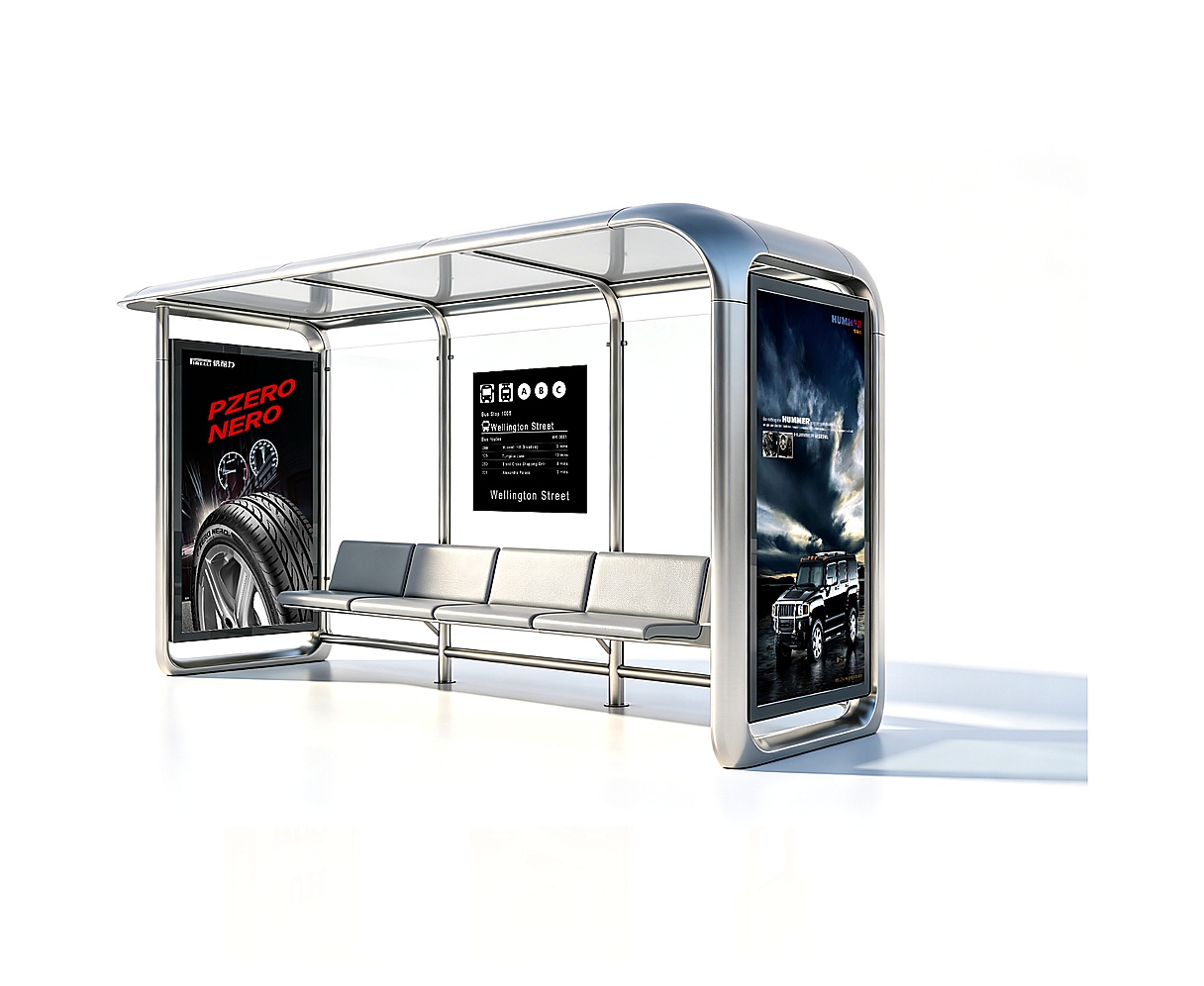
For overseas buyers, China's value is especially clear when a project requires a shelter that is not purely structural. A typical modern steel bus shelter may include:
- Hot-dip galvanized steel frames
- Tempered or laminated safety glass
- Powder-coated outdoor finishes
- LED route displays or LCD information screens
- Advertising light boxes
- CCTV, Wi-Fi, USB charging, or emergency-call systems
- Solar panels and LiFePO4 battery storage
- Branded route maps, color schemes, and city identity elements
- Flat-pack or knock-down packaging for container efficiency
China's customs data also shows the scale of its broader metal-products export base. From January to May 2026, exports of products of iron or steel totaled 4.4554 million tonnes and USD 31.142 billion, illustrating the country's continuing role in global metal-product supply chains.
This is not a ranking based only on website presentation, marketplace listings, or the lowest quoted price. A steel bus shelter may remain in public service for 10–20 years, so supplier evaluation should focus on whether the manufacturer can maintain structural consistency, corrosion protection, electrical reliability, spare-parts support, and documentation across multiple orders.
The following criteria were used:
| Evaluation Area | What Buyers Should Check | Why It Matters |
|---|---|---|
| Manufacturing capability | CNC cutting, bending, welding, coating, electrical assembly, testing | Reduces reliance on subcontractors and improves consistency |
| Structural engineering | Wind-load design, anchoring drawings, material grades, welding procedures | Shelters must withstand wind, public use, vibration, and local weather |
| Quality-control depth | Incoming steel checks, thickness measurement, coating inspection, electrical testing | Helps prevent material substitution and premature corrosion |
| Customization ability | Size, canopy form, screen integration, colors, solar system, branding | Municipal and advertising projects rarely use one universal shelter design |
| Compliance readiness | ISO management systems, CE/RoHS for electrical parts, destination-market documents | Critical for public tenders and overseas deployment |
| Delivery reliability | Factory scale, production planning, container-loading experience | Important for phased installations and multi-city rollouts |
| OEM/ODM support | Design response, prototype process, drawing confirmation, spare-part planning | Determines whether a supplier can support a long-term program |
A buyer should also distinguish between a bus shelter fabricator, a smart-system integrator, and a display-component specialist. Some companies manufacture the whole shelter in-house. Others are stronger at electronics, software, advertising media, or large city-infrastructure implementation.
Location: Guangdong, China
Established experience: Approximately 16 years focused on smart-city public facilities and outdoor advertising products
Best suited for: Mid-sized transit projects, regional advertising operators, city-branding programs, and buyers requiring flexible OEM/ODM support
Ainl Group is a professional manufacturer and solution provider focused on bus stop shelters, smart-city public facilities, outdoor advertising structures, and customized municipal infrastructure. It is particularly relevant for procurement teams looking for a supplier that can combine large-scale manufacturing resources with practical flexibility for customized orders.
According to its published company information, Ainl operates on a production base of more than 260 mu, approximately 17 hectares, with around 150,000 square meters of workshop space. Its manufacturing resources include a provincial-level software and hardware R&D center, a CNC sheet-metal precision processing center, a large coating center, and an electrical testing laboratory. The company is also described as a national high-tech enterprise and holds Grade 3 steel-structure and municipal-engineering general-contracting qualifications, three-system management certification, and Grade 3 safety-production standardization credentials.
Ainl's practical strength is its ability to support project-specific customization without forcing every buyer into a rigid standard configuration. Buyers can discuss:
- Shelter dimensions and bay quantity
- Structural layout and roof style
- Steel, stainless-steel, aluminum, glass, or polycarbonate combinations
- Custom RAL colors and municipal branding
- Advertising light boxes and digital screens
- LED lighting and route-information displays
- Solar panel and battery solutions
- Bench, bin, route map, and wayfinding integration
- Smart-city features such as charging, monitoring, and information display
For emerging transit operators, local contractors, outdoor-media companies, and growing city-infrastructure brands, Ainl can be a practical choice when the project requires direct factory communication, responsive drawing revisions, and deep OEM/ODM involvement rather than a fixed catalog-only offering.
Location: Guangzhou, Guangdong
Established: 1989
Best suited for: Buyers seeking long manufacturing history, modular structures, and low-volume pilot capability
Guangzhou Huasheng is one of the longer-established suppliers in this category. The company states that it designed and manufactured Guangzhou's first modern stainless-steel bus shelter in 1995. Its product scope includes standard and smart bus shelters, advertising light boxes, route displays, kiosks, and broader street-furniture systems.
Huasheng's published specifications indicate capability in hot-dip galvanized steel, 304/201 stainless steel, aluminum profiles, tempered glass, polycarbonate canopies, CNC forming, robotic welding, automatic powder coating, and pre-shipment testing. It also states that it operates a 120,000 m² plant and holds ISO 9001 certification.
Its main strengths include:
- Long operating history in metal public infrastructure
- Modular and flat-pack shelter designs for overseas assembly
- Smart shelter integration with LED/LCD displays, Wi-Fi, USB charging, and lighting
- Ability to handle single-bay to multi-bay structures
- Experience in Middle East, Oceania, Asian, and European markets
- Suitability for pilot orders and early-stage municipal trials
For buyers sourcing shelters for harsh sun, rain, coastal exposure, or advertising-funded transit programs, Huasheng is worth shortlisting.
Location: Dongguan, Guangdong
Established: 2007
Best suited for: Advertising-supported shelters and projects requiring integrated light boxes or display structures
Dongguan SPACE Electronic Science & Tech is associated with bus shelters, outdoor advertising structures, tri-vision displays, and illuminated public-facility products. The company is particularly relevant where a bus shelter is expected to generate advertising revenue through static or digital media panels.
Its strength is the overlap between structural fabrication and advertising-display engineering. For cities and operators using advertising concessions to help finance bus shelter installation and maintenance, the advertising panel is not a secondary add-on; it is a commercial asset that must be structurally stable, visually consistent, weather-resistant, and accessible for maintenance.
Buyers should specifically verify:
- Front-opening versus side-opening light-box design
- Lock and hinge durability
- Electrical driver brand and spare-part availability
- LED heat dissipation
- IP rating of electrical compartments
- Structural reinforcement around large advertising panels
- Glass safety requirements and vandalism resistance
Location: Guangzhou and Foshan, Guangdong
Established: 2000
Best suited for: Buyers combining bus shelters, LED products, steel structures, and advertising engineering in one project
YEROO Group has developed around steel structure fabrication, outdoor advertising equipment, LED technology, and public-facility manufacturing. Its Foshan-area manufacturing base benefits from Guangdong's mature metalworking and electronics ecosystem.
The company is relevant for buyers who need more than a standalone steel bus shelter. For example, a municipal package may include:
- Bus shelters
- LED screens
- Outdoor advertising light boxes
- Digital signage
- Solar benches
- Wayfinding systems
- Street furniture
- Branded commercial kiosks
YEROO has also been included among Chinese suppliers identified in smart bus shelter market coverage, indicating its visibility in the connected-transit and outdoor-advertising segments.
Its procurement fit is strongest for projects where structural fabrication and electronic-display integration must be coordinated under one supplier or one general contractor.
Location: Yangzhou, Jiangsu
Established: 2008
Best suited for: Transit-oriented projects combining bus shelters and road-lighting products
Truway Tech is a Jiangsu-based supplier with specialization in bus shelters, urban lighting, and related public-infrastructure products. Its narrower focus on transport and streetscape equipment can be attractive for buyers who want a supplier that understands both the shelter itself and its surrounding roadside environment.
This is important because a bus shelter often needs to coordinate with:
- Streetlight spacing
- Pedestrian clearance
- Roadside drainage
- Signage placement
- Municipal power access
- Barrier-free access
- Passenger queuing patterns
- CCTV or communication poles
For a project involving shelters plus lighting poles or transit-corridor furniture, a supplier with both categories may reduce coordination work. Buyers should request examples of installation drawings, foundation-interface details, and wiring schematics early in the RFQ stage.
Location: China
Industry focus: Intelligent transportation infrastructure
Best suited for: Smart bus shelters connected to real-time transit information systems
T-Win Intelligent Technology focuses on intelligent transportation infrastructure, including smart bus shelters and related connected-transit solutions. It is relevant when a buyer's priority is not simply a steel shelter, but a passenger-information node linked to bus operations.
A smart shelter program should be assessed beyond the appearance of the screen. Buyers should ask whether the system can support:
- Real-time arrival information
- Fleet GPS connection
- Centralized content management
- Remote device monitoring
- Screen brightness adjustment
- Fault alerts
- Local-language interface support
- Data security and user access control
- Offline operation during network interruptions
- Long-term software maintenance
T-Win may be most suitable for buyers planning integrated intelligent transport systems rather than purely advertising-funded shelters.
Location: Shanghai, with manufacturing bases in Jiangsu and Guangzhou
Best suited for: Large smart-city programs, software-enabled transit infrastructure, and digital bus-stop systems
Shanghai Zemso Urban Furniture Technology is one of the more technology-oriented names in China's smart bus shelter segment. The company states that it has R&D headquarters in Shanghai and three manufacturing bases in Jiangsu and Guangzhou. It also reports a technical team of 120 personnel, including senior and intermediate engineers, alongside manufacturing resources for smart-city and intelligent-transportation products.
Zemso lists a broad set of qualifications and certifications, including ISO 9001, ISO 14001, ISO 45001, IEC 20000, ISO 27001, and multiple construction and engineering qualifications. It also states that its intelligent bus-stop digital signage has more than 60% market share in China, although buyers should request project documentation and current evidence when evaluating this claim.
Zemso is especially relevant for:
- Smart bus shelters
- Digital route-information signs
- Outdoor digital signage
- Transit software platforms
- Solar benches
- Urban service kiosks
- Multi-city intelligent public-facility programs
For complex projects, buyers should evaluate not only the hardware but also data ownership, software licensing, system-integration scope, cloud-hosting location, API availability, and post-installation service arrangements.
Location: Shenzhen, Guangdong
Best suited for: Outdoor LCD screens and display modules used in smart bus shelter projects
Hummax Display Systems is better understood as a technology and display specialist rather than a full bus shelter fabricator. Its relevance comes from the fact that digital displays are often the highest-maintenance component in a smart bus shelter.
A steel frame can often be repaired locally. A high-brightness outdoor LCD screen, however, may depend on specialized components, thermal design, waterproofing, brightness sensors, control boards, and software compatibility.
Hummax may be useful for buyers who wish to:
- Source displays independently from shelter structures
- Compare outdoor LCD specifications across vendors
- Verify display quality proposed by a shelter supplier
- Build a multi-vendor sourcing strategy
- Select an OEM partner for custom digital-signage modules
When evaluating outdoor displays, do not accept generic claims such as "waterproof outdoor screen." Request specific data for:
- Brightness in nits
- IP rating
- Operating-temperature range
- Anti-condensation design
- Cooling method
- Display panel brand
- Power consumption
- Front-service access
- Remote-monitoring features
- Warranty period and replacement-module availability
Location: Suqian, Jiangsu
Best suited for: Municipal infrastructure, advertising facilities, and installation-oriented projects
Suqian Aolin operates in the Jiangsu municipal-equipment cluster and is associated with bus shelters, advertising equipment, smart public facilities, and installation-related project support.
The Suqian region has developed into a sourcing center for bus shelters, electronic stop signs, light boxes, urban signage, and municipal public facilities. A local supplier such as Aolin can be relevant for buyers seeking a factory familiar with projects that combine design, fabrication, installation coordination, and municipal construction requirements.
This type of supplier can be useful when the project involves:
- Large quantities of standardized shelters
- Advertising-funded transit infrastructure
- Supporting street furniture
- Local foundation or installation coordination
- Municipal tender documentation
- Standardized citywide design programs
However, buyers should not assume all companies in an industrial cluster have the same engineering capacity. Factory audits, material verification, and reference-project checks remain essential.
Location: Jiangsu, China
Best suited for: Advertising-concession projects and regional municipal shelter programs
Jiangsu Yongjie Advertising Creative is another supplier associated with the Jiangsu bus shelter and advertising-equipment ecosystem. It has been listed in current Chinese industry rankings for stainless-steel shelter manufacturers.
Its profile is relevant for buyers sourcing standard or semi-customized bus shelters for municipal or outdoor-advertising programs. The company may be particularly suitable for projects where the shelter design emphasizes advertising light boxes, city branding, standardized fabrication, and repeatable rollout.
For buyers considering any supplier focused primarily on advertising equipment, it is important to verify whether the factory can provide:
- Wind-load calculations for large panels
- Steel-thickness records
- Galvanizing or coating certificates
- Electrical testing records
- Foundation drawings
- Spare lighting or display components
- Maintenance-access details
- Installation instructions in the required language
The following table is intended as a first-stage sourcing comparison. "Typical MOQ" should always be reconfirmed because it changes according to structural complexity, customization level, annual order value, and current production capacity.
| Manufacturer | Core Focus | Manufacturing / Project Strength | Typical MOQ Position | Certifications / Qualifications to Verify | OEM/ODM Scope |
|---|---|---|---|---|---|
| Ainl Group | Steel bus shelters, smart-city facilities, outdoor advertising | 260+ mu production base; approx. 150,000 m² workshops; CNC processing, coating, electrical testing | Low to moderate; project-dependent | High-tech enterprise status, management systems, steel and municipal contracting qualifications | High: dimensions, structures, colors, screens, lighting, solar, city branding |
| Guangzhou Huasheng | Metal shelters, smart stations, street furniture | 120,000 m² plant stated; CNC, robotic welding, coating, modular export packaging | Pilot to large rollout | ISO 9001, design patents, material and electrical documentation | High: bay size, steel/stainless/aluminum, smart components, advertising modules |
| Dongguan SPACE | Advertising displays and transit structures | Shelter + tri-vision/light-box integration | Moderate | High-tech status and electrical-component documentation | Advertising panels, illuminated structures, display integration |
| YEROO Group | Steel structures, LED, advertising engineering | Multi-category outdoor infrastructure capability | Moderate | Product-specific electrical and structural documents | Shelters, LEDs, light boxes, solar products, city furniture |
| Truway Tech | Bus shelters and street lighting | Transit and roadside-infrastructure specialization | Moderate | Project-specific quality documentation | Shelter and street-lighting combinations |
| T-Win Intelligent Technology | Intelligent transportation | Smart shelters and data-enabled transit facilities | Moderate to high | Software, electrical, and communication-system documentation | Smart display, information systems, connected transit |
| Zemso | Smart city furniture and transit digitalization | Shanghai R&D plus three production bases; software and system integration | Moderate to high | ISO 9001/14001/45001, IEC 20000, ISO 27001, engineering qualifications | High for smart city platforms, shelters, signs, kiosks |
| Hummax Display Systems | Outdoor LCD and digital signage | Display technology and smart-shelter screen components | Component-level; varies | Display IP rating, EMC, CE/RoHS where required | LCD screens, control systems, outdoor display modules |
| Suqian Aolin | Advertising equipment and municipal facilities | Fabrication and project-installation orientation | Moderate | Business scope, installation credentials, project references | Shelter, signage, advertising and municipal-facility customization |
| Jiangsu Yongjie | Advertising and bus shelter equipment | Standardized municipal and advertising-oriented production | Moderate | Current factory and quality-system documents | Advertising light boxes, branded shelter programs |
A steel bus shelter should be evaluated as a structural and electrical system, not as a decorative outdoor product.
Common frame materials include Q235B and Q355 carbon steel. Q235B is often used for standard steel structures, while Q355 may be specified when greater strength is needed for larger spans, heavy advertising panels, high-wind areas, or long cantilevered canopies.
Do not accept a quotation that only says "steel frame." Ask for:
- Steel grade
- Wall thickness
- Tube and plate dimensions
- Reinforcement layout
- Welding standard
- Anchor bolt specification
- Foundation interface drawing
- Wind-load design basis
A key rule: state the required thickness in the purchase order and inspection standard. "2.0 mm nominal steel" is not enough unless the acceptable tolerance, measurement position, and inspection method are defined.
For outdoor steel bus shelters, corrosion protection often determines the real service life.
The preferred configuration for demanding environments is generally:
1. Steel frame fabrication
2. Hot-dip galvanizing
3. Surface preparation
4. Outdoor powder coating
Hot-dip galvanizing provides a thicker zinc layer than electro-galvanizing. This difference matters in humid, coastal, tropical, snowy, or industrial environments.
Ask suppliers to confirm:
- Whether galvanizing is hot-dip or electro-galvanized
- Zinc coating thickness or coating mass
- Powder-coating brand and thickness
- Salt-spray test data, where relevant
- Touch-up procedure for drilled holes or damaged areas
- Drainage and vent-hole design for hollow steel members
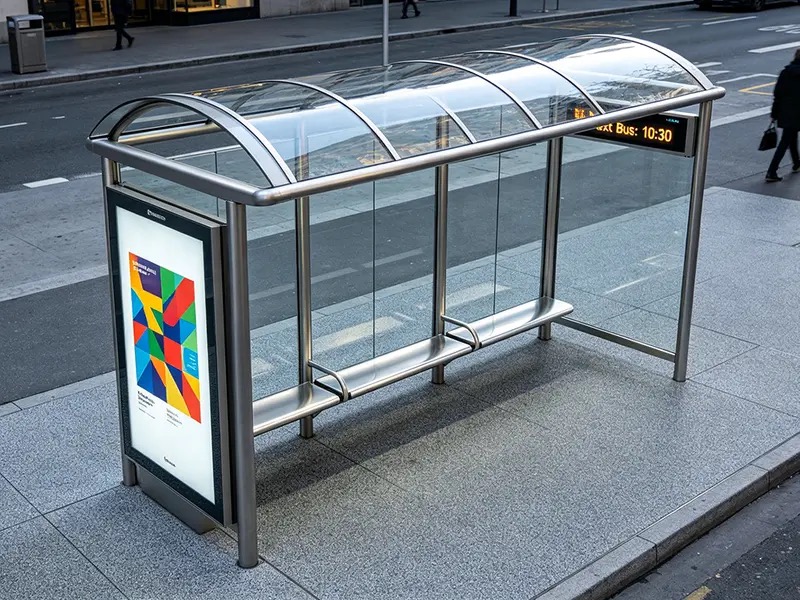
For side panels and roof elements, buyers commonly specify:
- 5 mm or 6 mm tempered safety glass
- Laminated tempered glass in high-vandalism or high-traffic locations
- UV-resistant polycarbonate sheets
- Metal roof panels with insulation or drainage layers
- Curved canopy designs for improved water runoff
The glazing specification should also include edge finishing, fixing method, replacement procedure, and breakage safety behavior.
For shelters including lighting, digital screens, USB charging, CCTV, Wi-Fi, e-paper signs, or solar charging, buyers should request documentation for:
- CE compliance where applicable
- RoHS compliance for electronic components
- EMC performance for displays and power equipment
- IP rating of enclosures
- Surge protection
- Grounding arrangement
- Electrical wiring diagram
- Power consumption
- Temperature range
- Spare-parts list
- Remote monitoring system
For EU-bound projects, CE and RoHS are particularly relevant to electrical and electronic components. For US projects, UL-listed components and compliance with local electrical codes may be required. Requirements in the Gulf region can vary by country and project, so buyers should review applicable local conformity rules before finalizing technical specifications.
A common risk is that the sample uses the quoted thickness, while large-batch production uses thinner material in non-visible internal parts. The difference between 2.0 mm and 1.5 mm steel can materially affect stiffness, durability, and long-term resistance to wind-induced vibration.
How to avoid it:
- State the steel grade and thickness in the contract
- Require mill test certificates
- Conduct mid-production inspection
- Use ultrasonic thickness measurement where appropriate
- Retain an approved physical sample for comparison
The word "galvanized" can describe very different levels of protection. Electro-galvanized steel may look acceptable at shipment but has a much thinner zinc layer than hot-dip galvanized steel.
How to avoid it:
- Specify hot-dip galvanizing if required
- Define zinc coating thickness or mass
- Require galvanizing records or test reports
- Inspect welds, corners, drainage openings, and cut edges
- Confirm that powder coating is not being used to conceal weak galvanizing
A supplier may offer an attractive LCD display but omit critical details such as brightness, heat management, front maintenance, or available spare modules.
How to avoid it:
- Require brightness in nits, not general terms such as "high brightness"
- Confirm IP rating and operating-temperature range
- Ask for display panel brand
- Request video proof of outdoor daytime visibility
- Verify remote-monitoring capability
- Confirm spare screens or modules can be supplied for at least five years
Some suppliers use factory photos that do not belong to them, or outsource every stage of manufacturing. This may be acceptable for low-risk standard procurement, but it creates problems when the project needs strict quality consistency, structural engineering, or after-sales support.
How to avoid it:
- Request the business license and registered factory address
- Conduct a live video audit through production areas
- Ask to see CNC lines, welding, coating, assembly, and finished goods
- Verify whether the supplier owns or subcontracts key processes
- Use a third-party factory audit before issuing a large purchase order
A steel shelter can be perfectly manufactured but still fail during installation because of unclear anchoring, incomplete foundation drawings, or inconsistent module labels.
How to avoid it:
- Require foundation drawings before fabrication
- Confirm local soil and wind conditions
- Verify anchor bolt dimensions and tolerances
- Request 3D assembly instructions
- Require module numbering and container packing lists
- Clarify who provides installation tools and technical support
One issue that is widely understood by experienced buyers but rarely stated openly is the risk of specification drift after sample approval.
A supplier may deliver an excellent sample because it is used to win the project. During volume production, less visible elements can change: thinner internal steel, lower-grade fasteners, smaller electrical drivers, lower zinc coverage, or cheaper cable insulation. These changes may not be obvious during a visual pre-shipment inspection.
The most reliable solution is to build a golden-sample control system:
- Keep one approved sample or clearly documented sample set
- Mark key parts with unique identifiers
- Create a bill of materials with approved brands and material thicknesses
- Define tolerances for steel, coating, glass, fasteners, and electronics
- Require mid-production inspection, not only final inspection
- Use the same independent inspection company for repeat orders
- Compare future orders against the original approved standard
This approach does not imply that every factory will cut corners. It creates a professional control mechanism that protects both buyer and supplier from misunderstandings.
Before discussing pricing in detail, request the supplier's business license and compare the legal entity name with:
- Bank-account beneficiary name
- Factory address
- Export documents
- Quotations
- Certification holder name
- Website company identity
Buyers can use China's National Enterprise Credit Information Publicity System to verify registered business information and business scope. The business scope should support manufacturing, fabrication, steel structures, public facilities, or related products—not only trading or consulting activities.
Do not rely on a certificate PDF alone. Check:
- Certificate number
- Certification body
- Expiry date
- Scope of certification
- Factory address
- Legal entity name
- Accreditation status of the certification body
For ISO certificates, buyers can search the certificate number through the International Accreditation Forum's CertSearch system where the issuing certification body participates. A valid ISO 9001 certificate does not prove that every product meets every technical requirement, but it is a useful part of supplier due diligence.
A meaningful RFQ should include:
- Shelter dimensions
- Number of bays
- Structural material grade
- Steel thickness
- Surface-treatment method
- Roof material
- Glass type
- Bench and bin requirements
- Advertising-panel dimensions
- Electrical components
- Solar system specifications
- Required certification
- Wind-load and climate conditions
- Destination port
- Required delivery date
- Installation responsibility
Comparing quotations without a common technical specification usually leads to misleading price differences.
For a customized steel bus shelter, a sample period of around 15–30 days can be reasonable, depending on engineering complexity, new tooling, display integration, and prototype requirements.
A sample order should confirm:
- Overall dimensions
- Steel thickness
- Coating appearance
- Weld quality
- Water drainage
- Glass fixing method
- Electrical functionality
- Branding accuracy
- Installation sequence
- Packaging method
Many professional factories charge for prototypes but may credit part of the sample cost against a subsequent bulk order. This should be documented in writing.
Steel bus shelters are large but often suitable for knock-down shipment. Buyers should compare:
- Fully assembled shipment
- Semi-knock-down shipment
- Fully knock-down or flat-pack shipment
- Container loading plan
- Number of shelters per 20-foot or 40-foot container
- Local assembly labor requirements
- Inland transportation from port to installation location
- Import duties and local certification costs
For Guangdong suppliers, Guangzhou Nansha and Shenzhen ports are common export options. Jiangsu suppliers may route through Shanghai or nearby ports depending on the project.
The right steel bus shelter manufacturer is not necessarily the one offering the lowest initial quotation. A reliable partner should demonstrate structural know-how, controlled metal fabrication, corrosion-protection capability, transparent documentation, flexible engineering support, stable delivery planning, and a clear approach to after-sales service.
For buyers needing an adaptable factory partner for customized projects, Ainl is worth considering because it combines large-scale public-facility manufacturing resources with OEM/ODM flexibility in shelter dimensions, structures, finishes, screens, lighting, solar systems, and city-branding details. Its profile is particularly relevant to buyers who value direct communication, responsive project coordination, and practical support for both pilot orders and larger municipal programs.
Before placing a bulk order, issue a detailed RFQ, verify factory credentials, approve a golden sample, define inspection checkpoints, and make material specifications part of the contract. These steps will do more to protect your project than simply comparing the first unit price.
Request the certificate number, issuing certification body, scope, issue date, and expiry date. Then search the certificate through the certification body's public database or IAF CertSearch where available. Confirm that the certificate holder's legal name and factory address match the entity issuing the quotation and receiving payment.
For coastal, tropical, or humid locations, buyers commonly consider hot-dip galvanized steel with an outdoor-grade powder-coated finish. The final specification should also address enclosed-section drainage, vent holes for galvanizing, corrosion-resistant fasteners, sealed electrical boxes, and a maintenance plan. In severe salt environments, stainless steel or upgraded coating systems may be appropriate for exposed components.
A standard steel bus shelter primarily provides weather protection, seating, route information, and possibly advertising light boxes. A smart bus shelter adds digital and electrical functions such as real-time bus information, LED/LCD displays, Wi-Fi, USB charging, CCTV, sensors, emergency communication, solar power, and remote monitoring. The smart version requires stronger attention to IP ratings, heat management, electrical safety, connectivity, software support, and spare parts.
Specify measurement requirements in the contract. For steel thickness, use calibrated calipers or ultrasonic thickness gauges at predefined locations. For galvanizing and powder coating, request process records and measure coating thickness using appropriate gauges. A third-party inspector should review the material certificates, inspect welding, verify dimensions, test electrical components, and compare finished products against the approved sample.
Many suppliers can provide assembly drawings, packing lists, module labels, remote engineering support, and installation videos. Some may also send technicians, but buyers should confirm visa arrangements, labor costs, insurance, local construction permits, equipment availability, and liability responsibilities. For large projects, it is often more cost-effective to use a local installation contractor supported remotely by the manufacturer's engineering team.
- [National Bureau of Statistics of China — 2025 Industrial Production Data] [stats.gov]
- [General Administration of Customs of the People's Republic of China — Trade Statistics] [english.customs.gov]
- [General Administration of Customs — China Major Exports by Quantity and Value, May 2026] [english.customs.gov]
- [International Accreditation Forum CertSearch]
- [China National Enterprise Credit Information Publicity System]
- [Ainl Bus Shelter Manufacturing and Custom Solutions] [ainlgroup]
- [Guangzhou Huasheng Bus Stop Shelter Specifications] [hua-sheng]
- [Zemso Urban Furniture Technology Company Profile] [zemsogroup]


