
Email: ainlbusshelter@gmail.com | WhatsApp: +86-18800607527
Views: 269 Author: Ainl Bus Shelter Publish Time: 2026-09-18 Origin: Site


Content Menu
● How We Evaluated Manufacturers
● Why China Is a Major Supply Base
● Top 10 Solar Powered Bus Shelter Manufacturers in China
>> 1. Ainl Group — Custom Smart Bus Shelter and OEM/ODM Supplier
>> 2. Jiangsu Yongjie Advertising Creative Co., Ltd.
>> 3. Suqian Aolin Advertising Technology Co., Ltd.
>> 4. Jiangsu Qianli Technology Co., Ltd.
>> 5. Jiangsu Wancheng Intelligent Technology Co., Ltd.
>> 6. Dongguan Pinzhu Intelligent Transportation Facilities Co., Ltd.
>> 7. Suqian Huajun Advertising Equipment Co., Ltd.
>> 8. Suqian Dewei Public Facilities Co., Ltd.
>> 9. Shijiazhuang Jiuming Metal Products Co., Ltd.
>> 10. Guangdong Yike Transportation Facilities Technology Co., Ltd.
● Manufacturer Comparison Table
● Technical Requirements for Solar Powered Bus Shelters
>> Structural materials and corrosion protection
>> Solar modules and energy design
>> Battery and controller requirements
● Procurement Risks and How to Avoid Them
>> 1. Steel thickness is lower than the drawing specification
>> 2. Powder coating is treated as a visual finish only
>> 3. Solar power is undersized for the actual load
>> 4. Outdoor display specifications are incomplete
>> 5. The supplier is an assembler, not the actual factory
● An Underused Industry Check: Ask for the "Night-Mode Energy Matrix"
● Buyer's Guide: From RFQ to Shipment
>> Step 1: Prepare a complete request for quotation
>> Step 2: Review drawings before discussing price alone
>> Step 3: Verify certificates properly
>> Step 4: Approve a pre-production sample
>> Step 5: Conduct inspections at critical stages
>> Step 6: Plan shipping and installation early
>> 1. How can I verify whether a manufacturer's ISO certificate is still valid?
>> 2. What information is needed to size the solar panel and battery correctly?
>> 3. Can a solar powered bus shelter operate an outdoor advertising LCD screen all day?
>> 4. Which anti-corrosion treatment is suitable for coastal areas?
>> 5. What should I inspect before making the balance payment?
China is one of the world's most established supply bases for solar powered bus shelters, combining structural metal fabrication, photovoltaic integration, outdoor digital signage, LED lighting, and smart-city hardware. For procurement managers, the advantage is not simply lower unit cost—it is the ability to source a coordinated, project-specific shelter system from manufacturers that can customize structure, branding, power configuration, displays, seating, lighting, and installation details.
However, a solar powered bus shelter is not a standard commodity. A shelter that looks similar in a catalog can differ substantially in steel thickness, corrosion protection, photovoltaic output, battery capacity, display protection level, wiring architecture, and after-sales support. Selecting a supplier therefore requires a factory-level review rather than a price-only comparison.
The following list is intended for buyers sourcing long-term partners for public transportation, municipal infrastructure, outdoor advertising, smart bus stops, and urban-renewal projects.
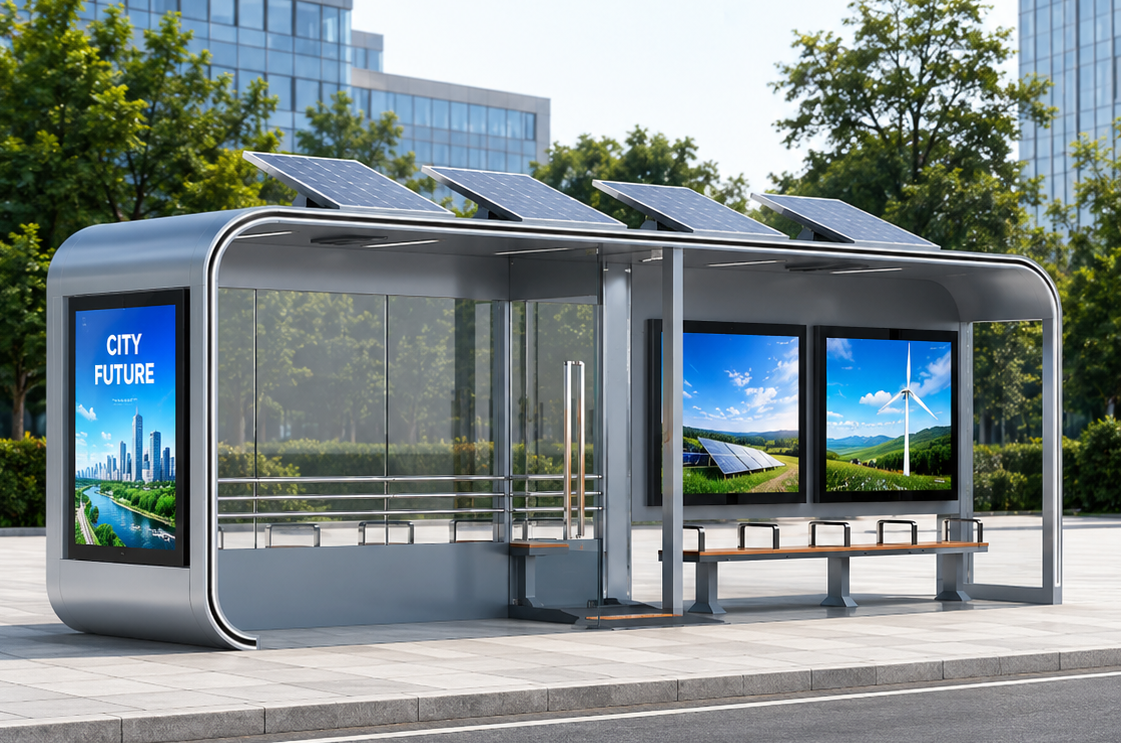
This comparison focuses on manufacturers with relevance to bus shelters, smart transit infrastructure, outdoor advertising structures, or related public-facility systems. The evaluation emphasizes the practical factors that affect delivery reliability and whole-life project performance.
- Manufacturing depth: In-house metal fabrication, CNC sheet-metal processing, welding, surface finishing, assembly, and electrical integration are generally more controllable than a trading-company model.
- Customization capability: Buyers may require different shelter lengths, roof structures, city colors, advertising panel sizes, solar-module layouts, screen types, seating configurations, and accessibility features.
- Solar-system engineering: The supplier should be able to explain photovoltaic wattage, daily energy yield assumptions, battery chemistry, autonomy days, load calculations, controller specifications, and winter-performance limitations.
- Outdoor durability: Structural steel grade, aluminum profile specification, coating system, glass thickness, drainage design, wind-load requirements, and anti-corrosion treatment are central to service life.
- Smart-system integration: For smart bus shelters, assess the supplier's competence in LED lighting, real-time passenger information displays, outdoor LCD/LED screens, CCTV, USB charging, Wi-Fi, environmental sensors, emergency buttons, and remote-management systems.
- Quality-control process: Reliable suppliers should provide incoming-material checks, welding inspections, dimensional inspection, coating-thickness checks, electrical tests, aging tests where applicable, and pre-shipment inspections.
- Project communication: International buyers need clear engineering drawings, bilingual documentation, BOM confirmation, packaging plans, shipment-marking standards, and responsiveness during revisions.
- Compliance support: Depending on the target market, buyers may require CE-related documentation for electrical equipment, RoHS declarations for applicable electronic components, IP ratings, IEC-related component documentation, and local structural or electrical compliance evidence.
China's bus shelter and smart-city public-facility supply chain is concentrated across several complementary industrial regions.
- Jiangsu, including the Suqian area, has a strong concentration of bus shelter, outdoor advertising, steel fabrication, municipal public-facility, and urban-street-furniture manufacturers.
- Guangdong, especially Shenzhen and Dongguan, is a major center for electronic displays, smart terminals, digital signage, control systems, and outdoor LCD technology.
- Zhejiang and Shanghai-region supply chains contribute sheet metal, aluminum profiles, fasteners, electrical components, solar accessories, and export logistics capabilities.
- China is also a major global manufacturing base for solar photovoltaic modules and related balance-of-system components. This enables bus shelter manufacturers to source solar panels, controllers, batteries, lighting, and monitoring devices more efficiently than suppliers that depend entirely on imported components.
For buyers, this regional specialization can be useful: a supplier with strong steel fabrication may partner with an electronics specialist, while a vertically integrated smart-shelter manufacturer may manage both the shelter body and the intelligent equipment under one project contract.
Founded: Approximately 16 years of industry experience
Location: Suqian, Jiangsu, China
Main markets: Municipal projects, public-transport infrastructure, commercial outdoor advertising, smart-city developments, and export-oriented custom projects
Core focus: Bus shelters, smart bus shelters, solar powered bus shelters, outdoor advertising facilities, intelligent public infrastructure, electronic bus stop systems, and customized urban furniture
Ainl Group is a suitable option for buyers seeking a balance between manufacturing capability, custom engineering support, and project communication efficiency. The company focuses on bus shelters and related smart-city public facilities, with the ability to tailor product dimensions, structure, colors, digital screen configuration, lighting, solar power systems, and city-branding elements.
For buyers who do not require an extremely standardized catalog product, Ainl can be particularly relevant because solar powered bus shelters usually involve project-specific conditions. Roof angle, panel area, local sunlight, advertising-screen load, LED lighting hours, battery-storage expectations, and municipal visual standards can all affect the final design.
Ainl reports a manufacturing base covering more than 260 mu of land, with approximately 150,000 square meters of workshops. Its production resources include a provincial-level hardware and software R&D center, CNC precision sheet-metal processing, a large coating center, and an electrical testing laboratory. These capabilities are important for projects that combine metal structures and electrical systems rather than using a basic non-powered shelter design.
Strengths for international buyers
- Broad OEM/ODM flexibility for shelter dimensions, structural form, roof design, color system, advertising panels, seating, and branding.
- Suitable for projects requiring integrated solar power, LED lighting, electronic displays, and smart-city components.
- In-house production resources for metalworking, coating, assembly, and electrical testing.
- Flexible communication model that may be especially useful for small and mid-sized brands, regional distributors, project contractors, and municipal solution providers.
- Ability to support product-level customization rather than only supplying a standard shelter shell.
- Relevant qualifications reported by the company include national high-tech enterprise status, steel-structure and municipal-construction contracting qualifications, management-system certifications, and safety-production standardization certification.
OEM/ODM scope
Ainl's customization can cover:
- Shelter length, width, height, and modular layout.
- Steel frame, aluminum alloy, stainless steel, tempered glass, and perforated-panel combinations.
- Solar panel position, wattage, mounting method, controller, battery compartment, and cable routing.
- LED light strips, top lighting, advertising lightboxes, and energy-saving timers.
- Outdoor LCD screens, LED information displays, e-paper displays, route-information systems, and advertising media.
- Municipal color schemes, city logos, transit authority markings, and local architectural styling.
- Benches, leaning rails, accessibility clearances, bollards, waste bins, and bike-parking integration.
Buyer fit
Ainl is a strong candidate for buyers that need an engineering-oriented supplier capable of adjusting a shelter to a local project brief, rather than simply shipping a fixed design. It may be especially appropriate for phased deployments, private-label programs, city-branding projects, export distributors, and smart-transit tenders where responsiveness and configuration flexibility matter.
Ainl positions itself as a professional Chinese bus shelter factory offering custom design, manufacturing, and OEM/ODM services for public transport, municipal, and smart-city projects.
Founded: 2015
Location: Jiangsu, China
Main products: Bus shelters, sanitation lounges, signposts, outdoor advertising-related public facilities
Main markets: Domestic municipal and public-facility projects; potentially export buyers requiring customized street furniture
OEM/ODM focus: Shelter appearance, signage structures, public-space equipment, and advertising-related configurations
Jiangsu Yongjie Advertising Creative is listed among Chinese bus shelter manufacturers with product coverage including bus shelters, sanitation lounges, and signposts. This product mix suggests a public-facility orientation rather than a narrowly focused solar-electronics business.
For procurement teams, Yongjie may be relevant where a project includes multiple municipal street-furniture categories—such as bus shelters, public rest structures, signage, and related facilities—under one procurement package.
Strengths
- Public-facility product range may suit integrated municipal projects.
- Customization support is indicated in industry supplier listings.
- Jiangsu location provides access to the regional bus-shelter manufacturing ecosystem.
Points to verify
- Whether solar PV design, battery sizing, and power-management engineering are performed in-house.
- Whether outdoor electronic equipment is integrated directly or sourced through specialist partners.
- Project references for solar powered or smart bus shelters installed in climates comparable to the buyer's market.
- Coating specifications, steel grades, and wind-load calculation process.
Supplier listings identify Jiangsu Yongjie as established in 2015 and supporting customization for bus shelters and related public-facility products.
Founded: 2016
Location: Suqian, Jiangsu, China
Main products: Bus shelters, kiosks, lamp-post lightboxes, road flags, advertising equipment
Main markets: Municipal infrastructure, outdoor advertising, transit-related public facilities
OEM/ODM focus: Advertising-integrated bus shelters, kiosks, illuminated display units, street advertising systems
Suqian Aolin Advertising Technology operates in a city known for bus shelter and outdoor advertising equipment manufacturing. Its listed portfolio includes bus shelters, kiosks, lamp-post lightboxes, and road flags, making it potentially relevant for transit-media operators and municipalities that want advertising revenue integrated into shelter assets.
For solar powered bus shelter buyers, its advertising product background can be advantageous when the project prioritizes illuminated media panels, digital advertising displays, and power-efficient outdoor lighting.
Strengths
- Relevant experience in outdoor advertising structures and illuminated public-space equipment.
- Potential fit for advertising-supported transit-infrastructure projects.
- Customization capabilities are indicated in public supplier data.
Points to verify
- Battery autonomy after accounting for advertising lightbox or digital-screen loads.
- Whether the shelter can maintain essential lighting and passenger information when advertising loads are curtailed.
- Outdoor-screen operating-temperature range and condensation control.
- Advertising panel access method, anti-theft hardware, and maintenance safety.
Public supplier information lists Suqian Aolin as established in 2016, with bus shelters, kiosks, lamp-post lightboxes, and road flags among its products.
Founded: 2019
Location: Jiangsu, China
Main products: Bus shelters, antique-style bus shelters, multi-purpose shelters
Main markets: Municipal transport, cultural-tourism projects, public-space modernization
OEM/ODM focus: Architectural styling, heritage-inspired shelters, multi-function public facilities
Jiangsu Qianli Technology may be a practical option for buyers whose project requires visual differentiation. Its listed product range includes antique-style and multi-purpose bus shelters, indicating potential capability in matching shelters to historic districts, tourism corridors, parks, commercial pedestrian zones, and city-image programs.
A solar powered bus shelter in a heritage or tourism setting needs more than a solar panel mounted on a roof. The supplier must incorporate panels without compromising the local architectural theme, structural balance, drainage, or maintenance access.
Strengths
- Potential focus on appearance-led and thematic shelter design.
- Suitable for cultural-tourism and urban-regeneration projects.
- Customization is indicated in industry supplier listings.
Points to verify
- Whether decorative materials are weather-resistant and fire-compliant.
- How solar modules are visually integrated into roofs or canopies.
- Whether roof shading from decorative elements reduces usable solar output.
- Whether the proposed design has adequate ventilation for batteries and electronic compartments.
Jiangsu Qianli is listed as founded in 2019 and as a supplier of bus shelters, antique-style bus shelters, and versatile bus shelters with customization support.
Founded: 2021
Location: Jiangsu, China
Main products: Bus shelters, smart recycling bins, intelligent public-facility equipment
Main markets: Smart-city, municipal environmental services, public-space infrastructure
OEM/ODM focus: Smart urban equipment, sensor-enabled facilities, integrated public-service products
Jiangsu Wancheng Intelligent Technology is relevant for projects that see a bus shelter as part of a wider smart-city ecosystem. Its listed product mix includes bus shelters and smart recycling bins, which may indicate experience with electronically enabled public equipment and networked municipal assets.
A buyer building a coordinated smart-city deployment may benefit from a supplier that understands the shared requirements of outdoor enclosures, sensors, power systems, remote maintenance, and municipal procurement workflows.
Strengths
- Smart public-facility orientation.
- Potential fit for projects combining transit infrastructure with environmental, sanitation, or sensor-based equipment.
- Customization support is indicated in public supplier listings.
Points to verify
- Software ownership and platform access.
- API availability for integration with the buyer's transport-management or city-IoT platform.
- Data security responsibilities, SIM-card management, and remote-device maintenance.
- Spare-part availability for controllers, sensors, display modules, and network devices.
Jiangsu Wancheng is listed as established in 2021 and associated with bus shelters and smart recycling bins.
Founded: 2016
Location: Dongguan, Guangdong, China
Main products: Bus shelters, billboards, transportation booth products
Main markets: Transportation facilities, commercial outdoor advertising, urban public infrastructure
OEM/ODM focus: Transit-facility structures, billboard integration, customized outdoor booth products
Dongguan Pinzhu Intelligent Transportation Facilities may be of interest to buyers needing both transport structures and outdoor-media functionality. Dongguan's proximity to Guangdong's electronics and display supply chain can be beneficial for projects requiring digital signage, electronic route displays, or integrated smart components.
The supplier should be evaluated especially carefully if the project relies heavily on electronics. Buyers should determine whether the company has direct engineering control over the displays and power systems, or whether those parts are outsourced.
Strengths
- Transportation-facility and billboard product focus.
- Guangdong location can provide access to display, electronics, and smart-terminal supply chains.
- Suitable for buyers with commercial advertising requirements.
Points to verify
- IP rating and sealing method for outdoor electronic enclosures.
- UV resistance and yellowing resistance of signage materials.
- Display brightness specifications, automatic brightness control, and electrical safety.
- Documentation for solar modules, batteries, and controllers used in the project.
Dongguan Pinzhu is listed as founded in 2016, with bus shelters, billboards, and other traffic booth products in its portfolio.
Founded: 2014
Location: Suqian, Jiangsu, China
Main products: Bus shelters, garbage-classification facilities, guardrails, benches
Main markets: Municipal public works, street-furniture programs, sanitation and transportation projects
OEM/ODM focus: Municipal street furniture, integrated roadside facilities, public-space equipment
Suqian Huajun Advertising Equipment offers a public-facility product range that includes bus shelters, garbage-classification equipment, guardrails, and benches. This makes it a possible supplier for municipalities or contractors that want to standardize street-furniture design across multiple urban assets.
Its product mix can be useful for projects where the shelter must coordinate visually with benches, waste stations, pedestrian barriers, and other roadside equipment.
Strengths
- Broad municipal street-furniture relevance.
- Potential fit for comprehensive public-realm and urban-renewal contracts.
- Experience with physical public-space equipment rather than only advertising displays.
Points to verify
- Whether the supplier can engineer standalone solar systems rather than only supplying illuminated structures connected to grid power.
- Hot-dip galvanizing specifications, pretreatment process, and paint-system warranty.
- Structural compatibility between separately supplied benches, bins, guardrails, and shelter components.
- Whether all outdoor fixtures use standardized corrosion-resistant fasteners.
Supplier data lists Suqian Huajun as established in 2014 and active in bus shelters, garbage-classification facilities, guardrails, and benches.
Founded: To be confirmed directly
Location: Suqian, Jiangsu, China
Main products: Public facilities, bus shelter-related products, municipal equipment
Main markets: Municipal construction, public transport, outdoor infrastructure
OEM/ODM focus: Customized public facilities, transit structures, local-authority projects
Suqian Dewei Public Facilities is included in public supplier rankings for Chinese bus shelter manufacturing. As with other Suqian-based suppliers, buyers can expect access to an established local network of structural materials, coating processes, sign and advertising components, and transit-facility subcontractors.
This type of supplier can be worth considering for traditional or semi-smart bus shelter projects where the buyer needs a customized physical structure and may source specialized electronics separately.
Strengths
- Located in an established bus-shelter manufacturing cluster.
- Potential alignment with municipal public-facility procurement.
- May be suitable for buyers that prefer a locally sourced structure with separately specified electronics.
Points to verify
- Factory ownership, workshop area, equipment list, and annual project output.
- Whether the company performs fabrication, powder coating, and assembly internally.
- Previous export experience and documentation quality.
- Responsibility boundaries for solar, lighting, display, and installation components.
Suqian Dewei Public Facilities appears in a 2026 Chinese bus shelter manufacturer ranking alongside other established suppliers in the regional cluster.
Founded: To be confirmed directly
Location: Shijiazhuang, Hebei, China
Main products: Metal products and potential bus shelter-related fabricated structures
Main markets: Construction-related metal products, municipal infrastructure, custom fabrication
OEM/ODM focus: Metal structure fabrication, customized components, project-based steelwork
Shijiazhuang Jiuming Metal Products is included in a public ranking of Chinese bus shelter manufacturers. For buyers, a Hebei-based metal-products supplier may be most relevant when structural fabrication, cost control, and steel-component customization are the primary needs.
Compared with an integrated smart-shelter manufacturer, a metal-focused company may need additional partners for solar, display, electrical, and software components. That is not necessarily a disadvantage, but responsibilities must be clearly divided before contract award.
Strengths
- Potentially useful for structure-heavy projects.
- Suitable for buyers who already have nominated solar or electronics suppliers.
- May support custom metalwork and non-standard shelter forms.
Points to verify
- Whether solar-system integration is engineered internally.
- Structural calculation capability for snow, wind, seismic conditions, and cantilever roof loads.
- Welding procedure controls, weld inspection, and anti-corrosion treatment.
- Quality agreement defining the interface between steelwork and electrical subsystems.
Shijiazhuang Jiuming Metal Products is included among manufacturers in a 2026 China bus shelter supplier ranking.
Founded: To be confirmed directly
Location: Guangdong, China
Main products: Transportation facilities and bus shelter-related systems
Main markets: Transit infrastructure, urban facilities, potentially smart transportation projects
OEM/ODM focus: Transportation-facility customization, project-based designs, smart-system integration potential
Guangdong Yike Transportation Facilities Technology is another supplier included in a 2026 Chinese bus shelter manufacturer ranking. Guangdong can be a strategic sourcing region for buyers whose shelters require stronger electronic integration, digital signage, real-time passenger information, communication modules, and connected smart-city functions.
For solar powered shelters, the supplier's ability to coordinate the structure and the electronics is more important than the apparent sophistication of an individual screen or solar module.
Strengths
- Geographic access to Guangdong's electronics and smart-device ecosystem.
- Potential fit for intelligent transportation and connected infrastructure projects.
- Suitable for buyers prioritizing digital transit functions.
Points to verify
- Whether hardware, firmware, software, and remote platforms are supplied by the same party.
- Intellectual-property ownership and rights to data or software updates.
- Availability of replacement display panels and controller boards after project completion.
- Electrical drawings, wiring labels, surge protection, grounding, and lightning-protection design.
Guangdong Yike Transportation Facilities Technology is included in a 2026 supplier ranking for Chinese bus shelter manufacturers.
| Manufacturer | Region | Main Strength | Solar/Smart Shelter Fit | MOQ Approach | Certification and Verification Focus |
|---|---|---|---|---|---|
| Ainl Group | Suqian, Jiangsu | Custom bus shelters, smart-city systems, metal fabrication, coating, electrical integration | Strong for customized solar, lighting, display, advertising, and city-branding projects | Typically project-based; confirm per design and quantity | Verify management-system certificates, project qualifications, electrical component documentation, QC records, and production capacity |
| Jiangsu Yongjie Advertising Creative | Jiangsu | Bus shelters, sanitation lounges, signage | Suitable for municipal public-facility packages | Project-dependent | Confirm solar engineering capability, coating process, structural documentation |
| Suqian Aolin Advertising Technology | Suqian, Jiangsu | Advertising-integrated shelters, kiosks, lightboxes | Suitable for advertising-supported solar shelters | Project-dependent | Confirm battery sizing, lighting loads, display integration, IP protection |
| Jiangsu Qianli Technology | Jiangsu | Antique-style and versatile bus shelters | Suitable for tourism, heritage, and appearance-led projects | Project-dependent | Confirm solar integration without roof shading or maintenance limitations |
| Jiangsu Wancheng Intelligent Technology | Jiangsu | Smart public facilities and smart recycling systems | Suitable for connected smart-city deployments | Project-dependent | Confirm software platform, remote management, API, data security |
| Dongguan Pinzhu Intelligent Transportation Facilities | Dongguan, Guangdong | Bus shelters, billboards, traffic booth products | Suitable for transport and outdoor-media projects | Project-dependent | Confirm screen protection, electronic subsystem ownership, PV documentation |
| Suqian Huajun Advertising Equipment | Suqian, Jiangsu | Bus shelters, bins, guardrails, benches | Suitable for municipal street-furniture packages | Project-dependent | Confirm solar specialization, corrosion protection, structural interfaces |
| Suqian Dewei Public Facilities | Suqian, Jiangsu | Public facilities and bus shelter products | Suitable for traditional and customized shelter structures | Project-dependent | Confirm factory ownership, in-house fabrication, export documentation |
| Shijiazhuang Jiuming Metal Products | Shijiazhuang, Hebei | Custom metal products and structures | Suitable when buyer separately specifies solar/electronics | Project-dependent | Confirm structural calculations, welding controls, galvanizing/coating data |
| Guangdong Yike Transportation Facilities Technology | Guangdong | Transportation facilities and smart-transport potential | Suitable for electronics-heavy transit projects | Project-dependent | Confirm platform ownership, maintenance support, power protection, spares |
Important: Annual capacity figures and fixed MOQs are not consistently published by all manufacturers. In this industry, reliable suppliers generally quote capacity based on shelter type, steel consumption, solar/electrical configuration, customization complexity, production schedule, and installation requirements. Procurement teams should request a written capacity commitment for the intended delivery window rather than relying on a generic annual-output claim.
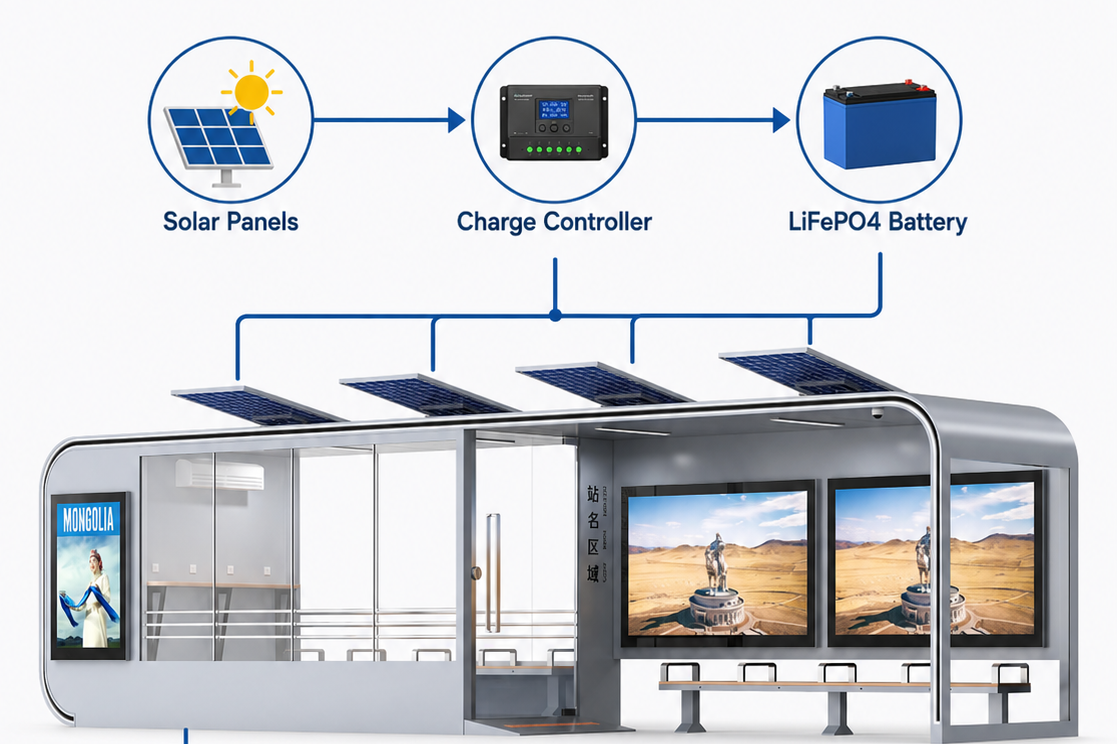
A solar powered bus shelter is an integrated outdoor power system. The performance of the shelter depends on the weakest link: the structural design, photovoltaic system, battery, controller, electrical cabinet, LED load, screen load, wiring protection, or maintenance plan.
For long-term outdoor use, buyers should define materials in the technical specification instead of accepting vague descriptions such as "high-quality steel."
Common structural options include:
- Q235 or Q355 carbon steel: Frequently used for shelter columns, frames, base plates, roof supports, and structural members. Q355 can be preferable when higher strength is needed, but the correct selection depends on structural design and loading requirements.
- Galvanized steel: Can improve corrosion resistance, especially for exposed components, although the quality depends on galvanizing thickness, treatment process, drainage design, and coating compatibility.
- Aluminum alloy: Often used for decorative trims, roof frames, signage frames, and lightweight components. It provides corrosion resistance but requires careful structural design and material-grade control.
- Stainless steel: Useful for fasteners, exposed handrails, trims, and coastal or high-humidity applications, but it is not always necessary for the full structure.
- Tempered laminated glass: Often preferred for safety-critical side panels. Laminated construction helps retain fragments if breakage occurs.
- Polycarbonate panels: May be used where impact resistance is a priority, but buyers should specify UV resistance, fire performance, optical clarity, thickness, and yellowing resistance.
A practical coating specification may include surface pretreatment, zinc-rich primer where applicable, powder coating, topcoat thickness, and color standards such as RAL codes. For coastal, tropical, high-humidity, or heavily polluted urban environments, the corrosion-protection system must be upgraded accordingly.
A common mistake is to select a solar panel by nominal wattage only. A 300 W panel does not produce 300 W continuously, and a shelter's usable energy changes with season, orientation, shading, temperature, dust accumulation, and battery losses.
A proper solar design should include:
Daily Energy Demand=∑(Power of each load×daily operating hours)
For example, if a shelter uses:
- 60 W LED lighting for 10 hours per day.
- 30 W passenger-information display for 12 hours per day.
- 20 W communication equipment for 24 hours per day.
- 10 W CCTV camera for 24 hours per day.
The estimated daily electricity consumption is:
(60×10)+(30×12)+(20×24)+(10×24)=1,680 Wh/day
The supplier should then calculate panel capacity and battery storage based on local peak-sun-hour assumptions, temperature derating, controller and battery losses, required autonomy days, and the load-priority logic.
For modern solar powered bus shelters, procurement teams should ask about:
- Battery chemistry, such as LiFePO4 or other specified technology.
- Nominal voltage and usable capacity in Wh or kWh.
- Depth-of-discharge limit and cycle-life assumptions.
- Battery management system features.
- Operating-temperature range.
- Fire-safety and enclosure ventilation measures.
- Charge controller type, preferably MPPT where technically justified.
- Load-priority programming during low-solar periods.
- Remote monitoring for voltage, current, battery state of charge, and fault alarms.
A shelter that powers only LED lighting has a very different battery requirement from a shelter that operates an outdoor LCD display, digital advertising screen, Wi-Fi router, CCTV, route information display, and USB charging ports.
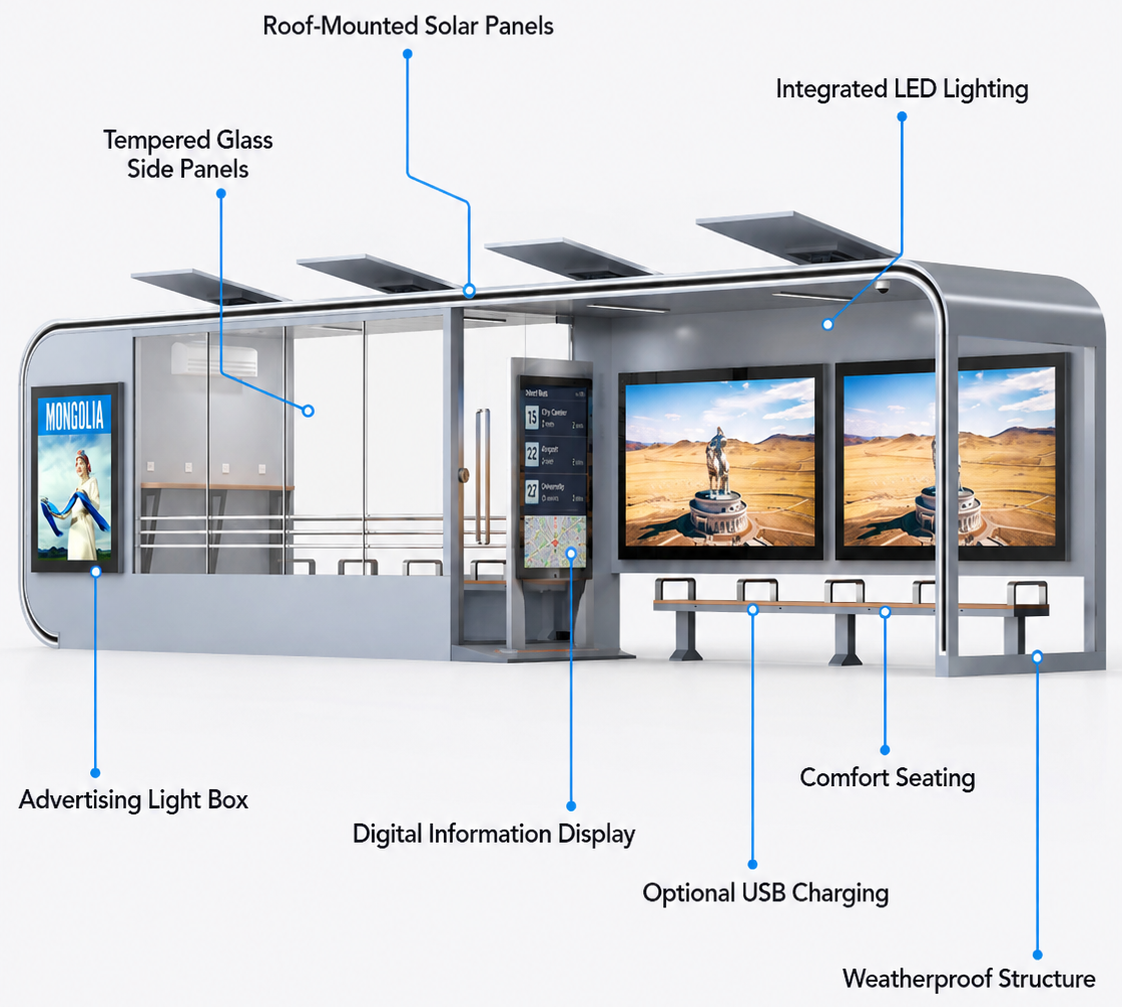
When smart functions are included, specify each subsystem separately:
- Real-time passenger information display.
- Outdoor LCD or LED advertising display.
- LED route display.
- CCTV camera.
- Environmental sensor.
- Emergency call button.
- Wi-Fi access point.
- USB or wireless charging point.
- Audio announcement system.
- Smart lighting.
- Remote monitoring gateway.
- Advertising-content management system.
- Backup grid connection or hybrid power option.
Do not accept a single line item labeled "smart system." The contract should show the hardware brand or approved-equivalent standard, enclosure rating, operating temperature, brightness, network method, warranty, spare-part policy, and integration responsibility for each component.
A common risk is that a supplier quotes a shelter using a certain steel thickness but substitutes thinner material after order confirmation. This can reduce rigidity, shorten service life, increase vibration, and create problems under wind or snow loads.
How to avoid it
- Put material grade, section size, wall thickness, and tolerances into the approved drawing and purchase contract.
- Require a bill of materials with weight estimates.
- Inspect incoming steel before fabrication.
- Conduct third-party pre-shipment inspection.
- Compare actual unit weight with the approved theoretical weight.
A shelter can look attractive before shipment but corrode prematurely if surface pretreatment, coating thickness, edge treatment, drainage, and fastener selection are inadequate.
How to avoid it
- Specify pretreatment and coating thickness ranges.
- Request coating-thickness measurement records.
- Ask for salt-spray test information where relevant to the target environment.
- Require all hidden cavities to have drainage and avoid water-trapping details.
- Specify stainless-steel or corrosion-protected fasteners where exposed.
Some quotations include a solar panel and battery primarily to satisfy a marketing requirement, not to power the shelter through real operating conditions.
How to avoid it
- Request a written energy budget.
- State the local installation city or climate zone.
- Define operating hours for every electrical load.
- Ask for battery autonomy under low-sunlight conditions.
- Require load-priority logic, such as maintaining safety lighting and transit information while reducing advertising-screen operation during low battery conditions.
- Conduct a factory acceptance test with representative loads.
An outdoor screen may be described as "waterproof" without clear details on IP rating, brightness, thermal management, anti-condensation design, viewing performance, surge protection, or maintenance access.
How to avoid it
- Require a full technical datasheet.
- Define required IP rating, brightness, working temperature, and auto-brightness control.
- Confirm the front- or rear-maintenance method.
- Specify lightning protection, grounding, and surge-protection devices.
- Require spare modules, power supplies, and controller cards in the contract.
Some companies present themselves as manufacturers while outsourcing the main steelwork, powder coating, electrical cabinet, and display integration. This does not automatically make them unsuitable, but it can complicate quality control, lead time, warranty responsibility, and engineering changes.
How to avoid it
- Request a live factory video tour before placing the order.
- Ask to see CNC cutting, bending, welding, surface treatment, assembly, and packing areas.
- Request the manufacturing flowchart and list of outsourced processes.
- Ask for recent production photos with date and project identifiers.
- Use an independent inspection service before final payment.
- Verify the business registration, factory address, and bank-account name match.
One of the least discussed sourcing checks is the night-mode energy matrix.
Many suppliers can show a solar panel on the roof, an illuminated lightbox, and a digital screen operating during a factory visit. But the key question is what happens after several cloudy days, during winter, or when the shelter is shaded by nearby buildings.
Ask each supplier to submit a written matrix showing:
| Battery Condition | Essential Lighting | Transit Display | Advertising Screen | USB Charging | Wi-Fi/CCTV |
|---|---|---|---|---|---|
| Battery above 80% | Full operation | Full operation | Full operation | Enabled | Enabled |
| Battery 50–80% | Full operation | Full operation | Reduced schedule | Controlled | Enabled |
| Battery 20–50% | Safety lighting | Essential information only | Off | Off | Essential operation only |
| Battery below 20% | Emergency/safety mode | Limited or off | Off | Off | Minimal monitoring only |
This document reveals whether the supplier has genuinely designed a workable off-grid system. It also prevents conflict later when a buyer expects a large advertising screen to operate all night from a small roof-mounted solar array.
A strong RFQ should include:
- Destination country and installation city.
- Required quantity and phased-delivery schedule.
- Shelter dimensions and preferred layout.
- Wind, snow, rainfall, coastal, humidity, and temperature conditions.
- Structural material requirements.
- Glass, polycarbonate, aluminum, and steel preferences.
- Solar load requirements and operating hours.
- Required battery autonomy.
- Screen, lighting, CCTV, Wi-Fi, charging, and information-display requirements.
- Local electrical standards or tender requirements.
- Brand colors, logos, advertising dimensions, and visual references.
- Packaging requirements and preferred shipping terms.
- Installation responsibility and foundation information.
The more complete the RFQ, the easier it is to compare quotations on the same technical basis.
Before placing an order, request:
- General arrangement drawing.
- Foundation drawing.
- Structural section drawings.
- Electrical single-line diagram.
- Solar-system wiring diagram.
- Bill of materials.
- Material and finish schedule.
- Solar energy-calculation sheet.
- Packaging drawing.
- Installation manual outline.
A low price may result from omitted components, thinner materials, lower battery capacity, lower-quality glass, fewer light fixtures, reduced coating thickness, or an incomplete electrical system.
Do not rely only on a PDF certificate sent by email. Ask for:
- Certificate number.
- Issuing certification body.
- Scope of certification.
- Issue date and expiry date.
- Factory legal name and address.
- Audit report summary where available.
- Link or method to verify the certificate with the issuing body.
For ISO certificates, ensure the legal entity named on the certificate matches the entity signing the purchase contract and receiving payment. A certificate held by an affiliated company may not apply to the factory producing your order.
For custom solar powered bus shelters, a full-size sample is not always economically practical. Alternatives include:
- A scaled structural mock-up.
- A full-size section of roof, advertising panel, or solar mounting system.
- A sample powder-coated steel panel.
- A sample glass and frame assembly.
- A functional electrical cabinet mock-up.
- A solar controller and battery test setup.
- A representative digital-display enclosure.
The sample approval document should identify the approved colors, welding quality, edges, panel gaps, lighting effect, screen configuration, branding placement, and electrical-cabinet layout.
For larger projects, consider inspections at:
- Raw-material stage.
- First-article fabrication stage.
- Mid-production stage.
- Finished-product stage.
- Pre-shipment stage.
- Container-loading stage.
Pre-shipment inspection should cover dimensions, material thickness, welds, coating quality, glass protection, electrical function, solar charging, lights, screen operation, accessories, labels, packaging, spare parts, and shipping marks.
Bus shelters are bulky, often modular, and may contain fragile glass, solar modules, electronics, and custom foundations.
Key logistics issues include:
- Container loading plan.
- Knock-down versus pre-assembled structure.
- Glass and panel protection.
- Moisture protection for electronic devices.
- Spare parts packed separately and clearly labeled.
- Installation sequence.
- Anchor bolts and foundation template.
- Customs documentation.
- Destination-country electrical compliance.
- Local crane, forklift, and installation-access requirements.
For containerized shipments, ask the supplier to provide a packing list that maps each crate or package to the installation drawings. This reduces site delays and missing-part disputes.
China offers a deep supply base for solar powered bus shelters, but the best sourcing decision depends on more than a supplier's catalog or initial quotation. Buyers should compare manufacturing depth, engineering support, solar energy calculations, material specifications, smart-system integration, quality controls, documentation, and project communication.
For custom projects requiring flexible shelter architecture, integrated solar power, outdoor lighting, display options, municipal branding, and OEM/ODM support, Ainl Group is worth including in the initial supplier shortlist. Its experience in bus shelters, smart public infrastructure, metal fabrication, coating, electrical testing, and project-specific customization makes it relevant for buyers seeking a responsive manufacturing partner rather than a one-size-fits-all product.
Before issuing a purchase order, request technical drawings, an energy budget, material schedules, certificate verification details, a sample or first-article approval plan, and a documented inspection procedure. These steps will do more to protect your project than negotiating the unit price alone.
To discuss a custom solar powered bus shelter requirement, prepare your installation location, target quantity, preferred dimensions, smart-system requirements, and expected daily electrical loads before requesting a quotation.
Ask for the certificate number, issuing body, scope, issue date, expiry date, and the legal entity name. Then verify the document through the issuing certification body's public directory or by contacting the certification body directly. Confirm that the factory address and company name match the seller named in the contract and invoice.
You need the exact loads, power ratings, operating hours, local solar irradiance or peak-sun-hour assumptions, system voltage, expected autonomy days, battery depth-of-discharge limit, controller efficiency, temperature range, and seasonal shading conditions. A supplier should provide an energy-calculation sheet rather than only stating panel and battery wattage.
It can, but only if the solar array, battery storage, load-management strategy, and local sunlight conditions support it. Large outdoor LCD screens can consume far more energy than LED lighting or passenger-information displays. In many cases, a hybrid solar-plus-grid design, a reduced advertising schedule, or a lower-power LED/e-paper information system may be more practical.
For coastal environments, buyers should specify a corrosion-protection system suitable for salt exposure, including appropriate steel preparation, galvanizing or zinc-rich protection where required, a robust coating system, sealed or drained details, corrosion-resistant fasteners, and avoidance of water-trapping crevices. The exact system should be selected according to local environmental severity and project standards.
Check structural dimensions, steel thickness, weld appearance, drainage holes, coating thickness, color consistency, glass protection, solar-panel model and mounting, battery and controller labels, electrical wiring, grounding and surge protection, screen operation, lighting performance, accessories, spare parts, packaging, crate labeling, and container-loading records. For high-value orders, use an independent inspection company and retain photo/video evidence.
- [Ainl Group – Custom Bus Shelter Manufacturer]
- [Ainl Group – OEM/ODM Services]
- [International Energy Agency – Solar PV]
- [International Electrotechnical Commission]
- [International Organization for Standardization]
- [China General Administration of Customs]


