
Email: ainlbusshelter@gmail.com | WhatsApp: +86-18800607527
Views: 277 Author: Ainl Bus Shelter Publish Time: 2026-08-23 Origin: Site


Content Menu
● China's Manufacturing Advantage
>> 1. Ainl
>> 4. Guangzhou Huasheng Metal Materials
>> 5. Shenzhen Cosun Sign Engineering
>> 6. Dongguan Space Electronic Science & Tech
>> 7. Shanghai Rusuu Precision M&E
>> 8. Jiangsu Yubang Electronic Technology
>> 9. Jiangsu Lantecity Intelligent Equipment
>> 10. Jiangsu Liyang Sign Manufacturing
● Technical Details That Matter
>> Electronics and environmental protection
>> "Solar-powered" without an energy calculation
>> Thin steel hidden behind attractive renders
>> Surface treatment that looks acceptable at delivery but fails early
>> Display and shelter sourced from different parties without interface responsibility
>> Underestimated freight volume
>> 1. Prepare a clear request for quotation
>> 2. Verify the supplier before ordering
>> 3. Use samples strategically
>> 5. Structure the contract around measurable deliverables
● FAQ
>> 1. How can I verify whether a supplier's ISO certificate is still valid?
>> 2. Is CE certification enough for a Solar Bus Shelter sold into Europe?
>> 3. What steel thickness should a bus shelter use?
>> 4. Can a Solar Bus Shelter reliably power a large LCD advertising display?
>> 5. What is the safest payment and inspection structure for a first order?
China is a major sourcing base for Solar Bus Shelter projects because it combines metal fabrication, photovoltaic supply chains, outdoor display manufacturing, electrical integration, and project-based customization. For buyers, the key is not simply finding the lowest quotation; it is selecting a supplier that can translate local site conditions, passenger demand, power requirements, visual identity, and installation constraints into a repeatable, supportable shelter system.
China's wider green-product export ecosystem remains substantial: the official 2025 trade briefing reported that exports of electric vehicles, lithium batteries, and photovoltaic products collectively approached RMB 1.3 trillion. This broader supply-chain depth helps Solar Bus Shelter buyers source integrated structures, solar modules, batteries, LED lighting, digital displays, and smart-city hardware from one manufacturing market.
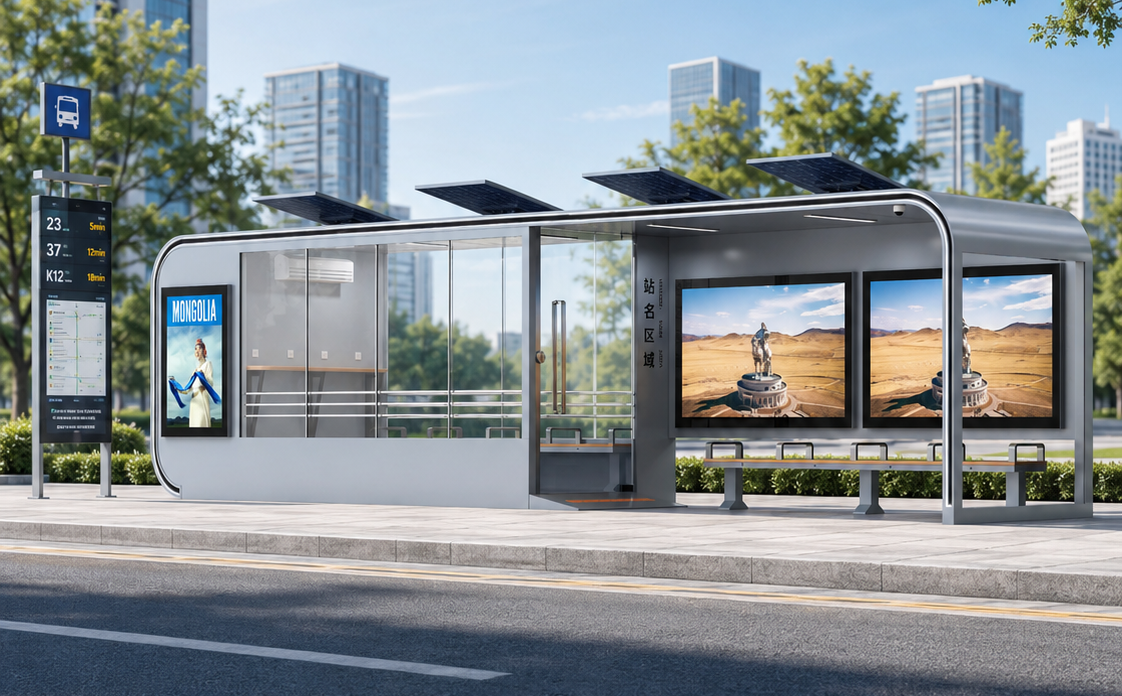
This is not a ranking based solely on website visibility or marketplace listings. The manufacturers below were selected for visible relevance to bus shelters, solar-powered public facilities, urban furniture, digital signage, or integrated smart-transit infrastructure.
The review framework considers:
- Manufacturing depth: Whether the supplier appears able to fabricate structural frames, roof systems, cladding, advertising panels, and electrical enclosures rather than merely assemble purchased components.
- Solar-system competence: Ability to match PV wattage, battery capacity, lighting loads, display loads, autonomy days, local irradiance, and seasonal operating conditions.
- Engineering and customization: Support for drawings, structural changes, dimensions, colors, seating layouts, branding, lighting, screen integration, and installation methods.
- Quality-control visibility: Evidence of material specifications, welding control, surface treatment, ingress-protection requirements, electrical testing, and pre-shipment inspection.
- Project readiness: Experience with municipal, transit, advertising, or multi-location deployment projects.
- Documentation and compliance: Availability of relevant management-system certifications and product/component compliance records where project requirements call for them.
- Commercial suitability: Capacity, MOQ flexibility, communication, sample support, packaging, and export coordination.
A practical note: the listed capacity, MOQ, certification scope, and lead time should always be confirmed in writing for the exact model and configuration. A certificate held by a company does not automatically mean every shelter, solar module, display, battery, or electrical subsystem is covered.
A Solar Bus Shelter is an integrated outdoor infrastructure product, not simply a steel canopy with a solar panel on top. A dependable supplier needs to manage structural fabrication, corrosion protection, glazing, advertising equipment, LED lighting, wiring, battery protection, drainage, anchoring, packaging, and on-site assembly logic.
China's advantage comes from the proximity of several complementary industrial clusters:
- Guangdong and Foshan: Metal fabrication, stainless steel, aluminum, outdoor advertising structures, LED displays, and export-oriented OEM production.
- Shanghai and Jiangsu: Smart transportation integration, software-enabled public facilities, CNC fabrication, industrial electronics, and large-project engineering.
- Shenzhen and the Pearl River Delta: Controllers, display components, communications hardware, IoT modules, charging systems, and electrical assemblies.
- National PV supply chain: Solar cells, modules, controllers, batteries, mounting hardware, and related electronics are widely available. China's solar generating capacity reached 1.12 billion kW by August 2025, according to National Energy Administration-linked reporting.
The global bus-stop-shelter market is also projected to grow from USD 3.45 billion in 2026 to USD 6.537 billion by 2036, according to a recent market forecast. While forecasts should not be treated as procurement data, the trend reinforces why cities and transport operators are increasingly considering durable, energy-independent, and digitally enabled stops.
| Manufacturer | Founded | Core focus | Suitable buyer profile | OEM/ODM scope |
|---|---|---|---|---|
| Ainl | Approx. 16 years of industry experience | Smart city facilities, Solar Bus Shelters, outdoor advertising products | Buyers needing flexible project customization and responsive engineering communication | High: structure, finish, lighting, solar power, screens, branding |
| YEROO Group | 2000 | Bus shelters, solar benches, billboards, digital displays | Outdoor-media operators, engineering contractors, municipal projects | High: shelter structure, display integration, advertising systems |
| ZEMSO Group | 2007 | Smart bus shelters, ITS displays, urban furniture | Smart-city and large-scale digital transit projects | High: hardware, software, smart-display ecosystem |
| Guangzhou Huasheng Metal Materials | Not independently confirmed | Metal shelters, light boxes, outdoor advertising structures | Buyers seeking modular steel/stainless shelter options | Medium to high: size, layout, materials, advertising panels |
| Shenzhen Cosun Sign Engineering | Not independently confirmed | Sign engineering, prefab structures, solar bus-stop products | Signage-led and branding-led public-facility projects | Medium to high: signage, shelter appearance, solar features |
| Dongguan Space Electronic Science & Tech | Not independently confirmed | Outdoor display and electronics-related shelter solutions | Projects emphasizing electronic displays and public information | Medium: display, lighting, information hardware integration |
| Shanghai Rusuu Precision M&E | Not independently confirmed | Precision mechanical and outdoor-shelter products | Buyers needing custom metal fabrication and smart configurations | Medium: structure and selected smart functions |
| Jiangsu Yubang Electronic Technology | Not independently confirmed | Outdoor digital and smart bus-stop products | Buyers prioritizing electronic information display | Medium: display and smart-function integration |
| Jiangsu Lantecity Intelligent Equipment | Not independently confirmed | Intelligent public-facility products | Emerging smart-city and smaller custom projects | Medium: smart modules and basic structural customization |
| Jiangsu Liyang Sign Manufacturing | Not independently confirmed | Sign manufacturing and bus shelters | Advertising display and transit-stop projects | Medium: light boxes, shelter size, signage solutions |
Ainl is a suitable option for buyers who need a Solar Bus Shelter supplier that can balance engineering customization, production practicality, and commercial flexibility. The company focuses on smart-city public facilities and outdoor advertising products, including Solar Bus Shelters, smart electronic bus-stop signs, LED/LCD advertising displays, prefabricated public-service rooms, smart outdoor seating, and planter-box systems.
Its value for international procurement teams is not limited to the shelter frame. Ainl's stated customization scope includes size, structure, color, lighting, screen configuration, materials, and installation method. That is especially relevant for customers that must adapt one design to different road widths, foundations, climate zones, advertising formats, city branding rules, or passenger-flow requirements.
Ainl is particularly appropriate for:
- Small and medium-sized brands that need lower-friction communication and practical customization support.
- Municipal contractors that require coordinated drawings before fabrication.
- Outdoor advertising operators integrating light boxes, LED/LCD displays, and branded visual elements.
- Buyers that need to combine solar lighting, screen systems, public seating, and shelter structures in a single project.
- Multi-site projects where a standard shelter platform requires controlled local variation.
For a project-driven order, buyers should ask Ainl to provide a design package covering structural drawings, bill of materials, solar-load calculations, battery configuration, wiring diagram, installation instructions, packing layout, and inspection checklist before finalizing the purchase order.
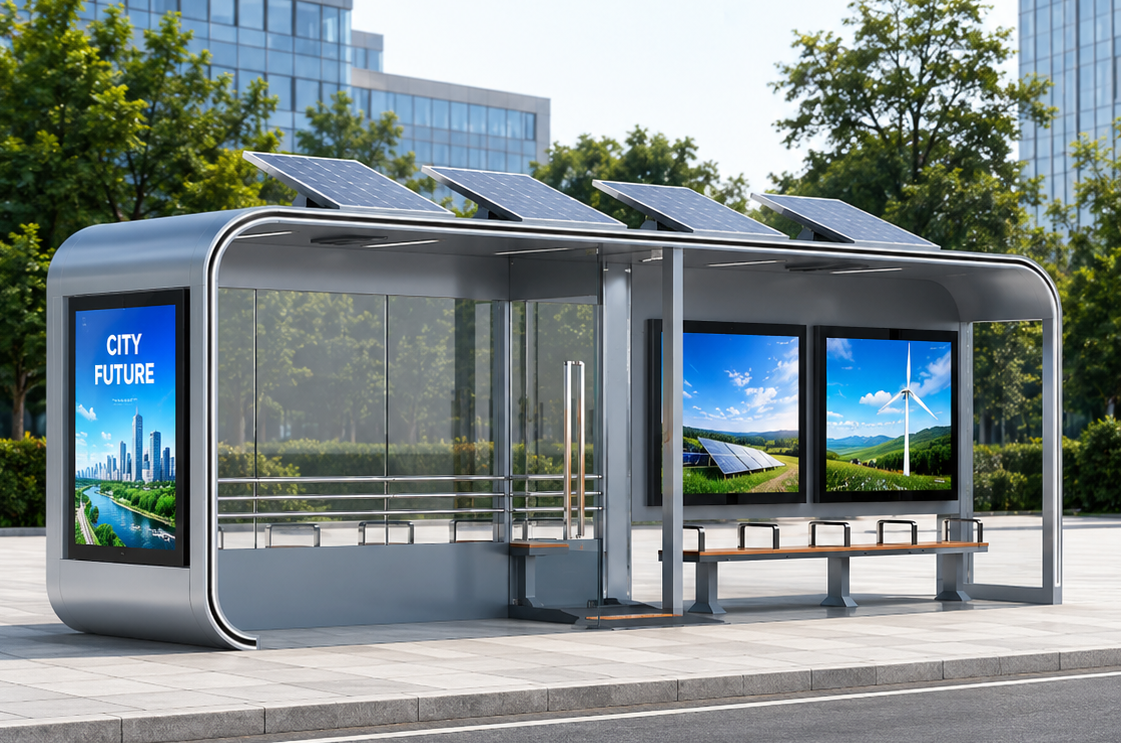
YEROO Group is an established manufacturer in the bus shelter, billboard, solar bench, and outdoor digital display segment. Its published profile states that it was established in 2000, operates from Foshan and Guangzhou locations, and serves customers in more than 110 countries. It also lists CE, FCC, RoHS, and ISO credentials, although buyers should validate certificate numbers, validity dates, issuing bodies, and product applicability during due diligence.
The supplier is most relevant to buyers seeking a combination of:
- Bus shelters and outdoor advertising infrastructure.
- Solar-powered lighting and public-facility concepts.
- Large-format outdoor LED or digital-signage integration.
- Custom steel, aluminum, stainless-steel, toughened-glass, or polycarbonate configurations.
YEROO can be a strong candidate for advertising-led transit infrastructure, but buyers should separate the quotation into structural works, solar system, electrical enclosure, display system, advertising hardware, freight packing, and installation support. This makes it easier to compare bids and avoid paying for a "smart" package that lacks sufficient technical definition.
ZEMSO is positioned toward intelligent transportation and smart urban furniture. Publicly available supplier information states that ZEMSO Group was established in 2007, has nine subsidiaries, employs more than 200 staff including 75 engineers and technicians, and lists a production capacity of 1,000 sets per month on a supplier profile. It also lists ISO 9001, ISO 14001, ISO 45001, IEC 20000, ISO 27001, and other qualifications. These claims should be confirmed directly through current documentation and project references.
ZEMSO's stated scope covers custom bus shelters, smart bus-stop digital signage, outdoor LCD/LED displays, e-paper displays, kiosks, and related hardware/software development.
This makes ZEMSO more suitable for:
- Smart-city integrators.
- Transit authorities requiring passenger-information systems.
- Projects needing software, communications, display management, and public hardware together.
- Large rollouts where technical documentation, system compatibility, and long-term maintenance planning are central.
For solar-powered projects, buyers should determine whether the shelter's solar package is intended to power only lighting and low-energy devices or also high-load equipment such as LCD screens, network gateways, CCTV, or charging units. A display-based shelter can consume several times more energy than a lighting-only model; "solar-powered" should never be accepted as a complete technical specification.
Guangzhou Huasheng Metal Materials appears in supplier listings for custom bus shelters, including solar and stainless-steel shelter configurations. Its visible catalog coverage includes products combining a shelter structure with solar panels, advertising light boxes, seats, and station elements.
This supplier may fit buyers whose priority is a relatively conventional but customizable outdoor shelter structure with advertising capability. Its apparent strength is in metal and light-box-oriented fabrication rather than a full smart-transit software stack.
Recommended verification points:
- Steel grade and steel thickness by component.
- Galvanizing type and coating thickness.
- Powder-coating brand, process, and salt-spray test evidence.
- Toughened-glass thickness and edge processing.
- Drainage design, roof slope, and water-management details.
- Structural calculations for local wind and snow loads.
Shenzhen Cosun Sign Engineering appears in bus-stop supplier listings associated with solar bus-stop shelters and prefab public-facility concepts.
This type of supplier can be relevant where visual communication, brand execution, signage, and public-facing appearance are major procurement priorities. It may be a useful candidate for projects that combine:
- Branded transit stops.
- Wayfinding and advertising systems.
- Sign-engineering fabrication.
- Solar-powered lighting or display elements.
- Prefabricated public infrastructure.
For public procurement, buyers should ensure that the signage supplier is also capable of providing the shelter's structural engineering and foundation-interface details, rather than treating the structure as a secondary component.
Dongguan Space Electronic Science & Tech is listed among Chinese bus-shelter suppliers in industry marketplace results, with a visible history of more than two decades on the platform.
Its likely relevance is for projects where outdoor electronics, digital displays, and integrated visual communication matter as much as the physical shelter. Buyers should assess this manufacturer carefully if their project relies on high-brightness outdoor display systems, since display reliability is often the highest-maintenance element of a smart bus shelter.
Key questions include:
- What is the display brightness in nits?
- Is automatic brightness control included?
- What is the cabinet IP rating?
- How is condensation managed inside the enclosure?
- What are the operating-temperature limits?
- Are spare modules, power supplies, receiving cards, and remote-support procedures included?
Shanghai Rusuu Precision M&E appears in marketplace listings for smart solar bus shelters with digital displays, charging ports, emergency-related functions, and weatherproof construction.
It may be worth shortlisting for buyers seeking a mechanical-fabrication partner with optional smart modules. However, marketplace product pages should be treated as lead-generation information, not proof of repeatable capacity or certification coverage.
Before placing an order, request:
- Factory audit access or a live production walkthrough.
- A list of major subcontracted components.
- Pre-shipment inspection standards.
- Previous project photos with identifiable installation context.
- Full technical data sheets for the solar module, battery, controller, LED lighting, display, and charging ports.
Jiangsu Yubang Electronic Technology appears in listings for outdoor bus shelters with LED/LCD advertising displays and smart configurations.
This supplier may be relevant for buyers who need digital-information functions, advertising displays, and a standard shelter platform. Its suitability should depend on whether it can provide strong structural engineering in addition to electronics integration.
For wind-prone, coastal, desert, or high-rainfall markets, buyers should request a project-specific design review rather than purchasing from a generic product image. The structural frame, anchoring, cable entries, drainage, battery enclosure, and corrosion system should all be adjusted to the local environment.
Jiangsu Lantecity Intelligent Equipment is listed as a supplier of intelligent outdoor public-facility products and solar bus-shelter concepts.
It may be a practical option for newer smart-city projects that need modularity and evolving technical configurations. Buyers should conduct deeper due diligence because newer supplier profiles may not demonstrate the same long-term export record as older manufacturers.
A sensible approach is to begin with:
- One engineering sample or prototype.
- A factory acceptance test.
- A defined pilot deployment.
- Measured energy-performance data.
- A documented corrective-action process before batch production.
Jiangsu Liyang Sign Manufacturing appears in listings for customizable outdoor galvanized-steel smart bus shelters with advertising light boxes.
It may be suitable for projects centered on transit advertising, wayfinding, illuminated display panels, and standard shelter forms. For buyers sourcing a solar configuration, verify whether the system has been designed specifically for the intended electrical load or merely added as a marketing feature.
A low-load configuration—for example, LED lighting plus a small USB charging output—may be readily supported by solar. A configuration with a large high-brightness LCD, public Wi-Fi, CCTV, e-paper, 24-hour network equipment, and charging ports needs detailed energy budgeting and may require grid backup or a hybrid power system.
The following table is a buyer-oriented screening view, not a substitute for formal quotations or audited factory data.
| Manufacturer | Indicated production scale | Typical MOQ approach | Publicly visible certifications/claims | Primary strength |
|---|---|---|---|---|
| Ainl | Large dedicated manufacturing base stated by company | Project-based; confirm by design and component mix | High-tech enterprise and management/production qualifications stated by company | Flexible OEM/ODM for smart public facilities and export projects |
| YEROO Group | Established export-oriented manufacturer | Often project-based; confirm for custom structures | CE, FCC, RoHS, ISO listed by company | Shelter, billboard, digital display, and solar public-facility integration |
| ZEMSO Group | Supplier profile lists up to 1,000 sets/month | Project-based; confirm per smart configuration | ISO 9001/14001/45001, ISO 27001 and other listed qualifications | Smart transportation, digital signage, hardware/software integration |
| Guangzhou Huasheng | Not publicly verified for a fixed monthly figure | Custom quotation basis | Confirm directly | Metal shelter and advertising-light-box fabrication |
| Shenzhen Cosun | Not publicly verified for a fixed monthly figure | Confirm directly | Confirm directly | Sign engineering and branded prefab public infrastructure |
| Dongguan Space | Not publicly verified for a fixed monthly figure | Confirm directly | Confirm directly | Outdoor electronics and display-related applications |
| Shanghai Rusuu | Not publicly verified for a fixed monthly figure | Confirm directly | Confirm directly | Mechanical fabrication with smart shelter options |
| Jiangsu Yubang | Not publicly verified for a fixed monthly figure | Confirm directly | Confirm directly | Smart display-oriented shelter systems |
| Jiangsu Lantecity | Not publicly verified for a fixed monthly figure | Confirm directly | Confirm directly | Intelligent public-facility concepts |
| Jiangsu Liyang | Not publicly verified for a fixed monthly figure | Confirm directly | Confirm directly | Galvanized-steel shelters and advertising light boxes |
ZEMSO's published supplier profile lists 1,000 sets per month, while its wider published information describes smart urban-furniture production and a multi-site operating footprint. YEROO publicly describes its export reach, engineering support, and listed certification categories. For Ainl and all other suppliers, buyers should obtain a current capacity statement based on the actual shelter drawing, selected materials, screen specification, solar-system requirements, and target delivery date.
For a Solar Bus Shelter, request material specifications by component rather than accepting "steel structure" as sufficient language.
Typical items to define include:
- Structural steel grade and thickness.
- Galvanized steel versus hot-dip galvanized steel.
- Aluminum alloy grade and wall thickness where used.
- Stainless-steel grade, especially for humid or coastal locations.
- Tempered-glass thickness, heat-soak testing requirements, and safety marking.
- Polycarbonate grade, UV resistance, and fire-performance requirements.
- Roof loading, wind loading, snow loading, and anchoring assumptions.
A practical procurement rule: do not compare total shelter weight alone. A manufacturer can increase total weight in non-critical panels while reducing the thickness of primary load-bearing columns, roof beams, base plates, or connection plates.
Outdoor shelters often fail first at joints, welds, bolt holes, drainage points, cable penetrations, and the interface between different metals—not at the visible center of a painted panel.
For coastal, tropical, high-humidity, industrial, or de-icing-salt environments, specify:
- Surface-preparation method.
- Zinc-coating requirements.
- Powder-coating system and target dry-film thickness.
- Corrosion-resistance test standard and required duration.
- Stainless-steel fastener grade.
- Isolation measures to reduce galvanic corrosion between dissimilar metals.
- Accessible drainage and water-release paths.
The solar system should be designed from an energy budget, not selected by panel size alone.
A basic sizing process is:
Daily energy demand=∑(Device power×Operating hours)
Required battery capacity≈(Daily energy demand×Autonomy days)/(Battery voltage×Allowed depth of discharge×System efficiency)
Ask suppliers to document:
- Solar module wattage, efficiency, and mounting angle.
- Daily irradiation assumption used in their calculation.
- Battery chemistry, nominal voltage, usable capacity, and cycle life.
- Charge-controller model and protection functions.
- Battery enclosure temperature control and service access.
- Autonomy target, such as two to five cloudy days.
- Low-voltage shutoff and load-priority strategy.
- Grid, generator, or hybrid-backup requirements if digital screens are installed.
For a smart Solar Bus Shelter, technical documents should identify:
- Ingress-protection rating for enclosures and connectors.
- Surge protection and grounding design.
- Cable type and UV resistance.
- Remote monitoring and fault alarms.
- Display operating temperature and brightness-control method.
- Electrical safety labeling.
- Local radio, telecommunications, and electrical compliance requirements.
CE and RoHS may be relevant depending on the destination market and product scope, but they are not universal substitutes for structural, electrical, radio, battery, fire, accessibility, or municipal compliance requirements.
A supplier may quote a solar panel, battery, and controller without proving the system can operate the required load through local winter conditions or cloudy periods.
How to avoid it: Require an energy-budget sheet, solar-resource assumption, battery-autonomy calculation, and defined load schedule.
The quotation may show an impressive conceptual image but omit wall thicknesses, base-plate dimensions, anchor-bolt specifications, and material grades.
How to avoid it: Request a complete bill of materials and approved production drawings before deposit payment.
Outdoor coatings can blister, fade, or rust prematurely when pretreatment, welding cleanup, zinc protection, coating thickness, or drainage design is inadequate.
How to avoid it: Include coating-system requirements, measurable dry-film thickness, and corrosion-test evidence in the specification.
When the steel factory, screen supplier, solar supplier, and installer are not coordinated, cable routing, thermal management, load capacity, water ingress, and warranty responsibility can become disputed.
How to avoid it: Appoint one party as the system-integration owner, or clearly define each supplier's interface responsibilities in the contract.
A shelter may be heavy, oversized, or difficult to containerize. Shipping cost can rise sharply when panels, roof sections, glazing, and advertising cabinets are poorly designed for nesting or flat-pack packing.
How to avoid it: Ask for a packing drawing, container-loading plan, packed dimensions, gross weight, container quantity, and installation sequence before approving the final design.
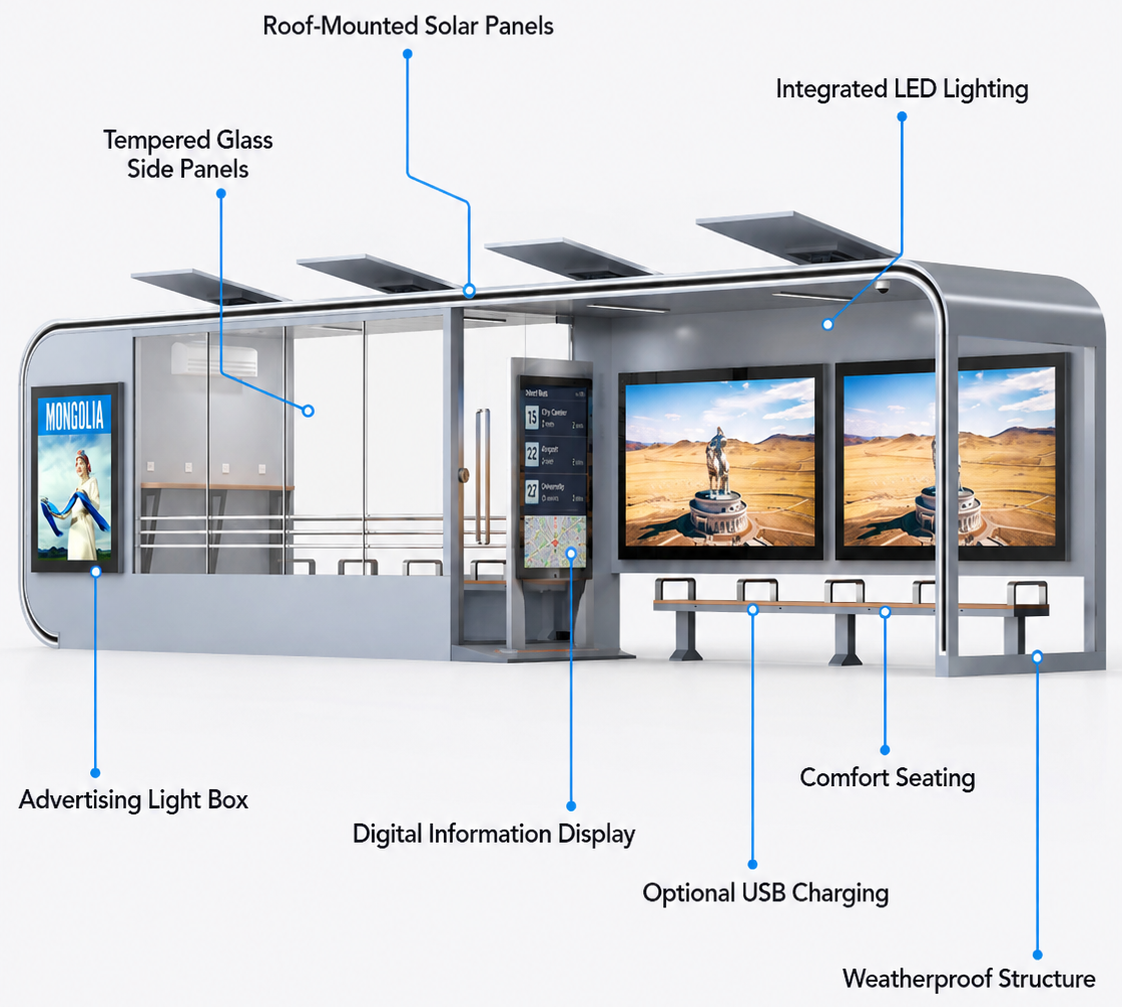
One frequently overlooked issue is battery heat exposure inside a sealed outdoor shelter.
Many quotations specify a battery by nominal capacity but do not explain where it will be installed, how heat dissipates, how maintenance is performed, or whether it is exposed to direct afternoon sun behind dark metal panels. High internal temperature can shorten battery life, reduce usable capacity, and increase system faults long before the steel structure shows any problem.
Before ordering, ask the supplier to show:
- The exact battery-cabinet location in the approved drawing.
- Ventilation, insulation, or thermal-management measures.
- Internal cabinet temperature assumptions.
- Service-clearance requirements.
- Battery replacement procedure.
- BMS protection details.
- Warranty exclusions related to ambient temperature.
This detail is especially important in the Middle East, Africa, South Asia, Southeast Asia, Latin America, and coastal regions.
A good RFQ should include:
- Destination country and installation city.
- Expected quantity and rollout schedule.
- Shelter dimensions and passenger capacity.
- Local wind, snow, rainfall, temperature, and corrosion conditions.
- Required solar-powered loads.
- Display size, brightness, operating hours, and content-management needs.
- Advertising panels, seating, bins, CCTV, charging, Wi-Fi, or emergency-button requirements.
- Required certifications and test documentation.
- Preferred Incoterm and destination port.
- Required drawing, sample, inspection, and warranty process.
Do not rely only on a business registration document, product photos, or a marketplace badge.
Use a layered verification process:
1. Request the business license, factory address, production photos, and organization chart.
2. Review current certificates and verify the issuer, certificate number, scope, and expiration date.
3. Conduct a video factory tour focused on machines, material storage, welding, coating, assembly, and packing—not only the showroom.
4. Ask for project-specific drawings and a detailed bill of materials.
5. Request references for comparable climates, configurations, or destination markets.
6. Use an independent third-party inspection before shipment.
7. Define acceptance criteria in the purchase contract.
For a high-value city project, a full shelter sample may be expensive. Instead, consider ordering:
- A full-size structural connection sample.
- A coating and material sample board.
- A solar/battery/control-cabinet prototype.
- A display enclosure sample.
- A mock-up of branding, glazing, seating, and lighting details.
- One complete pilot shelter before mass rollout.
The pilot should be evaluated for fit-up, drainage, electrical operation, packaging, assembly time, visual quality, and actual solar performance.
Solar Bus Shelters are frequently supplied in flat-pack or semi-knock-down form. Confirm:
- Whether glass ships separately.
- Whether each module can be handled by local lifting equipment.
- Whether all fasteners are labeled and packed by installation zone.
- Whether base plates and anchor bolts are included.
- Whether foundations are supplied by the manufacturer or locally designed.
- Whether the shipment includes spare electrical parts and touch-up paint.
- Whether installation manuals use clear drawings and part codes.
Your purchase contract should include:
- Approved drawings and revision-control procedure.
- Detailed bill of materials.
- Material and thickness tolerances.
- Coating and corrosion requirements.
- Solar-system performance assumptions.
- Display and electrical specifications.
- Factory-acceptance-test requirements.
- Pre-shipment-inspection checklist.
- Packaging and container-loading requirements.
- Spare-parts list.
- Warranty terms and response process.
- Liquidated-damages or remedy provisions for avoidable delivery delays where appropriate.
The most suitable Solar Bus Shelter manufacturer depends on whether your project is driven by structural durability, solar autonomy, public information, outdoor advertising, city branding, digital displays, or complete smart-transit integration.
Ainl is a practical candidate for buyers looking for flexible OEM/ODM support, efficient technical communication, and customized smart public-facility solutions covering shelter structures, lighting, solar systems, displays, and city-branding details. Its stated customization scope makes it particularly relevant for project buyers that need more than an off-the-shelf shelter model.
For your next sourcing round, prepare a project-specific RFQ, request a technical design package, compare suppliers at component level, and validate solar performance before approving production. This approach helps you evaluate true lifecycle value rather than only the initial unit price.
Ask for the full certificate, not just a logo or cropped image. Check the legal company name, factory address, certificate scope, expiry date, issuing certification body, and accreditation mark. Then contact the issuing body or use its official certificate-verification channel where available. Confirm that the certificate covers the manufacturing entity, not only an affiliated trading company.
Usually, no. CE obligations depend on the specific components and applicable directives or regulations. A steel shelter structure, LED luminaire, LCD display, Wi-Fi module, charger, battery system, and solar controller may have different compliance requirements. Consult a qualified local compliance specialist and define destination-market obligations before the design is finalized.
There is no universal correct number. The required thickness depends on shelter dimensions, span, roof material, wind speed, snow load, anchoring, advertising-panel loads, PV-module loads, and local building rules. Ask for engineering calculations and drawings rather than choosing only from a generic thickness figure.
It can, but only if the solar array, battery bank, display brightness schedule, local irradiance, and autonomy requirement are designed together. A large outdoor LCD can consume far more energy than LED lighting. In many locations, a hybrid solar-plus-grid system or a reduced operating schedule may be more reliable and cost-effective.
For a first project, link payment milestones to concrete deliverables: approved drawings, sample or pre-production approval, in-process inspection, passed pre-shipment inspection, shipping documents, and commissioning support where applicable. Use an independent inspection agency for critical projects and ensure that the inspection standard is attached to the purchase order.
- [China State Council Information Office: 2025 import and export briefing] — Official customs-based overview of China's 2025 trade performance and green-product exports. [english.scio.gov]
- [National Energy Administration-linked renewable energy update] — Officially reported solar-capacity context. [obor.nea.gov]
- [Future Market Insights: Bus Stop Shelter Market Forecast 2026–2036] — Market forecast and global-sector overview. [futuremarketinsights]
- [Statista: Solar Energy in China] — Solar-sector statistics and market context; access to some datasets may require subscription. [statista]


