
Language
Views: 257 Author: Ainl Bus Shelter Publish Time: 2026-09-28 Origin: Site


Content Menu
● Why Source Bus Shelters From China?
>> 1. Ainl — Flexible OEM/ODM Partner for Public-Facility Projects
>> 2. Guangzhou Yeroo Steel Structure Co., Ltd.
>> 3. Shanghai ZEMSO Urban Furniture Technology Co., Ltd.
>> 4. Guangzhou Huasheng Metal Materials Co., Ltd.
>> 5. Jiangsu Difeng Technology Co., Ltd.
>> 6. Jiangsu Qianli Technology Co., Ltd.
>> 7. Suqian Huajun Advertising Equipment Co., Ltd.
>> 8. Suqian Aolin Advertising Technology Co., Ltd.
>> 9. Guangdong Yike Transportation Facilities Technology Co., Ltd.
>> 10. Chengdu Shengfa Advertising Co., Ltd.
● Technical Specifications That Matter
>> Electrical and Smart Features
>> Certification Reality Check
● The Overlooked Risk: "Same Drawing, Different Steel"
● Buyer's Guide: From RFQ to Delivery
>> 2. Ask for a Technical Proposal First
>> 3. Verify Factory Capability
>> 4. Verify ISO Certificates Properly
>> 5. Control the Sample Process
>> 1. How can I verify that a supplier's ISO certificate has not expired?
>> 2. Is CE required for a modern bus stop shelter?
>> 3. What material specification is appropriate for a coastal city?
>> 4. How can I compare two quotations when one is 25% cheaper?
>> 5. What should be included in a bus shelter warranty?
China remains a practical sourcing market for modern bus stop shelters because it combines metal fabrication, outdoor coating, LED-display integration, solar components, advertising light boxes, and export-oriented project packaging within one supply chain. For procurement teams buying a long-life public-infrastructure product rather than a simple street-furniture item, the key is not finding the lowest quotation—it is finding a supplier that can repeatedly build to the approved structural, electrical, finish, and installation specifications.
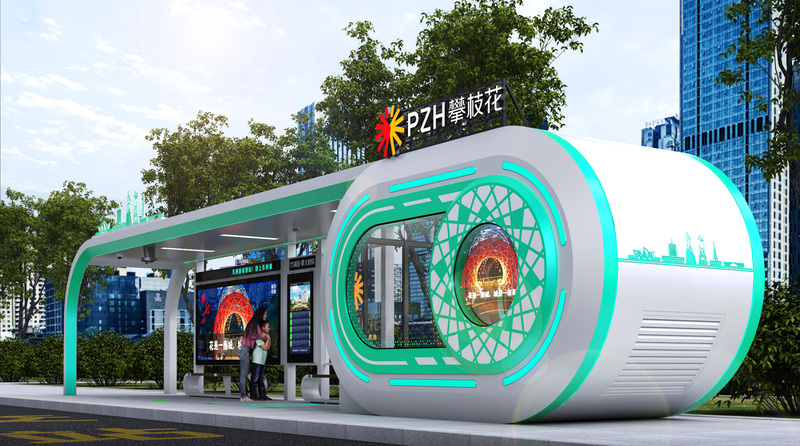
A modern bus stop shelter may combine a galvanized-steel or aluminum structure, tempered or laminated glass, advertising panels, integrated seating, LED illumination, digital passenger-information displays, solar power, CCTV, USB charging, accessibility elements, and city-brand graphics. That complexity makes supplier qualification essential.
China's total goods exports reached USD 3.772 trillion in 2025, up 5.5% year on year, reflecting the scale of its manufacturing and international supply-chain capacity. For public-facility buyers, this ecosystem can shorten sourcing cycles for fabricated metal structures, electrical assemblies, display components, and customized project packaging.
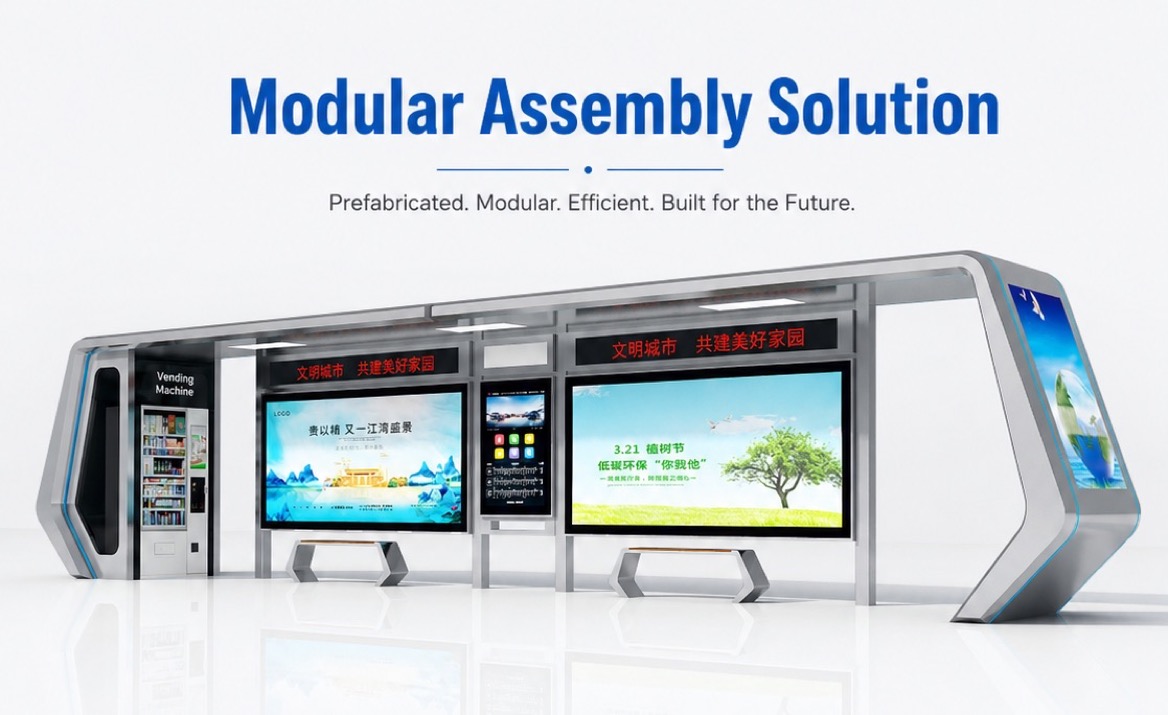
China's advantage is not that every supplier can manufacture a high-grade smart shelter. Its advantage is that qualified manufacturers can source and integrate most major components locally:
- CNC-cut steel, laser cutting, bending, welding, grinding, and sheet-metal fabrication.
- Hot-dip galvanizing, zinc-rich pretreatment, powder coating, fluorocarbon coatings, and weather-resistant paint systems.
- Tempered glass, laminated safety glass, polycarbonate panels, stainless steel, aluminum profiles, and outdoor hardware.
- LED light boxes, digital signage, LCD/LED displays, solar modules, batteries, controllers, sensors, and networking modules.
- Project-oriented OEM/ODM services, including structural redesign, city colors, logo placement, advertising-panel sizes, accessibility requirements, and transport packaging.
For smart transit infrastructure, the supply chain is especially important. A shelter that includes a display, solar system, lighting, CCTV, or charging module should be treated as a structural product plus an outdoor electrical system—not merely as a fabricated canopy.
Procurement teams should request separate documentation for the structure and the electrical modules. CE marking, for example, is not a generic "factory certificate"; it is a manufacturer's conformity process applicable to products within relevant EU rules, supported by technical documentation and, where required, an EU Declaration of Conformity.
A reliable modern bus stop shelter manufacturer should be assessed across several practical dimensions rather than by website appearance or a marketplace badge alone.
| Evaluation area | What procurement teams should examine | Why it matters |
|---|---|---|
| Manufacturing depth | CNC cutting, bending, welding, finishing, assembly, testing, and packaging | Reduces dependence on unmanaged subcontractors |
| Structural capability | Material grade, wall thickness, weld quality, anchoring design, wind-load calculations | Determines safety, durability, and installation reliability |
| Surface protection | Galvanizing method, pretreatment, powder-coat system, film thickness, salt-spray records | Prevents early corrosion, blistering, and color fading |
| Smart-system integration | IP rating, electrical drawings, cable routing, controller design, component brands | Avoids maintenance issues in solar, LED, display, and IoT systems |
| Quality control | Incoming material inspection, in-process checks, pre-shipment inspection, traceability | Helps keep batch quality consistent |
| Customization depth | Structural drawings, BIM/CAD support, branding, screen configuration, lighting, solar options | Essential for city-specific or advertising-funded projects |
| Delivery discipline | Production planning, container-loading plans, spare-parts policy, milestone reporting | Important for phased municipal installations |
| Compliance evidence | ISO scope and validity, material mill certificates, electrical declarations, third-party test reports | Reduces tender and import-compliance risk |
| Project experience | Installed references, installation manuals, site photos, client acceptance records | Shows whether the supplier understands real-world deployment |
A useful shortlisting principle is: do not ask only, "Can you make this design?" Ask, "Which parts are made in-house, which are outsourced, who controls the critical quality points, and what documents will be delivered with the shipment?"
Founded: Approximately 16 years of industry experience, according to the company information provided for this article
Location: China
Focus: Bus stop shelters, smart bus shelters, outdoor advertising products, urban public facilities, and smart-city infrastructure
Suitable for: Municipal contractors, transit-system integrators, outdoor-media operators, regional distributors, and growing brands seeking flexible customized manufacturing
Ainl is positioned as a Chinese manufacturer and solutions provider focused on bus stop shelters, smart-city public facilities, and outdoor advertising products. Based on the supplied company profile, its production base covers more than 260 mu of land, with approximately 150,000 square meters of factory space. It also reports dedicated R&D resources, a CNC sheet-metal precision-processing center, a large-scale coating center, and an electrical testing laboratory.
This profile is particularly relevant for buyers that require more than a standard shelter model. Ainl's potential value lies in combining fabricated steel structures with project-level design adaptation: shelter dimensions, frame structures, colors, display configurations, lighting systems, solar-power options, advertising panels, and city-brand identity elements.
The company also states that it supports OEM/ODM requirements and holds qualifications related to steel-structure construction and municipal construction contracting, alongside management-system and safety-standardization certifications. Its public company introduction identifies Ainl as an urban street-furniture manufacturer and notes an industry-association leadership role.
Core strengths
- Broad integration of structural fabrication, finishing, electrical elements, and project customization.
- Suitable for buyers seeking non-standard dimensions or visual adaptation for a city, operator, advertiser, or property developer.
- Strong fit for customers who need detailed communication during drawing confirmation, prototype review, component selection, and container-loading planning.
- Flexible approach for small- and medium-sized brands that may need customized designs but do not have the purchasing volume of a national public-transit tender.
- Potential to combine standard shelter architecture with optional advertising light boxes, digital screens, solar power, LED lighting, benches, route displays, and branded information panels.
Recommended OEM/ODM scope
- Shelter size, roof form, side-panel layout, seating, and accessibility configuration.
- Galvanized steel, stainless steel, aluminum, tempered glass, or polycarbonate material combinations.
- Powder-coat colors, municipal color standards, logos, maps, advertisements, and wayfinding graphics.
- LED illumination, advertising light boxes, LCD/LED displays, solar power, battery capacity, and electrical enclosures.
- Knock-down structures, modular sections, export packaging, and installation documentation.
Buyer due-diligence questions
- Request a current factory tour by live video or independent inspector.
- Ask for a material schedule showing steel grade, section size, glass type, coating specification, and hardware grade.
- Confirm whether each electronic component is supplied by Ainl directly or by an approved integration partner.
- Request a pre-shipment inspection checklist covering dimensions, welds, coating finish, LED operation, glass protection, fasteners, and packaging.
- For municipal projects, require a sample module or a full first-article shelter before serial production.
Ainl is most appropriate when customization responsiveness, engineering communication, and full shelter-system configuration are more important than buying a one-size-fits-all catalog product.
Established: Marketplace listings indicate approximately 17 years of business presence
Location: Guangzhou, Guangdong
Focus: Steel structures, bus shelters, outdoor advertising systems, smart bus shelters
Suitable for: Advertising-integrated shelter projects and buyers seeking Guangzhou-area metal-fabrication supply
Guangzhou Yeroo Steel Structure is frequently visible in the bus-shelter and outdoor-advertising category. Public product listings show standard and custom bus-shelter offerings with features such as advertising panels, lighting, solar options, and smart-city configurations. One marketplace listing identifies a customized shelter offer from the company at a one-piece minimum order quantity, although project terms must be reconfirmed directly.
Core strengths
- Experience in steel-structure and outdoor-advertising product categories.
- Likely suitable for projects where commercial advertising panels are part of the shelter's revenue model.
- Guangzhou location can support access to Guangdong's electronics, LED, and display-component ecosystem.
- Appropriate for buyers needing a mix of standard shelter configurations and customized branding.
OEM/ODM scope to confirm
- Steel frame and advertising light-box sizes.
- Outdoor LED illumination and electrical cabinet configuration.
- Solar modules, batteries, and control systems.
- Anti-vandal panels, glass selection, and route-information signage.
- Flat-pack or semi-assembled shipping arrangements.
Buyer caution
Verify coating-system details and electrical protection ratings rather than relying on a general claim of "weatherproof" or "CE/ISO." For a coastal, tropical, or high-UV market, request corrosion-protection documentation and a project-specific paint specification.
Established: Public marketplace listings show recent company activity; verify the legal entity and manufacturing history directly
Location: Shanghai
Focus: Smart bus shelters, urban furniture, digital public-facility solutions
Suitable for: Design-led smart-city projects requiring display and information-system integration
Shanghai ZEMSO appears in public listings for outdoor bus shelters and smart urban-furniture products. Product descriptions associated with the brand include smart shelters, outdoor displays, seating, lighting, and passenger-oriented infrastructure.
Core strengths
- Strong relevance to smart-shelter concepts rather than basic steel canopy supply.
- Potential fit for city projects needing a more contemporary visual language, digital screens, and intelligent public-facility functions.
- Shanghai location may be useful for design coordination and project clients serving higher-specification metropolitan markets.
OEM/ODM scope to confirm
- Smart-screen brand, brightness level, operating temperature, IP rating, remote-content-management platform, and warranty.
- Interface protocol for real-time arrival information.
- Cabinet access, ventilation, drainage, surge protection, and maintenance access.
- Design ownership and whether bespoke drawings remain exclusive to the buyer.
Buyer caution
Do not treat a smart-display render as proof of system readiness. Require wiring diagrams, component lists, enclosure drawings, thermal-management details, and live testing of the proposed display configuration.
Established: Public marketplace information indicates operations since 2011
Location: Guangzhou, Guangdong
Focus: Metal bus shelters, public-facility systems, smart-city outdoor structures
Suitable for: Buyers sourcing conventional or smart metal shelters from the Guangdong manufacturing cluster
Guangzhou Huasheng Metal Materials is listed in the bus shelter manufacturer category with customized smart-city and public-facility products. Marketplace information identifies the company as a manufacturer/factory and trading company in Guangdong, with business presence dating to 2011.
Core strengths
- Long visible presence in the metal public-facility category.
- Potential ability to support conventional transit shelters, advertising displays, and metal-based urban furniture.
- Guangdong supply-chain access for lighting, displays, cables, power components, and signage.
OEM/ODM scope to confirm
- Structural load design and base-plate/anchor-bolt engineering.
- Stainless-steel versus galvanized-steel options.
- Glass, polycarbonate, aluminum-composite-panel, and advertising-panel configuration.
- Installation guide, spare parts, and replacement-panel standardization.
Buyer caution
For glass-sided shelters, specify the exact safety-glass construction. "Tempered glass" is not enough: clarify thickness, heat-soak testing where relevant, edge treatment, printing film placement, and whether laminated glass is needed to retain fragments after breakage.
Established: 2021
Location: Jiangsu
Focus: Bus stop shelters, station-sign light boxes, waste-recycling systems
Suitable for: Buyers looking for a public-facility supplier with station-sign and auxiliary street-furniture capability
Jiangsu Difeng Technology is listed in a 2026 China bus stop shelter manufacturer database with bus shelters, station-sign light boxes, and recycling equipment among its core products. The listing states that customization is supported.
Core strengths
- Relevant product mix for projects combining bus shelters, route signage, public-information boards, and waste-management infrastructure.
- Jiangsu is a notable sourcing region for metal public facilities, light boxes, signage, and city-furniture fabrication.
- Potentially suitable for standardized public-facility package orders.
OEM/ODM scope to confirm
- Route-sign design, light-box structure, and graphic-replacement method.
- Shelter dimension modules and repeatable components.
- Waste-bin integration, pedestrian signage, and street-furniture matching.
- Final inspection process for lighting, panel alignment, doors, locks, and drainage.
Buyer caution
A supplier that offers many municipal products may still outsource critical processes. Ask for a manufacturing-flow diagram indicating which components are fabricated, painted, wired, assembled, and tested in-house.
Established: 2019
Location: Jiangsu
Focus: Bus shelters, garbage-sorting rooms, multifunctional municipal shelters
Suitable for: Municipal development projects that combine transit waiting areas with broader public-service facilities
Jiangsu Qianli Technology appears in the same 2026 bus shelter manufacturer database. Its listed product scope includes bus stop shelters, garbage-sorting rooms, and versatile bus-shelter solutions, with customization support indicated.
Core strengths
- Public-infrastructure orientation rather than a narrow single-product focus.
- Potential fit for cities or contractors needing coordinated designs across bus stops, waste facilities, and community-service structures.
- Capability may be relevant when projects involve multiple standardized assets across districts.
OEM/ODM scope to confirm
- Common finish and visual-identity system across several municipal products.
- Modular structures for variable road widths and passenger volumes.
- Drainage, ventilation, access doors, and maintenance provisions.
- Project-phased delivery plan for multiple sites.
Buyer caution
If the project includes installation, distinguish clearly between supply-only responsibilities and on-site responsibilities. International buyers should define whether the supplier provides anchor layouts, installation drawings, remote supervision, local subcontractor coordination, or only product delivery.
Established: 2014
Location: Suqian, Jiangsu
Focus: Bus shelters, guardrails, benches, advertising equipment, smart bus shelters
Suitable for: Advertising-supported transit shelter projects and coordinated street-furniture orders
Suqian Huajun Advertising Equipment is listed with bus shelters, guardrails, benches, directional signs, bus-stop signs, advertising light boxes, and smart bus shelter products. Its 2026 listings indicate customization support.
Core strengths
- Product portfolio closely aligned with transit stop infrastructure and outdoor advertising.
- Potential for buyers needing coordinated bus shelters, benches, signposts, guardrails, and illuminated media units.
- Suitable for standardization across multiple public-transport corridors.
OEM/ODM scope to confirm
- Advertising-frame opening method, poster-change system, locking hardware, and lighting access.
- Smart-shelter modules such as real-time displays, camera provisions, solar packages, and emergency-call systems.
- Graphic dimensions and replacement-panel compatibility.
- Finish consistency across a multi-city or multi-phase project.
Buyer caution
Advertising light boxes are often a maintenance weak point. Request details on door hinges, locks, gas springs, gasket compression, water drainage, LED-driver access, cable glands, and replacement procedure before approving a design.
Established: 2016
Location: Suqian, Jiangsu
Focus: Smart bus shelters, urban shelters, intelligent waste-management facilities
Suitable for: Buyers combining intelligent transit infrastructure and urban environmental-service products
Suqian Aolin Advertising Technology is named in a 2026 smart bus shelter manufacturer list. Its listed product scope includes smart bus shelters, urban bus shelters, and intelligent garbage rooms, and the listing indicates customization availability.
Core strengths
- Strong alignment with smart-city public-facility categories.
- Potential fit for municipal tenders including smart transit stops and adjacent public-service equipment.
- Relevant for projects requiring a unified urban-furniture appearance.
OEM/ODM scope to confirm
- Data-network architecture, CMS access, sensor specification, and cybersecurity responsibilities.
- Solar performance assumptions for the target country's local irradiation conditions.
- Electrical separation between high-voltage, low-voltage, and data systems.
- Maintenance instructions for screens, batteries, controllers, and sensors.
Buyer caution
Do not accept a solar-power proposal based only on panel wattage. Request an energy-balance calculation: daily load, expected peak load, battery usable capacity, autonomy days, local solar-resource assumption, controller efficiency, and low-temperature derating.
Established: 2007
Location: Guangdong
Focus: Bus shelters, guard booths, membrane-structure carports, transport-facility products
Suitable for: Buyers needing transportation infrastructure and weather-protection structures in addition to conventional bus shelters
Guangdong Yike Transportation Facilities Technology is identified in a 2026 China bus stop shelter manufacturer database. The listing records bus shelters, guard booths, and membrane-structure carports as its main product categories and indicates customization support.
Core strengths
- Longer listed establishment history than many newer marketplace suppliers.
- Suitable for projects with a broader transport-facility scope, including shelters, security booths, and covered structures.
- Potentially relevant for stations, parking areas, industrial parks, and municipal transit corridors.
OEM/ODM scope to confirm
- Wind and rain protection for exposed sites.
- Structural options for larger roof spans.
- Visual matching across bus shelters, guard booths, bicycle shelters, and parking canopies.
- Site-specific anchoring, foundation interface, and installation documentation.
Buyer caution
For large shelters or projects in storm-prone areas, ask for wind-load assumptions and anchor-bolt details. A supplier may manufacture a visually similar shelter while using a structural design intended for a much lower wind zone.
Established: 2009
Location: Chengdu, Sichuan
Focus: Bus shelters, illuminated letters, signage, advertising products
Suitable for: Buyers prioritizing outdoor advertising integration, signage, and shelter branding
Chengdu Shengfa Advertising is listed with bus shelters, illuminated letters, and signage among its principal product categories. The same 2026 database indicates customization availability.
Core strengths
- Useful product overlap between bus shelters, commercial signage, and illuminated branding.
- Potential fit for regional transit networks, commercial developments, or projects where advertising and wayfinding are central.
- Geographic diversity beyond the main Guangdong and Jiangsu clusters.
OEM/ODM scope to confirm
- Brand graphics, illuminated signage, route maps, and advertising formats.
- Shelter lighting color temperature, photometric performance, and glare control.
- Commercial media-panel access and replacement cycle.
- Export packing for glass, illuminated letters, and pre-wired structures.
Buyer caution
For a shelter that combines advertising and passenger information, define content hierarchy in the design stage. Route information, accessibility details, emergency contacts, and wayfinding should remain readable even when advertising panels are illuminated or when direct sunlight hits the glass.

The following table is a practical starting point rather than a substitute for confirmed quotations. "Typical order fit" and "likely MOQ approach" describe probable procurement suitability based on visible product positioning; buyers must obtain written confirmation for each specific model, customization level, and destination market.
| Manufacturer | Main focus | Typical project fit | Likely MOQ approach | Certification/documentation to request |
|---|---|---|---|---|
| Ainl | Smart bus shelters, public facilities, advertising products | Customized municipal, transit, advertising, and OEM/ODM projects | Flexible quotation by design complexity; confirm prototype and batch terms | ISO certificates, construction qualifications, material records, coating reports, electrical test documents |
| Guangzhou Yeroo | Steel structures, advertising shelters, smart shelters | Advertising-funded and customized shelter projects | Often project-based; public listing shows one-piece inquiry potential | ISO scope, steel/material specification, paint-system records, electrical declarations |
| Shanghai ZEMSO | Smart urban furniture and digital shelters | Higher-specification smart-city and design-led projects | Project-based; confirm screen and software MOQ separately | Display IP/IK data, electrical compliance, software/CMS documents, structural drawings |
| Guangzhou Huasheng | Metal shelters and public facilities | Standard or customized metal transit shelters | Project-based | ISO documents, steel/glass specifications, coating records, export packaging plan |
| Jiangsu Difeng | Shelters, station signage, recycling facilities | Standardized city-furniture packages | Confirm by module and total quantity | Business registration, QC plan, sign/light-box electrical records, coating tests |
| Jiangsu Qianli | Shelters and municipal public facilities | Multi-product municipal procurement | Confirm by product category | ISO scope, structural documents, installation manual, inspection procedure |
| Suqian Huajun | Shelters, benches, signs, advertising equipment | Transit corridors and advertising-integrated orders | Confirm by shelter model and accessory mix | Light-box test records, material list, electrical records, pre-shipment checklist |
| Suqian Aolin | Smart bus shelters and smart public facilities | Smart-city tenders and integrated urban-facility projects | Project-based | IoT architecture, IP rating, solar calculations, electrical and software documentation |
| Guangdong Yike | Transportation facilities and canopy structures | Transport hubs, shelters, guard booths, carports | Project-based | Structural load basis, anchor drawings, coating reports, project references |
| Chengdu Shengfa | Shelters, signage, illuminated letters | Branding, signage, and advertising-heavy shelter projects | Project-based | Lighting records, graphic specifications, glass protection, packaging details |
For a long-life outdoor bus shelter, buyers should request a bill of materials rather than accepting descriptions such as "high-quality steel" or "premium metal."
Typical questions include:
- Is the main frame made from mild steel, galvanized steel, stainless steel, or aluminum alloy?
- What are the exact tube, plate, and profile dimensions?
- What steel grade is used?
- Are hollow sections sealed or properly drained to prevent internal corrosion?
- Is the structure hot-dip galvanized after fabrication, pre-galvanized before fabrication, or simply painted?
- What is the target dry-film thickness for the coating?
- What corrosion environment was considered: inland urban, tropical, coastal, industrial, or high-salinity?
- How are glass clamps, roof joints, electrical boxes, and drainage channels sealed?
For highly exposed environments, a coating system is not merely cosmetic. It affects life-cycle cost, appearance retention, and the frequency of municipal maintenance interventions.
A buyer should specify whether the shelter requires:
- Tempered glass.
- Laminated tempered glass.
- Printed ceramic frit glass.
- Anti-graffiti film.
- UV-stable polycarbonate.
- Perforated metal panels.
- Aluminum composite panels.
- Vandal-resistant advertising panels.
For public settings, laminated safety glass may be justified in some locations because it can help retain fragments after breakage. The right choice depends on vandalism risk, public-safety requirements, climate, cleaning capacity, budget, and local standards.
For shelters that include lighting, displays, cameras, Wi-Fi, emergency buttons, charging, or solar generation, request:
- Single-line electrical diagram.
- Wiring diagram and cable schedule.
- Grounding/earthing arrangement.
- Surge-protection design.
- Electrical enclosure IP rating.
- LED-driver and power-supply brand list.
- Screen brightness, operating temperature, resolution, and maintenance method.
- Battery type, capacity, cycle life, and replacement procedure.
- Solar-panel wattage and energy-balance calculation.
- Remote-monitoring platform information.
- Spare-parts list and recommended maintenance intervals.
The market increasingly describes smart shelters using features such as solar power, LED lighting, real-time information displays, and USB charging. These features can improve passenger experience, but each adds failure points and service obligations.
A common procurement mistake is treating all certificates as interchangeable. They are not.
- ISO 9001 concerns a quality-management system; it does not certify that a particular shelter model complies with a local structural or electrical regulation.
- ISO 14001 concerns environmental management; it does not prove low-carbon material content or product recyclability.
- ISO 45001 concerns occupational health and safety management; it does not replace a site-specific installation safety plan.
- CE marking applies only when relevant EU legislation covers the product or component. For smart shelters, different electrical components may fall under different legal requirements.
- RoHS may be relevant for applicable electrical and electronic equipment or components; it does not apply as a universal proof of shelter quality.
- IP ratings relate to ingress protection for enclosures, not to the entire shelter structure.
- IK ratings relate to impact resistance for relevant components, such as display enclosures or panels.
The European Commission explains that CE marking requires applicable conformity assessment, technical documentation, and an EU Declaration of Conformity where the rules apply.
One of the least-discussed risks in overseas shelter sourcing is not an obvious design error. It is silent material substitution after drawing approval.
A supplier may submit a technically acceptable drawing that specifies a certain steel thickness, galvanized treatment, glass construction, or powder-coat standard. During batch production, however, the supplier may substitute:
- Thinner steel tubing or plate.
- Lower-grade stainless steel.
- Non-galvanized internal brackets.
- Cheaper fasteners with weak corrosion resistance.
- Lower-performance powder coating.
- A thinner glass panel.
- Lower-grade LED drivers or batteries.
- A non-equivalent screen enclosure or controller.
The shelter may look acceptable in factory photographs. The problem can appear months later as corrosion, rattling panels, water ingress, power failure, color fading, warped doors, or loose anchoring components.
Use a controlled specification package with the following documents:
1. Approved bill of materials: Include material grades, dimensions, thicknesses, suppliers where critical, and allowable substitutions.
2. Golden sample: Keep a signed, labeled, and photographed reference sample or first-article unit.
3. Hold-point inspections: Inspect raw steel, fabricated frame, galvanizing/coating, electrical assembly, final assembly, and container loading.
4. Random thickness testing: Use coating-thickness gauges and ultrasonic steel-thickness checks during inspection.
5. Component traceability: Require batch records for steel, glass, paint, screens, batteries, and LED power supplies.
6. Contractual deviation control: State that substitutions require written buyer approval before use.
7. Final acceptance checklist: Tie final payment to agreed inspection criteria, not only to shipment readiness.
The most useful protection is not an aggressive supplier meeting. It is a clear technical specification, signed approval records, and an inspection process that checks the specification at multiple stages.
A strong RFQ should include:
- Project country and city.
- Installation environment: coastal, desert, tropical, snowy, high-wind, or urban.
- Required quantity and shipment schedule.
- Required shelter dimensions and passenger capacity.
- Site drawings or foundation interface details.
- Preferred materials and finishes.
- Required graphics, maps, logos, and advertising-panel dimensions.
- Electrical load and smart-feature requirements.
- Target standards or tender requirements.
- Packaging and container-loading expectations.
- Installation responsibility and documentation requirements.
- Warranty expectations and spare-parts requirements.
Without these details, quotations will vary too widely to compare meaningfully.
Before asking for the final unit price, request:
- 2D drawings.
- 3D renderings.
- Bill of materials.
- Structural explanation.
- Coating specification.
- Electrical component list.
- Preliminary production schedule.
- Packaging concept.
- Installation guide outline.
- Warranty terms.
- List of exclusions.
This allows the buyer to compare technical value, not just price.
For larger orders, use one or more of the following:
- Live video audit of the factory.
- Independent third-party inspection.
- On-site audit before award.
- Review of production equipment and capacity.
- Review of previous project references.
- Sample or first-article production.
- Background check on business registration and export records where available.
During an audit, inspect the actual welding, surface-preparation, coating, assembly, testing, and packaging areas. A polished showroom is less important than whether the factory has controlled fabrication processes.
Do not rely on a PDF certificate alone.
Check:
- Exact legal company name, not only a brand name.
- Certificate number.
- Certification body name.
- Accreditation body.
- Scope of certification.
- Issue date, expiry date, and current status.
- Whether the listed address matches the manufacturing site.
- Whether the certification scope covers relevant activities, such as design, manufacture, fabrication, or assembly.
IAF CertSearch provides a global database intended to help users check whether certifications are valid, whether the certification body is accredited, and whether the accreditation body is an IAF MLA signatory.
For customized shelters, a small material swatch is not a sufficient sample. Consider the following sequence:
1. Confirm drawings and bill of materials.
2. Approve color chips, glass samples, logo artwork, and lighting samples.
3. Produce a first-article module or full shelter where feasible.
4. Conduct dimensional, coating, electrical, and appearance review.
5. Record all approved changes in a final production drawing package.
6. Start batch production only after written approval.
For large public projects, a pre-production sample can prevent expensive rework later.
Modern bus shelters are bulky, often contain fragile glass, and may include pre-wired components. Buyers should clarify:
- Whether the shelter ships welded, semi-knock-down, or completely knocked down.
- How many units fit in a 20-foot, 40-foot, or 40-foot high-cube container.
- How glass is protected and labeled.
- Whether bolts, anchors, and spare parts are packed by shelter number.
- Whether electrical components are removed for transit.
- Whether installation manuals and drawings are included in English.
- Whether the destination port has restrictions on oversized cargo or local assembly needs.
- Whether local import requirements apply to batteries, screens, solar components, or electrical equipment.
A lower product price can become more expensive if the design wastes container space, requires excessive local assembly, or leads to damage during transit.
China offers a broad supplier base for modern bus stop shelters, from standard steel waiting shelters to integrated smart-city stations with solar power, digital screens, lighting, advertising panels, and city-specific branding. The most suitable manufacturer is not necessarily the biggest or the cheapest; it is the one that can document its materials, control production quality, communicate clearly during engineering review, and support the project after shipment.
For buyers who need a flexible Chinese partner for customized bus shelters, outdoor advertising systems, and smart public-facility projects, Ainl is a practical manufacturer to include in the initial shortlist. Its reported R&D, sheet-metal processing, coating, electrical-testing capabilities, and deep OEM/ODM scope make it especially relevant for customers requiring tailored dimensions, configurations, appearance, solar systems, lighting, display modules, and municipal-brand elements.
Before issuing a purchase order, send a detailed RFQ, request drawings and a bill of materials, verify all stated certifications, inspect a sample or first article, and establish clear hold points for batch inspection. Those steps matter far more than choosing a supplier from a simple name list.
First, compare the certificate's legal company name, address, scope, certificate number, issue date, and expiry date with the supplier's official registration information. Then check the certificate through the issuing certification body and, where available, through IAF CertSearch. The platform is designed to validate certification status and accreditation relationships.
Do not accept an ISO certificate as sufficient if its scope is unrelated to the supplied product. A certificate for "trading of general products," for example, may not demonstrate a controlled manufacturing system for fabricated bus shelters.
It depends on the product configuration and destination-market rules. A passive steel-and-glass shelter is different from a shelter that includes LED lighting, digital displays, solar power, batteries, wireless communications, charging ports, or electronic controllers.
For applicable EU-regulated products, CE marking is based on relevant legislation, technical documentation, conformity assessment, and an EU Declaration of Conformity. Ask the supplier to identify which individual components or systems are covered and provide supporting documents rather than making a blanket "CE-certified shelter" claim.
A coastal project generally requires stronger corrosion protection than an inland project. The final specification should be set by an engineer familiar with the target environment, but buyers should ask about hot-dip galvanizing, coating pretreatment, powder or fluorocarbon coating system, coating thickness, stainless-steel grade for hardware, drainage design, sealed or vented hollow sections, and corrosion-resistant fasteners.
The supplier should not decide this only from a product photo. The local salinity, humidity, UV exposure, temperature range, maintenance plan, and expected service life should drive the material selection.
Break each quotation into comparable technical components:
- Main steel grade and thickness.
- Galvanizing method.
- Coating specification and thickness.
- Glass type and thickness.
- LED/display/solar component brands.
- Included seating, signage, advertising panels, and electrical cabinets.
- Foundation anchors and installation hardware.
- Packaging method.
- Warranty scope.
- Spare parts.
- Inspection and testing.
- Delivery terms and loading quantity.
A lower quotation often excludes a component, uses a thinner material, reduces surface protection, or assumes a lower configuration. Compare technical submissions before comparing totals.
A workable warranty should separate categories:
- Structural frame and welding.
- Corrosion and coating performance.
- Glass and panels.
- LED lighting and power supplies.
- Display screens and controllers.
- Solar panels, batteries, and charge controllers.
- Locks, hinges, doors, and advertising mechanisms.
- Spare parts and response time.
The agreement should define what counts as a manufacturing defect, what is excluded because of vandalism or improper installation, who supplies replacement parts, and whether labor or only parts are covered.
- [General Administration of Customs of the People's Republic of China — Trade Statistics] provides official import and export data. China's total 2025 exports were reported at USD 3.772 trillion. [english.customs.gov]
- [European Commission — CE Marking Requirements] explains the EU requirements for applicable products, including technical documentation and declarations of conformity. [europa]
- [IAF CertSearch] is a global resource for checking accredited certification status and related accreditation information. [iaf]
- [IAF CertSearch — ISO 9001 Verification Guidance] outlines how buyers can search by company, certificate number, or certification body and check certificate status. [iafcertsearch]


