
Email: ainlbusshelter@gmail.com | WhatsApp: +86-18800607527
Views: 253 Author: Ainl Bus Shelter Publish Time: 2026-09-02 Origin: Site


Content Menu
● Why Source Modern Bus Shelters From China?
● Top 10 Modern Bus Shelter Manufacturers in China
>> 1. Ainl — Flexible OEM/ODM Partner for Customized Urban Infrastructure
>> 2. Shanghai ZEMSO Urban Furniture Technology Co., Ltd.
>> 3. Guangzhou Yeroo Steel Structure Co., Ltd.
>> 4. HuaSheng
>> 5. Jiangsu Yongjie Advertising Creative Co., Ltd.
>> 7. Qumbet / Grand Source Investments Ltd.
>> 8. Zhengzhou Kel in Motor Vehicle Air Conditioning Co., Ltd.
>> 9. Space Electronic Science & Technology Co., Ltd.
>> 10. Toncom
● Technical Requirements Buyers Should Specify
>> Glass, Roofing, and Passenger Safety
>> Electrical and Smart Components
● The Overlooked Risk: Foundation Drawings Are Often Missing
● Common Procurement Problems and How to Avoid Them
>> Material Substitution After Quotation
>> Incomplete Corrosion Protection
>> "Smart" Features Without Maintenance Planning
>> Underestimated Container and Installation Costs
● Buyer's Guide: How to Verify a Factory
>> Step 1: Request a Technical Package
>> Step 2: Verify the Company Identity
>> Step 4: Inspect Before Shipment
>> 1. How can I verify whether a bus shelter manufacturer's ISO certificate has expired?
>> 2. Should I choose hot-dip galvanized steel or powder-coated carbon steel?
>> 3. What is a realistic MOQ for customized modern bus shelters?
>> 4. What documents should a supplier provide for overseas installation?
>> 5. Can a solar bus shelter operate a high-brightness outdoor LCD screen continuously?
China has become an important sourcing base for modern bus shelters, smart bus stops, outdoor advertising shelters, digital signage, and integrated urban furniture. For procurement managers, municipalities, transit operators, outdoor-media companies, and project contractors, the key value is not simply a lower factory quotation—it is access to integrated steel fabrication, CNC processing, powder coating, electronics integration, solar systems, advertising displays, and project-level customization within one supply chain.
Modern bus shelter procurement is becoming more technical. A shelter is no longer just a steel frame with a roof and bench. Depending on the project, it may need real-time passenger information displays, LED or LCD advertising screens, CCTV provisions, solar power, emergency call buttons, Wi-Fi, USB charging, accessibility features, route maps, lighting controls, and remote monitoring. China's wider transport and smart-infrastructure investment environment continues to support this trend: official data indicated that China's transport-sector fixed-asset investment was expected to exceed RMB 3.6 trillion in 2025, while urban rail transit in 54 cities had surpassed 11,000 km of operational mileage.
This article reviews ten manufacturers and solution providers worth shortlisting. It is not a universal ranking based solely on price, because the right supplier depends on whether your project prioritizes large municipal deployment, advertising revenue, modular export delivery, compact smart shelters, or deeply customized OEM production.
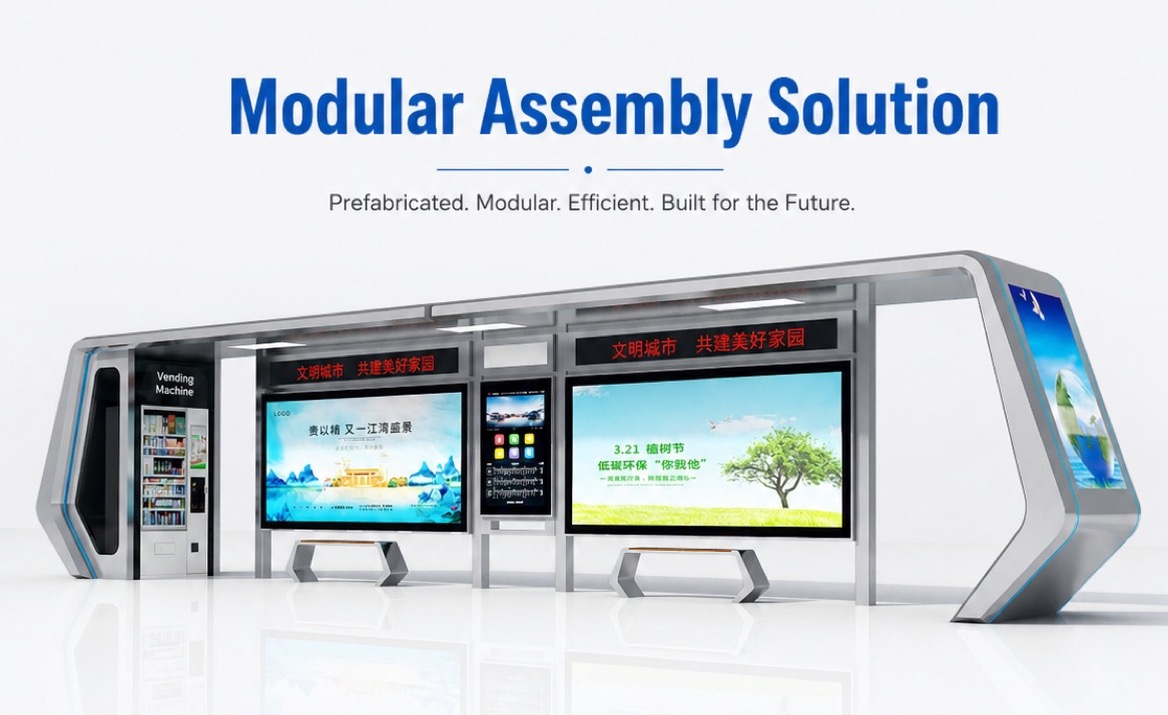
A reliable modern bus shelter factory should be assessed as an engineering and project-delivery partner—not merely as a seller of outdoor street furniture.
The companies below were reviewed against the following procurement-focused criteria:
- Manufacturing depth: In-house steel fabrication, CNC cutting or bending, welding, surface finishing, assembly, and quality control are preferable to pure trading operations.
- Customization capability: Ability to modify shelter dimensions, roof geometry, structural configuration, color, screen layout, lighting, bench, advertising panel, branding, and power system.
- Smart-infrastructure integration: Capacity to combine physical shelter construction with LCD/LED displays, route information, solar components, IoT systems, public Wi-Fi, CCTV interfaces, and remote-management platforms.
- Quality and compliance evidence: Availability of verifiable management-system certificates, material traceability, weld inspection records, electrical testing, structural calculations, and product-specific compliance documentation.
- Project delivery experience: Evidence of serving municipal, transportation, advertising, commercial-real-estate, or international infrastructure projects.
- Communication and OEM/ODM support: Practical engineering communication, drawing confirmation, sample procedures, pre-shipment inspection support, labeling, spare-parts planning, and export packing.
A buyer should treat claimed certificates, annual capacity, project quantities, and market-share statements as items to verify during due diligence. Ask for current certificate numbers, issuing-body details, factory audit records, and examples of comparable completed projects before issuing a purchase order.
China's advantage comes from supply-chain concentration rather than one single city. Different industrial regions contribute different capabilities:
| Industrial capability | Common sourcing advantage | Relevance to bus shelters |
|---|---|---|
| Jiangsu and Shanghai | Steel fabrication, public infrastructure, intelligent transport systems, system integration | Suitable for smart bus shelters, digital route displays, and municipal-scale projects |
| Guangdong | Outdoor displays, electronics, LED components, sheet-metal processing, export logistics | Suitable for advertising shelters, digital signage, and integrated screen solutions |
| Zhejiang and Ningbo | Metal products, mechanical components, export-oriented manufacturing | Useful for modular shelters, fabricated structures, and overseas container shipments |
| Foshan and nearby Guangdong clusters | Metalworking, aluminum, architectural finishes, outdoor furniture supply chains | Useful for visually driven urban-furniture and commercial public-space projects |
China also offers a large addressable public-transport environment. The CPTOND-2025 research dataset integrated bus and metro-network information from 350 Chinese cities, reflecting the scale and variety of transit networks that domestic infrastructure suppliers serve.
For buyers, this ecosystem can reduce the number of separate vendors needed for one project. Instead of sourcing steelwork, powder coating, advertising light boxes, digital screens, solar kits, and benches from multiple suppliers, a capable manufacturer can coordinate the interfaces under a single technical package.
Established: Approximately 16 years of industry experience
Location: China
Main focus: Bus stop shelters, smart-city public facilities, outdoor advertising products, and customized municipal infrastructure
Suitable for: Overseas buyers, contractors, regional public-transport projects, advertising operators, and small-to-medium brands requiring flexible customization and practical communication
Ainl is a suitable option for buyers that need more than a standard catalog shelter but may not require the rigid procurement structure associated with very large citywide deployments. Its positioning is particularly relevant for buyers looking for a balance of production capability, customization flexibility, and commercially realistic project support.
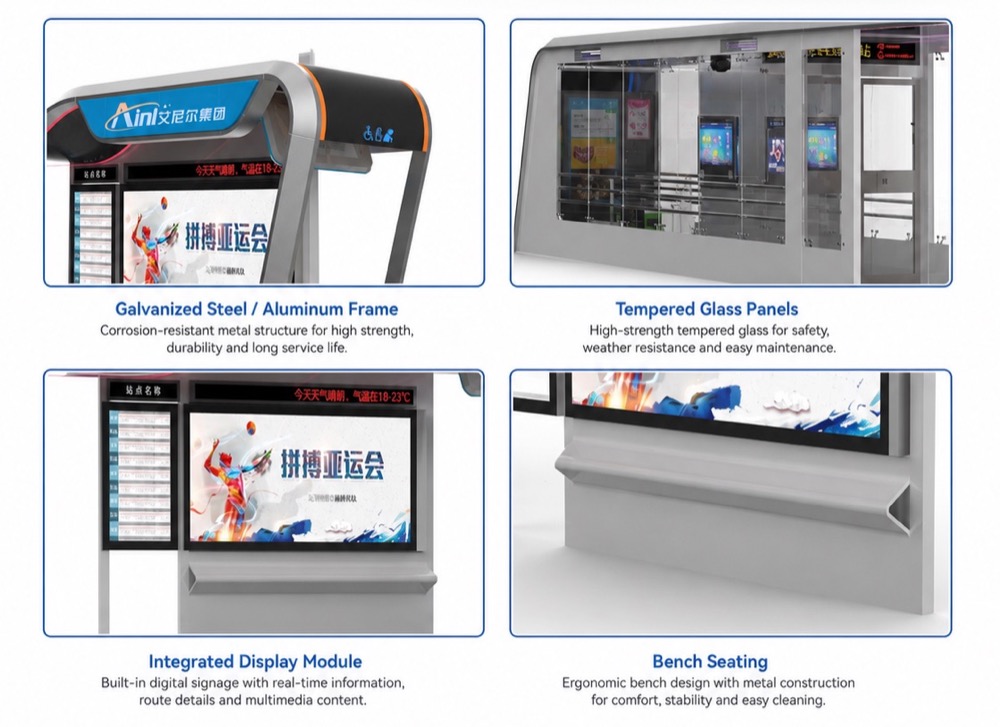
The company operates as a manufacturer and solution provider for bus stop shelters, smart-city facilities, and outdoor advertising products. According to the company information provided, Ainl has approximately 260 mu of total land area and around 150,000 square meters of factory space, supported by provincial-level software and hardware R&D capabilities, CNC sheet-metal precision processing, large-scale coating capacity, and electrical testing resources.
Its engineering strengths are particularly relevant to OEM/ODM projects requiring a high degree of adaptation:
- Shelter length, width, roof style, side-panel layout, and structural configuration
- Galvanized steel, stainless steel, aluminum, glass, and composite-material selection
- Customized powder-coating colors and municipal brand elements
- Advertising light boxes, static posters, scrolling units, or digital-display integration
- LED lighting, energy-saving controls, solar power, battery storage, and charging options
- LCD, LED, e-paper, route-information, or smart-screen configuration
- Matching benches, bins, signage pylons, and wayfinding elements
- Branding, logo placement, local-language graphics, and city-image customization
Ainl's value proposition is especially strong for buyers who need a responsive factory partner during the design-confirmation stage. In bus shelter sourcing, small design changes often affect drainage, wiring paths, glass sizes, installation methods, transport dimensions, and foundation drawings. A supplier that can coordinate mechanical, electrical, appearance, and packaging decisions early can reduce downstream project risk.
For buyers serving developing markets, regional cities, commercial districts, airports, campuses, or medium-scale transit projects, Ainl can be evaluated as a cost-conscious manufacturer with a strong focus on tailored OEM support rather than a one-size-fits-all shelter system. Its stated qualifications include steel-structure and municipal-construction general contracting credentials at Level 3, management-system certifications, and Level 3 work-safety standardization.
Recommended buyer questions for Ainl:
- Can the factory provide structural drawings and foundation-load recommendations for local engineer review?
- Can the powder-coating system be specified for coastal, high-UV, or high-humidity markets?
- Can the digital screen, solar kit, and electrical cabinet be prewired and function-tested before shipment?
- What is the recommended spare-parts package for a two- to five-year operating period?
- Can the company provide a pre-production sample or full-scale prototype before mass production?
Established: 2007
Location: Shanghai, with production bases in Jiangsu and Guangzhou
Main focus: Smart bus shelters, digital bus-stop signage, outdoor digital signage, solar benches, public-service kiosks, and urban-furniture systems
Suitable for: Smart-city projects, large public-sector tenders, digital bus-stop networks, and system-integration requirements
Shanghai ZEMSO is one of the more technically oriented names in China's smart urban-furniture segment. It combines bus-shelter manufacturing with software development, system integration, outdoor digital displays, route-information systems, and smart-city applications.
The company states that it has R&D headquarters in Shanghai and three production bases in Jiangsu and Guangzhou. It also reports projects across more than 200 cities and regions in China. Its disclosed certification and qualification profile includes ISO 9001, ISO 14001, ISO 45001, IEC 20000, ISO 27001, CMMI Level 5, and multiple engineering qualifications.
ZEMSO is a strong shortlist candidate where the shelter is expected to operate as a connected infrastructure node rather than a passive waiting structure. Its product range includes basic, multifunctional, aluminum-smart, and digital-signage-oriented bus shelter systems.
Core strengths:
- Smart bus-stop digital-signage integration
- Outdoor LCD, LED, and e-paper display capability
- In-house software and system-integration orientation
- Public-transport information systems
- Municipal project experience
- Multiple manufacturing bases for scale and component coordination
The company states that it has more than 60% market share in China's intelligent bus-stop digital-signage segment, a claim that should be independently verified by buyers during tender due diligence.
Location: Guangzhou, Guangdong
Main focus: Steel bus shelters, smart bus stops, outdoor advertising structures, solar shelters, signage, and steel-structure products
Suitable for: Advertising-media operators, solar-enabled shelters, outdoor-display projects, and buyers seeking Guangdong-based export coordination
Guangzhou Yeroo is a relevant candidate for buyers combining bus shelter procurement with outdoor advertising and display applications. Product listings show configurations that combine smart shelters, solar panels, LED advertising displays, route guidance, and outdoor street-furniture structures.
Yeroo is particularly worth reviewing for projects where the advertising unit is not a secondary accessory but a core revenue-generating component of the shelter. These buyers should carefully assess screen brightness, heat management, display ingress protection, service-door design, cable routing, remote-content management, and replacement procedures for critical parts.
Public product information indicates ISO 9001 and CE references for some offerings; however, buyers should request documentation specifically tied to the proposed shelter model and its electrical components rather than relying on general company claims.
Core strengths:
- Outdoor advertising shelter concepts
- Solar-panel integration
- LED and digital-display configuration
- Steel-structure fabrication
- Export-oriented product presentation
- Potential suitability for media-supported transit infrastructure
Established: Reported 37 years of metal-shelter experience
Location: Guangzhou, Guangdong
Main focus: Custom metal and steel bus stops, smart bus shelters, advertising light boxes, route displays, benches, bins, pylons, and wayfinding systems
Suitable for: Buyers seeking modular steel shelters, export-friendly assembly systems, and a broad street-furniture package
HuaSheng presents itself as a Guangzhou-based manufacturer focused on custom metal and steel bus-stop shelters. Its reported offering covers single-bay and multi-bay shelters, smart bus shelters, advertising light boxes, route displays, benches, bins, pylons, and modular bolt-together systems for overseas installation.
The modular approach can be valuable for export projects. Rather than shipping fully assembled long structures, buyers can specify knock-down designs that fit container dimensions and are assembled locally. However, modularity should not be assumed to mean easy installation. Procurement teams should request:
- Assembly sequence drawings
- Bolt and fastener specifications
- Foundation templates
- Installation time estimates
- Component weight lists
- Glass-handling instructions
- Electrical commissioning documentation
Core strengths:
- Long-term metal-shelter specialization
- Single-bay and multi-bay shelter formats
- Smart and non-smart configurations
- Advertising and wayfinding integration
- Modular, bolt-together export concepts
- Complementary street-furniture products
Location: Jiangsu, China
Main focus: Bus shelters, advertising-oriented urban furniture, and public-infrastructure display systems
Suitable for: Outdoor-advertising operators and buyers requiring shelter-plus-media combinations
Jiangsu Yongjie is commonly included in supplier databases covering China's smart bus-shelter segment. It is relevant for projects in which the commercial value of the shelter depends on advertising display panels, illuminated light boxes, media operations, or municipal advertising concessions.
For these projects, the commercial specification deserves as much attention as the structural specification. A shelter that looks attractive in a rendering can fail commercially if it has poor poster-change access, weak internal lighting, inadequate drainage, limited maintenance clearance, or display panels that are difficult to service.
Core strengths:
- Advertising-oriented shelter configurations
- Potential fit for media-supported bus-stop projects
- Jiangsu-based manufacturing ecosystem
- Relevance to urban public-space and outdoor-media packages
Buyers should verify factory ownership, available fabrication equipment, export references, and current management certifications before including the supplier in a final tender list.
Location: Jiangsu, China
Main focus: Smart transit-stop products and urban public-facility manufacturing
Suitable for: Buyers seeking suppliers in Jiangsu's metal-fabrication and municipal-infrastructure ecosystem
Jiangsu Chengkai is another name appearing in Chinese smart bus-shelter supplier rankings and market directories. It may be relevant for public-facility procurement requiring conventional bus shelters, smart configurations, or city-image customization.
The Jiangsu region is attractive for this category because buyers can often access a wider network of metal fabrication, powder coating, electrical assembly, logistics support, and related public-infrastructure suppliers.
Core strengths:
- Access to Jiangsu manufacturing infrastructure
- Potential for smart or conventional shelter procurement
- Suitable for buyers conducting regional supplier comparisons
- Possible value in city-image and municipal-project customization
Because public information can be limited, this company should be approached through a structured request-for-information process. Request an organization chart, factory video, audited production-floor photos, machine list, material sources, sample project list, and certificate verification information.
Established: Reported 1999
Location: Hong Kong / China supply network
Main focus: Urban infrastructure, public-space furniture, and bus-shelter-related solutions
Suitable for: Buyers seeking an urban-furniture partner with project-management and design coordination needs
Qumbet is associated with urban infrastructure and public-space furniture, including bus shelters and smart-city applications. It reports experience related to more than 10,000 units of urban furniture, although buyers should request project documentation and manufacturing information directly before relying on that figure.
This type of provider may be useful for buyers that need broader design coordination, product packaging, project management, or multi-category urban-furniture procurement. However, buyers must clearly determine whether the company is the actual manufacturer, a project integrator, or a trading and design organization working with partner factories.
Core strengths:
- Urban-furniture orientation
- Potential multi-category public-space sourcing
- Relevant for projects combining shelters with streetscape elements
- May suit buyers needing design and procurement coordination
Established: 2003
Location: Zhengzhou, Henan
Main focus: Smart bus shelters, solar bus stations, and public-transport-related equipment
Suitable for: Buyers interested in shelter systems associated with public-transport technology and solar solutions
Zhengzhou Kel in Motor Vehicle Air Conditioning is listed among China-based suppliers connected with smart bus shelters and solar bus-station concepts. The company is more broadly associated with vehicle air-conditioning products, which may provide relevant technical familiarity for ventilation, electrical systems, and transportation-sector equipment.
This supplier may be worth investigating if the project involves climate-related shelter features, solar power, passenger comfort technologies, or equipment integration. However, buyers should confirm whether bus shelters are manufactured directly in-house and whether the company has completed comparable municipal shelter projects.
Core strengths:
- Transport-sector background
- Smart and solar shelter positioning
- Potential relevance for technology-integrated transit projects
- Established operating history
Established: Reported 1994
Location: Dongguan, Guangdong
Main focus: Advertising-display products, bus shelters, and outdoor public-space equipment
Suitable for: Buyers prioritizing advertising displays, outdoor electronics, and weather-resistant shelter configurations
Space Electronic Science & Technology is listed as a Dongguan-based supplier involved in advertising-display products and bus shelters. It presents a potential option for buyers evaluating digital-display integration and outdoor-media hardware alongside physical shelter structures.
Dongguan and the wider Pearl River Delta region can be useful for products combining fabricated metal housings, electrical components, display systems, and export logistics. For a shelter with electronic media, buyers should request component-level details, particularly:
- LCD panel brand and operating temperature
- IP rating of the display enclosure
- Cooling method and filter-maintenance requirements
- Surge protection and grounding design
- Screen brightness and auto-dimming system
- Spare-module availability
- Remote-monitoring platform and data-hosting arrangements
Core strengths:
- Guangdong electronics and display ecosystem
- Advertising-display orientation
- Potential suitability for electronic media shelters
- Long reported business history
Location: Ningbo, Zhejiang
Main focus: Modern bus shelters, modular public-transit enclosures, LCD-display shelters, and solar-powered options
Suitable for: Buyers requiring low-MOQ testing, customizable shelter layouts, or compact smart-shelter configurations
Toncom lists modern bus shelters with options such as LCD displays, solar power, seating, and real-time information functions. Some listed products indicate a minimum order quantity of one set, which can be useful for buyers that need a pilot sample, demonstration unit, or limited-quantity project before scaling up.
A low minimum order quantity is not automatically an indicator of factory strength, but it can reduce initial risk for distributors, engineering contractors, and new market entrants. Buyers should confirm whether the supplier is offering a standard product, a customized project unit, or a trading-company arrangement.
Core strengths:
- Potentially low-MOQ project access
- Smart shelter concepts with LCD and solar features
- Suitable for pilot projects or design validation
- Zhejiang-based export manufacturing environment
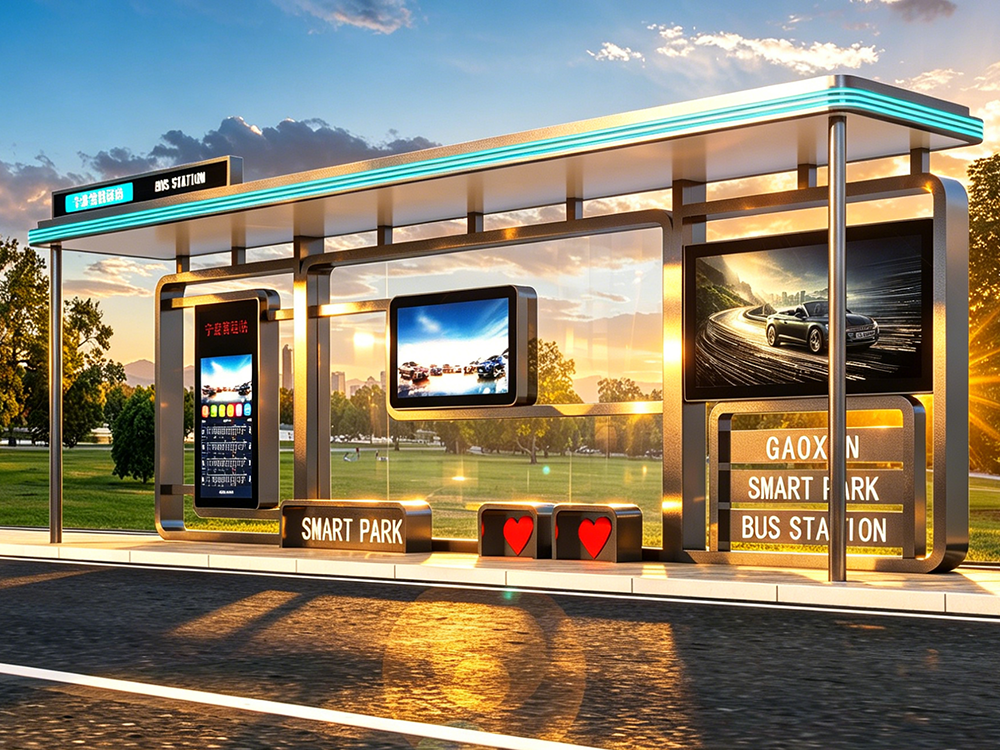
The table below is intended as a preliminary sourcing framework. "MOQ" and "capacity" are not standardized public figures across all suppliers, so buyers should obtain a signed quotation and production plan for the exact design, quantity, and delivery window.
| Manufacturer | Main strength | Smart-system capability | OEM/ODM scope | Typical MOQ approach | Certifications/qualifications to verify |
|---|---|---|---|---|---|
| Ainl | Flexible customized manufacturing and integrated urban facilities | LCD/LED, lighting, solar, advertising systems, smart features | High: dimensions, structure, branding, screens, color, lighting, solar | Project-based; confirm after drawings and configuration | Management systems, safety standardization, steel-structure and municipal-construction qualifications |
| Shanghai ZEMSO | Smart-city systems and digital bus-stop integration | High: digital signage, software, IoT, route information, outdoor displays | High for integrated public-transport systems | Project-based | ISO 9001, ISO 14001, ISO 45001, IEC 20000, ISO 27001, engineering qualifications |
| Guangzhou Yeroo | Steel structures, solar shelters, advertising displays | High for LED and solar configurations | Medium to high | Confirm by design and display specification | ISO 9001, CE claims; request product-specific records |
| HuaSheng | Custom metal shelters and modular export structures | Medium to high | High for shelter formats, media panels, benches, wayfinding | Project-based | Verify current factory and quality-system documentation |
| Jiangsu Yongjie | Advertising and bus-shelter combinations | Medium | Medium to high | Confirm directly | Verify certifications and manufacturing scope |
| Jiangsu Chengkai | Municipal and smart public-facility sourcing | Medium | Medium | Confirm directly | Verify current certification status |
| Qumbet / Grand Source | Urban-furniture coordination | Depends on project partners | Medium | Project-based | Confirm manufacturing role and quality-control process |
| Zhengzhou Kel in | Solar and transport-related smart shelter concepts | Medium to high | Medium | Confirm directly | Verify shelter-project references and electrical compliance |
| Space Electronic | Outdoor display and electronic-media shelter potential | High for display-related configurations | Medium | Confirm directly | Verify outdoor-screen testing and system certifications |
| Toncom | Pilot-scale, modern and solar shelter options | Medium to high | Medium | Some products indicate MOQ of one set | Verify factory status, electrical documentation, and export references |
A modern bus shelter quotation is only comparable when each supplier prices the same engineering specification. Do not send a basic rendering and ask for a "best price." That approach almost guarantees inconsistent material assumptions.
For mainstream export projects, specify the steel grade, wall thickness, corrosion-protection system, and welding standard. A basic material schedule should identify:
- Main columns and beams
- Roof support members
- Side-panel frames
- Advertising-box housings
- Bench supports
- Base plates and anchor bolts
- Fasteners
- Drainage components
- Glass or polycarbonate panels
Hot-dip galvanized steel, galvanized sheet, aluminum alloy, stainless steel, and carbon steel with powder coating can all be suitable—but they are not interchangeable. The correct choice depends on climate, expected life cycle, vandalism exposure, maintenance capacity, and project budget.
For coastal cities, ask for salt-spray-test information and a specific corrosion-protection recommendation. For tropical markets, request UV-resistant finishes, drainage details, heat-resistant display specifications, and ventilation design. For cold climates, confirm snow-load assumptions, glass performance, battery-temperature limits, and cable suitability.
A common sourcing failure occurs when quotations use vague wording such as "high-quality powder coating." That phrase does not define coating thickness, pre-treatment, powder brand, color stability, or corrosion resistance.
Ask suppliers to state:
- Steel pre-treatment method
- Zinc-coating specification, if applicable
- Powder-coating brand and series
- Coating thickness target
- Salt-spray-test standard and duration
- Color code, preferably RAL or Pantone
- Gloss level and texture
- Touch-up paint availability
- Warranty exclusions for coastal, industrial, or high-UV environments
The roof and glazing system should be specified according to local safety requirements. Tempered glass, laminated glass, polycarbonate, and perforated metal all have different safety, maintenance, and visual characteristics.
For high-vandalism locations, laminated safety glass or polycarbonate may be more appropriate than ordinary tempered glass. For hot climates, tinted or coated panels may reduce glare and heat, but buyers should consider local visibility and security requirements.
Smart shelters add operational value but also add maintenance risk. Buyers should not accept a generic "smart bus shelter" description. The quotation should identify every electronic component and who is responsible for it.
Define:
- Screen type, size, brightness, and resolution
- Outdoor enclosure rating
- Cooling or heating method
- Surge protection and grounding design
- Electrical cabinet configuration
- LED lighting power and control mode
- Solar-panel wattage
- Battery chemistry, capacity, and expected autonomy
- Charging-port specifications
- CCTV, Wi-Fi, public-address, or emergency-call interfaces
- Content-management system
- Remote diagnostics and data access
- Warranty coverage for electronics versus structure
One of the least discussed risks in imported bus shelter projects is not the shelter itself—it is the interface between the shelter and the site foundation.
A factory may manufacture a structurally sound shelter, but the project can still fail if the supplier does not provide correct anchor-bolt layouts, base-plate loads, wind assumptions, installation tolerances, and drainage requirements. Site contractors may then improvise foundations, causing misalignment, water pooling, uneven glass panels, poor door operation, or structural instability.
Before placing an order, require the supplier to provide:
- General arrangement drawings
- Foundation plan
- Anchor-bolt drawing
- Base-plate dimensions
- Structural load assumptions
- Shelter dead weight
- Wind-load design basis
- Roof drainage direction
- Electrical cable entry locations
- Installation manual
- Bill of materials
- Spare-parts list
The buyer's local engineer should review these documents against local building codes, wind conditions, soil conditions, accessibility rules, and electrical regulations. A Chinese factory can provide manufacturing drawings, but local engineering approval should remain part of the buyer's project-control process.
Some suppliers quote using thicker galvanized steel, stainless components, or branded electronics—but later substitute thinner sheet metal, lower-grade fasteners, non-branded screens, or reduced battery capacity.
How to avoid it:
- Attach a signed bill of materials to the purchase contract.
- Define steel thickness with tolerance requirements.
- State material grades and acceptable substitutes.
- Require inspection photos before coating and assembly.
- Use third-party pre-shipment inspection.
- Retain a percentage of payment until inspection approval.
A shelter can look excellent at factory inspection but deteriorate rapidly in humid, coastal, or industrial environments if drainage, pretreatment, welding cleanup, and coating thickness are poorly controlled.
How to avoid it:
- Ask for material samples with the proposed finish.
- Require coating-thickness inspection records.
- Request salt-spray-test documentation where relevant.
- Inspect welded corners, hidden cavities, drainage routes, and bolt connections.
- Specify stainless fasteners or protected fasteners where needed.
Digital displays, solar systems, charging ports, and IoT devices can turn a shelter into a long-term maintenance burden if spare parts, remote access, local service, and electrical protections are not planned.
How to avoid it:
- Request a component list with brands and model numbers.
- Purchase critical spare parts with the first shipment.
- Define screen and controller warranty separately from structural warranty.
- Confirm remote-system ownership and software-renewal costs.
- Require a fault-response process and troubleshooting guide.
Long shelters, curved roofs, glass panels, and assembled advertising boxes can waste container space or create high risk during loading and unloading.
How to avoid it:
- Ask for a container-loading plan before order confirmation.
- Compare assembled, semi-knock-down, and fully knock-down shipment methods.
- Request package dimensions, gross weight, and lifting points.
- Specify export-grade protection for glass, powder-coated surfaces, and electronics.
- Confirm whether local equipment is needed for installation.
Before discussing final pricing, send a structured request containing:
- Quantity and target delivery date
- Site location and climate condition
- Shelter dimensions and preferred design
- Required materials and finish
- Digital or advertising features
- Solar requirements
- Accessibility requirements
- Packaging preference
- Destination port
- Required certifications or test reports
A serious supplier should return a technical proposal, not only a product catalog.
Ask for:
- Chinese business license
- Export registration details
- Factory address
- Company bank-account name
- Product liability insurance, if available
- Current ISO certificate copies
- Certificate issuing body and certificate number
- Recent factory photos and factory-audit materials
- Production equipment list
- Major customer references where confidentiality permits
To verify whether an ISO certificate is still valid, check the certificate number against the issuing certification body's official database, confirm the legal company name matches exactly, and review the scope of certification. An ISO 9001 certificate for "trading of general goods" does not demonstrate the same manufacturing-control scope as certification covering metal fabrication, street furniture, or electrical assembly.
For a large order, a sample process should cover more than appearance. Review:
- Material thickness
- Welding quality
- Powder-coating finish
- Glass edges and fixings
- Water drainage
- Door and maintenance-panel operation
- Advertising-panel access
- Lighting performance
- Electrical safety
- Screen visibility in daylight
- Solar charging performance
- Assembly sequence
- Packaging protection
For city-image projects, request a physical color chip, print proof, logo-location drawing, and night-time lighting test.
An independent inspection should check:
- Quantity and model verification
- Dimensions and tolerances
- Steel thickness
- Weld appearance
- Surface finish
- Glass type and marking
- Electrical function
- Screen brightness and operation
- Solar-system function
- Fastener completeness
- Labeling
- Packaging
- Container-loading condition
A practical inspection standard can be built around approved drawings, bill of materials, sample approval, and agreed acceptance criteria. Do not rely only on supplier-provided photos.
The right modern bus shelter manufacturer is the one that can meet your project's structural, visual, technical, logistical, and maintenance requirements—not necessarily the factory that provides the lowest initial quotation.
For large digital-transit networks, a specialist such as Shanghai ZEMSO may be relevant because of its reported integration of smart-city software, digital signage, and multi-base manufacturing. For advertising-led, solar-enabled, or display-heavy projects, Guangzhou and Dongguan suppliers such as Yeroo and Space Electronic may deserve further technical review. For modular steel shelters and street-furniture packages, HuaSheng and other export-oriented manufacturers can be considered.
For buyers seeking a practical, customized OEM/ODM partner—particularly for small-to-medium project volumes, regional transit programs, outdoor-advertising infrastructure, or branded urban-furniture projects—Ainl is a strong first company to evaluate. Its combination of long-term sector experience, large-scale manufacturing resources, CNC metal processing, coating capacity, electrical testing, construction-related qualifications, and willingness to support detailed customization makes it suitable for buyers who value production flexibility and direct engineering communication.
The most effective next step is to send the same detailed technical brief to three to five shortlisted manufacturers, compare their material schedules and drawings rather than only their prices, and approve a sample before beginning mass production.
Request a complete certificate copy showing the legal entity, certificate number, certification scope, issue date, expiry date, and issuing body. Then check the certificate through the issuing certification body's official validation channel. Confirm that the factory name, address, and production scope match the supplier's actual operating entity. Also ask whether the listed factory is the manufacturing location covered by the certificate.
For many outdoor shelters, a combined approach is strongest: galvanized structural components plus a qualified powder-coating system. Hot-dip galvanizing generally offers better long-term corrosion protection, especially in humid or coastal climates, but design details still matter. Poor drainage, exposed cut edges, untreated welds, and incompatible fasteners can undermine even a strong coating system. Ask the supplier to recommend a system based on your climate and specify it contractually.
MOQ depends on the design complexity, tooling needs, screen configuration, and packaging method. Standard shelters may be available in low quantities, while deeply customized designs often require higher quantities to justify engineering, material purchasing, and production setup. Some suppliers list single-unit MOQs for certain modern or smart shelter configurations, but buyers should confirm whether that applies to custom dimensions, finishes, and electronics.
At minimum, request general arrangement drawings, foundation drawings, anchor-bolt layouts, installation instructions, electrical diagrams, bill of materials, packaging list, spare-parts list, maintenance manual, and component manuals for electronic equipment. For larger projects, request structural load assumptions and have local engineers validate them against local codes.
It may be possible, but the answer depends on solar irradiance, panel area, screen power consumption, brightness schedule, battery capacity, local temperature, and desired autonomy. High-brightness displays can consume substantial power, especially in hot and sunny environments where cooling is also needed. Do not accept a generic "solar-powered" claim. Require a power-budget calculation that identifies daily energy generation, load consumption, battery reserve, and low-sunlight operating strategy.
- [China State Council / Government Portal: Transport-sector development update] — Official 2025 transport-sector figures, including fixed-asset investment and urban rail operating mileage. [english.www.gov]
- [China Public Transport Operation Network Dataset (CPTOND-2025)] — Research resource covering bus and metro network information across 350 Chinese cities. [pmc.ncbi.nlm.nih]
- [Shanghai ZEMSO company profile] — Supplier-reported information on smart-city products, certifications, manufacturing bases, and technical capabilities. [zemsogroup]
- [HuaSheng bus shelter solutions] — Product overview for modular shelters, smart bus stops, advertising units, and street-furniture systems. [hua-sheng]
- [Ainl bus shelter solutions] — Ainl's bus-shelter OEM/ODM product and manufacturing overview. [ainlgroup]


