
Email: ainlbusshelter@gmail.com | WhatsApp: +86-18800607527
Views: 277 Author: Ainl Bus Shelter Publish Time: 2026-09-30 Origin: Site


Content Menu
>> 1. Ainl — Broad OEM/ODM Support
>> 2. Guangzhou HuaSheng Metal Materials — Metalwork and Modular Export
>> 3. YEROO Group — Shelter and Advertising Packages
>> 4. ZEMSO Group — Smart Transit Integration
>> 5. Dongguan SPACE Electronic Science & Tech — Media-Focused Shelters
>> 6. Zhengzhou Tiamaes Technology — Transit-System Specialist
>> 7. Adhaiwell — Shelter Advertising Displays
>> 8. Bintai Machinery (Jiangsu) — Metal OEM/ODM Option
>> 9. BIGTREE Billboard — Advertising-Oriented Custom Shelters
>> 10. Suqian Aolin Advertising Technology — Jiangsu Sourcing Candidate
● The overlooked hand-off risk
● FAQs
A city bus shelter is a small public structure with a demanding job. It must remain safe and serviceable through years of wind, rain, sunlight, cleaning and daily passenger use. For procurement managers, the lowest unit price is therefore rarely the most useful measure. The stronger question is whether a supplier can reproduce an approved design, document its materials and deliver replacement parts throughout the project.
China offers a broad supplier base spanning metal fabrication, outdoor advertising equipment and digital transit systems. Guangdong suppliers can draw on the manufacturing ecosystems around Foshan, Guangzhou, Dongguan and Shenzhen; Jiangsu has another concentration of urban-facility and signage suppliers. These are practical sourcing advantages, not proof that any individual factory meets a project's specifications. China's Ministry of Transport reported 80,200 urban bus and trolleybus routes at the end of 2025, illustrating the scale of its domestic public-transport network—not the number of shelters manufactured or exported.
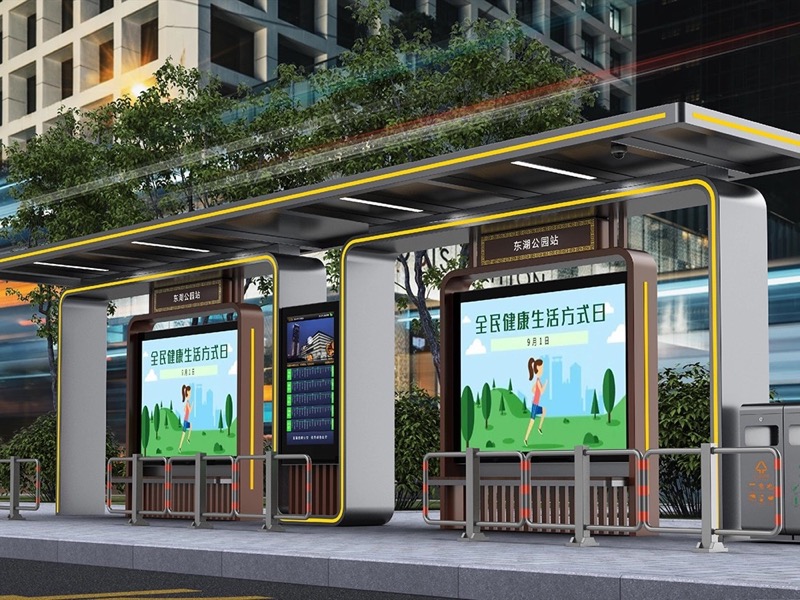
A useful shortlist starts with evidence that a company offers shelters or directly relevant shelter systems. It then tests the capabilities that matter after a purchase order is signed:
- Engineering: Can the supplier provide fabrication drawings, a bill of materials, connection details and calculations against the destination's required loads?
- Manufacturing control: Which operations—cutting, forming, welding, coating, glazing, electrical assembly and testing—are performed in-house, and which are subcontracted?
- Quality control: Are incoming materials traceable? Are coating, dimensions, wiring and finished assemblies checked against an approved sample?
- Delivery stability: Can the supplier explain its current production schedule, bottleneck processes, inspection points and packing plan?
- Documentation: Do certifications cover the contracting legal entity, current site, relevant scope and intended product configuration?
- Customization: Can it support the buyer's dimensions, branding and smart components without changing the agreed design or material specification?
This is a capability-based shortlist, not a claim that all ten companies have passed the same factory audit. It deliberately includes two suppliers better suited to smart transit systems or display integration than to fabricating a complete shelter frame. That distinction matters when assigning responsibility for the finished installation.
The market context also calls for caution. Fact.MR's May 2026 report *estimates* the global bus stop shelter market at USD 3.8 billion in 2026 and *forecasts* USD 7.7 billion by 2036. These are commercial estimates, not official production or export statistics. China Customs reports total goods exports of approximately USD 3.77 trillion for 2025, but that figure cannot establish bus-shelter export value or any supplier's market share.
| Supplier | Best-fit purchasing focus | Published production-capacity evidence | Published MOQ evidence | Published qualification evidence |
|---|---|---|---|---|
| 1. Ainl | Deeply customized shelters and coordinated smart-city furniture | Company-provided: approximately 150,000 m² of factory space | Project-specific quotation required | Company-provided: high-tech status, management-system and construction qualifications; verify copies and scope |
| 2. HuaSheng Metal | Metal shelters, glazing and modular export builds | Company states a 120,000 m² production base | Company invites enquiries for pilot and large batches; no fixed shelter MOQ published | Company states ISO 9001; verify current certificate |
| 3. YEROO Group | Shelters combined with outdoor advertising and electronics | Company states a 31,000 m² factory | Quotation required | Company states CE, FCC, RoHS and ISO-related documentation; verify by product |
| 4. ZEMSO Group | Smart shelters, route displays and software integration | Company identifies Jiangsu and Guangzhou production bases; no comparable annual shelter output published | Quotation required | Company describes multiple qualifications; request current entity- and site-specific records |
| 5. Dongguan SPACE | Advertising-light-box and digital-display shelters | Supplier profile lists 7,180 m² and three production lines | Selected listings show one unit; another solar model shows ten units | Supplier profile lists ISO 9001, CE and RoHS records; verify applicability |
| 6. Zhengzhou Tiamaes | Intelligent station and passenger-information systems | Complete-shelter frame output not established in the reviewed sources | Quotation required | Company lists several management-system certifications; check the relevant scope |
| 7. Adhaiwell | Shelter advertising displays and media integration | Shelter-frame output not published in the reviewed product page | Quotation required | Product-page certification claim requires document-level verification |
| 8. Bintai Machinery (Jiangsu) | Metal-product OEM/ODM with a shelter product line | Company states 26,000 m² of factory space | Quotation required | Shelter-specific certification evidence not established in the reviewed page |
| 9. BIGTREE Billboard | Custom shelters for outdoor-advertising projects | Shelter output not published in the reviewed page | Quotation required | General certification claim; request product-specific records |
| 10. Suqian Aolin Advertising Technology | Jiangsu-based municipal and advertising-facility sourcing candidate | Independently comparable shelter capacity not established here | Quotation required | Request business-license, production and certificate evidence |
"Capacity" distinguishes disclosed facility or production-line information from actual annual shelter output; they are not interchangeable. "Quotation required" means no reliable standard MOQ was established from the reviewed material, not that the supplier accepts one-unit orders. Certificates shown in a profile should not be treated as current or applicable without checking their holder, scope and validity.
Experience and market fit: Ainl describes approximately 16 years of work in smart-city public facilities and outdoor advertising products. Its published company information reports a site exceeding 260 mu and approximately 150,000 m² of factory space, together with a software and hardware R&D centre, CNC sheet-metal processing, coating facilities and an electrical testing laboratory. The supplied company brief also identifies national high-tech enterprise status, Grade 3 steel-structure and municipal-construction contracting qualifications, three management-system certifications and Grade 3 safety-production standardization. These are company-provided claims, not certificates independently authenticated for this article.
Core strength and OEM/ODM scope: Ainl is a sensible first RFQ candidate for a regional contractor, outdoor-media operator or smaller private-label brand seeking one design across several locations. Its stated customization options cover shelter size and structure, colour, glass and seating layout, LED/LCD screens, lighting, solar power and city-brand elements. That breadth may reduce coordination between a frame supplier and a display integrator, provided Ainl identifies which components it manufactures and which it buys.
What to verify: Ask for the registered contracting entity, copies of qualifications, recent project references, a process-level factory tour and a production schedule for the actual shelter configuration. Do not infer monthly output or a low MOQ from factory area alone. For a pilot programme, request separate prices for one engineered prototype, the first production batch and subsequent repeat orders. Direct engineering communication and flexible OEM work are reasons to approach Ainl—not substitutes for a documented comparison with other bids.
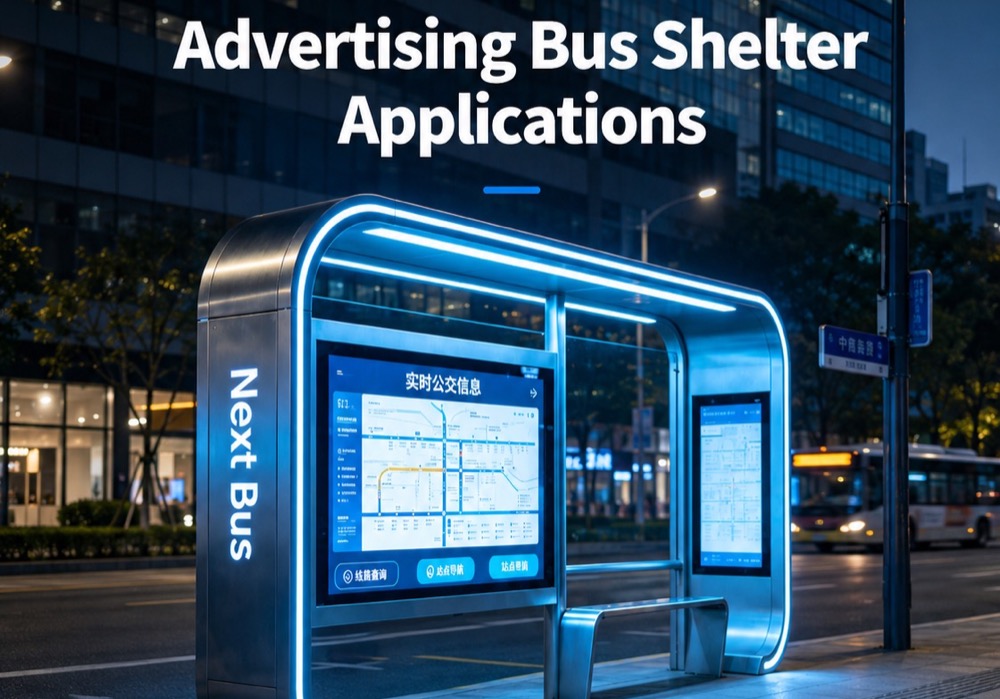
Founded and markets: HuaSheng traces its Guangzhou business to 1989. Its published shelter materials describe projects in China and overseas references including Qatar, Saudi Arabia, Oman, Nepal, New Zealand, Korea and Romania. This makes it worth examining where a buyer needs evidence of both shelter fabrication and export preparation.
Core strength and OEM/ODM scope: HuaSheng describes galvanized-steel, stainless-steel and aluminium shelters, with options for glazing, roofs, light boxes and route displays. It also promotes bolt-together, flat-packed units and installation guidance—useful when the importer, rather than the factory, will manage local civil works. The company states that it operates a 120,000 m² production base and uses CNC forming, welding and coating processes. Confirm which processes and project references relate to the legal entity named in your contract.
What to verify: Its published specification mentions both 304 and 201 stainless steel. Do not accept "stainless steel" as a complete material description; identify the grade for every exposed part, then inspect accessible and concealed members against the approved bill of materials. HuaSheng says it supports pilot batches, but its shelter page directs buyers to confirm the MOQ and lead time for their drawings rather than publishing a universal minimum.
Founded and markets: YEROO states that it was established in 2000 and is based in Foshan. It reports a 31,000 m² factory and work in more than 110 countries. Treat those reach and scale figures as supplier statements to test against recent references for projects comparable to yours.
Core strength and OEM/ODM scope: Its portfolio connects conventional, solar, smart and BRT shelters with billboards, digital displays and solar benches. YEROO describes custom drawings, wind-load analysis, prototype approval, electronic integration and export support. That combination is relevant to advertising-funded stops, where the display enclosure, maintenance access and shelter structure must be designed together.
What to verify: YEROO states that it has CE, FCC, RoHS and ISO documentation. Request the documents for the exact supplied modules and legal manufacturer; a certificate for an LED billboard is not automatically evidence for a wired shelter assembly. Ask who owns the screen design, control software and replacement-parts commitment after delivery.
Founded and markets: ZEMSO states that it was established in 2007, with an R&D headquarters in Shanghai and production bases in Jiangsu and Guangzhou. It reports products used in more than 200 Chinese cities and over 30 countries. These are useful starting points for reference checks, not audited delivery totals.
Core strength and OEM/ODM scope: ZEMSO lists basic and multifunctional shelters, bus-stop digital signage, outdoor displays and related urban furniture. It describes customization across product design, manufacturing, software and hardware development. A buyer specifying real-time arrivals, remotely managed advertising and maintenance alerts should test its system architecture as carefully as the shelter finish.
What to verify: Obtain the display and controller make/model, data-interface description, software licence terms and a demonstration using a representative transit data feed. Confirm whether the bid includes the structural shelter, foundation interface, screens and ongoing platform service, or only selected elements. Request current certificates for the entity and site performing each part of the work.
Founded and markets: A supplier profile lists Dongguan SPACE's registration date as 15 January 2007 and identifies the domestic market, Middle East and South America as its principal reported markets. This profile is more specific than many catalogue descriptions, but the buyer should still obtain the current business registration and export references.
Core strength and OEM/ODM scope: SPACE lists bus shelters alongside trivision billboards, light boxes and digital advertising products. Its profile describes full and lighter customization, material traceability and finished-product inspection. It reports 7,180 m² of floor space, three production lines and 22 production machines. Those figures indicate a production footprint, not a guaranteed number of shelters available in your delivery window.
What to verify: Some listed shelters show a one-unit minimum, while another solar shelter listing shows ten units. Specify the exact model, screen package and destination before assuming a pilot MOQ. The profile also lists ISO 9001, CE and RoHS records: match each document to its named product, issuer and validity period.
Founded and markets: Tiamaes states that it formed in 2004 and provides smart-transport solutions to transportation organisations across more than 400 cities worldwide. Its company page lists management-system certifications covering several activities. These claims support considering it for the *information-system* portion of a stop, not assuming it fabricates every shelter component.
Core strength and OEM/ODM scope: Tiamaes presents an intelligent electronic bus-station solution linking passenger information with transport-operator management. For a municipality replacing static timetables with networked arrival displays, the key procurement issues are data integration, commissioning and maintenance rather than roof profiles or coating colour. Any physical shelter customization should be confirmed through project drawings and the proposed manufacturing partner.
What to verify: Ask whether Tiamaes would contract as complete-shelter supplier, technology subcontractor or system integrator. Obtain a responsibility matrix naming the party that signs off the frame, electrical enclosure, software, connectivity and on-site installation. Its published certifications should be checked against the scope actually being purchased.
Founded and markets: An exact founding year was not established in the reviewed source, so it should be requested rather than inferred from dated articles on the site. Adhaiwell publishes a Shenzhen contact location and a bus-shelter product range. The same page does not substantiate a breakdown of shelter sales by export market; ask for recent destination-specific references.
Core strength and OEM/ODM scope: Its listed products centre on street bus-stop shelters with side-mounted or integrated advertising light boxes. This is a relevant candidate for an outdoor-media buyer whose revenue model depends on poster access, lighting uniformity and maintainable display panels. Request drawings that distinguish the load-bearing shelter frame from the removable advertising unit.
What to verify: Establish whether Adhaiwell makes the frame, the display, or both for your proposed design. Its general product-page wording about certifications is not sufficient evidence of a particular shelter's compliance. Ask for the actual test reports, electrical schematics and subcontractor details, along with a production-site audit.
Founded and markets: The reviewed Bintai page does not give a verifiable founding year or named principal export markets. Obtain the registration date, recent shelter shipment records and destination references directly before treating it as an established transit-project supplier.
Core strength and OEM/ODM scope: Bintai describes itself as an integrated metal-product R&D, production and export business and lists bus shelters in its product range. It states that its factory area is 26,000 m². That may make it worth approaching for a buyer-led shelter design requiring fabricated metal modules, but the published page offers less shelter-specific process detail than some specialist competitors.
What to verify: Supply a controlled drawing set and ask Bintai to identify the welding, coating, glazing and electrical operations it would perform itself. Request a relevant prototype, inspection plan and references before allocating a multi-site municipal order.
Founded and markets: Neither an exact founding year nor a reliable main-market breakdown was established from the reviewed shelter page. These are RFQ-stage verification items, not blanks to fill with assumptions.
Core strength and OEM/ODM scope: BIGTREE publishes custom-designed bus shelters and a modular shelter product listing. It may be relevant when a buyer wants a shelter shaped around an outdoor-advertising brief, especially where poster dimensions and brand presentation influence the layout. The publicly reviewed material does not establish annual output, a standard MOQ or the scope of in-house structural engineering.
What to verify: Request the legal entity name, production address and a sample engineering package. Its broad statement that shelters have passed international certification standards needs to be resolved into named standards, report numbers, tested models and current documents for the destination market.
Founded and markets: Ainl's previously published supplier list identifies Suqian Aolin Advertising Technology as a Jiangsu bus-shelter and municipal-facility candidate, but the material reviewed for this article does not independently establish its founding year, principal export markets, annual capacity or current certificates. A buyer should treat it as an investigation lead, not a verified peer to the more fully documented suppliers above.
Potential strength and OEM/ODM scope: The cited profile associates Aolin with advertising equipment, electronic stop signs and related public facilities. To determine whether it can support an OEM/ODM programme, request evidence of its own designs, fabrication and coating processes, completed shelter references and willingness to build to a controlled buyer drawing.
What to verify: Do not place Aolin on a final approved-vendor list from this profile alone. Confirm the exact registered name and founding date, audit the factory, speak to a recent customer and obtain a priced prototype proposal. If its evidence does not meet the tender requirements, replace it with another audited candidate rather than relaxing the criteria to preserve a ten-name list.
The most effective comparison is a common RFQ, not ten catalogue prices. Give each supplier the same site conditions, drawings and acceptance requirements. A low quotation that omits foundations, electrical certification or export packing is not a lower like-for-like cost.
1. Define the installation envelope. Provide the destination, applicable local design code, wind and snow requirements where relevant, footprint, pedestrian clearances, accessibility needs, drainage direction and foundation responsibility. Require a structural engineer acceptable to the destination authority to review the final design. A factory's domestic drawing should not be assumed to satisfy overseas permitting.
2. Lock the material schedule. State the grade and nominal thickness of each steel or aluminium member; distinguish 201 from 304 stainless steel where used. Define the glazing type, roof panel, fastener material and whether the corrosion-protection system is hot-dip galvanizing, another zinc treatment or a specified paint system. For painted steel, ISO 12944 provides a framework for selecting protection by corrosive environment; it does not replace project-specific acceptance criteria.
3. Separate product rules from marketing badges. The EU says CE marking is required only where applicable harmonised rules require it; a generic "CE-certified shelter" claim is not enough to identify what was assessed. The European Commission describes RoHS as restrictions concerning electrical and electronic equipment. For an EU-bound smart shelter, request a component-and-assembly compliance matrix identifying applicable rules, the declaration of conformity, test evidence and the responsible manufacturer. Check structural requirements separately under the destination's rules.
4. Verify the supplier before sampling. Obtain the business licence and registered address, match them to the contract and invoice, and conduct a live or on-site walkthrough of the processes claimed to be in-house. Ask to see material identification at receiving, work-in-progress inspection records and a finished unit ready for dispatch. For management-system certificates, ISO recommends checking accredited-certification status through IAF CertSearch or contacting the relevant certification body.
5. Approve a production-representative sample. A rendering cannot expose drainage defects, sharp edges, poor glass access or screen overheating. Approve a full-size bay, critical corner or complete prototype as appropriate, with signed drawings, photographs, finish samples, electrical tests and a written list of permitted deviations. Record whether sample cost is credited to a later order; do not assume either a fixed sample price or a standard development time.
6. Inspect before concealment and shipment. Schedule checks at material receipt, after welding and corrosion treatment, during electrical integration, and at final pack-out. Inspectors should compare the production units with the approved bill of materials, not merely with the seller's latest drawing. A pre-shipment photograph cannot prove what lies inside a closed roof beam.
7. Price the delivered installation, not only the factory gate. Ask for the packing drawing, crate sizes, weights, lifting points, container-loading plan, moisture protection, spare glass policy and labelled fastener kit. Agree on the Incoterm and destination unloading responsibility in the contract. Flat-packing can improve container use, but only if the receiving team has assembly drawings, identifiable parts and a practical method for replacing damaged components.
A frequent source of dispute sits between the factory drawing and the local foundation design. The shelter fabricator may price its baseplates and anchor holes while assuming the buyer will choose anchors and concrete foundations. The local installer may assume those details came from the factory. The result can be a shelter that looks correct in the container but cannot be approved or installed without redesign.
Close that gap before production: issue one signed *interface schedule* naming who supplies baseplates, anchors and templates; who calculates loads passed to the foundation; who approves the concrete design; and whose drawing takes precedence if site measurements differ. Inspect one trial baseplate and anchor template against the foundation drawing before the remaining frames are welded. This is a procurement control recommendation, not an allegation about any supplier.
Other expensive substitutions are easier to prevent when the contract identifies what an inspector must measure:
- Thinner members: Record nominal thickness and agreed manufacturing tolerances by part number, then measure production pieces at predetermined and randomly chosen locations.
- Different zinc treatment: Specify the required process and acceptance evidence rather than writing only "galvanized."
- Unapproved display swaps: Lock the screen, controller, power supply and enclosure specifications, with a written approval process for equivalent substitutions.
- Sample-to-batch drift: Keep a signed "golden sample" record and compare first-article and repeat-order units to it.
- Unclear spare-parts ownership: Require drawings, part numbers, software access terms and a replacement-parts quotation before the first shipment.
The right Chinese city bus shelter partner is the one that can document the specific shelter you intend to install: its structural design, material traceability, environmental protection, electrical configuration, repeatable quality checks and delivery interfaces. Ainl merits an early conversation for buyers seeking extensive OEM/ODM input and coordinated smart-city products; HuaSheng and YEROO offer different metalwork and advertising-oriented strengths, while ZEMSO, SPACE and Tiamaes warrant closer review for particular digital-transit requirements. The remaining candidates need more project-specific evidence before a purchasing decision.
For a useful first quotation, send Ainl and competing suppliers the same site brief, target quantity, design loads, shelter dimensions, display and power requirements, destination rules and delivery terms. Ask each to return a marked-up specification, evidence register and list of exclusions—not just a price.
1. How can I check whether an ISO certificate has expired?
Request the full certificate, including number, holder, site, scope, issuing body and validity dates. Search the accredited certificate in IAF CertSearch where available, or contact the certification body directly. Check for suspension as well as expiry, and make sure "metal-product manufacturing" or another stated scope actually relates to the work being ordered. ISO itself does not issue company certificates.
2. Does CE marking cover an entire smart shelter?
Not automatically. Identify the products and equipment in the proposed assembly and determine which EU rules apply to each; obtain the responsible manufacturer's declaration and supporting technical documentation where required. Keep that assessment distinct from the destination authority's structural and foundation approval. A supplier's CE document for a display should not be presented as a blanket approval for every shelter configuration.
3. How do I prove that production steel and coatings match the prototype?
Use part-numbered drawings, incoming material records, an agreed sampling and measurement plan, and inspections before components are hidden by cladding or coating. Record the specified corrosion-protection process and its acceptance method in the purchase order. Retain signed first-article records so later batches can be checked against the same baseline.
4. Should I buy a smart shelter from a frame factory or a transit-technology company?
Choose the party that can take clear responsibility for the complete scope. A frame specialist may need a systems integrator; a software-led supplier may need a fabrication partner. Either arrangement can work if the contract identifies one accountable lead, defines interfaces and includes a tested demonstration of route data, remote content management and failure recovery.
5. What should be settled before an overseas sample is approved?
Agree on the drawing revision, materials, finish, power arrangement, test method, packing concept, sample fee, change-control process and criteria for accepting the production batch. If a screen, roof or mounting method changes after approval, treat it as a new controlled revision rather than a verbal variation.
- [China Ministry of Transport: 2025 Transport Industry Statistical Bulletin] — national public-transport context; it does not report bus-shelter production. [xxgk.mot.gov]
- [General Administration of Customs of China: December 2025 trade statistics] — total goods exports, not shelter-specific exports. [english.customs.gov]
- [Fact.MR: Bus Stop Shelter Market, updated May 2026] — commercial market estimate and forecast. [factmr]
- [ISO: How to verify certification] — guidance on checking accredited management-system certificates. [iso]
- [European Commission: CE marking guidance] and [RoHS Directive overview] — starting points for destination-specific product-rule checks. [europa]


