
Email: ainlbusshelter@gmail.com | WhatsApp: +86-18800607527
Views: 261 Author: Ainl Bus Shelter Publish Time: 2026-08-17 Origin: Site


Content Menu
● Why Source Bus Shelters From China?
● Top 10 Bus Stop Shelter Manufacturers in China
>> 1. Ainl — Flexible OEM/ODM Partner for Smart City and Outdoor Advertising Projects
>> 2. Guangzhou HuaSheng Metal Materials Co., Ltd.
>> 3. Guangzhou YEROO Steel Structure Co., Ltd.
>> 4. Blue Cube Sign System Ltd.
>> 5. Dongguan Space Electronic Science and Technology Co., Ltd.
>> 6. Jiangsu Yongjie Advertising Creative Co., Ltd.
>> 7. Suqian Aolin Advertising Technology
>> 10. Regional Specialized Manufacturers in Guangdong, Jiangsu, and Shandong
● Supplier Comparison Snapshot
● Technical Requirements Buyers Should Specify
● The Most Overlooked Procurement Trap
● Buyer's Guide: From Inquiry to Delivery
>> 2. Verify the Factory Before Deposit
>> 3. Validate Certifications Properly
>> 4. Approve a Pre-Production Sample
>> 1. How can I confirm that an ISO certificate has not expired?
>> 2. What steel thickness should a bus stop shelter use?
>> 3. How do I compare two suppliers when one quote is much cheaper?
>> 4. Is CE marking enough for a smart bus shelter sold in Europe?
>> 5. What should be included in a bus shelter factory inspection?
China is a major sourcing base for bus stop shelters, smart transit stations, advertising light boxes, solar benches, and related urban furniture. Its advantage is not simply lower labor cost: mature metalworking supply chains, sheet-metal fabrication capacity, powder-coating infrastructure, display integration, and export logistics enable buyers to source both standard shelters and project-specific public-infrastructure systems.
For procurement managers, the right supplier is rarely the company with the lowest quoted unit price. A suitable long-term partner should be able to prove material specifications, structural engineering capability, coating quality, electrical safety controls, project-management discipline, and consistent delivery performance.
Industry forecasts indicate continued demand for public-transit infrastructure and outdoor urban facilities. Future Market Insights estimates the global bus stop shelter market at USD 3.45 billion in 2026, projected to reach USD 6.54 billion by 2036, driven by urbanization, transit upgrades, digital advertising, accessibility requirements, and solar-powered public infrastructure.
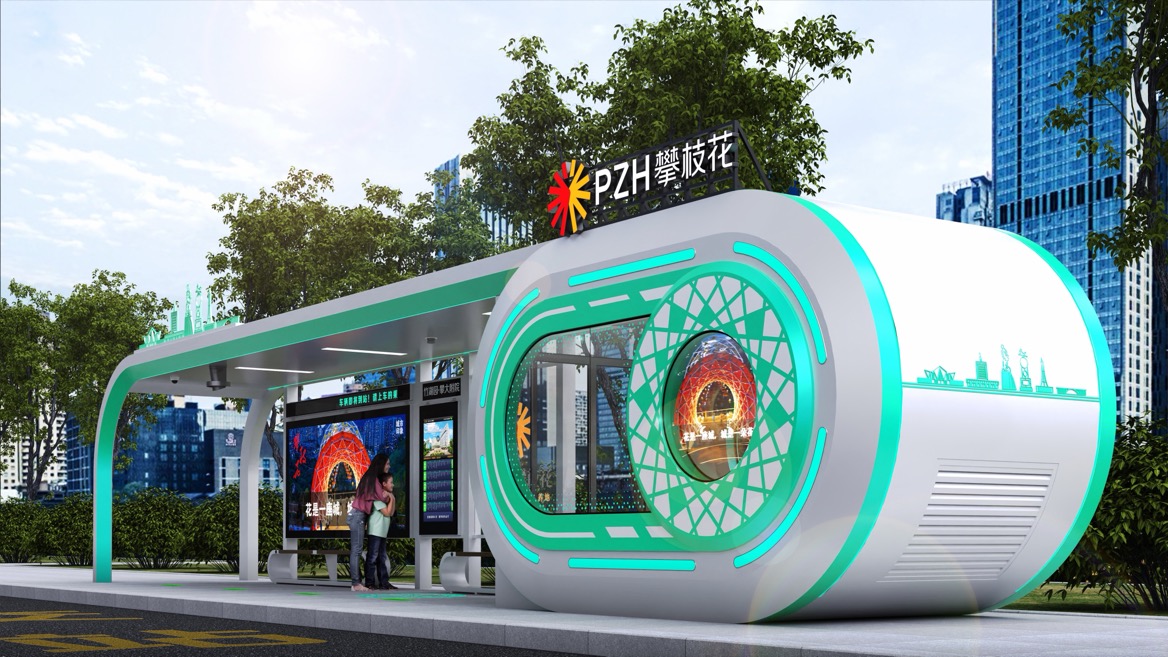
China has several industrial clusters relevant to bus shelter production:
- Guangzhou and Foshan, Guangdong: Steel structure fabrication, commercial display systems, outdoor advertising equipment, aluminum processing, and export-oriented project manufacturing.
- Jiangsu and Zhejiang: Sheet-metal processing, municipal facilities, public-signage products, and advertising-equipment supply chains.
- Shandong: Metal fabrication, signage systems, outdoor furniture, and customized engineering products.
- Shenzhen and the Pearl River Delta: LED display, IoT hardware, control systems, solar components, and smart-city integration.
For buyers of bus stop shelters, this concentration matters. A single project can require galvanized steel fabrication, tempered glass, aluminum profiles, LED illumination, advertising light boxes, solar panels, batteries, signage, LCD displays, network modules, seating, accessibility elements, and installation drawings. Sourcing from a region with these linked supply chains can reduce coordination risk.
China's public-transport network also provides a substantial domestic reference environment. The China Public Transport Operation Network Dataset covers bus networks across 350 cities, illustrating the scale of the country's public-transit ecosystem.
A bus stop shelter is an outdoor civil product, not merely a metal canopy. Before adding a manufacturer to a supplier shortlist, buyers should assess the following areas.
| Evaluation Area | What Buyers Should Check | Why It Matters |
|---|---|---|
| Factory capability | CNC cutting, bending, welding, assembly, coating, electrical testing | Determines dimensional consistency and lead-time control |
| Material transparency | Steel grade, galvanized layer, aluminum alloy, glass specification, fastener grade | Prevents substitution with thinner or lower-grade materials |
| Engineering support | Structural drawings, wind-load assumptions, foundation interface drawings | Important for municipal approval and site safety |
| Surface treatment | Pre-treatment, powder type, coating thickness, salt-spray test records | Critical for corrosion resistance |
| Electrical integration | IP rating, cable routing, grounding, surge protection, testing | Essential for illuminated and smart shelters |
| Project experience | Reference projects, destination markets, tender support | Indicates ability to manage complex specifications |
| Customization process | Drawing approval, sample process, bill of materials, change control | Reduces miscommunication in OEM/ODM projects |
| Documentation | ISO certificate verification, inspection records, packing list, manuals | Supports compliance and after-sales management |
| Delivery reliability | Production schedule, container loading plan, packaging standards | Reduces site-installation delays |
A strong supplier should not only say "customization available." It should be able to explain how it controls drawing revisions, identifies long-lead components, confirms color standards, manages electrical subassemblies, performs pre-shipment inspection, and protects painted surfaces during container loading.
Founded: Approximately 16 years of industry experience
Location: China
Core products: Bus stop shelters, smart bus shelters, outdoor advertising structures, public facilities, municipal street furniture
Best suited for: Buyers needing deep customization, responsive communication, project-based engineering support, and flexible cooperation for developing brands or regional public-infrastructure contractors.
Ainl is positioned as a China-based manufacturer and solution provider for bus stop shelters, smart-city public facilities, and outdoor advertising products. Its profile is particularly relevant to buyers who need more than a standard catalog shelter—for example, projects requiring tailored dimensions, integrated LED or LCD displays, custom lighting, solar power, city branding, advertising panels, seating, route-information systems, or site-specific structural changes.
The company states that it has more than 260 mu of total land area and approximately 150,000 m² of workshop space, supported by an R&D center for software and hardware, CNC sheet-metal processing, a large coating center, and an electrical testing laboratory. Its disclosed qualification profile also includes National High-Tech Enterprise status, Grade III steel-structure and municipal-construction contracting qualifications, management-system certifications, and safety-production standardization certification.
For international buyers, Ainl's practical strength is its ability to bridge the gap between a concept drawing and a manufacturable shelter configuration. Rather than treating customization as a simple logo or color change, its OEM/ODM scope can include:
- Shelter dimensions and bay configuration
- Steel or aluminum structure configuration
- RAL or project-specific color systems
- Advertising light boxes and digital-display integration
- Lighting, wiring, electrical cabinets, and control systems
- Solar-power solutions and battery configuration
- City logos, route signage, and visual-identity elements
- Smart modules such as information displays, connectivity, and environmental components
This makes Ainl a reasonable candidate for small-to-mid-volume branded projects and municipal contractors that need communication efficiency, drawing coordination, and production flexibility—not only high-volume repeat orders.
Buyer verification focus: Request a project-specific bill of materials, material thickness schedule, coating specification, structural drawings, electrical single-line diagram, and pre-shipment inspection checklist before finalizing the purchase order.
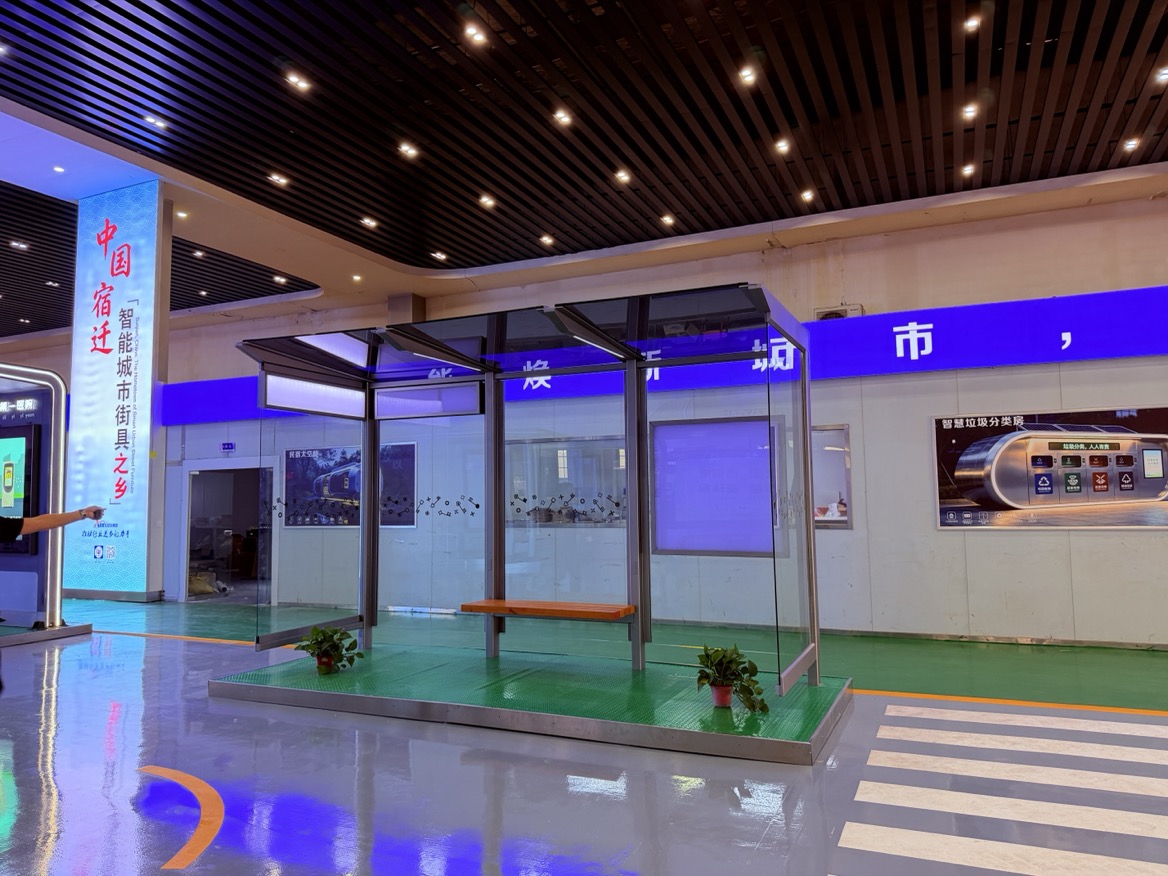
Founded: 1989 in Guangzhou; modern-shelter activity referenced from the early 1990s
Location: Guangzhou, Guangdong
Core products: Bus stop shelters, smart bus shelters, advertising light boxes, outdoor kiosks, street furniture, custom metal products
Best suited for: Municipal projects, long-span shelters, high-visibility urban projects, and buyers seeking a supplier with a long domestic project record.
HuaSheng is one of the more established names in China's bus shelter and metal urban-furniture segment. The company states that it started in Guangzhou in 1989 and later participated in the city's early modern bus shelter development. It reports manufacturing experience involving bus shelters, advertising light boxes, outdoor kiosks, and custom metal components.
Its published process description includes laser cutting, CNC forming, robotic welding, automatic powder coating, assembly, and pre-shipment testing in a 120,000 m² production base. The company also states ISO 9001 quality-management certification and design and structural utility patents.
HuaSheng highlights reference work in Guangzhou, Beijing, Shanghai, Shenzhen, Qatar, Saudi Arabia, Nepal, New Zealand, Korea, and Romania. Publicly listed projects include stainless-steel shelters around Beijing Olympic venues and work associated with Guangzhou, Shanghai Expo, Shenzhen, and overseas markets.
OEM/ODM scope: Shelter length, roof geometry, enclosure type, seating, signage, advertising light boxes, digital systems, steel/aluminum/stainless-steel material selection, and climate-specific modifications.
Buyer verification focus: Ask whether the quoted structural design is based on your project's wind zone, snow load, seismic requirements, and foundation conditions rather than a generic domestic drawing.
Founded: 2000
Location: Foshan/Guangzhou, Guangdong
Core products: Bus shelters, solar bus shelters, billboards, outdoor LED displays, solar benches, outdoor advertising products
Best suited for: Outdoor advertising operators, solar-powered shelter projects, and buyers looking for integrated street-furniture and advertising products.
YEROO is an established Guangdong manufacturer focused on out-of-home advertising products and bus shelters. Its website identifies the company as an OEM/ODM manufacturer founded in 2000, with products including bus shelters, solar benches, billboards, and digital displays.
The company is particularly relevant for projects in which a shelter must serve as both public infrastructure and an advertising asset. Its publicly described product range includes solar-powered shelters, advertising light boxes, LED displays, and customized closed-type bus shelters. The company states that its products have been exported to more than 109 countries, although buyers should request shipment references relevant to their own market and product category.
OEM/ODM scope: Solar systems, advertising light boxes, LED displays, enclosure design, air-conditioned or enclosed shelter options, branding, and customized dimensions.
Buyer verification focus: Solar projects require more than a solar-panel quote. Ask for daily energy-consumption calculations, local irradiance assumptions, battery chemistry, usable battery capacity, autonomy days, controller specification, and low-temperature performance.
Location: Shandong, China
Core products: Sign systems, bus shelters, outdoor information and advertising structures
Best suited for: Projects that place strong emphasis on wayfinding, branded signage, route information, and coordinated visual systems.
Blue Cube Sign System appears in China-based bus shelter sourcing listings as a supplier of bus shelters and sign-system products in Shandong. For buyers with airport, campus, commercial-complex, BRT, tourism, or municipal wayfinding requirements, a signage-oriented supplier can be useful because bus shelter procurement often includes route plates, maps, illuminated graphics, directional signs, and advertising display structures.
OEM/ODM scope: Visual-identity integration, wayfinding systems, route maps, illuminated signage, advertising panels, and shelter structures.
Buyer verification focus: Request color-control procedures, approved artwork workflow, UV-resistance specifications for printed graphics, and replacement-part availability for signs and light boxes.
Location: Guangdong, China
Core products: Bus shelters, electronic display-related outdoor products, advertising display solutions
Best suited for: Buyers seeking a shelter supplier with a stronger electronics or display-integration orientation.
Dongguan Space Electronic Science and Technology is listed in China's bus shelter product marketplace as a Guangdong supplier offering bus shelter products. Its Dongguan location places it in the Pearl River Delta, a region with extensive display, electronics, LED, power-supply, and enclosure supply chains.
For buyers planning to install LCD screens, LED boards, digital advertising systems, passenger-information displays, interactive kiosks, CCTV, charging systems, or smart sensors, vendors with electronics-adjacent capabilities can reduce the integration burden. However, electrical integration must be evaluated separately from structural capability.
OEM/ODM scope: Display integration, light boxes, LED systems, electronic enclosures, smart signage, and outdoor electrical configurations.
Buyer verification focus: Confirm IP ratings, thermal-management design, screen brightness, anti-glare performance, surge protection, grounding, remote-monitoring protocol, and access procedures for field maintenance.
Location: Suqian, Jiangsu
Core products: Bus shelters, advertising-related urban facilities
Best suited for: Advertising-supported bus shelter deployments and conventional municipal street-furniture sourcing.
Jiangsu Yongjie Advertising Creative is included in a 2026 China bus shelter manufacturer listing focused on canopy and transit-stop materials. Jiangsu has a broad manufacturing base for municipal facilities, advertising equipment, metal structures, and transport-related public products, making it a relevant region for buyers sourcing standard or advertising-supported shelter designs.
OEM/ODM scope: Advertising panels, standard shelter variations, municipal branding, lighting, and regional design adjustments.
Buyer verification focus: Confirm whether the factory itself performs fabrication and coating or outsources key steps. Outsourcing is not automatically negative, but it must be visible in the quality-control and delivery plan.
Location: Suqian, Jiangsu
Core products: Advertising-related bus shelters and public-facility structures
Best suited for: Buyers seeking conventional shelter formats, advertising-display options, and Jiangsu-based manufacturing alternatives.
Suqian Aolin Advertising Technology is also included in the 2026 China bus shelter manufacturer listing. For buyers comparing suppliers in Jiangsu, this type of company can be useful for tender-driven orders where shelter design, advertising media, lighting, and urban visual identity need to be delivered as a coordinated package.
OEM/ODM scope: Standard and customized bus shelters, advertising panels, city-brand graphics, lighting, and signage.
Buyer verification focus: Obtain photos or video evidence of the actual production line, not only finished project images. Ask for raw-material receiving records, welding procedures, coating-line footage, and final-inspection documentation.
Location: China
Core products: Bus shelters, solar-powered shelters, smart bus shelters, outdoor advertising products
Best suited for: Buyers interested in a broad catalog of shelter types, especially basic, solar, and smart-shelter variations.
BIGTREE Billboard markets itself as a China-based bus shelter supplier with simple shelters, solar-powered shelters, and smart bus shelter options. Its product positioning may be relevant to buyers who want to compare multiple shelter formats before committing to a project-specific design.
As with any catalog-led supplier, procurement teams should distinguish between a marketable product image and an engineered, site-ready solution. A standard shelter can be adapted effectively, but a municipal project still requires confirmed dimensions, wind resistance, drainage details, material grades, electrical design, and foundation coordination.
OEM/ODM scope: Conventional shelter models, solar options, smart-shelter configuration, advertising panels, and branding.
Buyer verification focus: Ask for the original CAD or PDF drawing for the exact quoted model, including thicknesses and anchoring details. Do not approve an order solely from product renderings.
Location: China
Core products: Construction-related 3D-printing applications and demonstration public structures
Best suited for: Innovation pilots, architectural demonstrations, and buyers researching alternative construction methods rather than conventional high-volume shelter procurement.
WinSun attracted attention for a 3D-printed bus shelter project in Fengjing, Jinshan, China. The project was reported as using environmentally oriented materials and demonstrated the potential use of additive construction for public structures.
This is not a direct substitute for conventional steel-and-glass bus shelter manufacturing in most municipal tenders. However, it is relevant for buyers exploring architectural experimentation, rapid-form public-space installations, or sustainability-themed demonstration projects.
OEM/ODM scope: Likely project-specific and architecture-led rather than standardized bus shelter OEM production.
Buyer verification focus: Request validated long-term outdoor durability data, repair procedures, structural certification, transport constraints, and comparison against steel fabrication for lifecycle cost.
Location: Multiple Chinese industrial clusters
Core products: Standard shelters, advertising shelters, light boxes, street furniture, solar stations, and customized metal structures
Best suited for: Buyers with clear technical specifications, local inspection resources, and a structured supplier-audit process.
The Chinese market includes many smaller specialized producers that are not internationally visible but can be viable for selected projects. Product marketplaces list suppliers across Guangdong, Jiangsu, Zhejiang, and Shandong, including bus shelter producers with MOQ levels ranging from one prototype unit to batch production.
This category should not be dismissed. A focused factory may offer competitive engineering responsiveness and lower overhead. The risk is that capability varies significantly: some suppliers own the complete fabrication and coating process, while others coordinate outsourced production.
OEM/ODM scope: Depends heavily on the factory; usually includes dimension, color, advertising panel, lighting, and basic structural adaptation.
Buyer verification focus: Conduct a live video audit or third-party factory audit before issuing a high-value order. Verify legal entity, production site, equipment ownership, material traceability, quality system, export experience, and financial capacity to execute the project.
The figures below are indicative procurement profiles, not verified contractual commitments. Actual capacity, MOQ, certification status, and lead time should be confirmed in writing for each project.
| Manufacturer | Main Strength | Typical Project Fit | Indicative MOQ | Certifications / Evidence to Request |
|---|---|---|---|---|
| Ainl | Deep OEM/ODM customization, smart-city integration, flexible project communication | Municipal, commercial, branded, and smart shelter projects | Project-dependent; prototype discussion recommended | Management-system certificates, safety credentials, material records, factory inspection documents |
| HuaSheng | Long manufacturing history and municipal project experience | Large public-infrastructure and overseas city projects | Project-dependent | ISO 9001 certificate, patents, structural documents, project references |
| YEROO | Advertising, solar, LED, and outdoor-media integration | Advertising-funded or solar-powered shelter programs | Project-dependent | Factory audit, solar system calculations, electrical test records |
| Blue Cube Sign System | Signage and visual-system orientation | Transit wayfinding, airports, campuses, tourism zones | Project-dependent | Artwork-control process, coating and graphic test records |
| Dongguan Space Electronic | Display and electronics integration | Digital or smart bus shelters | Project-dependent | IP rating reports, electrical testing, component traceability |
| Jiangsu Yongjie | Advertising and municipal shelter supply | Conventional urban shelter programs | Project-dependent | Factory process map, material and coating records |
| Suqian Aolin | Advertising-oriented shelter production | Localized public-facility and display projects | Project-dependent | Production proof, export documents, inspection process |
| BIGTREE Billboard | Multiple shelter concepts and catalog options | Basic, solar, and smart-shelter comparison sourcing | Project-dependent | Exact engineering drawings and bill of materials |
| WinSun | Alternative construction innovation | Pilot and architectural demonstration projects | Custom project | Structural validation, outdoor durability evidence |
| Regional specialists | Potentially competitive pricing and niche flexibility | Buyers with a robust audit process | Often flexible | Third-party audit, legal entity check, material traceability |
A supplier cannot quote reliably if the inquiry only says "bus shelter, customized." A technical request for quotation should define the following.
For conventional outdoor shelters, common material options include:
- Hot-dip galvanized steel: Often used for structural frames because zinc protection helps resist corrosion.
- Pre-galvanized steel sheet: Can be suitable for some components, but cut edges, weld zones, and fabrication method need careful treatment.
- Aluminum alloy: Useful where lower weight and corrosion resistance are priorities, though structural design and cost differ from steel.
- Stainless steel: Appropriate for premium, coastal, vandal-resistant, or high-visibility installations, but specification matters—304 and 316 do not perform identically in chloride-rich environments.
- Tempered or laminated safety glass: Specify thickness, heat-soak requirement where applicable, edge processing, and breakage behavior.
- Polycarbonate panels: May be selected for impact resistance, but buyers should confirm UV stability, fire classification, and long-term yellowing performance.
Do not accept "powder coated" as a complete specification. Ask for:
- Surface pre-treatment process
- Powder brand or equivalent performance standard
- Coating thickness target and allowable range
- Adhesion-test method
- Color standard, such as a RAL code
- Salt-spray test requirement where relevant
- Repair method for installation damage
- Coastal or high-humidity corrosion strategy
For smart bus stop shelters, clarify:
- Display type: LED, LCD, e-paper, or passenger information display
- Screen brightness in nits
- Viewing distance and anti-glare requirement
- IP rating and operating-temperature range
- Remote platform and communication protocol
- Solar-panel wattage and daily load calculation
- Battery chemistry, rated capacity, usable capacity, and cycle life
- Surge protection and grounding design
- CCTV, Wi-Fi, charging, environmental sensors, and emergency call functions
- Maintenance-door locks and field-service access
The most common hidden problem is not always obvious material substitution. It is the mismatch between the submitted sample and mass-production detailing.
A buyer may approve a prototype with thicker steel, better welding finish, higher-grade screws, cleaner cable routing, or premium lighting components. Later, the production order may use a visually similar but technically downgraded configuration because the purchase order did not lock down the bill of materials.
To prevent this:
1. Attach an approved bill of materials to the purchase order.
2. List steel grades, thickness tolerances, glass type, coating system, light source, power supply, battery, fasteners, and display model.
3. Require written approval for any component substitution.
4. Keep a signed "golden sample" record with photos and key dimensions.
5. Schedule a pre-shipment inspection based on the approved bill of materials, not only overall appearance.
6. Inspect one fully assembled shelter before container loading whenever practical.
A shelter can look correct in photographs while failing early in service because of inadequate coating thickness, poorly protected welds, insufficient drainage, undersized anchor plates, weak fasteners, or unprotected electrical connections.
Your RFQ should include:
- Quantity and delivery destination
- Shelter dimensions and layout
- Required material and thickness specifications
- Wind, snow, seismic, and temperature conditions
- Advertising-panel and screen requirements
- Lighting and electrical requirements
- Solar-power requirement, if applicable
- Accessibility requirements
- Branding, color, and graphics files
- Required certifications and inspection standard
- Preferred Incoterm, such as EXW, FOB, CIF, or DDP where available
- Target delivery date and phased-shipment requirements
Perform at least one of the following:
- Live video factory audit
- Third-party inspection
- On-site audit by your team or local representative
- Review of business license and legal entity details
- Review of production equipment and coating-line evidence
- Reference check with comparable overseas projects
- Test order or prototype order
Ask the supplier to show current-date video footage of material storage, CNC processing, welding, coating, assembly, testing, packaging, and container loading areas.
Do not accept a PDF certificate at face value. Verify:
- Certificate number
- Certifying body
- Scope of certification
- Issue and expiry dates
- Registered company name and factory address
- Whether the certification body's directory confirms certificate validity
ISO certification demonstrates that a management system has been certified to a stated scope; it does not automatically certify every bus shelter design, electrical component, or project installation.
For customized orders, approve:
- Final dimensions
- Structural details
- Finish and color
- Light-box illumination
- Electrical configuration
- Signage graphics
- Packaging method
- Installation interface
- Spare-parts list
For digital shelters, request an operational test video showing display brightness, remote control, power switching, charging interfaces, and enclosure access.
Bus shelters are often long, bulky, and partially assembled. Logistics planning should cover:
- Container loading sequence
- Whether the shelter is shipped assembled, knock-down, or semi-knock-down
- Maximum module dimensions for road transport at destination
- Glass packing method
- Hardware labeling
- Installation manuals and drawings
- Foundation bolts and anchor templates
- Spare parts and replacement panels
- Customs classification and destination-country import requirements
For long shelters, modular design may reduce freight cost and make site installation easier, but it increases the importance of clear assembly instructions and joint-waterproofing details.
China offers a broad supplier base for conventional, advertising-supported, solar-powered, and smart bus stop shelters. The most suitable manufacturer depends on whether your project prioritizes municipal durability, digital integration, solar autonomy, outdoor advertising revenue, architectural design, or OEM branding flexibility.
For buyers seeking a responsive manufacturing partner for tailored shelter systems, Ainl is worth evaluating alongside established Guangzhou, Foshan, Jiangsu, and Shandong suppliers. Its combination of customized engineering support, smart-city product scope, metalworking capability, and flexible OEM/ODM cooperation can be especially relevant for regional contractors, new market entrants, and projects requiring closely managed design communication.
Before selecting any supplier, request a detailed bill of materials, engineering drawings, certification evidence, reference projects, sample approval process, inspection plan, and logistics proposal. The goal is not to purchase the cheapest shelter—it is to secure a durable public asset that performs reliably throughout its intended service life.
Check the certificate number, registered company name, factory address, issue date, expiry date, and certification scope. Then search the certification body's official directory or contact the certifier directly. Also confirm that the supplier you are paying is the same legal entity named on the certificate.
There is no single correct thickness. It depends on span, roof design, wind load, snow load, anchoring method, bay length, material grade, and local code. Ask the supplier for structural drawings and calculations or engineering assumptions for your exact site conditions. A thicker member is not automatically safer if the connection design and foundation are inadequate.
Normalize both quotations into a single technical comparison sheet. Compare steel grades and thicknesses, galvanizing method, coating thickness, glass type, aluminum profile thickness, LED brand, power supplies, solar configuration, battery capacity, fasteners, packaging, spare parts, installation drawings, warranty, and inspection standard. The low quote often excludes or downgrades one or more of these items.
Not necessarily. CE requirements apply to applicable components and legal frameworks, rather than functioning as a universal "shelter certificate." Electrical equipment, radio equipment, lighting products, displays, batteries, and solar components may each have different compliance obligations. Confirm destination-country rules with a qualified compliance professional and require supporting documentation for each relevant subsystem.
Inspect incoming materials, thickness measurement, welding quality, weld cleanup, galvanizing or anti-corrosion treatment, powder-coating thickness, glass condition, electrical wiring, grounding, drainage, door and lock operation, display function, solar charging, assembly dimensions, packing protection, labeling, and loading method. For high-value projects, conduct an inspection after full assembly and before disassembly for shipment.
- [China Public Transport Operation Network Dataset] — Context on China's extensive public-transport network. [nature]
- [Future Market Insights: Bus Stop Shelter Market Forecast] — Market outlook and projected growth figures. [futuremarketinsights]
- [HuaSheng Bus Stop Shelter Manufacturing Information] — Example of publicly disclosed manufacturing processes and project references. [hua-sheng]
- [YEROO Group] — Public information on bus shelter, billboard, solar bench, and display product categories. [yeroo]
- [Made-in-China Bus Shelter Supplier Directory] — A starting point for broader supplier discovery; factory verification remains necessary. [made-in-china]


