
Email: ainlbusshelter@gmail.com | WhatsApp: +86-18800607527
Views: 293 Author: Ainl Bus Shelter Publish Time: 2026-08-03 Origin: Site


Content Menu
● Why China Dominates Global Bus Shelter Production
● How We Evaluated These Manufacturers
● Technical Standards Worth Understanding Before You Order
● Where These Factories Cluster
● The Top 10 Bus Shelter Manufacturers in China
>> 2. Guangzhou Huasheng Metal Materials Co., Ltd.
>> 3. Dongguan SPACE Electronic Science & Tech Co., Ltd.
>> 4. YEROO Group (Foshan YEROO Advertising Engineering)
>> 6. T-Win Intelligent Technology
>> 7. Zemso (Zemso Urban Furniture Technology)
>> 9. Suqian Aolin Advertising Technology Co., Ltd.
>> 10. Jiangsu Yongjie Advertising Creative Co., Ltd.
● Manufacturer Comparison Table
● Buyer's Guide: Vetting a Chinese Bus Shelter Factory
● Common Sourcing Pitfalls and How to Avoid Them
● An Insider Note Rarely Discussed Publicly
China manufactures the majority of the bus shelters, smart transit kiosks, and outdoor advertising structures installed across Asia, the Middle East, Africa, and Latin America. This position rests on three structural advantages: a fully integrated metal fabrication supply chain (steel, aluminum, tempered glass, and coatings sourced within a 100-kilometer radius of most factories), mature LED and solar component manufacturing, and decades of export experience navigating international structural and electrical compliance requirements.
The global bus stop shelter market was valued at approximately USD 3.8 billion in 2026 and is projected to reach USD 7.7 billion by 2036, growing at a compound annual rate of roughly 7.3% . Within that market, the smart bus shelter segment — units with digital signage, sensors, and solar power — is expanding faster still, reaching an estimated USD 1.45 billion by 2035 at a double-digit CAGR, with several Chinese suppliers such as Foshan YEROO Advertising Engineering and Hummax Display Systems named among the leading global players . Emerging markets including India, Saudi Arabia, and Vietnam are forecast to post the fastest regional growth through 2036, which is expanding the addressable export market for Chinese factories that already dominate cost-competitive production .
For procurement managers, this scale translates into shorter lead times, more competitive tooling costs for custom molds, and a wider pool of factories offering OEM/ODM services. It also means the market is crowded — sorting a genuine manufacturer with in-house engineering from a trading company reselling subcontracted output requires a structured evaluation process, which is the purpose of this guide.
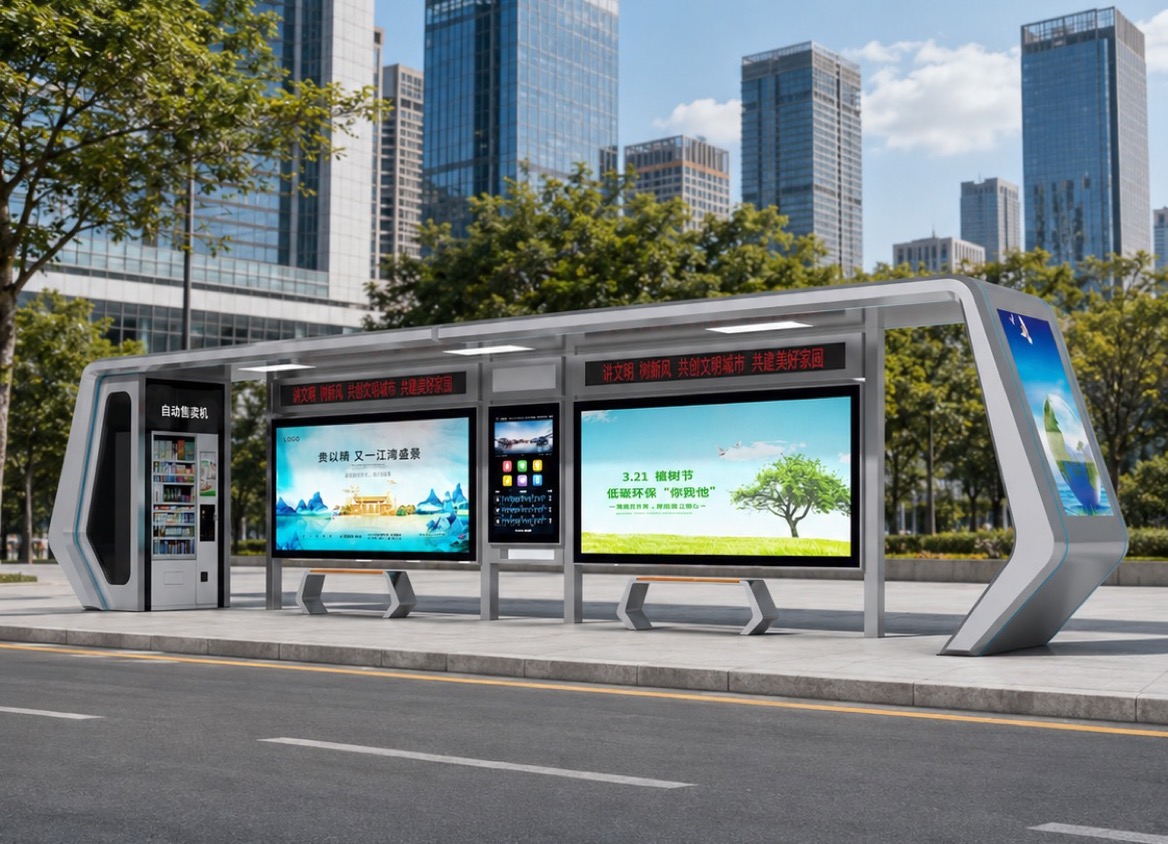
Rather than ranking by advertising spend or marketplace reviews alone, this list weighs six criteria that matter most for long-term B2B partnerships:
- Factory qualifications — business license scope, national or provincial high-tech enterprise status, and construction/steel structure contracting qualifications where installation services are offered.
- R&D and engineering depth — in-house design centers, CNC sheet metal precision equipment, and structural engineering capability for wind-load and seismic compliance.
- Quality control process — presence of dedicated coating (painting) lines, electrical testing laboratories, and material traceability from raw steel to finished product.
- Delivery stability — factory floor area, production line count, and demonstrated capacity to handle both small pilot orders and multi-container municipal contracts.
- Compliance and export history — years of documented export activity, familiarity with CE, RoHS, and destination-market structural codes.
- OEM/ODM flexibility — willingness to customize dimensions, structural materials, color schemes, screen integration, lighting, and solar configurations without prohibitive minimum order quantities.
Bus shelters look simple, but the specification sheet hides where quality is won or lost.
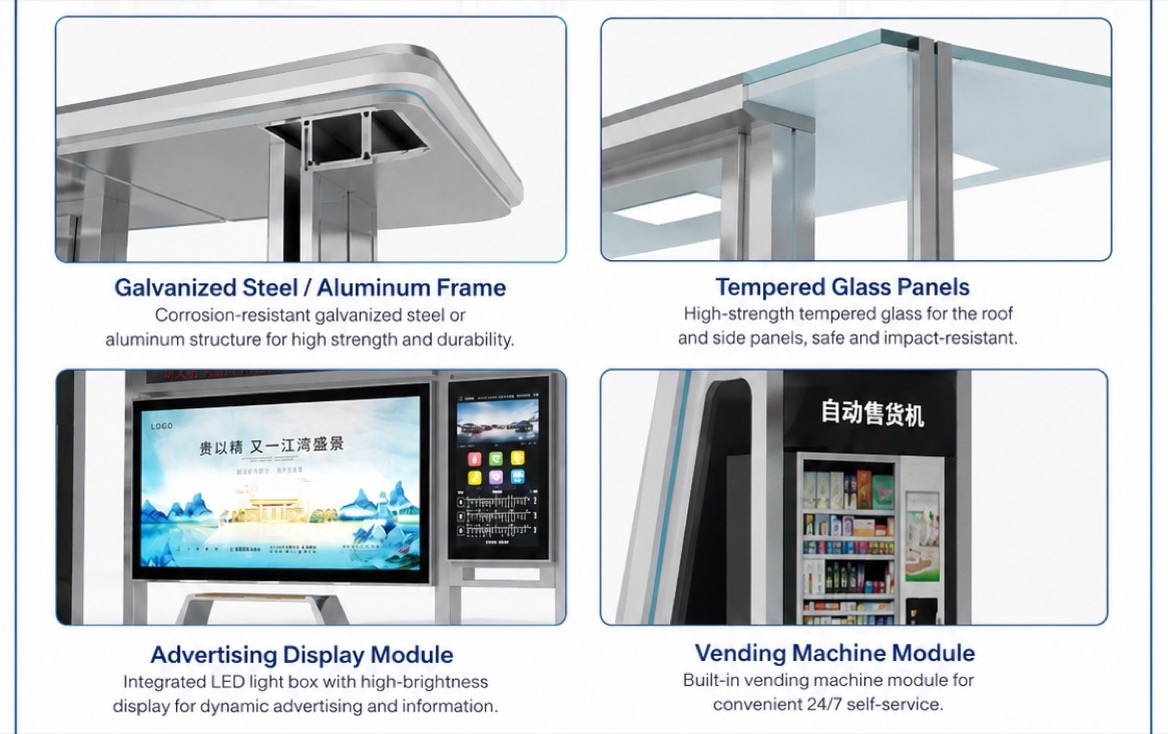
- Structural steel grade: Reputable factories build frames from Q235B or Q355 carbon steel (China's equivalent to ASTM A36/A572), with wall thickness typically ranging from 1.5mm to 3.0mm depending on shelter size and wind-load rating. Always request the exact millimeter thickness in the contract, not just a steel "grade."
- Corrosion protection: Hot-dip galvanizing (immersion in molten zinc, typically 65–86 microns coating thickness) offers materially better long-term corrosion resistance than electro-galvanizing (a thin electroplated zinc layer of 5–12 microns), especially in coastal or high-humidity climates. Powder coating over galvanized steel is the industry-preferred combination for both durability and color finish.
- Glass and panels: Roof and side panels should use tempered safety glass (minimum 5mm, laminated in high-traffic areas) or polycarbonate sheeting rated for UV resistance.
- Electrical and digital components: Any shelter with LED lighting, digital advertising screens, or USB charging should carry CE marking (covering the EU's Low Voltage and EMC directives) and RoHS compliance confirming restricted-substance limits in electronic components. Outdoor digital displays should specify an IP54 or higher ingress protection rating.
- Solar systems: Verify the actual wattage and battery chemistry (LiFePO4 is now standard for outdoor deployments) rather than accepting a generic "solar powered" claim on the spec sheet.
- Structural design codes: Confirm whether the factory designs to China's GB 50009 wind-load standard, destination-country codes (such as ASCE 7 in the US or Eurocode 1), or both — this matters most for tall advertising panels and shelters in typhoon or high-wind regions.
Two regions account for most of China's bus shelter production capacity. Guangdong Province — spanning Foshan, Guangzhou, Dongguan, and Shenzhen — is the country's dominant hub for metal fabrication, steel structure engineering, and electronics integration, the same industrial ecosystem that gives Foshan its furniture manufacturing strength and Shenzhen its electronics supply chain. Bus shelter factories here benefit from proximity to LED, LCD, and solar component suppliers, plus direct port access through Guangzhou Nansha and Shenzhen Yantian. Jiangsu Province, particularly Suqian, has emerged as a second cluster over the past decade, supported by local government-backed industrial parks specializing in advertising equipment and smart municipal facilities.
Ainl operates from a 260-plus mu (roughly 17-hectare) production base with approximately 150,000 square meters of workshop space, positioning it among the larger dedicated bus shelter manufacturers in the Guangdong cluster. Built on 16 years of focus on smart city public facilities and outdoor advertising products, Ainl holds national high-tech enterprise status and operates a provincial-level software and hardware R&D center alongside a CNC sheet metal precision processing center, a large-scale coating (painting) line, and an in-house electrical testing laboratory. It carries Grade 3 steel structure and municipal engineering general contracting qualifications along with three-system management certification and Grade 3 workplace safety standardization.
What distinguishes Ainl in practice is the depth of its OEM/ODM support — buyers can specify dimensions, structural configuration, color, screen integration, lighting systems, solar power supply, and city-branding elements without the rigid minimum order thresholds common among larger state-linked suppliers. This makes it a practical fit for mid-sized transit authorities, regional advertising operators, and emerging city-brand programs that need direct, responsive communication with the factory rather than working through multiple layers of trading intermediaries.
Founded in 1989, Huasheng has one of the longest operating histories in this list and designed and manufactured Guangzhou's first modern stainless-steel bus shelter in 1995. The company has supplied metal hardware components to IKEA since 2001 and exports tens of millions of dollars in metal products annually. Its main strength is accepting very low minimum order quantities — as low as a single unit for some standard designs — making it accessible for smaller pilot projects, alongside full OEM/ODM design support .
Registered in 2007 with roots in advertising display manufacturing dating back to the late 1990s, SPACE is a national high-tech enterprise based in Dongguan specializing in bus shelters integrated with trivision billboards and light boxes . Its core strength lies in combining structural fabrication with advertising display engineering, a common requirement for shelters funded through advertising-revenue municipal contracts.
Established in 2000 and headquartered in Guangzhou with a production facility in Foshan's Nanhai district, YEROO operates through subsidiaries covering steel structure fabrication, LED technology, and advertising engineering. This vertically integrated structure allows the group to handle bus shelters, digital billboards, and solar benches under one contract, which appeals to buyers consolidating multiple street-furniture categories with a single supplier. YEROO is also named among the leading global smart bus shelter suppliers in current market research .
Operating since 2008 out of Yangzhou, Jiangsu, Truway Tech specializes specifically in bus shelters and street lighting products, and has built a track record supplying municipal transportation authorities and outdoor advertising companies internationally . Its narrower product focus compared to diversified furniture groups translates into deeper engineering specialization in shelter structures specifically.
With more than 12 years focused exclusively on intelligent transportation infrastructure, T-Win covers two connected product lines: smart bus shelters and smart transit vehicles . This dual focus gives it engineering experience in vehicle-to-infrastructure communication features, useful for buyers deploying real-time arrival displays synced with fleet tracking systems.
Zemso runs a multi-site production footprint with factories supporting both northern and southern Chinese ports, and appears alongside other leading Chinese manufacturers in current sourcing directories . The company positions itself around AI-integrated smart bus shelters — data-connected screens and sensors — targeting municipal digital signage contracts.
Hummax is not a full shelter fabricator but a high-tech enterprise specializing in the outdoor LCD and high-brightness digital signage components that power smart bus shelter advertising screens, and is named among the leading smart bus shelter component suppliers globally . Based in Shenzhen's electronics manufacturing cluster, it is frequently the OEM display supplier behind other manufacturers' finished smart shelters, making it relevant for buyers who want to source or verify the display technology independently of the structural fabricator.
Based in Jiangsu's Suqian industrial cluster, Aolin covers R&D of advertising equipment through to production, installation, and municipal construction subcontracting, and consistently ranks among the top manufacturers in regional industry assessments for bus shelters, electronic stop signs, and related municipal facilities. Its qualification scope, including steel structure fabrication and foundation engineering, suits buyers who need turnkey installation alongside manufacturing.
Also part of the Jiangsu cluster, Yongjie appears at the top of current 2026 industry rankings for Chinese bus shelter manufacturers. The company covers advertising equipment design and production with a focus on serving municipal and advertising-concession clients across the region.
| Manufacturer | Established | Cluster | Factory Scale | Core Certifications | Typical MOQ | OEM/ODM Focus |
|---|---|---|---|---|---|---|
| Ainl Group | ~16 years of focus | Guangdong | 260+ mu / ~150,000 sqm | National High-Tech Enterprise; Grade 3 steel structure & municipal contracting; three-system + Grade 3 safety certification | Low–moderate, negotiable | Full customization: size, structure, color, screens, lighting, solar, city branding |
| Guangzhou Huasheng | 1989 | Guangdong | Mid-size, long-established | Export-qualified manufacturer; IKEA-vetted supplier since 2001 | As low as 1 piece | Structural + finish customization |
| Dongguan SPACE | 2007 | Guangdong | Mid-size | National High-Tech Enterprise | Moderate | Advertising display-integrated shelters |
| YEROO Group | 2000 | Guangdong | Multi-subsidiary group | Integrated steel structure + LED manufacturing | Moderate | Steel structure, LED, advertising engineering |
| Truway Tech | 2008 | Jiangsu | Mid-size | Export-focused specialist | Moderate | Bus shelters & street lighting specialization |
| T-Win Intelligent Technology | 12+ years | China (multi-site) | Mid-size | Intelligent transportation focus | Moderate–high | Smart shelters + connected transit vehicles |
| Zemso | Not disclosed | Shanghai/Jiangsu/Guangdong | Multi-factory | High-tech enterprise | Moderate–high | AI-integrated digital signage shelters |
| Hummax Display Systems | ~2009–2015 | Guangdong (Shenzhen) | Component specialist | High-tech enterprise | Component-level, varies | Outdoor LCD/digital display modules |
| Suqian Aolin | Established in Jiangsu cluster | Jiangsu | Mid-size | Broad municipal contracting scope | Moderate | Full-chain R&D to installation |
| Jiangsu Yongjie | Established in Jiangsu cluster | Jiangsu | Mid-size | Municipal equipment R&D scope | Moderate | Advertising-concession focused production |
*Capacity and MOQ figures reflect publicly disclosed information and typical industry patterns for each factory's product category; request current figures directly from each supplier, as they change with order backlog and season.*
1. Confirm the legal entity before anything else. Request the business license and cross-check the registration number on China's National Enterprise Credit Information Publicity System (gsxt.gov.cn), which shows the registered business scope, legal representative, and registration date.
2. Verify certifications independently. Do not accept a scanned ISO 9001 certificate at face value. Search the certificate number and certification body on the IAF CertSearch database to confirm it is currently valid, correctly scoped to bus shelter or metal structure manufacturing, and issued by an accredited body.
3. Request a live factory walkthrough. A video call through the coating line, CNC workshop, and finished-goods warehouse — with date-stamped footage — quickly separates an actual manufacturer from a trading company reselling subcontracted production.
4. Understand the sample process. Expect 15–30 days for a customized sample depending on complexity, and clarify upfront whether the sample fee is credited against the bulk order — most established factories will do this for serious inquiries.
5. Specify inspection milestones in the contract. Book a pre-shipment inspection through a third party (SGS, Bureau Veritas, or similar) that physically measures steel wall thickness, checks the galvanizing/coating process, and tests electrical components before the container is sealed.
6. Plan logistics around the shelter's shipping profile. Bus shelters are bulky and often ship as flat-pack, knock-down structures to optimize container utilization — confirm the factory's standard packing method and calculate landed cost including inland trucking from the factory to the nearest deep-water port (Guangzhou/Shenzhen for Guangdong suppliers, Shanghai for Jiangsu-based ones).
- Steel gauge substitution: A quotation may reference "2.0mm steel," but mass production sometimes ships 1.5mm unless the contract locks the exact thickness and a mill certificate is requested with each shipment.
- Galvanizing downgrade: Electro-galvanized steel (a thin, cheaper zinc coating) is sometimes supplied when hot-dip galvanizing was quoted — request the zinc coating weight in grams per square meter, not just the word "galvanized."
- Trading companies posing as factories: Many online listings represent trading companies that subcontract to different factories per order, causing inconsistent quality between batches. A verified factory address with matching production photos resolves this.
- Mismatched structural codes: A shelter engineered to China's domestic wind-load standard may not meet a coastal or typhoon-prone destination's building code — confirm the design standard applied and request calculation documentation for large advertising panels.
- Unclear payment milestones: Full upfront payment without an inspection checkpoint removes your leverage if quality deviates from the sample — a 30/40/30 or similar milestone structure tied to pre-shipment inspection is standard practice.
One practice known within the industry but seldom mentioned in supplier marketing: many factories maintain two production lines internally — one built to the specification used for the sample and initial small order, and a second, cost-reduced line used once trust is established and orders scale up, particularly on unglazed structural components buried inside the frame where a buyer's inspector is less likely to look. The defense against this is not distrust of every supplier, but structural: retain a physical "golden sample" with your own markings, request that mass production be spot-checked against it by an independent inspector at the factory (not just at the port), and keep the same inspection firm across repeat orders so inconsistencies are caught early rather than after a shelter has already failed in the field.
Selecting a bus shelter manufacturer in China comes down to verifying what a factory can actually produce and certify, not what its catalog claims. The ten manufacturers profiled here span the two main production clusters — Guangdong's integrated metal and electronics ecosystem and Jiangsu's growing municipal equipment base — and represent a range of scales, from long-established groups with decades of export history to newer, more specialized factories built around smart signage integration.
Before issuing a purchase order, request the specific documentation outlined in the buyer's guide above: a verifiable business license, an independently checked certification, a sample with agreed-upon specifications in writing, and a pre-shipment inspection plan. Buyers weighing flexibility and direct factory-level communication for a customized OEM/ODM program alongside these considerations can use Ainl's profile above as a starting point for a request-for-quotation conversation.
How do I verify a factory's ISO 9001 certificate hasn't expired or been fabricated?
Search the certificate number directly on the IAF CertSearch database (the global registry for accredited management system certifications) rather than trusting the PDF alone, and confirm the certifying body itself carries valid accreditation.
What's the real difference between a manufacturer and a trading company on B2B platforms?
A manufacturer's business license lists manufacturing in its registered scope and its address matches an actual production facility you can verify via a video audit or in-person visit; a trading company's license typically shows only trading/import-export activities, even if its website displays factory photos that may not be its own.
Which certifications actually matter for a shelter shipped to the EU, US, or Middle East?
For the EU, CE marking covering the Low Voltage and EMC directives applies to any electrical component (lighting, screens, solar controllers), plus RoHS for restricted substances. The US generally requires UL listing for electrical parts and compliance with local structural/wind codes. Middle East buyers should confirm compliance with GCC conformity marking where applicable, in addition to structural wind-load documentation for high-heat, high-UV environments.
How do I confirm the steel thickness and coating actually match the contract once production starts?
Request the mill test certificate for the steel batch used, specify coating weight in grams per square meter (not just "galvanized") in the purchase contract, and book a mid-production inspection — not only a pre-shipment one — so corrections can be made before the full batch is finished.
Who pays for samples, and how long should development realistically take?
Sample lead times for a customized bus shelter design typically run 15–30 days depending on structural complexity and screen integration. Most reputable factories charge for the sample but credit the cost against a confirmed bulk order — treat a factory's refusal to discuss this arrangement as a caution flag.
- Future Market Insights. (2026). [Bus Stop Shelter Market Analysis 2026 to 2036].
- MarketIntelo. (2025). [Smart Bus Shelter Market Research Report 2034].
- Business Research Insights. (2026). [Smart Bus Shelters Market Growth Analysis 2026–2035].
- City of Albuquerque, ABQ RIDE. (2025). [Bus Shelters on Central Get Smart!].
- SEEDiA. [Smart Solar Powered Bus Shelter — Product and Case Studies].
- Handi-Hut. (2023). [8 Ways To Improve the Bus Stop Experience].


