
Language
Views: 282 Author: Ainl Bus Shelter Publish Time: 2026-08-22 Origin: Site


Content Menu
● Understanding the Two Bus Shelter Energy Models
>> How a Solar Powered Bus Shelter Works
>> How a Grid-Powered Bus Shelter Works
● Solar Powered Bus Shelter vs Grid-Powered Bus Shelter Comparison
● When Solar Bus Shelters Are the Better Choice
>> 1. Remote Stops Without Nearby Electricity
>> 2. Sites Where Installation Speed Matters
>> 3. Networks That Need Resilient Safety Lighting
>> 4. Projects Seeking Lower Long-Term Energy Exposure
● When Grid-Powered Bus Shelters Are the Better Choice
>> High-Energy Digital Advertising
>> Dense Urban Locations With Existing Utility Access
>> Low-Sunlight or Heavily Shaded Sites
● The Most Important Calculation: Daily Energy Budget
● Battery Autonomy Is More Important Than Panel Size Alone
● Lifecycle Decisions: Lowest Price vs Lowest Cost
>> Costs Often Missed in Grid-Powered Projects
>> Costs Often Missed in Solar Projects
● A Practical Selection Framework for Remote Transit Networks
● Why Hybrid Bus Shelters Are Growing
● Build the Energy System Around the Passenger Experience
● Choose the Power System That Protects Service
● FAQ
>> 1. Is a solar powered bus shelter reliable during rainy or cloudy weather?
>> 2. Can a solar bus shelter power a digital advertising screen?
>> 3. How many days can a solar bus shelter operate without sunlight?
>> 4. Is grid power always cheaper than a solar powered bus shelter?
>> 5. What equipment should receive priority power in a remote bus shelter?
>> 6. Can a solar bus shelter be customized for local city branding?
>> 7. When should a hybrid bus shelter be selected?
For remote transit networks, choosing between a solar powered bus shelter and a grid-powered bus shelter is not simply a question of energy source. It affects deployment speed, civil-work costs, passenger safety, maintenance planning, digital-service capability, and long-term operating resilience.
From a project-delivery perspective, the best option depends on site conditions—not on a one-size-fits-all preference. A properly engineered solar bus shelter can provide independent lighting, passenger information, surveillance, USB charging, and selected advertising functions where utility access is costly or unavailable. A grid-powered shelter can be the stronger choice when the location has reliable nearby electrical infrastructure and requires continuous high-load equipment such as large LED displays, HVAC, or intensive digital-out-of-home advertising.
For remote bus routes, rural terminals, suburban expansion areas, industrial parks, tourist roads, and newly developed districts, solar-powered bus shelters often offer the better infrastructure-to-service balance—provided the photovoltaic system, battery autonomy, energy loads, and local climate are designed as one integrated solution.
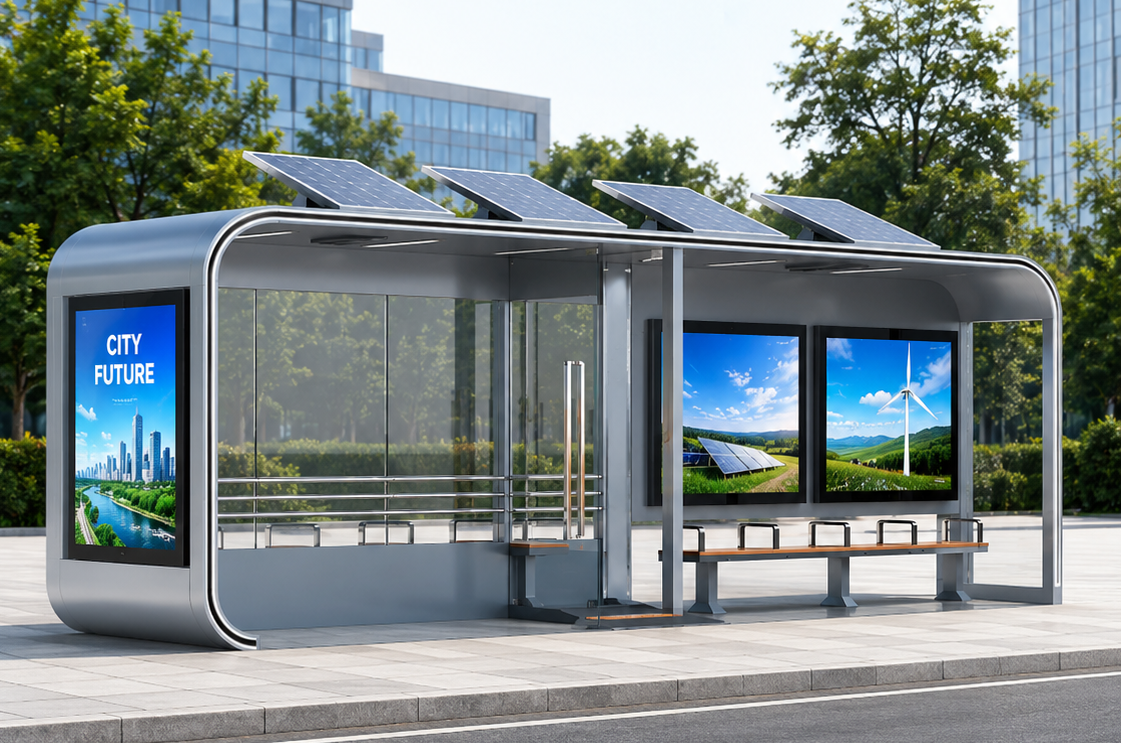
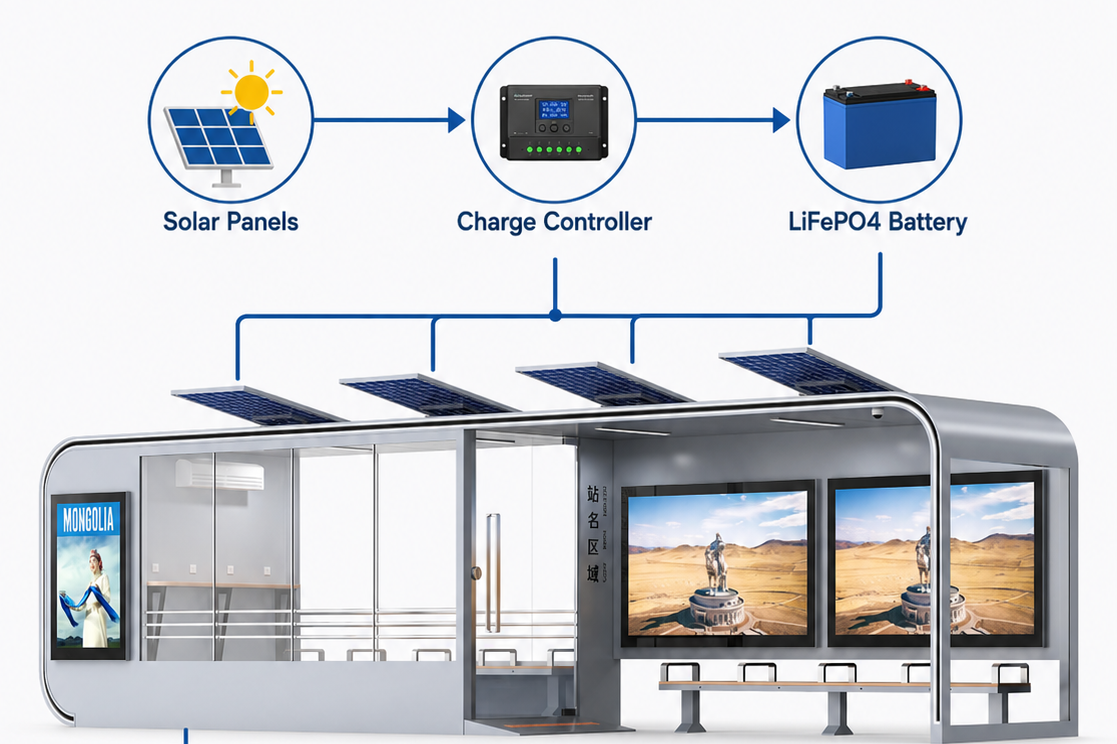
A solar powered bus shelter generates electricity through photovoltaic panels, usually installed on the roof or an adjacent mounting structure. The energy is managed by a controller and stored in batteries for use at night or during periods of low sunlight.
A grid-powered bus shelter connects to the local electricity network through underground cabling, utility metering, protection equipment, and electrical distribution components. It receives continuous electricity as long as the grid remains available.
Both options can support a modern smart bus shelter. The real difference lies in how the shelter receives, stores, controls, and protects its energy supply.
A typical off-grid solar bus shelter includes:
- Solar PV modules that capture daylight and generate electricity
- MPPT charge controller to optimize charging performance
- Battery storage system for night-time operation and reserve power
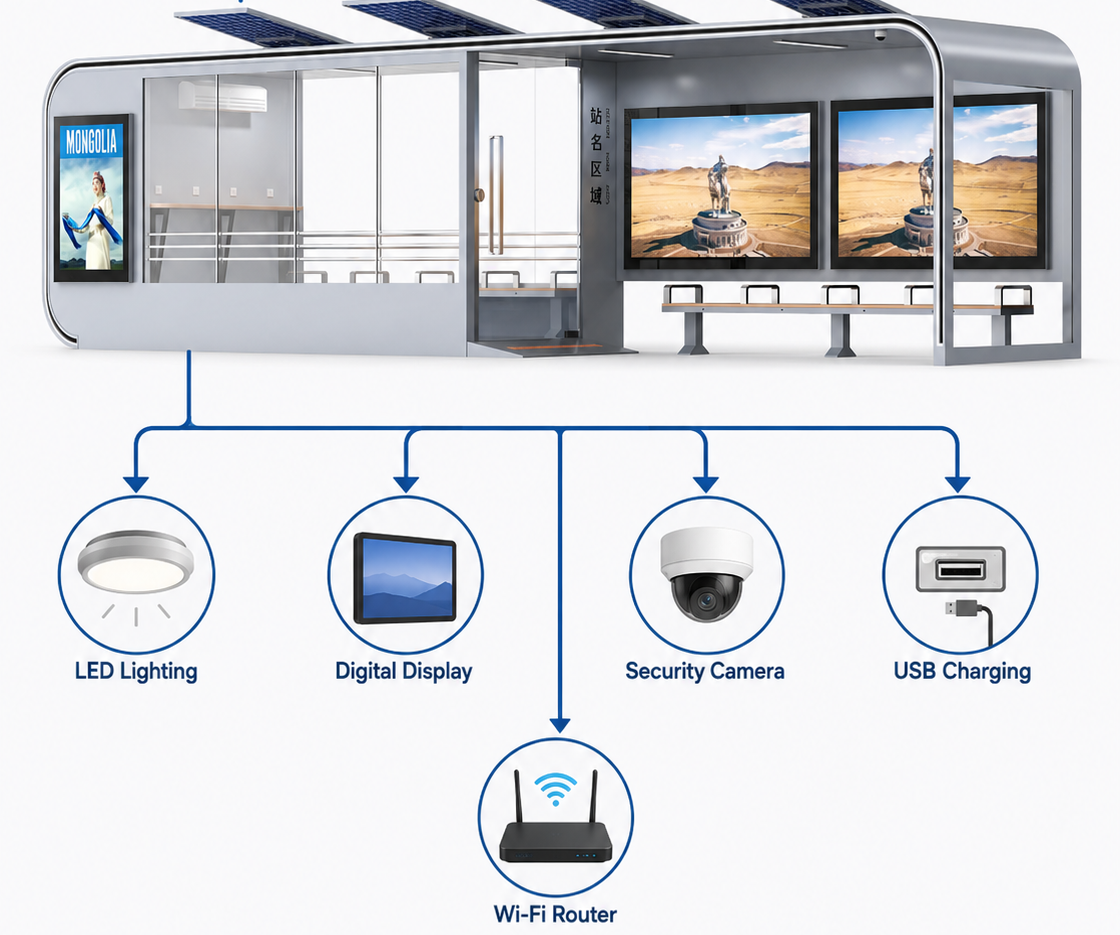
- LED lighting for passenger safety and lower energy consumption
- DC or AC power distribution based on equipment requirements
- Energy-management controller to prioritize essential loads
- Remote monitoring module for battery, solar, lighting, and fault status
- Optional LCD displays, digital signage, CCTV, Wi-Fi, USB charging, and emergency communication
The most important principle is simple: solar output alone does not define performance. A reliable system is determined by the relationship between solar resources, daily energy consumption, battery capacity, autonomy days, seasonal weather, panel orientation, shading, and expected equipment load.
A grid-connected bus shelter normally requires:
- Utility connection approval
- Excavation and cable trenching
- Electrical conduits and underground cables
- Distribution cabinet and protection devices
- Metering, grounding, and surge protection
- Connection inspections and commissioning
- Ongoing electricity billing
This arrangement can provide stable capacity for high-demand equipment. However, the shelter's commissioning date may depend on utility schedules, roadwork permits, trenching conditions, and coordination between multiple project stakeholders.
| Evaluation Factor | Solar Powered Bus Shelter | Grid-Powered Bus Shelter |
|---|---|---|
| Best-fit location | Remote roads, rural areas, new developments, parks, tourist zones, industrial estates | Dense urban areas, transit terminals, commercial streets with established utility access |
| Utility dependency | Independent from the local grid | Fully dependent on grid connection and local utility availability |
| Upfront civil work | Usually reduced because trenching may be avoided | Often higher due to excavation, cable routing, restoration, and permit requirements |
| Installation timeline | Can be faster after site preparation | May be delayed by utility approval and connection scheduling |
| Energy capacity | Limited by PV area, weather, battery size, and load profile | Better suited for continuous high-load equipment |
| Power during outages | Can continue operating if battery reserves are available | Usually stops unless backup power is added |
| Operating cost | No routine utility bill for off-grid electricity use | Ongoing utility charges apply |
| Maintenance focus | Battery health, panel cleaning, controller checks, load management | Utility connection, electrical components, metering, and power-cost monitoring |
| Digital display suitability | Suitable for low- or medium-power displays with energy controls | Better for large, high-brightness, long-run LED screens |
| Environmental profile | Uses on-site renewable generation | Depends on the electricity mix supplied by the grid |
| Scalability | Strong for distributed remote stop networks | Strong where electrical infrastructure already exists |
| Main design risk | Undersized battery or solar capacity | High connection cost, delayed utility work, or outage exposure |
The comparison shows why solar bus shelters should not be evaluated only by panel price. The correct comparison is total project cost plus service reliability over the operating life of the shelter.
A solar powered bus shelter is often the preferred solution when extending grid power would create disproportionate cost, disruption, or delay.
Remote transit routes may have limited electrical infrastructure. Bringing power to one bus stop can require long cable runs, trench excavation, traffic management, reinstatement of pavements, and coordination with road authorities.
In these situations, an off-grid solar bus shelter can reduce dependence on complex utility construction. The shelter becomes a self-contained public facility rather than a small project waiting for a large infrastructure connection.
This is particularly valuable for:
- Rural bus stops
- Mountain or coastal tourist routes
- New airport-access roads
- Industrial park shuttle routes
- University campuses
- Logistics zones
- New suburban communities
- Park-and-ride locations
- Village public transport upgrades
A solar shelter can often be installed once its foundations, steel structure, photovoltaic system, and site conditions are ready. It does not necessarily need to wait for utility energization.
For public projects with tight delivery schedules, this can make a meaningful difference. The project team can focus on structural installation, functional testing, and system commissioning without depending entirely on a separate utility construction timeline.
Passenger safety should be treated as the priority load in any remote shelter energy strategy. Lighting, emergency call systems, critical information displays, and security devices should receive power before convenience loads.
A well-designed solar system can keep core functions operating during grid interruptions because it has local energy storage. This is one reason solar lighting is frequently considered for isolated stops and public areas where night-time visibility matters.
For example, a transit agency procurement document in Duluth required solar lighting systems to support at least five days of reserve capacity based on 12 hours of daily operation without solar charging. It also specified weather resistance, vandal resistance, LED performance, and controller requirements. This illustrates a useful industry principle: battery autonomy must be defined before equipment is selected.
Electricity prices, utility tariffs, and energy demand can change over time. With an off-grid solar powered bus shelter, core energy production happens on site. While batteries and components still require lifecycle planning, the project avoids recurring electricity consumption charges for the loads served by the solar system.
This makes solar particularly attractive for large networks with many modest-load shelters, where each location needs lighting and basic smart-city functions but not continuous high-power equipment.
Grid power remains the more practical option in several scenarios. The goal is not to force solar into every project, but to match power architecture to real operating requirements.
A large outdoor LED advertising screen can consume considerably more energy than LED lighting, a passenger information display, or a CCTV camera. Its energy draw may also rise with brightness requirements, operating hours, heat, and local weather conditions.
If the shelter will run:
- Large-format LED billboards
- High-brightness digital-out-of-home displays
- Multiple advertising screens
- Air conditioning or heating systems
- Continuous Wi-Fi infrastructure
- High-volume charging stations
- Multi-device surveillance systems
- Interactive kiosks with long operating hours
Then a grid-powered shelter, or a solar-plus-grid hybrid shelter, may be more appropriate.
In a central commercial district or bus terminal, power may already be close to the installation location. If trenching is minimal and connection procedures are straightforward, grid power can provide predictable capacity without demanding oversized solar arrays or battery banks.
This can improve operational flexibility for shelters that serve high passenger volumes and need brighter lighting, larger displays, or extended digital-advertising time.
Solar performance depends on site-specific conditions. Buildings, trees, elevated roads, mountains, and surrounding structures can create shading that reduces generation significantly.
A solar feasibility review should examine:
1. Annual and seasonal solar exposure
2. Roof orientation and usable panel area
3. Shading by buildings, trees, poles, and signage
4. Daily operating hours for every electrical load
5. Winter and rainy-season generation conditions
6. Battery reserve requirements
7. Maintenance access for cleaning and inspection
If the site receives insufficient sunlight during the least favorable season, relying exclusively on solar may create unacceptable service risk. In this situation, a grid connection or hybrid architecture should be considered.
The strongest solar bus shelter projects begin with an energy budget, not with a standard panel configuration.
A project team should first calculate the expected daily consumption of each load:
Daily Energy Consumption=∑(Equipment Power×Operating Hours)
For example, a remote shelter could include:
| Equipment | Typical Load | Daily Operating Time | Estimated Daily Energy |
|---|---|---|---|
| LED shelter lighting | 40 W | 12 hours | 480 Wh |
| Passenger information display | 35 W | 16 hours | 560 Wh |
| CCTV camera | 12 W | 24 hours | 288 Wh |
| Wireless router | 10 W | 24 hours | 240 Wh |
| USB charging allowance | 30 W | 3 hours | 90 Wh |
| Total estimated daily demand | — | — | 1,658 Wh |
This example shows why product selection matters. A system designed only for lighting may fail if a high-power display is added later without revising the PV and battery configuration.
A professional manufacturer should therefore provide an energy-load assessment before confirming:
- Solar panel wattage
- Battery capacity
- Controller specification
- Lighting schedule
- Display operating schedule
- Emergency reserve period
- Seasonal performance expectations
- Optional grid or generator backup strategy
Many buyers focus first on solar panel wattage. In remote transit projects, however, battery autonomy is often the more critical design factor.
Autonomy refers to how long the shelter can continue operating when solar generation is weak due to rain, snow, clouds, dust, or shading.
A practical design approach separates loads into three priorities:
| Priority Level | Typical Equipment | Power Strategy |
|---|---|---|
| Essential | Safety lighting, emergency button, critical passenger information | Protected first; maintained during low-energy conditions |
| Important | CCTV, basic communications, limited USB charging | Controlled according to battery status |
| Optional | Advertising screens, decorative lighting, high-load charging | Reduced, scheduled, or switched off when energy reserves fall |
This approach protects passenger safety without forcing the system to maintain non-essential loads during poor weather.
For remote transit networks, an intelligent controller can automatically dim lighting, reduce screen brightness, shorten advertising hours, or temporarily suspend non-essential devices when stored energy falls below a preset threshold.
The cheapest initial quotation is not always the lowest-cost solution. A realistic evaluation should consider the entire asset lifecycle.
- Cable trenching and excavation
- Pavement repair and landscaping restoration
- Road-crossing permits
- Electrical utility coordination
- Delays caused by connection approvals
- Metering and recurring power bills
- Outage-related service disruption
- Future expansion of electrical loads
- Battery replacement planning
- Periodic cleaning of photovoltaic panels
- Seasonal solar-performance assessment
- Anti-theft and anti-vandal mounting design
- Battery enclosure ventilation or thermal control
- Remote monitoring platform requirements
- Load-growth planning for future smart devices
The right decision should compare capital expenditure, operating cost, construction risk, maintenance capacity, and service continuity across the expected project life.
Use the following five-question framework before selecting a solar powered bus shelter or grid-powered bus shelter.
1. Is reliable grid power available within a practical connection distance?
If no, solar is usually the stronger starting point.
2. What functions must remain active at night and during outages?
Define critical loads first, especially lighting and emergency communication.
3. How much electricity will displays, advertising, surveillance, and charging consume?
High-load digital features may require grid or hybrid power.
4. What are the site's worst-season solar conditions?
Design for rainy, cloudy, snowy, or low-sunlight periods—not only annual averages.
5. How will the shelter be maintained for the next several years?
Confirm access for battery inspection, PV cleaning, remote diagnostics, and component replacement.
For many cities, the best answer is neither fully solar nor fully grid-powered. It is a hybrid smart bus shelter.
A hybrid solution may use solar generation and battery storage for lighting, passenger information, CCTV, and emergency functions, while grid power supports high-load advertising screens or acts as a backup supply during extended low-sun conditions.
This structure gives project owners more flexibility:
- Lower grid-energy consumption for basic daily operations
- Continued safety lighting during utility interruptions
- Greater capacity for commercial digital displays
- More reliable public-service operation in changing weather
- Easier future upgrades for smart-city equipment
For citywide projects, different locations can also use different configurations. A remote rural stop may use fully off-grid solar. A downtown commercial shelter may use grid power. A busy suburban interchange may use a hybrid system.
Passengers do not judge a shelter by its energy source alone. They notice whether it is bright, safe, clean, comfortable, informative, and operational when they need it.
A successful shelter should combine:
- Durable steel or aluminum structure
- Weather-resistant roof and side panels
- Clear route information
- Comfortable seating
- High-efficiency LED lighting
- Accessible layout
- Robust drainage design
- Secure electrical enclosures
- Vandal-resistant components
- Flexible branding and advertising surfaces
- Optional real-time passenger information
At Ainl, solar bus shelter solutions can be developed around real project conditions rather than a fixed product template. With 16 years of manufacturing experience, large-scale fabrication capability, in-house research and development resources, precision sheet-metal processing, coating capability, electrical testing, and OEM/ODM customization support, the project team can align the structure, solar system, lighting, screen configuration, colors, branding elements, and smart-city functions with local transit requirements.
For remote transit networks, a solar powered bus shelter is often the best choice when utility access is unavailable, trenching costs are high, installation speed matters, or resilient lighting is essential. It can deliver independent, renewable power for carefully managed public-service loads.
A grid-powered bus shelter is the stronger choice where dependable electrical infrastructure already exists and the shelter must operate high-demand equipment continuously. For complex locations, a hybrid configuration can deliver the most balanced result.
The critical step is to design from the real operating profile: local solar conditions, energy consumption, battery autonomy, safety requirements, digital equipment, maintenance resources, and future expansion plans.
Need a tailored solar bus shelter, grid-powered bus shelter, or hybrid smart transit shelter for your project? Contact Ainl with your location, required functions, preferred dimensions, display requirements, and local climate conditions to receive a customized technical proposal.
Yes, if it is correctly designed with sufficient battery storage and an appropriate reserve period. The design should be based on worst-season sunlight conditions, expected daily energy loads, and the priority of essential equipment such as lighting and emergency systems.
It can power low- or medium-energy digital displays when the photovoltaic panels, battery capacity, screen brightness, and operating hours are engineered together. Large LED advertising displays with long daily operating hours may require grid power or a hybrid power solution.
The answer depends on battery capacity, energy consumption, local weather, and load-management settings. Many public projects specify multiple days of battery autonomy for essential lighting, but the exact requirement should be determined through a site-specific energy analysis.
Not necessarily. Grid-powered shelters may have lower equipment complexity in locations with nearby utility access, but trenching, cable installation, permits, restoration work, utility coordination, and recurring electricity charges can increase total project cost.
Safety lighting, emergency communication, and critical passenger information should be prioritized. CCTV and communications may come next. Advertising screens, decorative lights, and high-demand charging functions should be treated as optional loads during low-energy periods.
Yes. A professional OEM/ODM manufacturer can customize shelter size, structural style, color, roof form, panel layout, lighting, display configuration, advertising positions, solar power system, seating, city logos, and other visual identity elements.
A hybrid shelter is suitable when a project needs solar-powered resilience for core functions but also requires stable high-capacity electricity for large advertising displays, high-brightness signage, extended operating schedules, or other power-intensive equipment.
1. U.S. Department of Energy, National Renewable Energy Laboratory. [PV Fleet Performance Data Initiative].
2. National Renewable Energy Laboratory. [Photovoltaic Plant and Battery Energy Storage System Integration at NREL's Flatirons Campus].
3. U.S. Federal Transit Administration. [Transit Investments for Greenhouse Gas and Energy Reduction].
4. Duluth Transit Authority. [Bus Shelter Solar Lights Request for Quotes].
5. National Renewable Energy Laboratory. [Research and Development Priorities to Advance Solar Photovoltaic Technologies].
6. SEPCO Solar Lighting. [Solar LED Bus Stop and Shelter Lighting Systems].
7. South Carolina Office of Regulatory Staff. [Photovoltaic System Best Practices Guide].


