
Email: ainlbusshelter@gmail.com | WhatsApp: +86-18800607527
Views: 212 Author: Ainl Bus Shelter Publish Time: 2026-08-01 Origin: Site


Content Menu
● What Separates a Solar Bus Shelter From a Traditional Bus Shelter
>> Power Source and Energy Independence
>> Core Components and Technology Stack
● Head-to-Head Comparison: Solar Bus Shelter vs Traditional Bus Shelter
● Why Off-Grid Public Transit Projects Favor Solar Solutions
>> Eliminating the High Cost of Grid Extension
>> Reliability During Power Outages and Natural Disasters
>> Adoption Data From the Transit Industry
● Engineering Considerations for Off-Grid Solar Shelter Projects
● When Solar Still Makes Sense Even With Grid Access Nearby
● Manufacturing Standards That Determine Real-World Performance
● Making the Final Call for Your Project
City planners weighing a solar bus shelter against a traditional bus shelter are really asking a bigger question: should a transit stop depend on the public grid, or generate its own power? For off-grid public transit projects — rural routes, heritage districts, or corridors where trenching cable is impractical — that choice affects budgets, rider safety, and long-term maintenance for decades. This guide compares both shelter types across cost, resilience, and technology, then walks through the engineering decisions that determine which option actually performs better in the field.

The core difference is not aesthetics. It is where the electricity comes from.
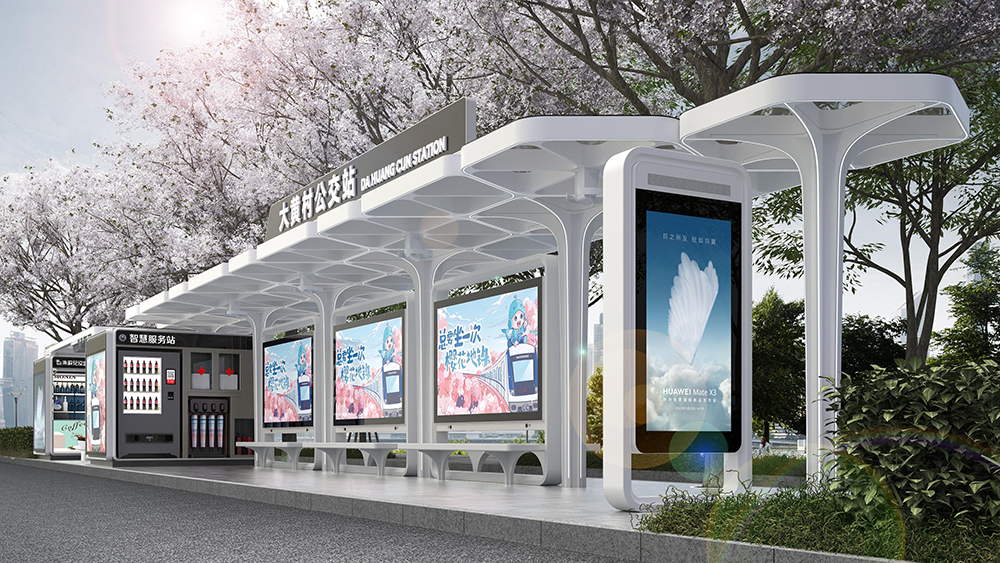
A traditional bus shelter is a passive structure. If it has lighting or digital signage, that equipment draws power through a cable connection to the municipal grid. A solar bus shelter, by contrast, generates its own electricity on-site using rooftop or pole-mounted photovoltaic panels, stores it in rechargeable batteries, and distributes it through an energy management controller. This single design decision changes almost everything downstream — installation cost, maintenance schedule, and how the shelter behaves during a blackout.
A modern solar shelter typically integrates:
- Photovoltaic panels mounted on the roof or an adjustable bracket angled toward peak sun exposure
- Sealed battery banks sized for several days of autonomy during low-sunlight periods
- LED lighting with dusk-to-dawn automatic control
- Digital displays for real-time arrival information or advertising
- USB or wireless charging ports for rider devices
- Smart monitoring sensors for occupancy, air quality, or structural diagnostics
A traditional shelter usually offers only the structural frame, seating, and roofing — any added technology depends entirely on a live grid connection. That dependency is precisely why the comparison matters so much once a project moves outside a well-served urban grid.
| Factor | Solar Bus Shelter | Traditional Bus Shelter |
|---|---|---|
| Power source | Self-generated (photovoltaic + battery) | Municipal grid connection |
| Grid infrastructure needed | None | Trenching, cabling, utility coordination |
| Typical base installation cost | Higher upfront (panels, battery, controller) | Lower upfront if no power features |
| Cost during outages | Fully operational via battery reserve | Non-functional without backup generator |
| Best fit | Remote, rural, or grid-restricted sites | Urban areas with existing power infrastructure |
| Maintenance profile | Panel cleaning, battery replacement cycle | Utility coordination, cable repair after damage |
| Passenger amenities | Lighting, USB charging, displays, Wi-Fi | Limited unless grid-tied |
| Environmental footprint | Zero-emission operation | Depends on grid energy mix |
| Digital advertising potential | High, self-powered screens | Requires separate power source |
For off-grid public transit projects specifically, the grid-dependence row is the deciding factor. Without nearby power infrastructure, a traditional shelter simply cannot support lighting or displays unless a costly extension is built.
Bringing utility power to an isolated bus stop often means trenching, permitting, and coordinating with the local utility — expenses that can rival or exceed the cost of the shelter itself. One documented transit lighting deployment in the southwestern United States eliminated grid-extension costs entirely by switching to standalone solar lighting for stops in areas with little or no existing infrastructure. Municipal transportation offices that install solar shelter systems commonly report a 60–80% drop in running costs within the first five years compared with grid-tied installations.
Because a solar shelter stores its own energy, it keeps lighting and communication systems running during grid failures, storms, or scheduled utility maintenance. Battery reserves are typically sized to provide several consecutive nights of operation even without fresh sunlight. This resilience matters most on routes serving night-shift workers, students, or elderly riders in areas without reliable street lighting, where a dark, powerless shelter is a genuine safety liability rather than a minor inconvenience.
Independent market research gives a clearer picture of how fast this shift is happening. The global smart bus shelter segment was valued at roughly USD 0.61 billion in 2026 and is projected to reach USD 1.45 billion by 2035, growing at a 10.1% annual rate, with solar-powered and IoT-enabled units accounting for a 33% share of new deployments. Separately, industry researchers report that 58% of urban transit authorities are now specifying solar-powered or energy-efficient smart shelters as a standard requirement rather than an optional upgrade. The broader bus stop shelter market, covering both traditional and solar formats, is forecast to grow from roughly USD 3.45 billion in 2026 to USD 6.5 billion by 2036 — evidence that transit agencies are investing heavily in shelter infrastructure across both categories, but tilting toward self-powered designs wherever grid access is limited.

Specifying a solar shelter correctly requires more than choosing a panel size. A rigorous off-grid design process follows several sequential steps:
1. Calculate the daily load. Add up watt-hours for every powered component — LED strips, displays, charging ports — multiplied by expected daily runtime.
2. Determine peak sun hours for the site. Panel wattage is sized by dividing total daily watt-hours by the region's average peak sun hours, not total daylight hours.
3. Size the battery bank for autonomy. Most specifications call for battery capacity that guarantees continuous operation for multiple consecutive nights without sun, factoring in depth-of-discharge limits.
4. Confirm environmental and impact ratings. Outdoor electrical enclosures and luminaires should meet a minimum IP65 ingress protection rating, with panels backed by a 20-year warranty and batteries by at least a 5-year warranty.
5. Match the mounting angle to local latitude. Panels are typically fixed at roughly a 45-degree angle facing the equator-side compass direction to maximize year-round exposure.
Skipping any of these steps is the most common reason a solar shelter underperforms in the field — usually because the battery bank was undersized relative to real-world load, not because the panel technology failed. Agencies that request a documented load calculation before manufacturing begins consistently avoid this problem.
Off-grid necessity is not the only trigger for choosing solar. Field data from transit lighting deployments point to several recurring scenarios where a solar shelter outperforms a grid-tied one even when cable access exists nearby:
- Remote and rural routes where ridership does not justify the cost of a dedicated utility drop
- Urban stops where trenching is disruptive, such as heritage streets, protected landscapes, or heavily paved intersections
- Temporary or seasonal routes that do not warrant permanent grid infrastructure
- Disaster-prone corridors where continuous power during grid failure is a safety requirement, not a convenience
The comparison above assumes both shelter types are built to a professional specification — but shelter quality varies enormously between suppliers, and this is where many procurement decisions quietly go wrong. Facilities with dedicated CNC sheet-metal precision centers, large-scale coating lines, and in-house electrical testing laboratories are far better positioned to guarantee the structural tolerances and weatherproofing that a solar shelter's electronics depend on for a 10–15 year service life. Certifications worth verifying before procurement include:
- Steel structure and municipal engineering contracting qualifications, confirming the manufacturer can legally execute structural installation work rather than subcontract it out
- Integrated management system certifications covering quality, environmental, and occupational health standards across the production facility
- Safety production standardization certification, indicating audited factory-floor safety practices at scale
A manufacturer combining these credentials with genuine OEM/ODM flexibility — covering shelter dimensions, structural style, color schemes, screen configuration, lighting layout, solar power sizing, and city branding elements — gives transit agencies far more room to match a shelter to a specific corridor's climate and ridership profile, rather than forcing a one-size-fits-all product onto every stop. This matters most on off-grid projects, where a single miscalculated battery spec can mean a dark, unsafe stop for months before the issue is even diagnosed.
For most off-grid public transit projects, a solar bus shelter is the stronger long-term choice: it removes grid-extension costs, keeps critical lighting and information systems running during outages, and delivers a materially lower cost of ownership after the first several years. A traditional bus shelter remains reasonable only where grid power is already inexpensive to access and no digital amenities are planned.
Before finalizing a specification, request a load calculation and site solar assessment from your shelter supplier — this single step prevents the undersized-battery problem that causes most field failures. If your agency is scoping a new corridor and needs a shelter engineered specifically for off-grid conditions, request a custom OEM/ODM solar bus shelter consultation from a manufacturer that can validate load calculations, structural certifications, and battery autonomy for your exact climate and ridership before you commit to a design.
1. Can a solar bus shelter work in areas with limited sunlight?
Yes, provided the battery bank and panel size are calculated for the local peak sun hours and days-of-autonomy requirement rather than average daylight hours. Underperformance in low-sun regions is almost always a sizing error, not a technology limitation.
2. How long do solar bus shelter batteries typically last?
Specifications commonly require a minimum 5-year battery warranty, with photovoltaic panels warrantied for up to 20 years under standard outdoor procurement guidelines. Battery replacement, not panel replacement, is usually the main lifecycle maintenance cost.
3. Is a solar bus shelter more expensive than a traditional shelter?
Upfront costs are typically higher because of the panel, battery, and controller components, but total cost of ownership often favors solar within five years due to eliminated utility bills and reduced grid-maintenance coordination.
4. What IP rating should a solar shelter's electrical components meet?
Outdoor luminaires and enclosures should carry a minimum IP65 rating to withstand dust and water exposure across seasonal conditions, and impact resistance ratings should also be checked for high-traffic public sites.
5. Can solar shelters support advertising displays and Wi-Fi?
Yes. Because the system generates independent power, digital advertising screens, real-time arrival displays, and wireless connectivity can be integrated without requiring a separate grid connection, which also opens new advertising revenue potential for transit authorities.
6. What certifications should I check before selecting a shelter manufacturer?
Look for steel-structure and municipal engineering contracting qualifications, integrated quality/environmental/safety management system certification, and safety production standardization certification, which together indicate audited manufacturing and installation capability.
1. SEPCO Solar Lighting. "Solar LED Lighting for Transit System Projects." [sepco-solarlighting.com]
2. SEPCO Solar Lighting. "Solar Bus Stop and Shelter Design for a Brighter Transit Future." [sepco-solarlighting.com]
3. SEPCO Solar Lighting. "No Grid No Problem: Solar Lighting Keeps Bus Stops Safe." [sepco-solarlighting.com]
4. Future Market Insights. "Smart Bus Shelters Market Growth Analysis 2026–2035." [futuremarketinsights.com]
5. Future Market Insights. "Bus Stop Shelter Market Forecast and Outlook 2026 to 2036." [futuremarketinsights.com]
6. Khamisani, Ayaz A. "Design Methodology of Off-Grid PV Solar Powered System (A Case Study of Solar Powered Bus Shelter)." GRIN Publishing. [grin.com]
7. Washington State Department of Transportation. "Bus Stop Shelter Special Provisions — Solar Lighting System Requirements." [wsdot.wa.gov]
8. Knoxville Area Transit (KAT). "Guidelines for Selecting and Installation of Bus Shelters." [katbus.com]


