
Email: ainlbusshelter@gmail.com | WhatsApp: +86-18800607527
Views: 224 Author: Ainl Bus Shelter Publish Time: 2026-09-26 Origin: Site


Content Menu
● What Counts as Renewable Energy Value?
● Solar Bus Shelter vs Solar Street Furniture: Key Differences
● Where a Solar Bus Shelter Delivers More Value
>> A Roof Can Support Multiple Transit Functions
>> Reliability Matters More Than Maximum Output
● Where Solar Street Furniture Wins
>> Small Loads Can Make Better Use of Small Arrays
● A Practical Way to Compare Both Options
>> Calculate Useful Energy, Not Just Panel Capacity
>> Specify Battery Autonomy Separately
>> Compare Service per Investment
● Three Often-Missed Procurement Questions
>> Could Extra Solar Energy Go Unused?
>> Does Adding a Screen Improve the Project?
>> Is the Product Durable Enough for Its Site?
● Which Application Should a City Choose?
>> Is a solar bus shelter always more efficient than a solar bench?
>> Which option produces more electricity per installation?
>> Can either application work without a grid connection?
>> Are digital advertising screens practical on solar bus shelters?
>> What should buyers compare besides the purchase price?
>> How can a city check a supplier's performance claims?
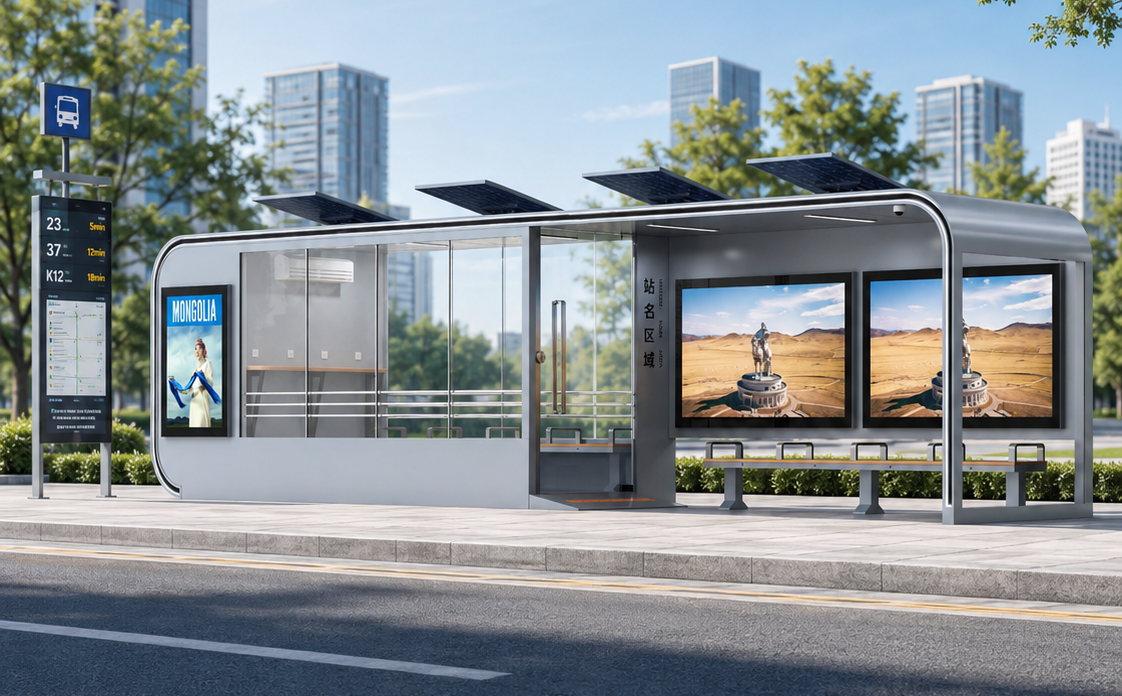
A solar bus shelter will usually deliver more renewable energy value at a busy transit stop, where its roof can support a larger solar array and its electricity can serve lighting, passenger information, and other essential functions. Solar street furniture—such as a solar bench, charging station, or small information kiosk—may deliver better value when the goal is to serve many dispersed locations with modest power needs. The right choice depends less on the product label than on sunlight, useful energy consumption, installation costs, and long-term reliability.
It is tempting to compare products by panel wattage alone. In practice, that misses the question a city buyer needs answered: How much useful service does the solar system deliver over its lifetime, and at what cost?
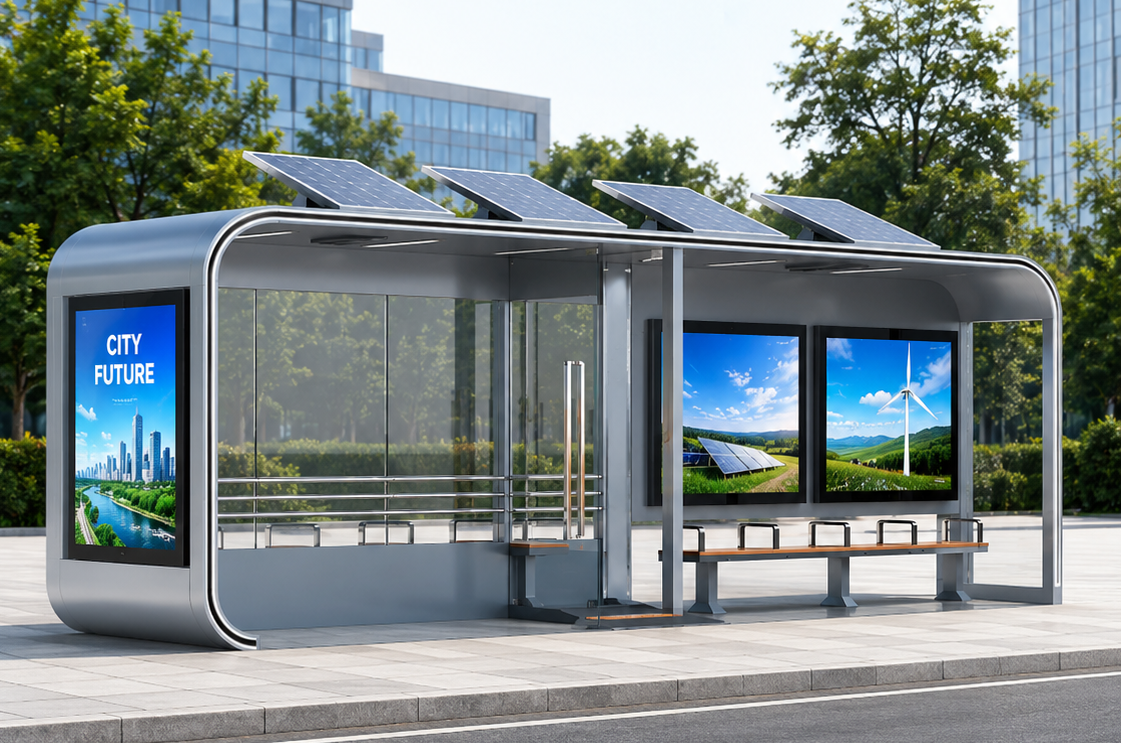
For this comparison, a solar bus shelter is a roofed waiting structure with an integrated photovoltaic (PV) system. Solar street furniture refers to smaller public-space products with their own PV supply, including benches, charging points, lighting units, and kiosks. Both can incorporate batteries and controls. Their physical size, service priorities, and deployment patterns differ.
A sound evaluation considers five measures:
- Annual solar generation: Estimated electricity produced, measured in kilowatt-hours (kWh).
- Useful solar consumption: Electricity actually delivered to intended services, rather than generated when a battery is already full.
- Service availability: The proportion of required operating hours during which lighting, displays, or other functions work.
- Avoided costs: Grid connection, trenching, purchased electricity, or maintenance costs that the project genuinely avoids.
- Whole-life impact: Manufacturing, foundations, batteries, replacements, and end-of-life treatment—not just emissions during operation.
These measures can point to different winners. A shelter might generate more electricity per installation, while a small solar light could deliver a dependable, lower-cost service at a location where a full shelter would be unnecessary.
| Decision factor | Solar bus shelter | Solar street furniture |
|---|---|---|
| Typical setting | Established bus stop with waiting passengers | Park, plaza, campus, pedestrian route, or dispersed stop |
| Space for PV | Often a larger roof area | Usually a smaller, product-specific surface |
| Main power demands | Lighting, route information, displays, communications | Lighting, device charging, sensors, connectivity |
| Energy priority | Reliable transit service, often after dark | Convenience or localized public service |
| Construction scope | Structure, foundation, passenger access, and solar system | Often a smaller installation, depending on the product |
| Main risk | Adding loads that exceed available winter energy | Limited panel area or shading at pedestrian level |
| Best purchasing metric | Cost per reliably served stop | Cost per reliably served location or function |
A shelter's larger roof creates more potential PV area, not a guaranteed energy advantage. Orientation, nearby buildings, trees, roof geometry, and maintenance access can reduce its output. Likewise, a well-positioned furniture unit may outperform a poorly located shelter on a per-watt basis.
The categories can overlap. A bench beneath a bus shelter is still street furniture, and a shelter may contain charging points or sensors. Buyers should therefore compare complete proposed systems, not rely on category names.
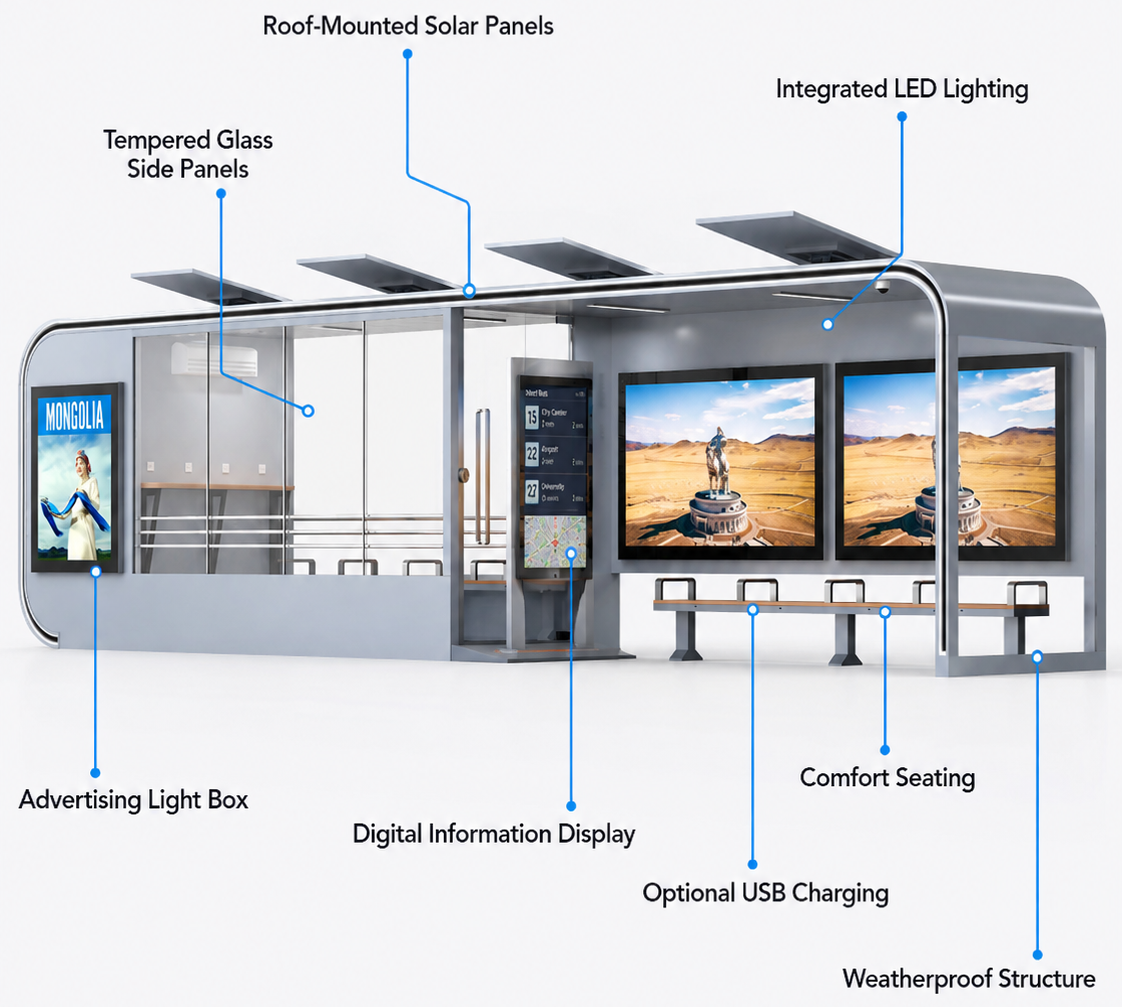
A solar bus shelter has a practical advantage when a transit agency already needs a substantial structure. The roof can host PV while the shelter provides weather protection and a place to wait. Solar power may support interior lighting, timetable illumination, an electronic passenger-information display, communications equipment, or a modest charging feature.
This is especially relevant when extending grid power would require substantial civil work. If the alternative is trenching across a roadway or pavement, a properly designed off-grid shelter may avoid a meaningful project cost. That saving must be demonstrated with site-specific quotations, not assumed for every stop.
The strongest applications prioritize services passengers need consistently. Lighting and essential travel information are easier to justify than a large screen installed solely because space is available. A screen's operating schedule and power demand can change the entire battery specification.
Transit lighting is valuable when the stop needs it, often after sunset and during poor weather. A design based only on average annual sunshine can therefore fail at precisely the wrong time.
The engineering question is: Can the system maintain its required services during the lowest-sunlight period? That calls for local solar-resource data, a daily load schedule, battery autonomy requirements, and a clear plan for prolonged cloudy conditions. Motion-responsive lighting, display scheduling, or a hybrid grid connection may improve service reliability, depending on the project.
A real-world transit example illustrates the distinction. NASA describes how Urban Solar uses its POWER solar-resource data, including December minimums, to size bus-stop systems for difficult conditions. NASA reports that Urban Solar has implemented more than 25,000 solar-powered lighting solutions across North America; its account also describes more than 900 shelter, lighting, and signage projects undertaken with King County Metro. Those figures show deployment experience, not the electricity output or financial return of an individual shelter.
Solar street furniture works well when the required service is compact. A bench might power low-demand lighting, intermittent phone charging, or a sensor. A standalone lighting unit can serve a pedestrian area without requiring a complete transit shelter.
A smaller PV system does not automatically produce more electricity per panel or deliver faster payback. Its advantage is proportionality: buyers need not procure a roofed structure where they only need a light, seat, or information point.
Distributed products can also reach places where shelters do not belong. A park path, civic square, or university campus might benefit from several small service points. In those settings, the number of useful locations served can matter more than the generation of any single unit.
Furniture-level solar systems face their own constraints. Benches may sit beneath trees because shade is desirable for users, while their panels need sunlight. Small surfaces also restrict how much PV can be installed. Heavy or continuous device-charging demand may exceed the energy available from a compact array, particularly in winter.
For buyers, the lesson is simple: do not treat "solar-powered" as a performance specification. Ask what the unit will power, for how many hours, in which season, and with what fallback if the battery reaches its minimum charge.
A preliminary design begins with the electrical load:
Daily load (Wh) = device power (W) × operating hours per day, summed across all devices.
For illustration, consider a proposed shelter with:
| Device | Assumed power and schedule | Daily demand |
|---|---|---|
| LED lighting | 20 W for 12 hours | 240 Wh |
| Route display | 15 W for 24 hours | 360 Wh |
| Communications unit | 5 W for 24 hours | 120 Wh |
| Total illustrative load | 720 Wh/day |
Now compare a hypothetical furniture unit using a 5 W light for 10 hours, a 3 W controller for 24 hours, and an allowance of 100 Wh for charging. Its illustrative demand is 222 Wh/day.
These figures are worked assumptions, not tested Ainl product specifications. They do not include all conversion losses, standby behavior, temperature effects, or unexpected charging demand. Their purpose is to show why an apparently small design decision—such as adding an always-on display—can have a large effect on PV and battery sizing.
Panel ratings are also not daily energy figures. A 200 W module does not deliver 200 W around the clock. Estimate monthly generation for the actual location, orientation, and shading, then assess the energy that remains usable after system losses.
Battery storage moves daylight energy into evening and overnight service, but storage entails losses and has a finite usable capacity. A simple first-pass relationship is:
Required usable battery energy ≈ critical daily load × required days without adequate solar charging.
For the illustrative 720 Wh/day shelter, two days of critical-load autonomy imply approximately 1.44 kWh of usable battery energy before allowing for design margins and component-specific limits. That is not a final battery recommendation. Temperature, permissible depth of discharge, battery aging, system voltage, and the chosen backup strategy all affect the specification.
Separate critical loads from optional ones. The shelter might preserve lighting and essential route information while dimming an advertising display during an extended low-sunlight period. This can deliver more dependable public value than sizing every feature for uninterrupted full-power operation.
A purchasing team should request more than an estimated kWh total. For each proposal, ask for:
1. A site drawing: Panel area, tilt, orientation, nearby obstructions, and maintenance access.
2. A load schedule: Power draw and operating hours for every component.
3. Monthly energy estimates: Particular attention to the weakest solar month.
4. A reliability plan: Usable battery capacity, critical loads, autonomy target, and fallback behavior.
5. A whole-life cost breakdown: Equipment, foundations, installation, cleaning, monitoring, and expected component replacements.
Then compare options against the job each must do. At a bus stop, cost per reliably illuminated and informed stop may be more meaningful than cost per kWh. Across a park, cost per reliably served location may be the better measure. Use the same project period and cost assumptions for both bids.
Yes. If a product generates more than its loads consume and has no practical way to export or use the surplus, some potential generation provides no additional service. This can occur with an oversized array, a full battery, or loads that operate only occasionally.
That is why useful solar consumption matters alongside estimated generation. A larger shelter array is not inherently better if most of its output cannot serve a need. Conversely, deliberately retaining some generation headroom may be justified when winter reliability is critical. The design brief should explain which goal takes priority.
Not necessarily. A digital screen may support passenger information or an outdoor advertising plan, but its power demand, hours of operation, brightness, and maintenance needs must be assessed. An advertising return should be evaluated separately from renewable energy value; a screen does not create an energy benefit simply by running on solar power.
When specifying screens, ask suppliers for measured consumption under the proposed operating schedule, not only a peak rating. A lower-power display, shorter schedule, or content that can remain visible without continuous backlighting may change the system design.
A well-sized PV system still needs a sound public-space structure. Check wind and structural design, foundation responsibilities, corrosion protection, water ingress, cable protection, vandal resistance, and safe maintenance access. Specify the relevant test evidence for the proposed modules and electrical enclosures rather than accepting a general claim that the finished product is "weatherproof."
This is where engineering and manufacturing capability affect energy value. If water enters an enclosure, a coating fails early, or a damaged component is difficult to replace, modeled annual generation will not describe the service citizens receive. Specify replaceable components and an accessible maintenance plan at the outset.
Choose a solar bus shelter when a stop already warrants a roofed waiting area, has adequate solar access, and needs dependable lighting or passenger information—especially where a grid connection is costly. It is the stronger candidate for higher useful energy per installation, provided its loads and winter supply are matched.
Choose solar street furniture when the service is smaller, the locations are dispersed, or a full shelter would add unnecessary material and construction. It can offer better value per useful public-space function, even if each unit produces less electricity.
Neither answer should be universal. A shaded shelter roof may be a worse solar site than an open plaza. A lightly used bench with oversized charging equipment may also be a poor investment. The best design meets a defined public need with the least avoidable complexity while maintaining reliable operation.
For Ainl projects, that means treating the shelter or furniture design and the solar system as one coordinated specification. Ainl describes its offering as covering public-facility manufacturing and OEM/ODM customization, including structure, finishes, screens, lighting, and solar configurations. Those details are useful starting points, but buyers should request project-specific drawings, calculations, test documents, and verified performance commitments before procurement.
Planning a transit or public-space project? Send Ainl your site location, photographs, intended functions, operating hours, and any available grid-connection estimate. Ask for a side-by-side shelter and street-furniture proposal that states the assumed loads, monthly solar generation, battery autonomy, structural scope, and maintenance plan.
No. A shelter may accommodate more PV capacity, but actual output depends on sunlight, orientation, shading, and system losses. Efficiency and usefulness should be assessed against the proposed equipment and service at each site.
A shelter often has the potential to produce more because its roof can provide more panel area. That is a design opportunity, not a guaranteed result. Compare site-specific monthly generation estimates for the exact proposals.
Yes, if its PV, battery, controls, and loads are designed for the location and required availability. An off-grid claim should include a credible winter-energy assessment and a plan for extended poor weather.
They can be, but their energy needs must be included from the beginning. Screen size, brightness, duty cycle, and nighttime schedule can materially affect panel and battery requirements. Commercial advertising returns should be assessed separately.
Compare civil works, grid-connection costs, useful services delivered, maintenance access, expected component replacements, and performance in the weakest solar month. Ask suppliers to state assumptions so bids can be evaluated on a consistent basis.
Request a device-level load schedule, site-specific monthly solar estimate, battery specification, structural calculations, applicable component test evidence, and an acceptance-test plan. Confirm which figures are modeled and which have been measured in comparable installations.
- National Laboratory of the Rockies, [PVWatts Calculator]. Describes location-based PV energy estimates and cautions that modeled results contain assumptions and uncertainty.
- NASA POWER, ["POWER's Accessible Solar Data Drives Everyday Transit Applications"], January 2024. Describes winter-focused solar analysis for transit equipment and reports Urban Solar deployment figures.
- U.S. Department of Energy, ["Solar Integration: Solar Energy and Storage Basics"]. Explains the mismatch between solar production and demand, battery operation, storage losses, and the effects of weather and shading.
- Town of Chapel Hill Million Solar Roofs Steering Committee, ["Demonstration Project Proposal: Solar-Powered Bus Shelters"], February 2007. Historical project proposal illustrating load assessment, solar access, and backup-power planning; its costs are not current prices.
- National Renewable Energy Laboratory, ["Life Cycle Greenhouse Gas Emissions from Solar Photovoltaics"], November 2012. Explains why PV manufacturing and other life-cycle stages belong in environmental assessments.
- International Electrotechnical Commission, [IEC 61215-1:2021]. Sets design-qualification requirements for terrestrial PV modules intended for long-term outdoor operation.
- International Electrotechnical Commission, ["Ingress Protection (IP) Ratings"]. Explains the IP code used to classify enclosure protection against dust and water.
- International Organization for Standardization, [ISO 12944-1:2017]. Introduces the standard series concerning corrosion protection of steel structures by protective paint systems.


