
Email: ainlbusshelter@gmail.com | WhatsApp: +86-18800607527
Views: 230 Author: Ainl Bus Shelter Publish Time: 2026-09-03 Origin: Site


Content Menu
● What Is the Difference Between a Smart Recycling Bin and a Traditional Waste Bin?
>> Traditional Waste Bin: Simple, Reliable, and Familiar
>> Smart Recycling Bin: Physical Infrastructure Plus Operational Data
● Smart Recycling Bin vs Traditional Waste Bin: Side-by-Side Comparison
● Why Traditional Waste Bins Still Matter in Smart City Projects
● Where Smart Recycling Bins Create the Greatest Value
>> Transport Hubs and Stations
>> Commercial Streets and Retail Districts
>> Parks, Waterfronts, and Tourist Attractions
>> Campuses, Stadiums, and Event Venues
● The Real Challenge: Recycling Quality, Not Just Bin Capacity
>> Design Principles for Better Public Recycling Behavior
● A Practical Decision Framework for Project Buyers
>> Choose Traditional Waste Bins When You Need:
>> Choose Smart Recycling Bins When You Need:
>> Choose a Hybrid System When You Need Scale and Efficiency
● How to Launch a Smart Recycling Bin Pilot
>> Step 1: Select High-Impact Locations
>> Step 2: Define Measurable Performance Indicators
>> Step 3: Design the Bin for Local Conditions
>> Step 4: Build a Response Process
>> Step 5: Review Results and Scale Selectively
● Customization Is Essential for Public Waste Infrastructure
● FAQ
>> 1. What is a smart recycling bin?
>> 2. Are smart recycling bins more expensive than traditional waste bins?
>> 3. Can smart recycling bins work without electricity?
>> 4. Do smart recycling bins improve recycling rates?
>> 5. What data can a smart waste bin collect?
>> 6. Where should smart recycling bins be installed first?
>> 7. Can a smart recycling bin be customized for city branding?
>> 8. Is a hybrid bin strategy better than installing only smart bins?
For public-space operators, the comparison between a smart recycling bin and a traditional waste bin is no longer simply about where people throw litter. It is a decision about collection efficiency, recycling quality, public-space appearance, operating cost, user behavior, and the digital infrastructure of a city.
A traditional waste bin remains a practical and cost-effective choice for many low-traffic locations. However, a smart recycling bin can give municipal departments, transport operators, commercial property managers, and smart city project teams real-time visibility into bin status, collection demand, and user interaction. When deployed in the right locations and connected to a well-managed collection process, it can help cities move from fixed, reactive waste collection to a more efficient and data-informed model.
For projects involving transit hubs, pedestrian streets, parks, tourism districts, shopping areas, campuses, and high-footfall public spaces, the best answer is often not "smart bins everywhere." It is a hybrid public waste management system that combines durable traditional waste bins with strategically placed smart recycling bins.

A traditional waste bin is a physical container designed to collect litter, general waste, or recyclable materials. It may include separate compartments, labels, lids, ashtrays, and weather-resistant finishes, but it typically does not generate operational data or communicate with collection teams.
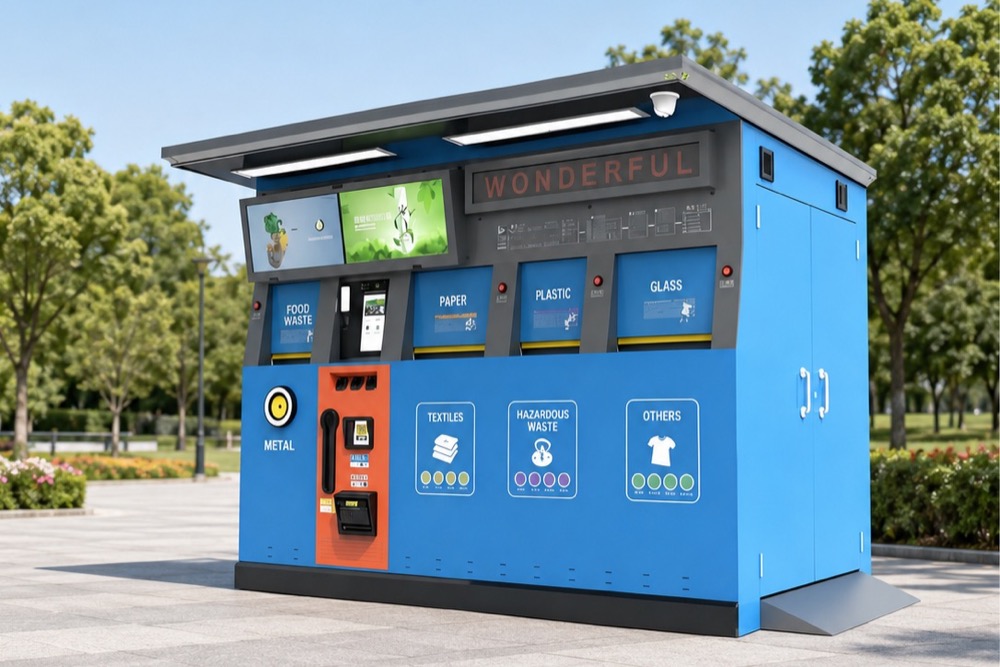
A smart recycling bin combines waste collection hardware with technologies such as sensors, connectivity modules, display screens, solar power systems, automated doors, fill-level monitoring, compaction, user guidance, and management software. Depending on the project, it may also support advertising, public-information displays, city branding, environmental education, and remote alerts.
The distinction matters because public waste management has two separate challenges:
- Collecting waste before bins overflow
- Helping users place the right material in the right stream
A conventional bin can address the first challenge only through routine inspection and scheduled collection. A connected smart recycling bin can help operators understand when, where, and how waste is being generated.
Traditional waste bins are still widely used because they offer several direct advantages:
- Lower initial procurement cost
- Simple installation and maintenance
- No requirement for connectivity or software integration
- Easy replacement of liners, lids, decals, and internal containers
- Suitable for low-volume or remote locations
- Strong visual consistency across streets, parks, plazas, and public facilities
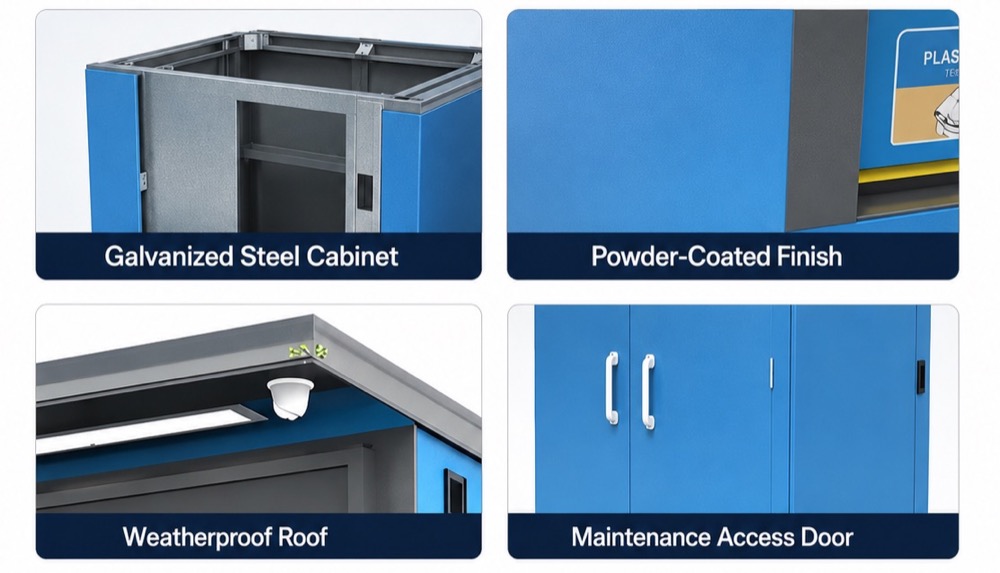
A well-designed outdoor waste bin can remain useful for many years. Its performance depends heavily on material selection, corrosion resistance, structural durability, drainage, accessibility, liner-change design, and clear waste-stream labels.
For example, a powder-coated galvanized steel or stainless-steel bin with a robust internal liner, rainproof opening, secure lock, and clearly marked recycling compartments can provide dependable service in a park or neighborhood street without the cost of digital components.
However, traditional bins have a key limitation: operators do not know the fill level until a worker visits the site or a member of the public makes a complaint.
A smart recycling bin is designed to make public waste collection more responsive. It can monitor fill levels, transmit alerts, support dynamic collection planning, and provide users with clearer recycling guidance at the point of disposal.
Typical smart recycling bin functions may include:
- Fill-level sensors that indicate when a bin approaches capacity
- Overflow alerts for collection teams or facility managers
- Temperature, tilt, fire, or door-status monitoring
- Compaction systems that increase usable waste capacity
- Solar panels and battery systems for off-grid power
- LED lighting for nighttime visibility and public safety
- Digital screens for advertising, municipal notices, or recycling education
- Multi-stream openings for general waste, plastic bottles, cans, paper, and other local recycling categories
- Remote platform access for equipment status, maintenance planning, and collection analysis
- Custom city branding through color, graphics, public-service messages, and display content
The value is not simply the sensor. The value comes from using bin data to improve decisions.
One six-month waste-monitoring deployment reported that bins were collected at average fill levels of only 24% in one municipality and 45% in another before routes were adjusted. After using monitoring data to redesign collection routes and service frequencies, the project reported cost savings of 63% and 43%, respectively. These results should not be treated as universal outcomes, but they illustrate how fixed collection schedules can lead to unnecessary trips when bins are only partly full.
| Comparison Factor | Smart Recycling Bin | Traditional Waste Bin |
|---|---|---|
| Initial investment | Higher due to sensors, screens, connectivity, power systems, and software | Lower and easier to budget |
| Collection method | Data-driven, condition-based, and potentially route-optimized | Usually fixed schedule or manual inspection |
| Fill-level visibility | Remote monitoring may be available | No remote visibility |
| Overflow prevention | Alerts can trigger timely collection | Depends on inspection frequency |
| Recycling guidance | Can use labels, icons, screens, lights, or interactive prompts | Relies mainly on static labels and compartment design |
| Public engagement | Can support city campaigns, digital content, and advertising | Limited to printed graphics or signage |
| Maintenance needs | Requires both physical and electronic maintenance | Primarily mechanical cleaning and repair |
| Power requirements | May require grid, battery, or solar power | Usually no power required |
| Best locations | Transit hubs, commercial districts, tourism zones, smart city pilot areas, high-footfall venues | Residential streets, parks, remote areas, lower-volume locations |
| Data collection | Can reveal waste generation patterns and service demand | Little or no operational data |
| Customization potential | High: screen, lighting, solar, branding, materials, compartments, sensors | High for size, material, color, compartments, branding, and openings |
The correct choice depends on the location, waste volume, collection model, budget, maintenance capacity, and project goals.
A smart city does not require every piece of public infrastructure to be connected. In fact, deploying advanced hardware in the wrong location can increase costs without creating meaningful operational value.
Traditional outdoor waste bins remain the better fit when:
- Footfall is low and waste generation is predictable
- Collection teams already pass the location frequently
- The site has no reliable power or connectivity option
- The project budget prioritizes coverage over digital functionality
- The operator does not have a platform or team to act on alerts
- The main goal is a consistent, durable, attractive public-space design
- Replacement speed and low maintenance complexity are priorities
For a large municipal rollout, traditional bins can provide a dependable baseline system. They are especially useful where the core need is to place more litter capacity across a broad area rather than to optimize high-cost collection routes.
The most important requirement is not whether the bin is connected. It is whether the bin is durable, easy to service, visually clear, secure, and appropriate for local waste behavior.
A poorly designed traditional recycling station can still create contamination if users cannot quickly understand which opening is for which material. Clear labels, consistent colors, intuitive iconography, restricted openings, and locally relevant instructions are often more important than adding technology alone.
Smart recycling bins are most valuable in locations with high variation in footfall, high visibility, frequent overflow risk, or strong public-engagement potential.
Passenger volume can vary sharply by hour, weather, holiday periods, and special events. Smart recycling bins can help operators identify peak-demand zones and dispatch cleaning teams before litter affects the passenger experience.
Digital display modules can also communicate:
- Service notices
- Safety reminders
- Wayfinding information
- Public health announcements
- Tourism messages
- Recycling campaigns
- Advertising content
For transportation operators, the bin becomes both a waste-collection point and a public-information asset.
Shopping streets, food-service clusters, and pedestrianized commercial zones often produce highly variable waste volumes. Packaging, beverage containers, food waste, and event-related litter can fill bins quickly.
In these settings, smart bin data can support:
- More responsive cleaning schedules
- Better placement of recycling stations
- Identification of recurring overflow hotspots
- Seasonal collection planning
- Performance reporting for business improvement districts
- Public-space advertising or sponsorship opportunities
Tourist sites can experience dramatic changes in waste volume during weekends, festivals, holiday seasons, or favorable weather. Traditional fixed schedules may either waste labor on underfilled bins or fail to prevent visible overflow during busy periods.
A solar-powered smart recycling bin can be suitable where grid access is difficult but public appearance is highly important. Solar power should be evaluated carefully based on local sunlight conditions, panel exposure, battery capacity, screen usage, sensor load, and seasonal weather patterns.
These locations generate predictable peaks around classes, matches, concerts, exhibitions, and seasonal events. Smart recycling bins can help operators study demand by zone and time period.
They can also support targeted recycling messages. For example, a stadium may use a digital display to prompt visitors to place bottles and cans in the correct stream before entering or leaving the venue. This approach is more effective when the bin opening, color coding, and message all reinforce the same action.
Adding more recycling bins does not automatically increase recycling performance. The quality of collected material matters just as much as the quantity.
When people place non-accepted materials into recycling containers, the recycling stream becomes contaminated. Contamination can increase sorting costs, damage processing equipment, and cause otherwise recyclable materials to be rejected. Public recycling instructions should therefore align with the actual acceptance rules of the local recycling processor or municipal program.
A smart recycling bin can improve the user experience, but it cannot solve contamination by itself. The most effective public recycling system combines hardware design, communication, servicing, and local operational rules.
1. Use restricted openings.
Shape the opening around the intended material where possible. A round opening for bottles and cans, for example, can discourage disposal of large food containers or general litter.
2. Make labels immediate and visual.
Users should understand the bin within seconds. Use clear icons, simple wording, consistent colors, and examples of accepted materials.
3. Match instructions to local rules.
Avoid generic recycling claims. A material accepted in one city may not be accepted in another collection system.
4. Place streams together.
People should not need to search for the recycling bin after finding a general waste bin. Pairing waste and recycling options supports better choices.
5. Keep bins clean and serviceable.
A dirty, overflowing, or damaged recycling station reduces trust and encourages incorrect disposal.
6. Measure contamination patterns.
If a particular location repeatedly receives the wrong materials, change the signage, bin openings, placement, or service plan.
The U.S. Environmental Protection Agency advises that recycling containers should be clearly marked and that color systems should be consistent to reduce misuse.
Before selecting smart recycling bins or traditional waste bins, project teams should define what problem they are solving.
- Broad public-space coverage at a controlled cost
- Strong physical durability and simple servicing
- A standard design language across a city or property portfolio
- Reliable collection points in low-traffic locations
- Custom colors, branding, capacity, and waste-stream configurations
- Fast procurement and straightforward maintenance
- Real-time awareness of fill levels or equipment status
- Better response to recurring overflow problems
- Data for route planning and service optimization
- Public displays for advertising, information, or city branding
- Solar-powered infrastructure for suitable outdoor sites
- High-visibility recycling stations in dense or premium locations
- A pilot project that demonstrates smart city capability
For most cities and commercial portfolios, a mixed strategy is the most practical approach.
Use smart recycling bins in high-value, high-footfall, high-variation locations. Use traditional waste bins across lower-demand streets, parks, residential zones, and peripheral public areas.
This model can reduce unnecessary technology costs while still creating data-rich collection points where they generate the greatest operational return.
A well-planned pilot is more valuable than a large rollout based on assumptions. Start with a limited number of sites, establish a baseline, and evaluate outcomes before scaling.
Choose sites with known challenges, such as:
- Repeated overflow complaints
- High cleaning costs
- Tourist congestion
- Busy transit flows
- Food and beverage concentration
- Large events or weekend peaks
- Weak recycling participation
Avoid selecting sites only because they are visually prominent. The best pilot locations are where data can lead to a meaningful operational decision.
Track practical metrics before and after installation:
- Number of overflow incidents
- Collection trips per week
- Average bin fill level at collection
- Labor hours per route
- Fuel or vehicle distance where available
- Recycling volume
- Contamination incidents
- Maintenance events
- Advertising or display utilization
- Public feedback and cleanliness complaints
A smart recycling bin should be configured around the actual environment, not selected as a standard product without adaptation.
Consider:
- Bin capacity and internal compartment layout
- Outdoor corrosion resistance
- Rainproofing and drainage
- Wind load and anchoring
- Anti-vandalism and secure access
- Climate and temperature conditions
- Screen brightness and daylight visibility
- Solar panel orientation and battery autonomy
- Local communication network availability
- Accepted local recycling materials
- Accessibility requirements
- Municipal visual identity
Data only has value when a team can act on it. Define who receives alerts, how collection priorities are decided, how maintenance issues are escalated, and what happens if connectivity is interrupted.
A smart bin platform should support operations rather than create another dashboard that no one checks.
After a pilot period, compare the data with the original baseline. Expand only where there is evidence of operational, environmental, public-experience, or commercial value.
A recent smart waste management framework reported reductions in overflow events, missed pickups, and fuel use when sensor data and route optimization were compared with a static collection model. The exact result will vary by city, fleet, waste profile, and operating discipline, but the direction is clear: collection planning improves when it reflects actual demand rather than assumptions.
Public waste bins are highly visible city assets. They affect how residents, visitors, investors, and business owners perceive a space.
For this reason, product selection should consider more than sensor functions or capacity. A professional manufacturer and solution provider should be able to support customization across:
- Product dimensions and bin capacity
- Internal waste-stream configuration
- Steel structure and sheet-metal fabrication
- Surface treatment and corrosion protection
- Color, logos, city emblems, and project graphics
- Screen size and display configuration
- Lighting and night-visibility systems
- Solar power and battery solutions
- Sensor selection and connectivity options
- Advertising module integration
- Locking system and maintenance access
- Outdoor installation and anchoring methods
For urban projects, the goal is to create infrastructure that is functional, durable, easy to maintain, visually integrated, and adaptable to future needs.
Ainl supports this type of project requirement through integrated research, manufacturing, finishing, electrical testing, and custom development capabilities. With 16 years of experience in smart city public facilities and outdoor advertising products, Ainl can provide OEM and ODM solutions for smart recycling bins, outdoor waste bins, public recycling stations, digital-display waste bins, solar-powered street furniture, and related municipal infrastructure.
A traditional waste bin is still the right solution when simplicity, coverage, durability, and low initial investment are the primary priorities. A smart recycling bin is the stronger choice when a project needs operational data, responsive collection, public communication, digital advertising potential, and a more visible smart city experience.
The best smart city waste management strategy is not based on choosing one product for every location. It is based on matching the right bin system to the right environment.
For high-footfall and high-visibility areas, smart recycling bins can turn waste collection into a measurable, manageable, and more engaging public service. For widespread everyday coverage, traditional waste bins continue to provide an essential foundation.
If you are planning a municipal, transportation, commercial, campus, tourism, or smart city project, contact Ainl to discuss a customized smart recycling bin or traditional waste bin solution based on your site conditions, waste streams, branding requirements, display needs, and collection operations.
A smart recycling bin is a connected waste and recycling unit that may include fill-level sensors, communication modules, solar power, digital displays, compaction, remote alerts, and a management platform. It helps operators monitor bin usage and improve collection decisions.
Yes, the initial purchase cost is generally higher because smart recycling bins may include sensors, software, screens, solar systems, batteries, connectivity, and electronic components. However, they may create operational value in high-demand locations by reducing unnecessary collection trips and preventing overflow.
Some models can operate with solar panels and battery storage. The right solar solution depends on local sunlight, weather, screen usage, sensor requirements, battery capacity, and the installation environment.
They can support better recycling behavior through clearer instructions, digital education, multi-stream design, and improved servicing. However, recycling performance also depends on local acceptance rules, bin placement, user behavior, maintenance quality, and collection-system capability.
Depending on the configuration, a smart waste bin may collect fill level, collection history, temperature, tilt, door status, battery status, location, usage patterns, and maintenance alerts. Not every project requires every data type.
Start with locations that have high footfall, frequent overflow, variable waste volumes, high collection costs, public visibility, or a need for advertising and public information. Transport hubs, tourist areas, shopping streets, parks, campuses, and event venues are common starting points.
Yes. A project can customize dimensions, materials, compartment layout, colors, logos, graphics, display screens, lighting, solar systems, recycling labels, openings, and other visual or functional details.
For many projects, yes. Smart recycling bins are most valuable in high-demand or high-visibility locations, while traditional waste bins offer economical and durable coverage in lower-demand areas. A hybrid system balances capital investment with operational benefits.
1. U.S. Environmental Protection Agency. "[Managing and Reducing Wastes: A Guide for Commercial Buildings]." Guidance on waste prevention, recycling programs, labeling, and consistent bin systems.
2. U.S. Environmental Protection Agency. "[Frequent Questions on Recycling]." Information on contamination, accepted materials, and the importance of following local recycling guidance.
3. U.S. Environmental Protection Agency. "[How Do I Recycle Common Recyclables?]." Practical guidance on preparing common recyclable materials.
4. Sensoneo. "[More Efficient Waste Collection Resulting in Cost Savings]." Case study describing sensor-based monitoring, adjusted collection routes, and reported municipal cost savings.
5. Anitha, R. et al. "[AI-IoT-Graph Synergy for Smart Waste Management]." Research discussing sensor-enabled waste monitoring, intelligent routing, and operational performance outcomes.
6. ISSA. "[Smart Waste Management Systems in Intelligent Buildings]." Overview of real-time sensors, waste data platforms, and intelligent building waste-management applications.
7. SmartEnds. "[Smart Waste Management for Cities]." Industry perspective on sensor data, contamination detection, dynamic routing, and phased deployment approaches.


