
Email: ainlbusshelter@gmail.com | WhatsApp: +86-18800607527
Views: 248 Author: Ainl Bus Shelter Publish Time: 2026-08-06 Origin: Site


Content Menu
● What Separates a Smart Bus Shelter From a Solar Bus Shelter
>> The Smart Bus Shelter: Data-Driven Passenger Experience
>> The Solar Bus Shelter: Self-Sufficient Clean Energy Infrastructure
● Head-to-Head Comparison: Technology, Cost, and Use Case
● 2026 Market Outlook: Why Cities Are Investing in Both
● Technical Specifications That Actually Matter in Procurement
>> Structural and Material Benchmarks
>> Solar Power System Benchmarks
● Matching the Technology to Your City's Priorities
>> Choose a Smart Bus Shelter When
>> Choose a Solar Bus Shelter When
>> Consider a Hybrid Smart-Solar Shelter When
● A Manufacturer's Perspective: What 16 Years of Field Data Teaches
● Supplier Evaluation Checklist for Procurement Teams
Cities weighing a smart bus shelter against a solar bus shelter are really asking two different questions: how much digital intelligence does my transit stop need, and how independent should it be from the municipal power grid? Both technologies serve the same mission — modernizing public transit infrastructure — but they solve different problems. This guide breaks down the engineering, cost, and procurement differences so transit planners, municipal buyers, and outdoor advertising operators can match the right shelter technology to their city's sustainability roadmap.
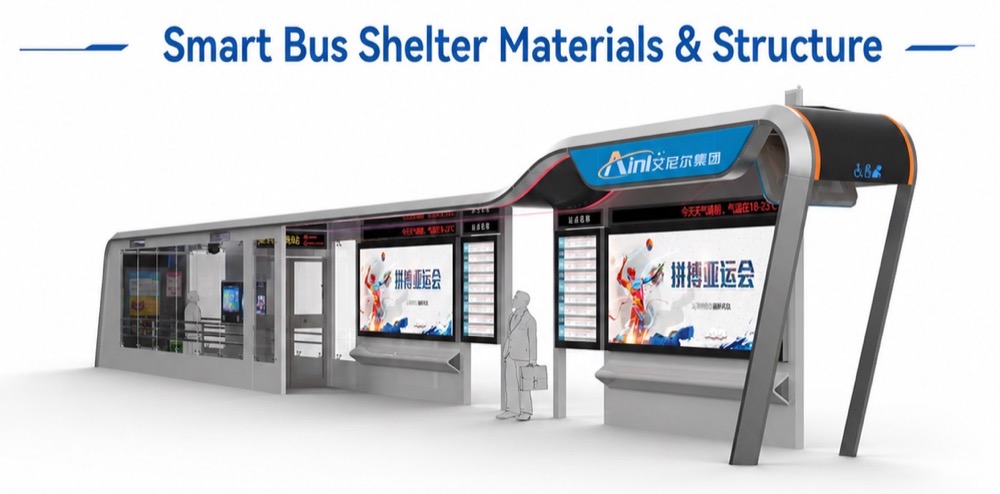
The terms get used interchangeably in marketing copy, but they describe distinct engineering priorities. Understanding this distinction is the first step toward a sound procurement decision.
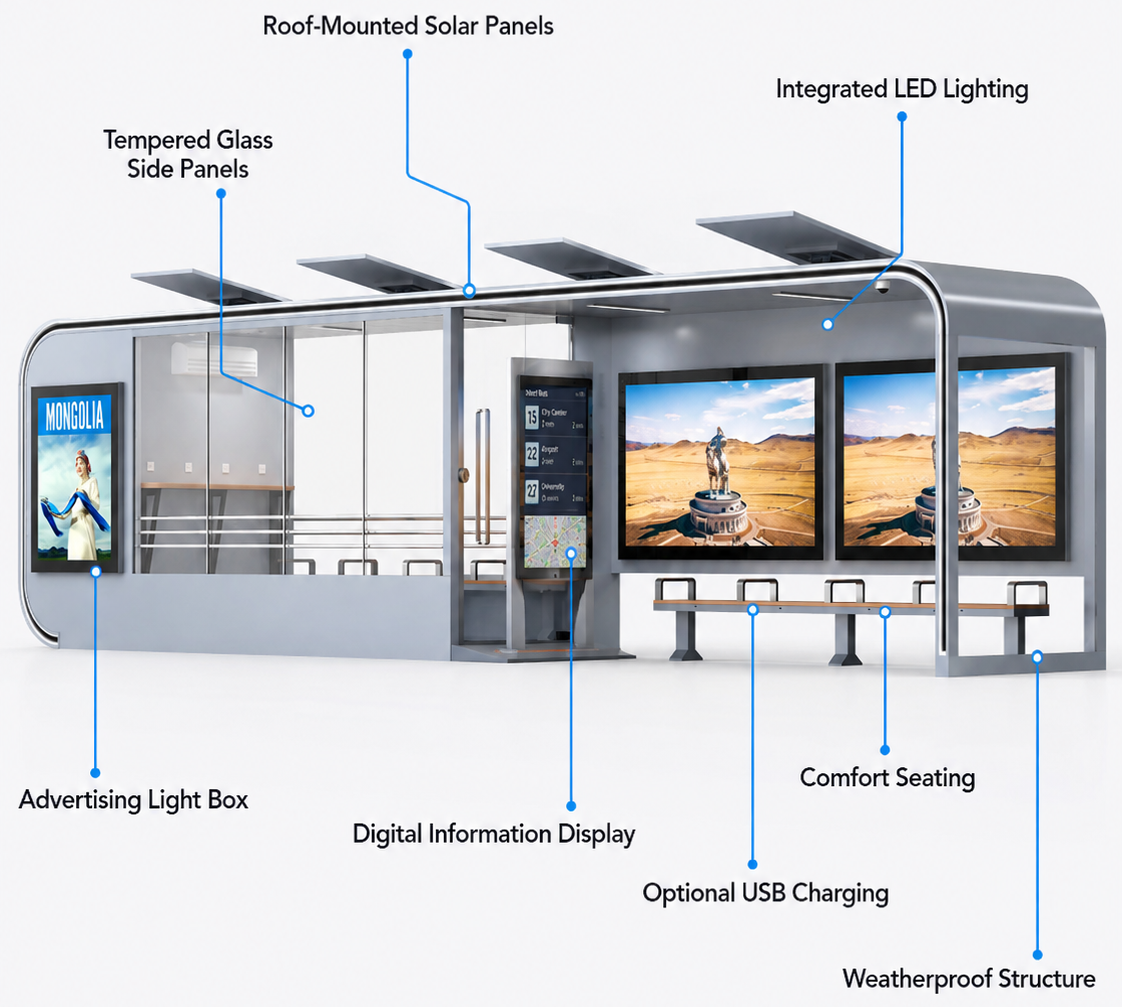
A smart bus shelter is defined by its digital layer. It typically integrates real-time arrival displays, Wi-Fi connectivity, digital advertising screens, passenger counting sensors, and safety features such as CCTV and emergency call buttons. Its core value proposition is information and interaction — turning a waiting area into a connected micro-hub that feeds data back to transit authorities and generates advertising revenue for operators.
Power for a smart shelter usually comes from the grid, though many models now add a solar panel as a backup or a supplement, not the primary source.
A solar bus shelter, by contrast, is defined by its energy architecture. Photovoltaic panels mounted on the canopy convert sunlight into electricity, which is stored in batteries and distributed through a charge controller to LED lighting, USB ports, and basic displays. The core value proposition is energy independence — the shelter keeps functioning during grid outages, in remote locations without utility access, and without recurring electricity bills.
In practice, the strongest municipal projects blend both approaches: smart features for passenger experience, solar power for operational resilience.
| Factor | Smart Bus Shelter | Solar Bus Shelter |
|---|---|---|
| Primary function | Digital passenger information and advertising | Off-grid clean energy generation |
| Power source | Grid electricity, optional solar backup | Photovoltaic panels + battery storage |
| Best-fit location | Dense urban corridors with existing grid access | Suburban, rural, or remote routes lacking grid infrastructure |
| Typical add-ons | LCD/LED advertising screens, Wi-Fi, sensors, cameras | LED lighting, USB charging, basic e-paper displays |
| Grid dependency | High, unless hybridized | None to minimal |
| Operating cost trend | Ongoing utility and data connectivity fees | Up to 60–80% lower running costs after five years of use |
| Installation complexity | Requires electrical trenching in most cases | Standalone, faster to deploy in unwired areas |
The global appetite for connected, sustainable transit furniture is accelerating faster than most procurement teams realize. Industry research places the smart bus shelter market at approximately $2.8 billion in 2025, with projections reaching $7.4 billion by 2034 at a compound annual growth rate near 12.4%. Parallel research on the broader bus stop shelter category shows a similarly steep trajectory, climbing from roughly $3.57 billion in 2025 to $6.62 billion by 2034.
Three forces are driving this growth:
1. Municipal decarbonization mandates are pushing transit agencies to specify renewable-powered street furniture in new tender documents.
2. Advertising revenue models are making digital, sensor-equipped shelters self-funding for cash-constrained cities.
3. Grid-access gaps in rapidly urbanizing regions make solar the only practical power option for many new routes.
This is precisely why leading manufacturers now engineer shelters that combine both capabilities in a single product line rather than treating them as separate categories.
Marketing brochures rarely tell buyers what to check before signing a purchase order. Based on current industry benchmarks, here is what a properly engineered shelter should deliver.
- Frame material: Hot-dip galvanized or powder-coated steel, or #304 stainless steel for coastal and high-humidity regions.
- Roof and panel glazing: Tempered glass (typically 6mm) or laminated composite panels rated for wind and impact loads.
- Corrosion protection: Multi-stage surface treatment (sandblasting, phosphating, electrostatic spray coating) to withstand outdoor exposure for 10+ years.
- Standard footprint: Roughly 3.5m length x 1.6m width x 2.5m height, though modular OEM/ODM configurations allow custom sizing.
| Component | Typical Specification Range |
|---|---|
| Solar panel output | 100W to 400W depending on load and daylight hours in the deployment region |
| Battery storage | 55Ah to 140Ah, with lithium-ion increasingly replacing lead-acid for longer cycle life |
| Autonomy | 3 to 5 days of runtime without direct sunlight, assuming properly sized battery banks |
| Charge controller | MPPT-type controllers for higher conversion efficiency over older PWM units |
Buyers should request load calculations from suppliers rather than accepting generic panel ratings — a shelter running a digital advertising screen and Wi-Fi router needs a materially larger solar array than one running LED lighting alone.
- Your route runs through dense, grid-connected urban corridors.
- Advertising revenue generation is a budget priority for the transit authority.
- Passenger information accuracy and safety monitoring outweigh energy autonomy concerns.
- The installation site has limited or no access to grid power.
- Reducing long-term utility costs and carbon footprint is the primary municipal objective.
- Reliability during power outages or extreme weather events is a non-negotiable requirement.
Most large-scale municipal tenders in 2026 are no longer choosing one technology exclusively. A hybrid design — solar-powered digital displays with grid backup, or grid-powered screens with solar-assisted lighting — is becoming the default specification for smart city transit programs because it hedges against both power outages and grid connection costs.
Specifying a shelter on paper is one thing; keeping it operational through a decade of coastal humidity, monsoon seasons, or desert heat is another. After 16 years designing and manufacturing public transit and smart city furniture — including both fully digital smart shelters and off-grid solar units — a few field lessons consistently separate durable installations from costly replacements:
1. Sheet metal precision matters more than aesthetics. Shelters built on CNC-precision sheet metal frames resist the warping and misalignment that cause water leaks and electrical faults within the first two years.
2. Coating quality determines lifespan, not just appearance. A shelter processed through a proper large-scale spray coating line with electrostatic and multi-layer treatment will consistently outlast one finished with a single coat.
3. Electrical systems need independent testing, not just component certification. Shelters that pass through a dedicated electrical testing laboratory before shipment show far fewer field failures in solar controllers, batteries, and LED drivers.
4. Modular OEM/ODM design reduces total project risk. Cities that specify shelter dimensions, screen size, lighting layout, solar capacity, and branding elements upfront avoid costly retrofits after installation.
These are not theoretical points — they reflect what happens when a manufacturer with a provincial-level research and development center, in-house CNC sheet metal precision processing, a large-scale coating center, and a dedicated electrical testing laboratory applies that infrastructure across thousands of shelter units deployed in transportation, municipal, and commercial projects.
Before shortlisting a manufacturer for either shelter type, verify these five items:
1. Manufacturing scale and facility certification. Confirm production capacity, factory area, and whether the supplier holds relevant construction qualifications, such as a steel structure and municipal engineering contracting license.
2. Quality and safety management systems. Look for three-system certification (quality, environmental, occupational health and safety) and safety production standardization accreditation.
3. Customization depth. Verify the supplier can adjust size, structure, color, screen configuration, lighting, solar power sizing, and city branding elements without excessive minimum order requirements.
4. After-sales and technical support. Confirm response times for maintenance, warranty terms, and availability of spare parts for batteries, panels, and electronics.
5. Reference projects. Ask for documented installations in comparable climates — coastal, desert, or high-latitude — rather than generic renderings.
There is no universal winner between a smart bus shelter and a solar bus shelter — the right choice depends on grid access, budget structure, and how much digital interactivity your commuters actually need. What does matter is working with a manufacturer capable of engineering either technology, or a hybrid of both, to municipal-grade durability standards.
If your transit authority or outdoor advertising program is evaluating shelter technology for an upcoming smart city tender, request a technical consultation and OEM/ODM design proposal before finalizing specifications. A properly sized solar array or digital display package on day one saves significant retrofit costs later.
1. Can a bus shelter be both smart and solar-powered at the same time?
Yes. Hybrid designs power digital displays, sensors, and lighting through solar panels and battery storage, with grid backup for high-load periods. This is increasingly the standard specification for new smart city transit tenders.
2. How much does a solar bus shelter save compared to a grid-connected smart shelter?
Industry data shows municipal operators typically see a 60–80% reduction in electricity-related running costs within five years of switching to solar power, primarily from eliminated utility bills and reduced maintenance coordination with power companies.
3. What solar panel size does a typical shelter need?
It depends on the load. A shelter running only LED lighting may need as little as 100W, while one running a digital advertising screen, Wi-Fi router, and sensors can require 300W or more, paired with a correspondingly larger battery bank.
4. Are solar bus shelters reliable in cloudy or low-sunlight climates?
Yes, provided the battery bank and panel array are sized correctly for the region's average sunlight hours. Well-engineered systems typically deliver three to five days of autonomous operation without direct sun.
5. What certifications should a bus shelter manufacturer hold?
Buyers should look for quality, environmental, and safety management system certifications, safety production standardization accreditation, and, where applicable, a steel structure and municipal engineering construction qualification, in addition to product-level compliance such as CE, RoHS, or equivalent regional standards.
6. How customizable are smart and solar bus shelters for city branding?
Most established manufacturers offer OEM/ODM services covering dimensions, structural style, color schemes, screen configuration, lighting design, solar power capacity, and city branding elements, allowing shelters to match a municipality's visual identity.
1. Polaris Market Research, "Smart Bus Shelter Market Research Report, 2033" — [Market data on global smart bus shelter valuation and growth]
2. Polaris Market Research, "Bus Stop Shelter Market Size, Future Growth and Forecast 2033" — [Bus stop shelter market sizing and CAGR data]
3. Topview Display, "Solar Bus Shelter Functions and Design Features Explained" — [Technical breakdown of solar shelter materials, cost savings, and design]
4. Zemso Group, "The Complete Guide To Smart Bus Shelters" — [Overview of smart shelter digital features and sustainable design]
5. Scribd, "EnGo Smart Solar Bus Shelter Technical Data Sheet" — [Solar panel and battery specification benchmarks]
6. Deloitte Insights, "Transportation Trends 2025–2026: Modernizing America's Transportation Infrastructure" — [Analysis of technology and sustainability trends shaping transit infrastructure]


