
Email: ainlbusshelter@gmail.com | WhatsApp: +86-18800607527
Views: 264 Author: Ainl Bus Shelter Publish Time: 2026-10-17 Origin: Site


Content Menu
● Smart Bus Shelter vs EV Charging Shelter: Core Differences
>> What Is a Smart Bus Shelter?
>> What Is an EV Charging Shelter?
● Side-by-Side Comparison for Infrastructure Buyers
● Passenger Experience and Site Layout Must Come First
>> Design the Smart Bus Shelter Around Boarding
>> Design the EV Charging Shelter Around Movement
● Electrical Demand: The Most Important Technical Difference
● Can Solar Power Support Both Shelter Types?
>> Solar Power for Smart Bus Shelters
>> Solar Power for EV Charging Shelters
● Current Market Context: Why Combined Planning Matters
● Three Practical Ways to Combine Public Transit and Charging
>> 1. Adjacent Facilities at a Park-and-Ride Site
>> 2. A Shared Canopy at a Mobility Hub
>> 3. A Future-Ready Transit Shelter
● An Illustrative Design Review: Testing the Combined Concept
● Cost Comparison: Evaluate the Whole Operating Life
● A Manufacturer's Checklist for Reliable Procurement
● How Ainl Supports Customized Shelter Projects
● Plan the Right Combination for Your Site
>> Can a Smart Bus Shelter Charge Electric Vehicles?
>> Can an EV Charging Shelter Also Serve Bus Passengers?
>> Is a Solar EV Charging Shelter Completely Off-Grid?
>> Are Combined Shelters Cheaper Than Separate Installations?
>> Does a Charging Canopy Increase Charging Speed?
>> What Should Buyers Submit When Requesting a Quotation?
A smart bus shelter improves the passenger waiting experience. An EV charging shelter protects vehicles and charging equipment while supporting electric mobility. Comparing a smart bus shelter vs EV charging shelter therefore starts with a distinction: one primarily serves people waiting for public transport; the other supports vehicles receiving energy.
For municipalities, transit operators, developers, and infrastructure investors, the opportunity is integration—but only where passenger demand, charging needs, available space, and electrical capacity align.
At Ainl, our manufacturing perspective is straightforward: start with the operating environment, not the equipment catalogue. A successful installation must remain comfortable, accessible, maintainable, and structurally reliable long after its opening day.
This guide compares both shelter types and explains how to combine public transit and energy infrastructure without compromising either function.

A smart bus shelter combines weather protection with connected passenger services. Depending on the project, its features may include:
- Real-time arrival displays and route information.
- LED lighting with scheduled or sensor-based controls.
- Remote equipment monitoring.
- Digital advertising and public announcements.
- Optional emergency communication equipment.
- Solar panels and battery storage for selected electrical loads.
Its primary purpose remains passenger service. Technology should improve waiting, wayfinding, and maintenance rather than obstruct boarding or complicate everyday use.
Real-time information also requires reliable transit data and communications. Installing a screen alone does not create an accurate passenger information system.
An EV charging shelter is a canopy or covered structure associated with electric vehicle charging spaces. It can provide shade, rain protection, lighting, signage, and optional rooftop solar generation.
The shelter and charger are separate systems. A canopy does not determine charging speed, connector compatibility, payment functionality, or electrical safety.
Here, "EV charging shelter" mainly refers to covered charging for passenger vehicles. Electric bus charging requires a separate engineering brief addressing fleet schedules, vehicle geometry, charging interfaces, and substantially different operational demands.
| Comparison factor | Smart bus shelter | EV charging shelter |
|---|---|---|
| Primary users | Passengers, including wheelchair users | Drivers and charging customers |
| Main function | Protected waiting and passenger information | Covered vehicle charging |
| Typical location | Roadside stop, interchange, transit corridor | Parking area, mobility hub, commercial site |
| Spatial priority | Boarding access and pedestrian circulation | Vehicle manoeuvring and charger access |
| Electrical loads | Lighting, displays, communications | Chargers plus lighting and auxiliary equipment |
| Digital systems | Transit feeds and content management | Charger monitoring, payment, energy management |
| Potential income | Advertising and sponsorship | Charging services, parking, sponsorship |
| Maintenance focus | Structure, glazing, lighting, displays | Structure, chargers, cables, payment systems |
| Solar suitability | Potential supply for modest shelter loads | Partial energy contribution, subject to sizing |
| Main planning risk | Equipment obstructing passenger movement | Insufficient power or poorly arranged charging bays |
Neither is universally better. The correct choice depends on whether the site primarily needs passenger facilities, charging infrastructure, or a coordinated combination.
A successful smart bus stop makes it easy to identify the service, see approaching buses, wait comfortably, and board safely.
Digital displays should remain readable without blocking sightlines. Seating and wheelchair waiting spaces should sit outside the main pedestrian route. Roof drainage should not discharge onto boarding areas.
Advertising panels deserve particular attention. They can support project funding, but their placement should not obstruct visibility or reduce usable waiting space.
Covered charging needs more than marked parking spaces. Drivers must be able to reach the charging interface, handle the connector, and move between the vehicle and nearby facilities.
Accessible routes, clear operating space, cable management, and protective bollards must be coordinated together. A bollard that protects equipment can still create an access barrier if positioned poorly.
For combined sites, charging vehicles should not reverse through a bus boarding area. Likewise, charging cables must never cross passenger circulation routes.
The design principle is simple: share infrastructure where useful, but separate conflicting movements.
A smart shelter's electrical demand depends on its equipment schedule. Low-power lighting and an information display create a very different load from a large, continuously operating advertising screen.
EV charging introduces another scale of demand.
For context, U.S. guidance describes AC Level 2 equipment with outputs ranging from approximately 2.9 to 19.2 kW. DC fast-charging equipment can reach outputs up to 500 kW. These figures illustrate the difference; charging classifications and supply arrangements vary across markets.
Before specifying a combined transit and EV charging shelter, establish:
1. The number of charging ports.
2. Required output per port.
3. Expected simultaneous charging demand.
4. Existing electrical supply capacity.
5. Shelter lighting, display, and communications loads.
6. Future expansion requirements.
A transformer upgrade or utility connection can influence project feasibility more than the canopy design. Resolve electrical capacity early rather than treating it as a final installation detail.
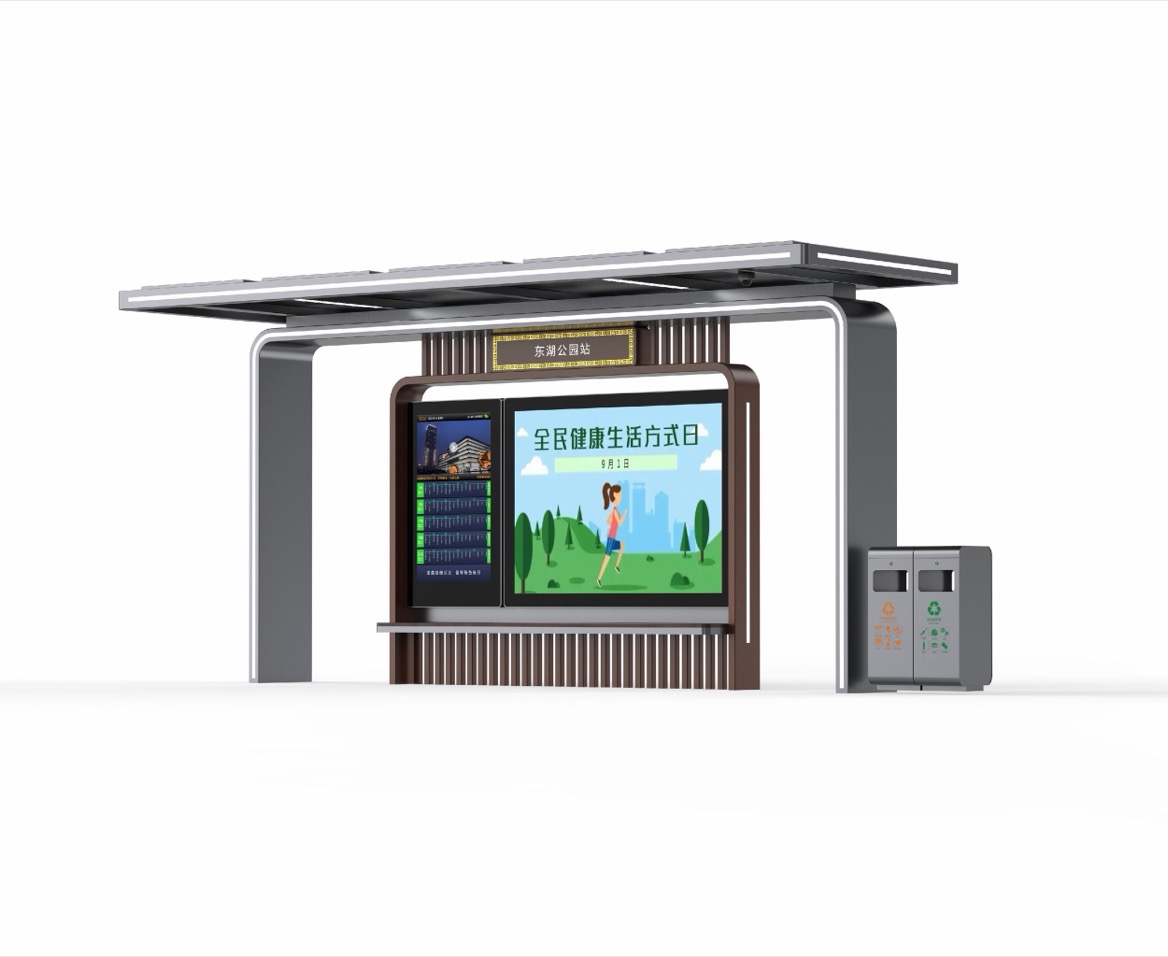
A solar smart bus shelter can be practical where electrical loads are modest and extending grid power would be difficult.
However, feasibility depends on shading, usable roof area, seasonal sunlight, equipment operating hours, and battery capacity. Design for the required service level during less favourable months, not just average annual sunshine.
High-brightness displays may change the energy balance substantially.
Solar panels can contribute energy to an EV charging site, but a small canopy should not automatically be described as an independent charging station.
Consider an illustrative comparison: a 5 kW solar array cannot continuously supply a charger operating at 150 kW without substantial additional supply. Actual solar production also varies with weather and time of day.
Grid connections, storage, or both may therefore remain necessary.
A credible proposal should distinguish:
- Peak solar generation.
- Expected annual energy production.
- Charger power demand.
- Battery storage capacity.
- Grid import requirements.
Energy production and instantaneous charging power are different measurements. Confusing them creates unrealistic expectations.
Public charging infrastructure is expanding rapidly. The 2026 global electric mobility outlook reports that nearly 1.8 million public charging points were added worldwide in 2025, an increase exceeding 33% over the previous year.
That growth supports earlier coordination between transport planning, parking management, and electricity infrastructure.
However, global charging growth does not prove that every bus stop needs charging bays. A constrained roadside stop may have strong passenger demand but no suitable vehicle space.
The strongest opportunities are sites where users already transfer between transport modes: park-and-ride facilities, larger interchanges, commercial mobility hubs, and mixed-use developments.
Demand evidence should guide investment—not the appeal of combining technologies.
Install a smart bus shelter beside the pedestrian route and covered charging bays within the parking area.
This arrangement supports drivers who charge while continuing their journey by bus. It also allows each structure to follow its own dimensional and operational requirements.
Charging policies should reflect expected parking duration.
A larger canopy can visually connect waiting areas, charging spaces, and pedestrian links.
Potentially shared elements include lighting, signage, roof drainage, and selected civil works. Passenger zones and vehicle zones should nevertheless remain clearly defined.
Shared construction does not remove the need for separately coordinated electrical protection and maintenance access.
Where immediate charging demand is uncertain, install the passenger shelter first while reserving suitable space, ducts, and distribution capacity for later development.
This staged approach can reduce premature equipment investment.
However, "future-ready" should mean documented provisions—not simply an empty enclosure labelled for future use.
Consider a hypothetical park-and-ride project with a smart bus shelter, six covered charging bays, passenger information screens, and rooftop solar panels.
Before approving a shared canopy, the project team should test three questions.
First, can passengers reach the bus without crossing charging cables or vehicle reversing paths?
Second, does the electrical design support the intended simultaneous charging demand while maintaining essential shelter services?
Third, can technicians isolate and service charging equipment without closing the passenger waiting area?
If any answer is unclear, the layout needs revision.
This is a planning example, not an Ainl project claim. Its lesson is broadly applicable: successful integration depends on operational boundaries, not merely a matching architectural appearance.
There is no reliable universal price comparison between a smart bus shelter and an EV charging shelter. Dimensions, local conditions, equipment, utility works, and installation scope vary too widely.
Compare quotations using the same cost categories:
- Structural design, foundations, fabrication, and installation.
- Chargers, displays, lighting, and communications.
- Utility connections and distribution equipment.
- Software subscriptions and network services.
- Inspection, cleaning, repairs, and replacement parts.
- Energy charges and any applicable demand charges.
- Insurance, administration, and eventual replacement.
Advertising and charging income should be modelled separately. Neither is guaranteed to recover project costs.
For procurement, request assumptions for utilisation, electricity tariffs, maintenance response, and equipment replacement. A low purchase price can conceal expensive operational dependencies.
From a manufacturing standpoint, the most useful specification is one that makes interfaces and responsibilities explicit.
Use this seven-step process:
1. Define passenger volumes, charging demand, and service priorities.
2. Survey utilities, underground services, access, and site constraints.
3. Confirm local structural, electrical, accessibility, and planning requirements.
4. Develop coordinated drawings for foundations, drainage, equipment, and circulation.
5. Specify materials, corrosion protection, replaceable components, and inspection access.
6. Agree software access, documentation, warranties, spare parts, and support responsibilities.
7. Complete factory checks and site acceptance tests before handover.
For connected systems, also define data ownership, user permissions, remote access, and software update responsibilities.
Structural loading must account for the actual site, including wind, snow where applicable, and rooftop equipment. Adding solar panels later may require structural reassessment.
Ainl brings 16 years of experience in developing, manufacturing, and supplying smart-city public facilities and outdoor advertising products.
Our manufacturing base covers more than 260 mu, with approximately 150,000 square metres of factory space. Supporting facilities include a provincial-level software and hardware research centre, CNC sheet-metal processing, large-scale coating facilities, and an electrical testing laboratory.
As a nationally recognized high-tech enterprise in China, Ainl supports OEM/ODM customization covering:
- Shelter dimensions and structural configuration.
- Colours, finishes, and city branding.
- Display specifications and lighting systems.
- Solar power configurations.
- Equipment accommodation and maintenance access.
Ainl's stated qualifications include Grade III steel-structure and municipal construction credentials, three-system management certification, and Level III safety-production standardization certification.
For international procurement, Chinese qualifications should be reviewed alongside destination-market requirements. They do not automatically establish local approval or certify a complete charging installation.
Choose a smart bus shelter when passenger waiting and information are the primary requirements. Choose an EV charging shelter when covered charging is the main operational need.
Combine them when the site can support both without compromising access, electrical reliability, or maintenance.
Send Ainl your site plan, project location, shelter dimensions, passenger-service requirements, proposed charger specifications, and branding guidelines. Request a coordinated OEM/ODM proposal identifying structural scope, equipment interfaces, power assumptions, and documentation for local review.
Only when a separately engineered charging system is included. USB charging for passenger devices is not equivalent to vehicle charging infrastructure.
Yes, provided a designated waiting area offers suitable weather protection, seating, information, and accessible boarding connections without conflicts with charging vehicles.
Not necessarily. Off-grid operation requires a project-specific energy assessment covering solar generation, storage, charging demand, and required availability. A solar roof alone does not establish independence.
They may share selected construction elements, but savings are site-dependent. Electrical upgrades, complicated foundations, or additional circulation requirements can offset those benefits.
No. Charging speed depends on the charger, available supply, vehicle capability, battery condition, and operating controls—not the presence of a roof.
Provide the site layout, destination, dimensions, environmental conditions, passenger equipment schedule, charging requirements, available power information, branding, and required compliance documentation.
1. International Energy Agency. "Electric Vehicle Charging," *Global EV Outlook 2026*. Source for global public charging additions in 2025 and infrastructure growth. [iea]
2. U.S. Department of Energy, Alternative Fuels Data Center. "Electric Vehicle Charging Stations." Source for charging equipment categories, illustrative power ranges, and electrical supply characteristics. [afdc.energy]
3. U.S. Access Board. "Design Recommendations for Accessible Electric Vehicle Charging Stations." Technical guidance covering accessible routes, operating spaces, interfaces, and charger placement; distinguish recommendations from applicable legal requirements. [access-board]
4. U.S. Department of Energy, Alternative Fuels Data Center. "ADA Compliance for Electric Vehicle Charging Infrastructure." Guidance on accessible charging layouts, equipment access, and jurisdiction-specific considerations. [afdc.energy]
5. Project for Public Spaces. "Bus Shelters." Design guidance covering visibility, accessibility, comfort, passenger information, materials, and maintenance. [pps]


