
Email: ainlbusshelter@gmail.com | WhatsApp: +86-18800607527
Views: 236 Author: Ainl Bus Shelter Publish Time: 2026-08-25 Origin: Site


Content Menu
● What Is a Smart Bus Shelter?
● What Is an Advertising Bus Shelter?
● Smart Bus Shelter vs Advertising Bus Shelter
● Passenger Experience: The Most Important Difference
● Commercial Value: Where Advertising Shelters Excel
● The Best Model: A Hybrid Smart Advertising Bus Shelter
● Choosing the Right Shelter for Your Project
>> Choose a Smart Bus Shelter When
>> Choose an Advertising Bus Shelter When
>> Choose a Hybrid Solution When
● Practical Design Checklist Before Procurement
● Manufacturing Quality Matters More Than It Appears
● Build a Shelter That Works for People and Revenue
● FAQ
>> 1. What is the main difference between a smart bus shelter and an advertising bus shelter?
>> 2. Can a smart bus shelter display advertisements?
>> 3. Are solar-powered bus shelters practical?
>> 4. What information should be shown on a smart bus shelter display?
>> 5. How can an advertising bus shelter generate revenue?
>> 6. What materials are suitable for outdoor bus shelters?
>> 7. What should buyers ask a bus shelter manufacturer before ordering?
A bus shelter is no longer just a roof and a bench. Today, cities, transit operators, developers, and media owners must decide whether to invest in a Smart Bus Shelter, an Advertising Bus Shelter, or a combined solution that improves the passenger journey while creating measurable commercial value.
At Ainl, we have spent 16 years designing and manufacturing public-facility and outdoor-display solutions for urban environments. From heavy-duty steel structures and precision sheet-metal fabrication to intelligent displays, solar power systems, lighting, and city-brand customization, we have seen one principle hold true: the most successful bus shelters serve people first, then create value around that service.
This guide compares smart bus shelters and advertising bus shelters from the perspectives of passenger experience, public infrastructure, operational practicality, revenue potential, and long-term urban value.
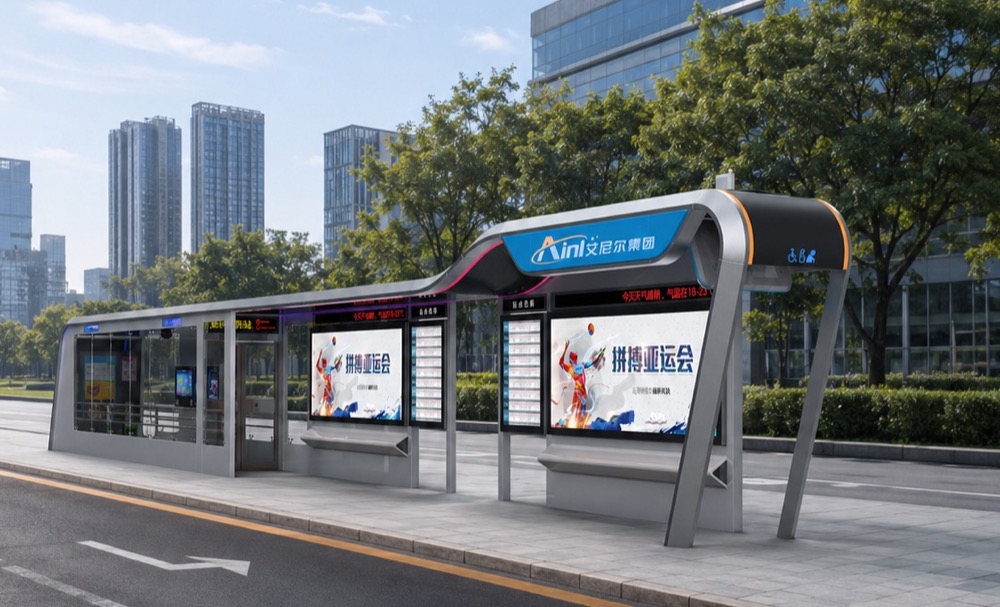
A Smart Bus Shelter is a digitally enabled transit facility designed to improve waiting, navigation, safety, accessibility, and communication at a bus stop.
Unlike a conventional shelter, it can integrate real-time bus arrival information, route maps, LED or LCD displays, public Wi-Fi, USB charging, emergency communication, environmental sensors, intelligent lighting, surveillance equipment, solar power, and interactive passenger information systems.
The key objective is simple: reduce uncertainty for passengers and improve operational visibility for transit authorities.
A smart shelter can provide information such as:
- Real-time arrival and departure information
- Route number, destination, and transfer guidance
- Service disruption alerts
- Local weather and public notices
- Accessibility guidance
- Emergency messages
- City events and community information
- Passenger-facing digital maps
- Energy-use and equipment-status data for operators
A smart shelter normally requires coordination between the shelter manufacturer, transit-data provider, municipal authority, electrical contractor, network operator, and maintenance team. Its success depends on more than installing a screen. The information must be accurate, legible, accessible, and continuously maintained.
An Advertising Bus Shelter is primarily designed as an outdoor media asset. It combines basic passenger protection with an advertising display panel, usually placed on the side wall, rear panel, roof edge, or integrated digital screen.
Traditional models use static poster frames or backlit light boxes. More advanced advertising bus shelters use digital signage to run multiple campaigns, schedule content remotely, adjust brightness automatically, and display location-specific messages.
The main commercial objective is to create high-frequency visibility in high-traffic public locations. Bus shelter advertising reaches pedestrians, commuters, cyclists, drivers, nearby residents, and people visiting retail or business districts.
Advertising bus shelters are especially suitable for:
- Commercial streets
- Shopping districts
- Airports and transport hubs
- Tourism areas
- Residential communities
- Business parks
- Stadiums and event venues
- City gateways
- High-footfall roadside locations
Transit shelter advertising is valuable because it is positioned at street level, close to the audience, and visible during repeated daily travel routines. Industry sources commonly describe bus shelter displays as a high-attention outdoor format because viewers often stand nearby while waiting for transport.
The difference is not simply "technology versus advertising." A smart shelter is built around public-service performance, while an advertising shelter is built around media exposure and monetization.
| Comparison Area | Smart Bus Shelter | Advertising Bus Shelter |
|---|---|---|
| Primary purpose | Improve passenger service and transit efficiency | Generate advertising exposure and media revenue |
| Main user | Passenger, transit operator, municipality | Advertiser, media operator, property owner |
| Core features | Real-time arrival data, route information, safety systems, smart lighting, connectivity | Static posters, light boxes, digital advertising screens |
| Passenger value | High, especially during delays and transfers | Basic, unless paired with passenger information |
| Revenue potential | Indirect or mixed; may include media, data, sponsorship, and service benefits | Direct; advertising inventory is the central business model |
| Infrastructure complexity | Higher; requires power, connectivity, software, data integration, and maintenance | Lower for static panels; moderate for digital panels |
| Investment level | Typically higher upfront | Lower for static units; variable for digital units |
| Best use case | Smart-city programs, transit upgrades, high-volume routes, mobility hubs | Commercial corridors, media networks, retail zones, public-space advertising |
| Long-term value | Better public service, operational insight, stronger city image | Recurrent media income and stronger advertiser reach |
| Customization focus | Passenger interface, functionality, accessibility, energy system, city identity | Display size, panel type, illumination, media layout, campaign visibility |
For passengers, the biggest question is not whether the shelter has a screen. It is whether the shelter makes waiting easier, safer, and more predictable.
A bus user facing a 15-minute delay experiences the stop differently when they can see the actual arrival estimate, route changes, and alternative travel options. A well-designed digital information display can reduce uncertainty and help passengers make better decisions.
Smart bus shelters may support real-time vehicle information through GPS, mobile-network communication, and centralized transit-management systems. In a typical arrangement, one display can prioritize arrival information while another can carry advertisements, allowing the shelter to provide public service and commercial content simultaneously.
For passenger-centered design, we recommend prioritizing:
- Clear arrival information visible in sunlight and at night
- High-contrast typography for older passengers and people with low vision
- Accessible circulation space for wheelchairs, strollers, and mobility devices
- Weather protection from rain, wind, sun, and heat
- Comfortable seating with durable materials
- Safe lighting around the waiting area
- Emergency communication options where local policy requires them
- Multilingual content in international, tourism, or cross-border cities
- Audio announcements or tactile guidance for inclusive use
A shelter with a large advertising display but poor lighting, no seating, limited sidewalk access, or unclear route information may perform as media infrastructure, but it will not fully serve the public-transport system.
An advertising bus shelter offers a straightforward proposition: install public street furniture and monetize the display surface.
Static advertising shelters remain practical where budgets are limited, campaign turnover is low, or electrical and network infrastructure is unavailable. They are easier to operate and often require less technical maintenance than fully connected digital shelters.
Digital advertising bus shelters, however, expand the business model. A media operator can manage multiple advertisers, schedule campaigns by time of day, run public announcements, support local promotions, and adapt content according to location.
For example, a shelter near an office district could show breakfast, coffee, financial-service, and lunchtime retail campaigns during weekday commuting hours. The same screen could shift to entertainment, dining, or weekend-event messages in the evening.
The commercial advantages include:
- Multiple campaigns on one screen
- Remote content scheduling
- Faster campaign updates
- Location-based messaging
- Public-service announcements between commercial content
- Potential sponsorship of transit information or city services
- Better use of premium roadside locations
- Flexible packages for local and national advertisers
Transit shelter advertising is often valued for its eye-level placement and its ability to reach both waiting passengers and surrounding street traffic.
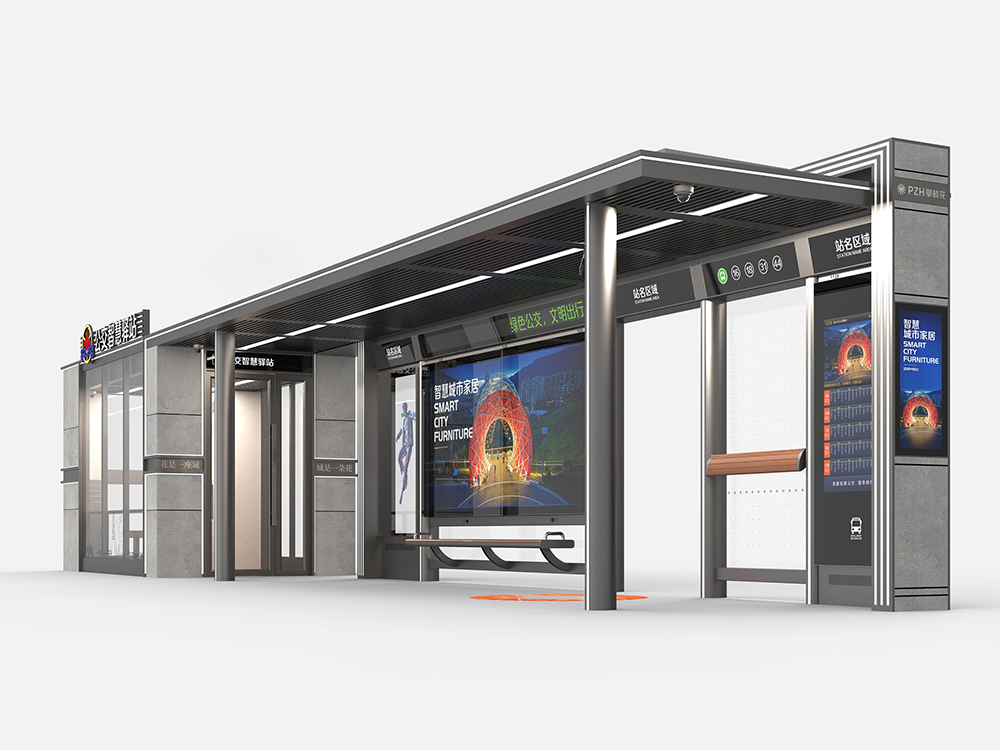
In many urban projects, the strongest option is not choosing one model over the other. It is building a hybrid smart advertising bus shelter.
This approach separates the display strategy into two clear priorities:
1. Passenger-critical information receives a protected, always-available display area.
2. Commercial advertising uses a separate panel or scheduled content zone.
This design prevents a common failure: allowing advertisements to crowd out essential transit information. If a passenger cannot quickly find the next bus, route direction, or disruption notice, the shelter has failed its public purpose.
A hybrid configuration may include:
| Component | Passenger-Service Role | Commercial Role |
|---|---|---|
| LED/LCD transit screen | Arrival times, routes, alerts, weather | Sponsored information content where appropriate |
| Digital advertising screen | Public announcements during emergencies | Rotating paid advertising campaigns |
| Solar power system | Supports lighting and critical equipment | Reduces operating dependence for displays |
| Smart lighting | Improves safety and nighttime usability | Enhances advertisement visibility |
| Wi-Fi or charging unit | Passenger convenience | Brand sponsorship opportunity |
| Shelter structure | Weather protection and accessibility | Premium, long-lasting media asset |
| City-brand elements | Strengthens local identity | Supports placemaking and advertiser appeal |
This is the model we often recommend for cities that want to improve urban mobility without relying entirely on public funding.
The right solution depends on the project's operating model, passenger volume, location, budget, and maintenance capacity.
A smart solution is usually the better fit when the project requires reliable public information and stronger urban-service performance.
Consider this option if you need:
- Real-time bus arrival data
- Smart-city integration
- Passenger information during disruptions
- Accessible and inclusive design
- Solar-powered or energy-efficient operation
- Security cameras, emergency call systems, or environmental sensors
- Premium public facilities for a new district, airport, university, or transport hub
- A city-wide unified public-facility identity
An advertising-focused shelter is effective when the priority is commercial media exposure with durable basic passenger amenities.
Consider this option if you need:
- High-visibility outdoor advertising panels
- A lower-complexity infrastructure model
- Static or backlit poster advertising
- Rapid deployment across multiple roadside locations
- Revenue from media-space leasing
- Customized branding for commercial streets or developments
- A practical solution where transit-data integration is unavailable
A hybrid smart advertising bus shelter is best when both service quality and commercial return matter.
It is especially suitable for:
- Municipal PPP projects
- Airport and railway feeder routes
- City-center transport corridors
- Tourist destinations
- New urban districts
- Large commercial developments
- Smart-city demonstration projects
- Transit networks with high passenger volumes
A visually attractive shelter is not automatically a durable or workable shelter. Before selecting a supplier, project owners should assess the structure, digital system, maintenance model, and local environment together.
Use this checklist during planning:
1. Confirm the site conditions. Review sidewalk width, passenger flow, wind exposure, sun direction, drainage, underground utilities, and vehicle clearance.
2. Define the passenger-service standard. Specify seating capacity, accessibility requirements, lighting level, route-information format, emergency features, and weather-protection expectations.
3. Separate public and commercial display functions. Ensure advertising never blocks or delays essential route and arrival information.
4. Choose display technology for the environment. Outdoor screens need appropriate brightness, heat dissipation, weather protection, vandal resistance, and remote monitoring.
5. Plan the power strategy early. Compare grid power, solar power, battery storage, and hybrid systems before finalizing the shelter structure.
6. Specify the maintenance responsibility. Define who manages cleaning, screen repairs, software updates, advertising content, electrical inspections, and replacement parts.
7. Build for local identity. Incorporate city colors, logo elements, district maps, cultural patterns, and architectural language without compromising readability or maintainability.
8. Require scalable modularity. A modular structure makes future upgrades easier, whether the project later adds screens, solar panels, cameras, charging ports, or smart sensors.
For outdoor public infrastructure, the visible design is only one part of the project. Long-term performance depends on the materials, structural engineering, welding quality, coating process, electrical safety, drainage design, fastening system, and maintenance access.
A poorly engineered shelter can become expensive after installation. Common issues include corrosion, water ingress, loose panels, display overheating, poor cable protection, insufficient drainage, fading finishes, and difficult maintenance access.
At Ainl, our manufacturing capability supports customized public-facility projects through integrated design, software and hardware research, CNC sheet-metal processing, large-scale coating operations, electrical testing, and structural production. Our team can support OEM/ODM customization across:
- Shelter dimensions and structural configurations
- Steel, aluminum, stainless steel, glass, and panel materials
- Colors and city-brand graphics
- Digital display sizes and installation positions
- LED lighting and intelligent-control systems
- Solar panels, battery storage, and hybrid energy solutions
- Seating, waste bins, route maps, and accessibility features
- Advertising light boxes and digital media panels
- Smart hardware integration and equipment enclosures
The goal is not to supply a standard product and force it into a complex location. The goal is to engineer a shelter system that fits the city, route, climate, passenger profile, and commercial model.
A Smart Bus Shelter creates stronger passenger value through real-time information, safety, accessibility, connectivity, and efficient public-service delivery. An Advertising Bus Shelter creates a commercial platform with consistent street-level visibility and recurring media potential.
For most forward-looking urban projects, the hybrid approach delivers the best balance: a durable shelter structure, protected passenger information, flexible advertising capacity, efficient lighting, solar-power options, and a customized city identity.
Contact Ainl to discuss your smart bus shelter, advertising bus shelter, solar bus shelter, digital bus stop, or customized street-furniture project. Our engineering and manufacturing team can help you turn your location requirements, functional needs, and commercial goals into a practical OEM/ODM solution.
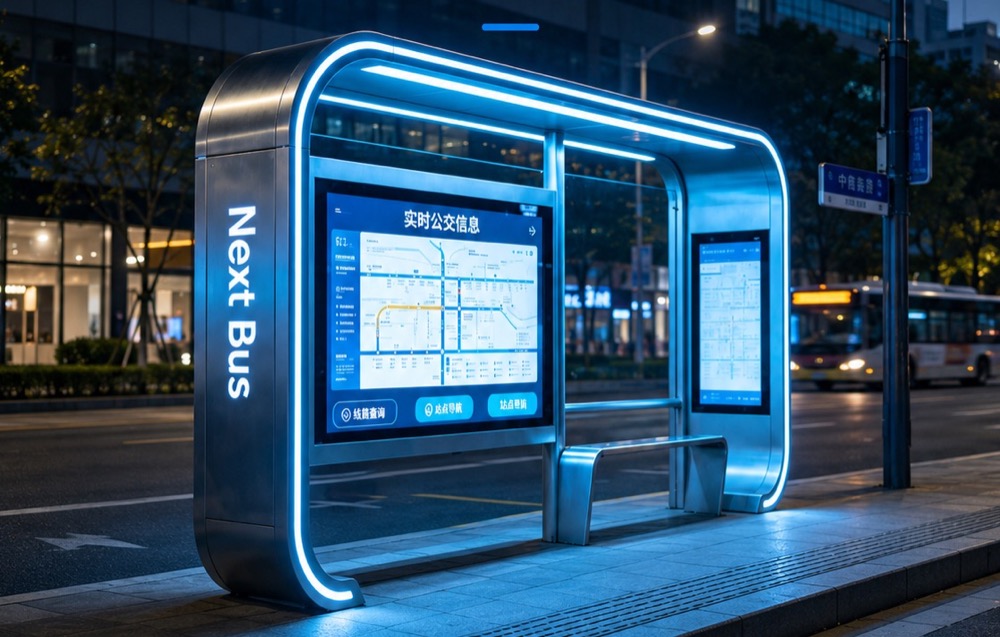
A smart bus shelter focuses on passenger services, such as real-time arrival information, route guidance, safety lighting, and digital connectivity. An advertising bus shelter focuses on displaying static or digital campaigns to create media revenue.
Yes. A smart bus shelter can include a separate advertising screen or a defined advertising zone. The best practice is to keep real-time transit information visible at all times and place commercial content on an independent display.
Yes, especially in locations where grid connection is difficult or where the project aims to reduce operating energy use. Solar panels can support lighting, displays, charging systems, and other equipment when correctly sized with battery storage and energy-management controls.
The essential content includes arrival time, route number, destination, service alerts, and transfer guidance. Additional useful content can include weather, city notices, local maps, emergency messages, and accessibility information.
Revenue can come from leasing static poster panels, selling digital advertising time slots, running location-based campaigns, offering sponsorship packages, or combining public information with branded content.
Suitable materials commonly include galvanized steel, aluminum, stainless steel, tempered glass, polycarbonate panels, and weather-resistant coatings. Material selection should reflect local climate, wind load, corrosion risk, maintenance capacity, and design requirements.
Buyers should ask about structural drawings, material thickness, coating process, wind-load design, electrical protection, waterproofing, solar-system sizing, display specifications, remote-management capability, spare parts, installation support, warranty, and customization options.
1. [Tata Consulting Engineers — Information and Communication Technology for Smart Bus Shelter]
2. [SMART — Bus Stop Updates and Accessibility Improvements]
3. [AdQuick — Bus Shelter Advertising: Plan, Buy and Measure]
4. [Seedia — Smart Bus Shelter Design Solutions]
5. [Sierra Wireless / Sierra T&T — Delivering Real-Time Transit Information Via Smart Bus Shelters]


