
Email: ainlbusshelter@gmail.com | WhatsApp: +86-18800607527
Views: 241 Author: Ainl Bus Shelter Publish Time: 2026-09-27 Origin: Site


Content Menu
● What Is the Difference Between Prefabricated and On-Site Bus Shelter Construction?
● Why Prefabricated Bus Shelters Usually Offer Better Cost Control
>> 1. Earlier Cost Lock-In Reduces Budget Surprises
>> 2. Factory Production Improves Material and Labor Efficiency
>> 3. Parallel Workstreams Shorten the Project Schedule
● Where On-Site Construction Can Be the Better Choice
>> Irregular or Constrained Urban Sites
>> Projects With Uncertain Site Information
● Total Cost of Ownership Matters More Than Unit Price
● Cost Risks That Buyers Often Miss
>> Common Prefabrication Risks
>> Common On-Site Construction Risks
● A Practical Decision Framework for Buyers
>> Step 1: Classify the Project by Volume
>> Step 2: Identify What Must Be Customized
>> Step 3: Validate Each Site Before Production
>> Step 4: Compare Installed Cost, Not Ex-Factory Price
>> Step 5: Evaluate the Supplier's Engineering Capability
● Why a Hybrid Model Often Delivers the Best Result
● The Bottom Line: Which Method Better Controls Project Costs?
● FAQs
>> Is a prefabricated bus shelter always cheaper than on-site construction?
>> What costs should be included in a bus shelter comparison?
>> Can prefabricated bus shelters be customized for a city brand?
>> How does factory production reduce bus shelter maintenance costs?
>> Are solar-powered bus shelters practical?
>> What site data should be confirmed before ordering a prefabricated bus shelter?
>> Can a prefabricated bus shelter be relocated later?
When public-transit authorities, municipal contractors, advertising operators, and smart-city developers compare a prefabricated bus shelter with on-site construction, the central question is rarely the purchase price alone. The more important question is: which method delivers stronger cost control across design, manufacturing, installation, operation, maintenance, and future upgrades?
In most standardized or multi-location transit projects, a prefabricated bus shelter provides better budget certainty than conventional on-site construction. Factory-based production helps control material usage, labor hours, quality consistency, delivery timing, and change-order risk. However, on-site construction can remain appropriate for highly irregular streetscapes, landmark locations, complex underground conditions, or architecturally unique city-center projects.
For buyers, the right decision is not simply "prefabricated is cheaper" or "site-built is more flexible." It is about selecting the construction method that best matches the project's volume, site conditions, customization requirements, local installation capacity, and long-term operating model.
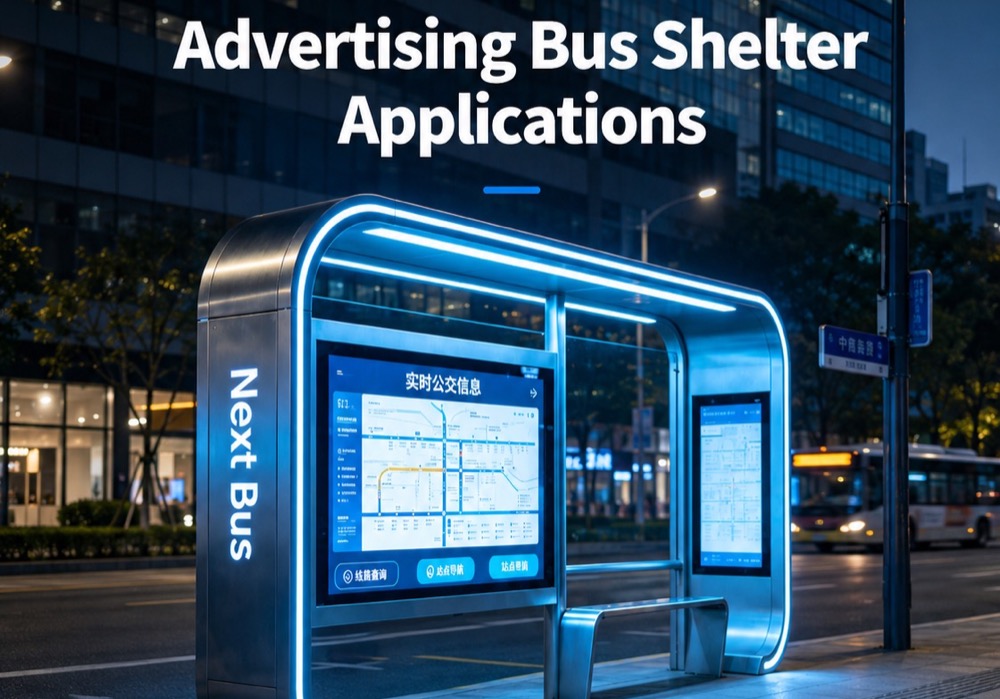
A prefabricated bus shelter is manufactured primarily in a controlled factory environment. Its steel or aluminum frame, roof, glass panels, seating, lighting, digital display enclosure, advertising cabinet, solar-power system, and electrical components can be produced, assembled, inspected, and partially tested before shipment.
The finished shelter is then transported to the project site, where local teams complete foundation work, anchoring, electrical connection, signage installation, and final commissioning.
By contrast, on-site bus shelter construction relies more heavily on field fabrication and installation. Materials may be cut, welded, coated, assembled, wired, and finished directly at the bus-stop location or through several local subcontractors.
The difference affects far more than installation speed. It changes how a project manages uncertainty.
| Cost-Control Factor | Prefabricated Bus Shelter | On-Site Construction |
|---|---|---|
| Design standardization | High | Moderate to low |
| Factory quality inspection | Strong and repeatable | Dependent on site conditions |
| Weather exposure during production | Low | High |
| Material waste | Usually lower | Often higher |
| Installation time at the stop | Shorter | Longer |
| Change-order exposure | Lower after design approval | Higher during field work |
| Customization flexibility | High when planned early | High during construction, but often costly |
| Suitability for large rollouts | Excellent | Less efficient |
| Suitability for unusual sites | Good with engineering adaptation | Often more adaptable |
| Budget certainty | Usually stronger | More variable |
For a citywide rollout of 50, 100, or 500 shelters, repeatability becomes a major financial advantage. A supplier can use one validated structural platform and apply different colors, city logos, advertising panels, route maps, LED lighting, digital displays, solar modules, seating styles, and accessibility details without redesigning the full shelter from the beginning.
The biggest financial benefit of a prefabricated bus shelter is not always the lowest initial unit price. Its real value is often cost predictability.
Public-facility projects frequently face budget pressure because of late design changes, weather delays, labor shortages, local subcontractor coordination, site rework, inconsistent materials, and unplanned traffic-management requirements. Factory production reduces many of these variables before the shelter reaches the street.
Research summarized by the U.S. National Institute of Standards and Technology found that, among more than 800 architecture, engineering, and construction professionals surveyed, 66% reported improved project schedules through prefabrication and modularization, 65% reported lower project costs, and 77% reported reduced construction waste. These findings do not guarantee identical savings for every bus shelter project, but they show why controlled off-site production is widely associated with stronger project outcomes.
A well-managed prefabrication project requires key decisions to be made early:
- Shelter length, width, and height
- Structural materials and surface treatment
- Roof type and drainage design
- Glass, polycarbonate, aluminum, or perforated-panel configuration
- Seating, leaning rails, and accessibility features
- Advertising-panel dimensions
- Digital information displays
- LED lighting and electrical equipment
- Solar modules and battery storage
- City brand colors, logos, route information, and wayfinding graphics
This front-loaded design process may appear demanding, but it protects the budget. Once drawings, bill of materials, finishes, and technical specifications are approved, the manufacturer can purchase materials in a planned manner and schedule production with fewer last-minute changes.
A 2025 study on prefabricated construction cost control similarly concluded that investment in the design stage can reduce costs in later production, transportation, and construction stages. In practice, this means a buyer should spend more time validating drawings and site data before production rather than trying to solve every issue after delivery.
In a factory, production teams can use standardized processes, jigs, numerical-control metalworking equipment, batch purchasing, welding procedures, powder-coating lines, electrical testing, and quality-control checkpoints.
For bus shelter manufacturing, these capabilities can reduce:
- Unnecessary steel and aluminum offcuts
- Incorrect hole positions and misaligned assemblies
- Surface-finish defects
- Repeated welding or repair work
- Damage caused by rain, dust, or uncontrolled job-site storage
- Lost time waiting for scattered subcontractors
- Inconsistent installation quality across different locations
For example, a supplier producing 100 shelters with the same core frame can optimize cutting plans for galvanized steel or aluminum profiles, manufacture brackets in batches, and apply the same coating standard across the full order. A site-built project may need repeated mobilization, temporary work areas, local welding, material storage, and cleanup at every location.
The result is not merely lower direct labor. It is a more measurable production cost per shelter.
A major advantage of prefabricated bus shelter construction is that site preparation and factory production can happen at the same time.
While the manufacturer fabricates the shelter frames, roof assemblies, glass panels, benches, display housings, and lighting systems, the local project team can complete:
1. Site survey and utility verification
2. Permit coordination and traffic-management planning
3. Foundation excavation and concrete works
4. Underground conduit installation
5. Electrical supply preparation
6. Curb, pavement, and accessibility improvements
7. Delivery-route planning and lifting arrangements
This overlap can reduce total project duration. Shorter schedules can limit temporary traffic-control costs, contractor overhead, financing exposure, public disruption, and the lost revenue associated with delayed advertising or passenger-information operations.
McKinsey's modular-construction analysis estimated that modular methods can reduce costs by up to 20% in favorable conditions, while also accelerating project delivery. The key phrase is "in the right environment." Savings are strongest where designs are repeatable, volumes are sufficient, and the project team coordinates early.
Prefabricated does not automatically win every comparison. On-site construction can offer better value when a shelter must respond to exceptional conditions that are expensive to resolve through standardized manufacturing and long-distance transport.
A dense historic district may have narrow sidewalks, irregular paving, steep slopes, mature trees, underground utilities, heritage requirements, overhead wires, or adjacent building features that prevent the delivery and placement of a large prefabricated unit.
In these situations, a more site-intensive approach may allow the contractor to adapt structural elements as work progresses. However, this flexibility should not be confused with lower cost. Field changes can create additional engineering reviews, delayed approvals, labor inefficiency, and rework.
A flagship transit stop near an airport, railway station, cultural district, stadium, tourism zone, or central business district may require a distinctive architectural structure rather than a repeatable model.
If the shelter includes custom curved steel, complex façades, special stone finishes, extensive public-art elements, or integrated landscape features, the project may require substantial on-site work. Even then, many components can still be prefabricated, including structural frames, lighting systems, advertising units, digital screens, benches, and roof modules.
The best alternative is often not entirely prefabricated or entirely site-built. It is a hybrid delivery model: factory-produced core components combined with site-specific foundations, cladding, utility connections, and landscape integration.
On-site construction may appear more flexible when utility maps are incomplete or ground conditions are unknown. Yet proceeding without reliable data is a cost-control risk in either method.
Before selecting a construction method, buyers should verify:
- Underground utilities and drainage routes
- Existing foundation conditions
- Sidewalk width and pedestrian clearance
- Vehicle and crane access
- Local wind, snow, rain, and corrosion exposure
- Electrical capacity and communications connectivity
- Advertising sightlines and transit-operator requirements
- Accessibility and boarding-space needs
Transit-shelter planning guidance emphasizes the importance of site assessment, design criteria, construction impacts, and early procurement planning.
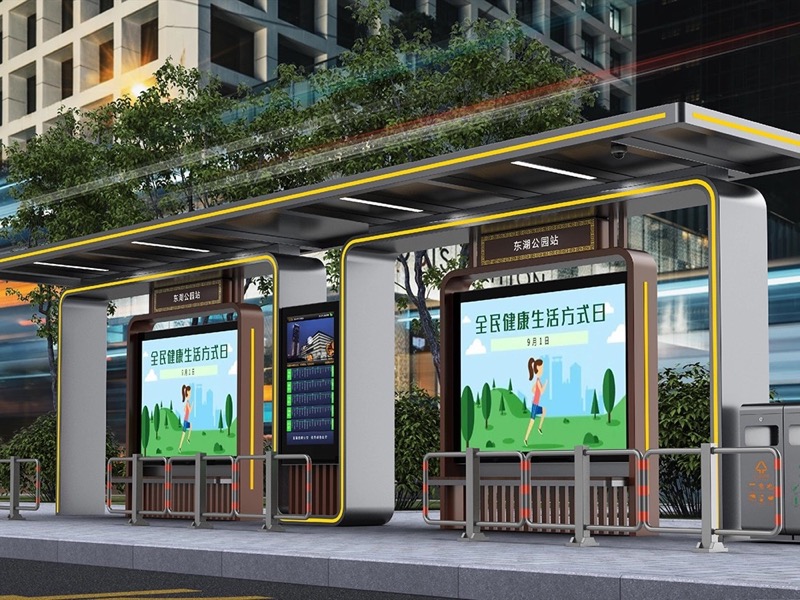
A lower quoted shelter price can become expensive if the product requires frequent repairs, repainting, glass replacement, electrical troubleshooting, or difficult spare-part sourcing. For public infrastructure, buyers should evaluate the total cost of ownership, not just the initial manufacturing price.
A durable bus shelter should be assessed across the following cost categories:
| Lifecycle Cost Area | Questions Buyers Should Ask |
|---|---|
| Structure | Is the steel galvanized, aluminum alloy, or another corrosion-resistant material? |
| Surface finish | Is the coating suitable for UV exposure, humidity, salt spray, and urban pollution? |
| Roofing | Does the roof manage rainwater safely and resist wind uplift? |
| Panels | Are glass or polycarbonate panels easy to replace after vandalism or impact damage? |
| Electrical system | Are LED lights, wiring, control boxes, and connectors protected and serviceable? |
| Smart components | Can screens, sensors, cameras, Wi-Fi equipment, and advertising systems be upgraded? |
| Solar system | Are panel angle, battery capacity, lighting load, and maintenance needs properly calculated? |
| Spare parts | Can the supplier provide replacement panels, fasteners, lights, and display parts over time? |
| Installation | Does the design support efficient local assembly and future relocation? |
A properly engineered prefabricated bus shelter can reduce lifetime maintenance costs because its components are standardized. If a side panel, bench, roof sheet, LED module, or advertising door needs replacement, the operator can use defined parts rather than creating a new field solution every time.
This is especially relevant for advertising-supported street furniture. A shelter that looks attractive on opening day but is difficult to maintain can reduce visual quality, advertising value, passenger satisfaction, and municipal confidence.
Many projects underestimate costs because they compare only a factory quotation with a local construction quotation. A better comparison should include the complete installed cost and the cost of operational disruption.
Prefabrication can lose its cost advantage when buyers overlook:
- Long-distance freight, port handling, customs, and inland transport
- Oversized-load restrictions
- Damage during shipment
- Inadequate crane access at the installation site
- Late changes after materials have been purchased
- Foundations that do not match approved anchor-bolt layouts
- Electrical connections not ready at delivery
- Weak coordination between supplier and local installer
These risks are manageable, but they require disciplined planning. A shelter manufacturer should provide detailed drawings, packing plans, installation instructions, anchor layouts, electrical diagrams, bill-of-material documentation, and remote or on-site technical support where required.
On-site construction frequently faces:
- Weather-related delays
- Local labor-price volatility
- Repeated equipment mobilization
- Inconsistent workmanship among contractors
- Material theft, loss, or damage
- Higher safety-management demands
- More traffic-control time
- Field modifications caused by incomplete design information
- Delayed inspections and handovers
For a distributed network of bus stops, these risks can multiply. A small delay at one location may be manageable; a similar delay across 100 locations can materially change the total program budget.
The following process helps procurement teams choose between a prefabricated bus shelter, on-site construction, or a hybrid approach.
Use prefabrication as the starting point when the project includes:
- Multiple shelters with similar dimensions
- A citywide renewal program
- A bus rapid transit corridor
- New residential or industrial development zones
- Airport, railway, school, hospital, or commercial-site networks
- Standardized advertising or digital-information systems
Higher volume allows the manufacturer to spread engineering and tooling costs across more units.
Customization does not necessarily mean on-site construction. Modern bus shelters can be customized in the factory for:
- Dimensions and structural layout
- Roof style and canopy depth
- Powder-coating colors
- Municipal branding and graphic elements
- Advertising-panel configuration
- Smart-screen size and mounting method
- Solar-power package
- Lighting color temperature and control method
- Seating type, wheelchair space, and accessibility layout
- Climate protection for rain, heat, wind, snow, or coastal corrosion
The key is to distinguish between repeatable customization and site-specific structural redesign.
Site validation should include photographs, measurements, utility data, sidewalk conditions, foundation levels, accessibility requirements, and delivery access.
A supplier should not begin full production based only on a general concept drawing. The most reliable projects use approved shop drawings and a location-by-location installation schedule.
Ask every bidder to separate:
- Product manufacturing
- Packaging and export preparation
- Ocean or land transportation
- Insurance and customs-related costs
- Foundation works
- Electrical and communications connection
- Installation labor and equipment
- Traffic control and permits
- Testing and commissioning
- Spare parts and warranty support
- Long-term maintenance requirements
This format makes hidden cost differences visible.
A bus shelter is not just a metal frame with a roof. It is public infrastructure exposed to vibration, wind, rain, ultraviolet light, corrosion, vandalism, electrical risk, and heavy daily use.
Select a supplier that can support:
- Structural and manufacturing drawings
- Metal fabrication and precision processing
- Coating and corrosion-protection systems
- Electrical testing
- Smart-city equipment integration
- OEM and ODM customization
- Factory inspection and documented quality control
- Spare-part availability
- Installation guidance and after-sales support
For large or long-term programs, engineering depth matters as much as the quotation.
For many cities, the most cost-effective approach is a hybrid model.
The bus shelter's main frame, roof, glass panels, seating, advertising boxes, lighting modules, and smart-device enclosures are fabricated and tested in the factory. Local partners then complete foundations, underground works, final assembly, electrical connection, pavement restoration, and landscaping.
This approach captures the strongest benefits of prefabrication while respecting local site conditions.
For example, a municipality may deploy a standardized 4-meter or 6-meter shelter platform across suburban routes, while adapting the foundation, solar solution, advertising layout, and visual branding for each district. The city maintains a consistent public identity without forcing every location into an identical installation method.
Public-space guidance also stresses practical shelter design considerations, including safe access, seating needs, appropriate side-panel treatment, and placement of route information without obstructing visibility of approaching buses.
For most repeatable transit-infrastructure programs, prefabricated bus shelters provide stronger overall project-cost control. They reduce exposure to field labor variability, weather delays, waste, inconsistent workmanship, and repeated on-site fabrication. They also make it easier to establish a defined scope, approve a bill of materials, inspect quality before shipment, and plan a predictable rollout.
On-site construction may be more suitable for landmark projects, difficult urban sites, or highly irregular conditions. But it should be selected because the site truly requires it—not because it appears easier to change things later.
The most successful public-facility projects combine early engineering, accurate site data, transparent installed-cost comparison, robust manufacturing quality, and a clear maintenance strategy. When these elements are in place, prefabrication becomes more than a faster way to build. It becomes a practical tool for protecting the project budget.
If you are planning a bus shelter, smart transit stop, outdoor advertising shelter, or city street-furniture program, Ainl can help evaluate your project requirements and develop an OEM or ODM solution covering structure, dimensions, finishes, lighting, solar power, digital screens, advertising components, and municipal branding. Contact the Ainl team to request a technical consultation, preliminary design proposal, and project-specific cost-control recommendation.
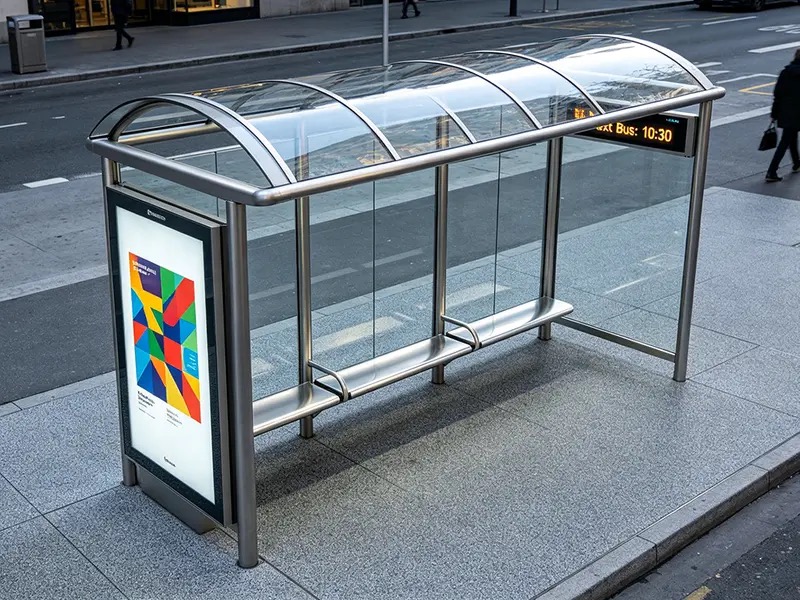
Not always. A prefabricated bus shelter is usually more cost-effective when designs are repeatable, order quantities are large enough, and installation sites are accessible. For one-off landmark structures or highly constrained locations, on-site or hybrid construction may provide better value.
Compare the complete installed cost: manufacturing, packing, freight, customs-related charges, foundations, electrical works, installation labor, lifting equipment, permits, traffic management, testing, spare parts, maintenance, and warranty support.
Yes. Common customization options include dimensions, structural configuration, powder-coating color, logos, advertising panels, digital displays, route-information systems, LED lighting, solar power, seating, accessibility features, and climate-protection components.
Factory-produced shelters commonly use standardized components and controlled assembly methods. This can make replacement of glass panels, LED lights, roof elements, advertising doors, benches, fasteners, and electrical parts faster and more consistent during operation.
Solar-powered bus shelters can be practical for LED lighting, low-power displays, CCTV, sensors, USB charging, and selected smart-city equipment. Feasibility depends on local solar availability, shading, daily electrical load, battery sizing, panel orientation, and maintenance planning.
Confirm exact dimensions, sidewalk width, utility locations, drainage, foundation conditions, ground level, traffic access, crane or lifting access, electrical capacity, communication needs, accessibility clearances, and local environmental exposure such as wind, snow, heat, humidity, or coastal salt.
Many prefabricated shelters can be relocated if their structural design, anchor system, foundation condition, electrical connections, and panel configuration support disassembly and reinstallation. This requirement should be specified during the engineering stage.
1. National Institute of Standards and Technology. "[Prefabrication and Modularization: Increasing Productivity in the Construction Industry]." Data cited on schedule improvement, project-cost reduction, and construction-waste reduction among surveyed construction professionals. [nist]
2. New York State Department of Transportation. "[Policy & Procedures for Bus Shelter and Signage]." Guidance cited on site assessment, planning, procurement, design criteria, and construction impacts. [dot.ny]
3. PMC / peer-reviewed research. "[Analyzing Cost Impacts Across the Entire Process of Prefabricated Construction]." Research cited regarding the importance of early design investment in reducing downstream costs. [pmc.ncbi.nlm.nih]
4. McKinsey & Company. "[Modular Construction: From Projects to Products]." Analysis cited on potential cost savings and project-speed advantages under suitable modular-delivery conditions. [mckinsey]
5. Project for Public Spaces. "[Bus Shelters]." Design guidance cited on side panels, seating, access, and passenger-information placement. [pps]


