
Email: ainlbusshelter@gmail.com | WhatsApp: +86-18800607527
Views: 226 Author: Ainl Bus Shelter Publish Time: 2026-09-01 Origin: Site


Content Menu
● What Is the Difference Between an Outdoor Advertising Display and a Traditional Billboard?
● Why ROI Means More Than Advertising Revenue
● ROI Comparison: Upfront Cost vs Lifetime Revenue
>> Traditional Billboard Economics
>> Outdoor Advertising Display Economics
● Content Flexibility Creates Commercial Value
>> Examples of High-Value Digital Content Use
● The Measurement Advantage of Digital Outdoor Advertising
>> A Practical ROI Measurement Framework
● The Hidden Costs That Can Change the ROI Equation
>> 1. Brightness and Daylight Readability
>> 3. Corrosion Resistance and Structural Quality
>> 4. Power, Connectivity, and Remote Control
>> 5. Maintenance Access and Spare-Parts Planning
● When a Traditional Billboard Still Delivers Better ROI
● When Outdoor Advertising Displays Win in Public Spaces
● A Decision Framework for Buyers and Project Owners
>> Step 1: Define the Primary Outcome
>> Step 2: Assess Location Value
>> Step 3: Model Revenue Capacity
>> Step 4: Specify the Right Product, Not the Highest Specification
>> Step 5: Plan for Compliance and Community Acceptance
● Final Verdict: Which Option Delivers Better ROI?
>> 1. Is an outdoor advertising display more profitable than a traditional billboard?
>> 2. How long does it take to update content on an outdoor digital display?
>> 3. What should buyers consider when choosing outdoor LED or LCD advertising displays?
>> 4. Can outdoor advertising displays operate with solar power?
>> 5. Are traditional billboards still effective for advertising?
>> 6. How can outdoor advertising ROI be measured?
>> 7. Can a digital advertising display be integrated into a bus shelter or smart-city facility?
For cities, media owners, retailers, developers, and infrastructure contractors, the choice between an outdoor advertising display and a traditional billboard is no longer just a creative decision. It is an investment decision involving visibility, operating costs, content flexibility, public-space value, maintenance, compliance, and measurable commercial outcomes.
A traditional billboard can still be an effective, straightforward way to secure long-term brand exposure. However, an outdoor LED/LCD advertising display can create a more flexible and measurable media asset—especially when it is installed as part of a bus shelter, smart street furniture system, transit hub, commercial plaza, pedestrian street, or municipal public-information network. The solution with the better return depends on the project's business model, location, audience flow, lifecycle plan, and ability to monetize screen time.
For many high-traffic public spaces, digital outdoor advertising displays can generate stronger long-term ROI because one installation can support multiple advertisers, real-time content, public messaging, remote management, and city-branding applications. Traditional billboards often remain the lower-risk choice when the campaign is static, short on operational resources, or located where digital signage is restricted.
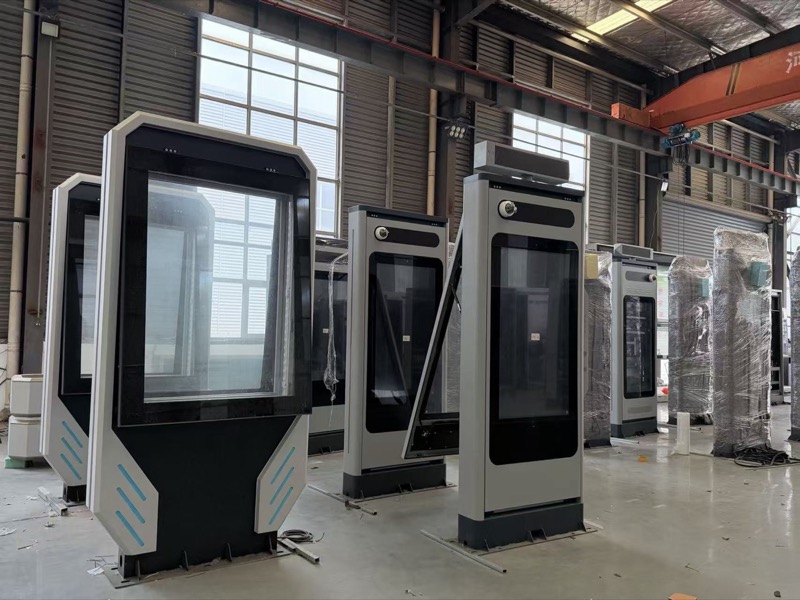
An outdoor advertising display is a digital screen—typically LED or high-brightness LCD—designed to communicate advertising, public information, wayfinding, emergency messages, event content, or city branding in outdoor environments.
Traditional billboards generally use printed vinyl, paper, fabric, painted panels, or other static formats. The creative remains unchanged until the billboard owner physically replaces it.
The distinction may look simple, but it changes the economics of the asset.
| Comparison Area | Outdoor Advertising Display | Traditional Billboard |
|---|---|---|
| Content format | Dynamic video, images, data, schedules, public alerts | Static printed creative |
| Content updates | Remote and nearly immediate | Requires printing and on-site installation |
| Advertiser capacity | Multiple advertisers can share one screen | Usually one advertiser per display face |
| Dayparting | Supports time-based messages | Same message runs continuously |
| Real-time messaging | Can respond to weather, traffic, events, promotions, or emergencies | Cannot change without replacement |
| Measurement potential | Can integrate proof-of-play, QR tracking, audience estimates, footfall attribution, and campaign reporting | Usually relies on estimated traffic and location-based exposure |
| Initial investment | Higher equipment, installation, power, network, and system costs | Lower initial structure and production costs |
| Long-term operations | Requires maintenance, content management, power, and monitoring | Requires periodic printing and physical replacement |
| Public-service value | Can support civic communication alongside advertising | Primarily advertising or static public messaging |
| Best use case | High-value, high-footfall, multi-purpose public environments | Stable, single-message, lower-complexity placements |
An important point: digital is not automatically better. A screen installed in the wrong location, operating with poor content, insufficient brightness, unreliable thermal design, or weak maintenance support can underperform a well-positioned traditional billboard.
The value comes from the complete system: location, structure, screen quality, operating model, content strategy, local approvals, and lifecycle management.
When evaluating public-space advertising infrastructure, ROI should not be limited to advertising sales. A city, transit operator, developer, or media operator may benefit from several return streams at the same time.
For an outdoor advertising display, the return can include:
- Advertising revenue from multiple brands or campaigns.
- Higher inventory utilization through rotating content and time-based scheduling.
- Premium pricing for video, motion, contextual messages, or peak-hour exposure.
- Public-information value from traffic notices, emergency communication, weather alerts, and event announcements.
- City-brand value through consistent design, color, messaging, and visual identity.
- Reduced creative replacement costs because campaigns can be updated without reprinting.
- Data value through campaign logs, QR-code activity, website visits, lead attribution, or audience measurement.
- Asset-sharing opportunities when the same structure supports lighting, seating, wayfinding, Wi-Fi, solar power, charging, or other smart-city functions.
By comparison, a traditional billboard typically offers a simpler revenue model: one display face, one fixed advertiser, one defined contract period.
That simplicity can be financially attractive. It reduces technology risk and avoids the need for a content management system, network connection, screen monitoring, or technical maintenance program. For a landowner or advertiser seeking long-term exposure with limited operational complexity, a static billboard can provide predictable value.
However, its inventory capacity is limited. Once a printed campaign is installed, the display cannot serve another advertiser, promote a new event, respond to a weather change, or carry a municipal emergency message without another production and installation cycle.
The largest objection to outdoor digital signage is usually the upfront investment. This concern is reasonable.
A weatherproof LED/LCD advertising display needs more than a screen. It requires a robust steel or aluminum structure, outdoor enclosure, electrical design, thermal management, anti-corrosion treatment, waterproofing, access control, wiring, mounting components, and often a remote monitoring system. Depending on the project, it may also require civil works, foundation engineering, solar power, battery storage, communications equipment, or integration with public facilities.
A traditional billboard has lower technical complexity. Its cost structure is often easier to understand at the beginning of a project.
Yet a lower initial cost does not always result in the best lifetime return.
Traditional billboards may be the stronger financial option when:
- The location has moderate rather than premium traffic volume.
- The advertiser needs one stable creative for several months.
- Local regulations limit digital signage, brightness, motion, or operating hours.
- The project owner does not have a sales team capable of selling rotating ad inventory.
- Reliable power and network access are unavailable.
- The site is remote and maintenance access is difficult.
- The visual environment requires a low-impact format.
A static billboard is particularly suitable for property developments, industrial parks, highways, construction projects, regional brand awareness campaigns, and long-duration directional messages.
Its primary strength is predictability. The operator knows the installation cost, the available display area, and the basic leasing model.
An outdoor advertising display has a more complex investment profile but more ways to create value.
A single LED or LCD screen can divide its schedule among multiple advertisers. For example, a 60-second loop may sell six 10-second advertising slots, while still reserving screen time for city information, transit notices, or the site owner's own messaging.
This turns one physical location into a flexible media platform.
A digital network may also sell inventory by:
- Hour of day.
- Day of week.
- Audience profile.
- Seasonal demand.
- Event periods.
- Weather conditions.
- Nearby retail activity.
- Geographic location.
- Campaign duration.
- Category exclusivity.
For example, a restaurant can run breakfast promotions during commuting hours, while a cinema promotes evening showtimes after work. A shopping center can display tenant campaigns at lunch, weekend promotions in the afternoon, and event information during peak periods.
The screen remains in the same physical place, but its commercial purpose changes throughout the day.
That ability to monetize time is one of the strongest arguments for digital outdoor advertising displays in high-value locations.
The practical advantage of a digital display is not simply that it moves. It is that it enables a smarter communication strategy.
Traditional billboards are designed around a single static visual. Therefore, advertisers must finalize the artwork, print it, transport it, install it, and wait until the next replacement cycle to make changes.
With an outdoor advertising display, a campaign can be updated from a centralized content management platform. This supports faster decision-making and more relevant messaging.
- A transit hub can show live passenger notices, municipal updates, and paid advertising.
- A retail district can promote nearby stores, promotions, parking guidance, and cultural events.
- A tourism destination can display maps, event calendars, local business advertising, and multilingual visitor information.
- A property developer can use the screen for leasing campaigns during the day and local advertising in other time slots.
- A sports venue can change content before, during, and after an event.
- A smart bus shelter can display route information, weather, city announcements, and commercial content on the same digital asset.
- A roadside digital display can schedule messages based on commuting patterns, traffic congestion, or time-sensitive offers.
This flexibility can improve revenue potential, but only if the content is planned well. Public-space viewers often have only a few seconds to notice and understand a message.
The best-performing outdoor content is usually:
- Short and immediately understandable.
- Built around one core message.
- Designed with high contrast.
- Readable at the expected viewing distance.
- Appropriate for vehicle speed and pedestrian dwell time.
- Supported by a clear call to action.
- Updated often enough to remain relevant without becoming distracting.
One of the main limitations of traditional outdoor advertising is the gap between visibility and proof.
Traffic counts can estimate the number of people passing a location. But they do not confirm whether a person noticed the creative, remembered the brand, visited a store, scanned a code, downloaded an app, or completed a purchase.
Modern out-of-home measurement increasingly combines estimated impressions with location analytics, audience modeling, QR engagement, web traffic, store visits, sales analysis, and controlled geographic testing. Digital outdoor campaigns can also generate proof-of-play records that show when and where a specific creative was scheduled to appear.
This does not mean every result is perfectly attributable. Outdoor media operates in a real-world environment, where consumers may encounter multiple channels before taking action. However, better campaign data improves accountability.
Before installation, define the objective. Do not judge every digital display using the same metric.
| Project Objective | Useful KPI | Practical Measurement Method |
|---|---|---|
| Brand visibility | Estimated reach and frequency | Traffic data, audience modeling, visibility studies |
| Retail footfall | Incremental store visits | Location analytics, matched audience studies, geographic comparisons |
| Lead generation | QR scans, calls, enquiries, form submissions | Unique QR codes, landing pages, call tracking |
| Public communication | Message delivery and response time | Proof-of-play logs, content schedule records, service feedback |
| Advertising sales | Revenue per screen, fill rate, average slot price | Media sales reports and booking data |
| Asset efficiency | Revenue per square meter or per location | Operating cost and revenue analysis |
| City-brand value | Public awareness, event participation, visitor engagement | Surveys, event data, digital interaction metrics |
A useful rule is this: measure the action closest to the project's commercial goal.
If the goal is retail visits, do not rely only on impression estimates. If the goal is municipal communication, do not focus only on ad revenue. If the goal is media sales, measure occupancy rate, advertiser retention, average revenue per slot, and unsold inventory.
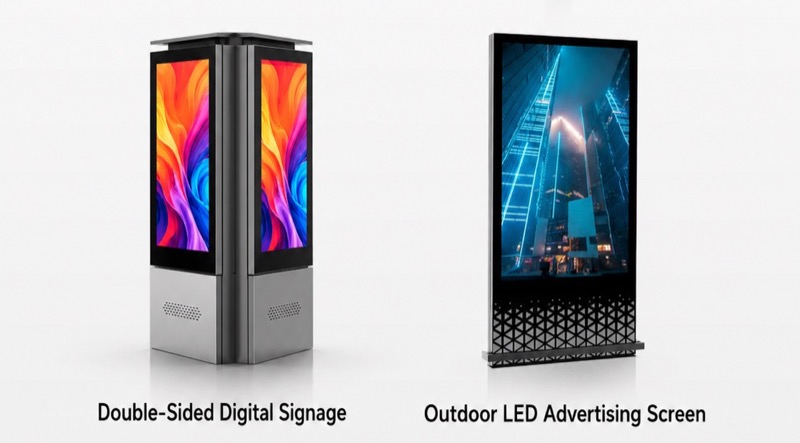
Digital signage projects should be assessed over their full lifecycle, not only at purchase price.
A low-cost outdoor display may appear attractive during procurement but become expensive if it suffers from poor visibility, corrosion, overheating, water ingress, high energy use, difficult servicing, or repeated component failures.
For outdoor LED and LCD advertising displays, buyers should evaluate the following factors before comparing quotations.
Outdoor displays must remain readable under direct sunlight, changing weather, and reflective urban surroundings. High brightness alone is not enough; the screen also needs appropriate contrast, anti-glare performance, ambient-light adjustment, and content designed for daylight viewing.
For outdoor LCD installations, 2,500 to 5,000 nits is often considered a common range, depending on sunlight exposure, viewing angle, and application. LED solutions used in strong outdoor environments may require higher brightness, but the final specification must align with the installation site and local rules.
Over-specifying brightness can increase power consumption and create glare concerns. Under-specifying it can make the screen unreadable during the most valuable daytime hours.
Outdoor displays face solar heat, high ambient temperatures, humidity, dust, rain, cold conditions, and large daily temperature changes.
A reliable enclosure should address:
- Internal heat dissipation.
- Ventilation or air-conditioning design where required.
- Temperature monitoring.
- Humidity control.
- Dust management.
- Component protection.
- Safe access for service personnel.
A display that looks excellent in a controlled indoor test can fail quickly if its outdoor thermal design is weak.
Public-space products must withstand more than weather. They may face vandalism, accidental impact, salt air, pollution, vibration, unauthorized access, and frequent cleaning.
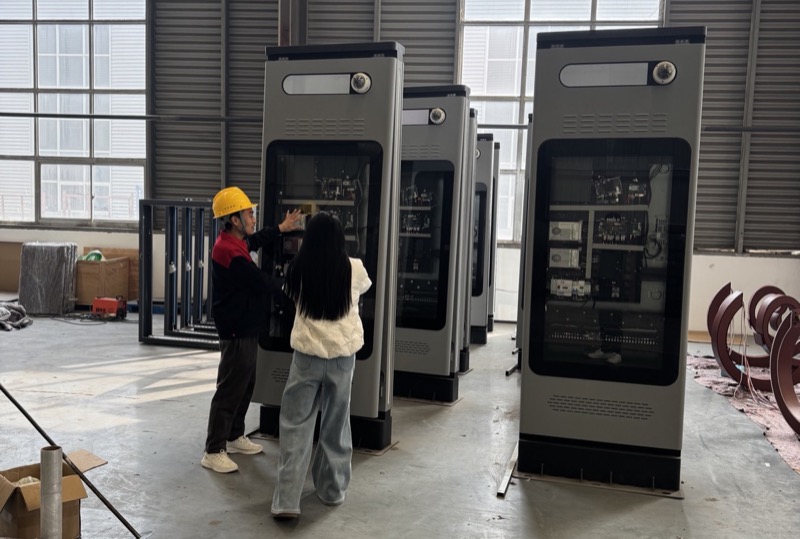
For infrastructure projects, the steel structure, sheet-metal fabrication, weld quality, coating process, drainage design, door locks, maintenance access, and foundation interface matter as much as the screen itself.
Ainl's manufacturing capabilities are relevant here. With a large-scale production base, in-house software and hardware development resources, CNC sheet-metal processing, coating capacity, electrical testing, and public-facility project experience, the company can support an integrated approach rather than supplying only a display panel. This matters when the final product must combine advertising equipment with bus shelters, smart street furniture, municipal structures, lighting, solar systems, and a consistent urban visual identity.
An outdoor advertising display needs a stable power plan and communication strategy.
Depending on the project, the design may include:
- Grid power.
- Solar panels.
- Battery storage.
- Hybrid power systems.
- Ethernet, 4G/5G, Wi-Fi, or fiber connectivity.
- Remote content management.
- Remote fault alerts.
- Power monitoring.
- Brightness adjustment.
- Timed shutdown or dimming programs.
Remote monitoring reduces unnecessary site visits and helps operators respond to faults before revenue or public service is affected.
A screen cannot generate return if it is offline.
Ask the supplier practical questions:
1. Can technicians access the screen safely from the front, rear, or side?
2. How quickly can common components be replaced?
3. Which spare parts should be stored locally?
4. Does the system report power, temperature, network, brightness, and door-status alerts?
5. What is the recommended preventive maintenance schedule?
6. Can the enclosure be serviced without dismantling major structural parts?
7. How are software updates managed?
The strongest procurement decision is not "Which display is cheapest?" It is "Which solution will remain visible, safe, serviceable, and commercially productive for years?"
Despite the advantages of digital media, traditional billboards should not be treated as outdated by default.
They can deliver better ROI when their simplicity matches the objective.
Choose a traditional billboard when:
- A single brand needs broad, continuous exposure.
- The creative will not change frequently.
- The site has no reliable power or data connection.
- The location has low-to-medium commercial value.
- Digital media is not permitted by local planning rules.
- The project has a tight capital budget.
- Maintenance resources are limited.
- The surrounding environment calls for a less illuminated visual solution.
- The campaign is seasonal or temporary and does not justify a permanent digital asset.
For example, a manufacturer promoting a long-term industrial park project along a regional highway may gain sufficient value from a well-designed static billboard. The campaign message may remain unchanged for months, and the project may not need multiple advertisers, live content, or detailed attribution.
In that case, the lower capital requirement and operational simplicity can produce the stronger return.
Outdoor digital displays generally have the greatest advantage when the location supports multiple functions and recurring revenue.
They are especially suitable for:
- Smart bus shelters.
- Urban transit stations.
- City-center pedestrian streets.
- Commercial plazas.
- Shopping-center exteriors.
- Airport and railway approaches.
- Stadium districts.
- Tourist attractions.
- Large residential developments.
- Government information points.
- Roadside media networks in premium locations.
- Mixed-use public facilities.
The case becomes even stronger when the display is integrated into a durable public-facility structure rather than treated as a standalone screen.
For example, an advertising display can be incorporated into a bus shelter with seating, lighting, route information, solar power, branded color schemes, and municipal wayfinding. In this model, the asset serves commuters, local government, advertisers, and the facility operator at once.
That multi-purpose design can improve the commercial justification for the infrastructure investment.
Before choosing an outdoor advertising display or traditional billboard, use this five-step framework.
Choose one primary objective:
- Advertising revenue.
- Brand exposure.
- Public information.
- Retail traffic.
- Transit communication.
- Smart-city infrastructure.
- Property marketing.
- City-image improvement.
A project with no defined objective often ends up with no reliable ROI measurement.
Evaluate:
- Pedestrian volume.
- Vehicle volume.
- Viewing distance.
- Dwell time.
- Sightlines.
- Nearby businesses.
- Traffic direction.
- Daytime sunlight.
- Nighttime environment.
- Available power and network access.
- Local regulations.
- Safety requirements.
A high-quality display in a weak location may not outperform a simple billboard in a premium location.
For digital assets, calculate:
Annual Revenue Potential=Sellable Slots×Average Slot Price×Fill Rate
Then subtract:
Annual Operating Cost=Power+Connectivity+Maintenance+Content Operations+Site Costs
For static billboards, consider leasing revenue, printing expenses, installation labor, replacement frequency, land or site fees, maintenance, and vacancy periods.
The best screen is the one designed for the real environment.
Consider:
- LED or LCD technology.
- Screen size and aspect ratio.
- Pixel pitch or display resolution.
- Viewing distance.
- Brightness range.
- Cabinet material.
- IP protection level.
- Cooling system.
- Access method.
- Structural integration.
- Solar power feasibility.
- Color and branding requirements.
- Remote management functions.
A custom OEM/ODM solution can be particularly valuable when the display must fit a specific architectural design, city standard, transit shelter, commercial structure, or solar-powered public facility.
Digital signage regulations can cover brightness, operating hours, content motion, screen size, zoning, traffic safety, energy controls, and light spill. Some jurisdictions require automatic lighting controls and nighttime dimming for illuminated signs, while municipalities may impose specific restrictions to manage glare.
Early planning reduces the risk of redesign, delays, and unexpected compliance costs.
The best answer is conditional.
A traditional billboard often delivers better ROI when the goal is stable, low-complexity, long-duration visibility with limited capital investment and minimal operational requirements.
An outdoor advertising display is more likely to deliver better ROI when the site has high audience value, the operator can sell multiple time slots, campaigns need frequent updates, public messaging has value, and the project benefits from measurable performance and smart-city integration.
For many public-space projects, digital outdoor advertising is not merely a replacement for a printed billboard. It is a long-term communications asset that can combine advertising revenue, urban services, municipal information, brand identity, and infrastructure value.
The key is to select a supplier that understands both display technology and outdoor public-facility engineering.
Ainl supports this requirement through integrated OEM/ODM customization for outdoor LED/LCD advertising displays and public infrastructure. From screen size, structure, color, lighting, and display configuration to solar solutions and city-brand elements, Ainl can help project owners develop durable, visually coherent, application-specific advertising and smart-city facilities.
Contact Ainl to discuss your project requirements and receive a customized solution proposal for outdoor advertising displays, smart bus shelters, municipal facilities, or integrated public-space media infrastructure.
It can be, especially in high-traffic locations where the screen can sell multiple ad slots per day. Digital displays can also support public information, remote campaign updates, and premium time-based pricing. However, the higher investment and operating costs must be justified by location quality, advertiser demand, and an effective media-sales plan.
With a properly configured content management system and stable network connection, content can usually be updated remotely within minutes. This allows advertisers and public-space operators to react quickly to events, promotions, weather, traffic conditions, and public notices.
Key considerations include installation environment, sunlight exposure, screen brightness, viewing distance, size, enclosure protection, heat management, corrosion resistance, energy consumption, access for maintenance, network connectivity, software compatibility, and local regulations.
Yes, solar-powered or hybrid solar-grid solutions can be designed for certain projects. Feasibility depends on screen power consumption, screen operating hours, local solar resources, battery capacity, installation orientation, weather conditions, and the required reliability level. A detailed power assessment should be completed before selecting a solar configuration.
Yes. Traditional billboards remain effective for simple, high-visibility, long-term campaigns. They can be especially suitable where digital signage is restricted, where power and connectivity are unavailable, or where the campaign does not require frequent creative changes.
ROI can be measured using estimated impressions, reach, QR scans, landing-page visits, phone calls, store visits, leads, ad-slot sales, fill rate, campaign lift studies, and sales performance. The right metrics depend on whether the project goal is advertising revenue, brand awareness, public communication, or commercial conversion.
Yes. Digital advertising displays can be integrated into bus shelters, information kiosks, street furniture, transit hubs, commercial structures, and municipal facilities. Integrated designs can combine advertising screens with seating, lighting, wayfinding, solar power, public information, and city-brand elements.
1. Broadsign. "[What Is Out-of-Home Advertising? A Marketer's Guide to OOH Media]."
2. AdQuick. "[What Is the Best Digital Out-of-Home Advertising?]."
3. Digital Signage Today. "[Outdoor LCD Displays in 2026: Why Buyers Need to Think Beyond Brightness]."
4. Boxi. "[How to Measure Out-of-Home Advertising in 2026]."
5. LED Craft. "[Understanding Nits: How Bright Should Your Outdoor LED Sign Be?]."
6. Genoptic Smart Displays. "[California Sign Requirements: The 2026 Compliance Guide]."
7. Blue Alpha. "[How to Measure OOH Advertising: Geo Holdouts, MMM, and More]."


