
Email: ainlbusshelter@gmail.com | WhatsApp: +86-18800607527
Views: 236 Author: Ainl Bus Shelter Publish Time: 2026-08-18 Origin: Site


Content Menu
● What Is a Modular Bus Shelter?
● What Is a Permanent Bus Shelter?
● Modular vs Permanent Bus Shelter: Core Comparison
● Why Modular Shelters Fit Rapid Urban Expansion
>> Easier adjustment after demand changes
>> Better standardization across sites
● Where Permanent Bus Shelters Perform Better
>> High-volume transport interchanges
>> Landmark streets and civic districts
>> Sites with stable, long-term utility infrastructure
● Accessibility and Passenger Safety Must Come First
● The Real Cost Question: Initial Price vs Lifecycle Value
>> Evaluate these lifecycle factors
● A Practical Selection Framework for Cities
>> Choose a modular bus shelter when:
>> Choose a permanent bus shelter when:
● Expert Insight: Design for Upgrades, Not Just Installation
● FAQ
>> 1. What is the main difference between a modular bus shelter and a permanent bus shelter?
>> 2. Are modular bus shelters durable enough for long-term public use?
>> 3. Can a modular bus shelter include digital advertising and smart displays?
>> 4. Which bus shelter type is better for a new residential development?
>> 5. How should a bus shelter support accessible public transport?
>> 6. Can bus shelters be customized to match a city's brand identity?
>> 7. Is solar power practical for a smart bus shelter?
When a city expands quickly, public transport infrastructure must keep pace with new residential districts, employment zones, commercial corridors, and temporary construction-related route changes. The question is no longer simply whether to install a bus shelter. It is whether a modular bus shelter or a permanent bus shelter provides the better long-term result for each location.
From a manufacturer's and project-delivery perspective, the best choice depends on four practical factors: deployment speed, site stability, passenger demand, and future flexibility. Modular shelters are often the stronger option for phased growth, changing routes, and standardized citywide upgrades. Permanent shelters are usually better for high-volume, landmark, or long-established transit locations that require a highly integrated architectural solution.
For municipalities, transport operators, outdoor media companies, developers, and smart-city project contractors, the most effective strategy is often not choosing one type exclusively. It is creating a shelter program that uses both systems according to real site conditions.
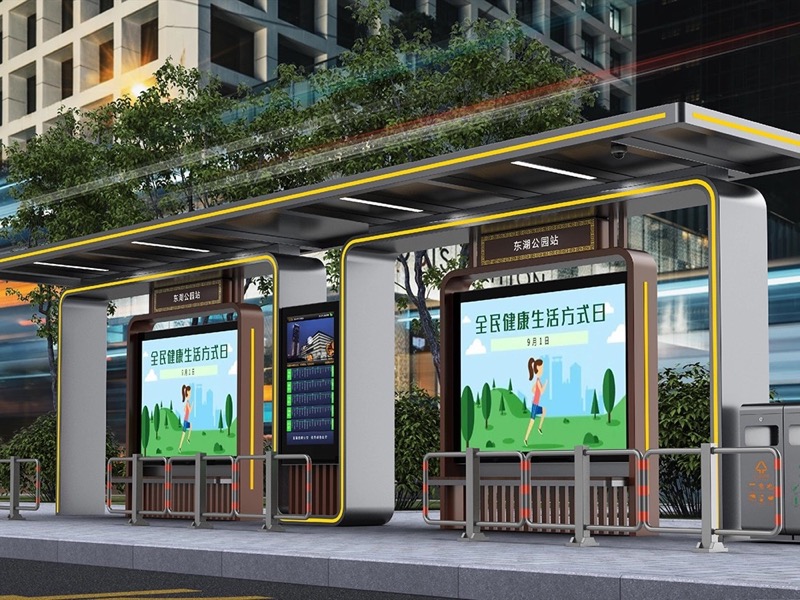
A modular bus shelter is a transit waiting facility built from standardized, repeatable components. These components may include steel frames, roof modules, glass or perforated panels, seating, route signs, lighting, digital displays, solar power systems, and advertising panels.
Instead of designing every shelter as a completely unique product, the project team selects a suitable base configuration and adds modules based on the location.
A typical modular bus shelter system can support:
- Single-bay, double-bay, and multi-bay configurations
- Expandable roof spans and waiting areas
- Optional LED lighting and illuminated signage
- Digital passenger information displays
- Outdoor advertising light boxes or digital media screens
- Solar panels and battery storage
- CCTV, emergency intercoms, USB charging, and environmental sensors
- Custom colors, logos, route maps, and city-branding elements
This approach supports a faster and more consistent rollout across many stops. In Los Angeles, a new shelter program was designed around modular deployment, with the first 150 shelters installed as part of a planned 3,000-unit program. The design also offered a larger canopy option providing 35% more shade than existing shelters.
For rapidly developing cities, modularity is valuable because it creates a clear path from a basic shelter to a smarter, larger, or more media-enabled public facility.
A permanent bus shelter is generally designed as a fixed, site-specific structure with long-term foundations and a more customized architectural appearance. It may be integrated with streetscape works, pavement, landscaping, drainage, utility connections, cycling facilities, commercial buildings, or transit hubs.
A permanent shelter is usually appropriate when a bus stop is expected to remain in the same location for many years and has a stable passenger volume.
Permanent bus shelters often include:
- Heavy-duty structural steel or aluminum construction
- Deep or site-engineered foundations
- Larger roofs and enclosed waiting areas
- Custom architectural cladding and finishing
- Integrated electrical, communication, and drainage systems
- High-capacity seating and passenger circulation areas
- Large-format advertising or information displays
- Bespoke features matching surrounding public architecture
The word "permanent" does not mean the shelter can never be replaced. It means the shelter is designed around a fixed location, with a stronger commitment to the site's final layout, utilities, pavement, and surrounding urban design.
| Factor | Modular Bus Shelter | Permanent Bus Shelter |
|---|---|---|
| Deployment speed | Faster due to standardized parts and repeatable installation processes | Slower because site engineering and custom construction are often required |
| Flexibility | High; can be extended, reconfigured, relocated, or upgraded | Lower; modifications may require civil works and redesign |
| Initial planning | Easier for multi-stop programs with standardized specifications | More detailed, site-specific planning is required |
| Customization | Strong OEM/ODM options within a modular system | Very high, especially for landmark or architect-led projects |
| Best use case | New districts, temporary routes, phased projects, network-wide upgrades | Transit hubs, city centers, BRT corridors, long-term flagship stops |
| Smart-city upgrades | Easier to add screens, solar modules, sensors, and lighting packages | Possible, but retrofitting can be more complex |
| Construction disruption | Usually lower and shorter | Often higher due to foundations, utility work, and finishing |
| Lifecycle strategy | Easy to standardize maintenance and spare parts | Requires more location-specific maintenance planning |
| Visual identity | Consistent citywide appearance | Can deliver a distinctive site-specific architectural statement |
Modular bus shelters are not low-quality or temporary by definition. A well-engineered modular shelter can be a durable, long-service public asset. The distinction is primarily about configuration, production method, installation efficiency, and adaptability.
Rapid urban expansion creates uncertainty. A new district may have changing road layouts, incomplete sidewalks, shifting bus routes, evolving commercial density, and passenger volumes that are difficult to predict accurately during the first few years.
A modular bus shelter helps cities respond without overcommitting too early.
When dozens or hundreds of new stops require protection from sun, rain, wind, and heat, a repeatable shelter platform can accelerate procurement, fabrication, logistics, and installation.
One supplier states that modular shelter lead times can be as short as eight weeks, compared with four to six months often associated with traditional shelter programs. This varies by design, approvals, shipping distance, and local civil works, but it illustrates the potential advantage of standardized production.
For a growing city, faster coverage can mean:
- More comfortable passenger waiting areas
- Better visibility of new bus routes
- A stronger public perception of transport service quality
- Earlier opportunities for transit advertising revenue
- Faster rollout of smart passenger information systems
A new housing development may initially need a small single-bay shelter. Within two years, a school, hospital, industrial park, or shopping center may substantially increase boarding volumes.
With a modular system, the operator can add a bay, extend the canopy, install more seating, or upgrade to a larger digital display without replacing the entire shelter.
This is especially useful for:
- New town developments
- Airport access roads
- Industrial parks
- University districts
- Construction-detour routes
- Tourism corridors
- Newly launched BRT feeder services
A network of standardized shelters simplifies many project tasks. These include engineering review, component sourcing, quality control, staff training, spare-parts planning, and maintenance procedures.
For Ainl, modularization can be combined with OEM/ODM flexibility. The city can retain a unified structural platform while customizing color schemes, local cultural graphics, advertising formats, solar configurations, lighting systems, and smart-device packages.
That balance matters. Cities want a recognizable public-facility identity, but they also need each location to fit its available space and passenger demand.
Permanent bus shelters remain essential for important transport locations. A modular system may be scalable, but some sites deserve a fully site-specific solution.
Major terminals, rail-station transfer points, airport links, BRT stations, and central business district stops experience heavy passenger flows. They may require larger covered areas, dedicated boarding zones, multiple waiting areas, ticketing facilities, security systems, retail integration, and extensive wayfinding.
At these sites, a permanent bus shelter can be designed as part of a wider transport structure rather than as a standalone street facility.
In historic areas, commercial boulevards, waterfront zones, cultural districts, and government precincts, visual integration can be as important as passenger protection.
A permanent shelter can use custom roof forms, premium cladding, locally appropriate materials, landscape coordination, public art, and bespoke lighting. The result can become part of the city's visual identity.
A permanent shelter is often preferred when electrical supply, fiber connectivity, drainage, pavement, and underground works are already established. These conditions make it easier to install large digital displays, CCTV, advertising systems, advanced lighting, and other connected equipment.
The key is not to assume that a permanent shelter is automatically better. It is better when the site is stable enough to justify a larger initial investment.
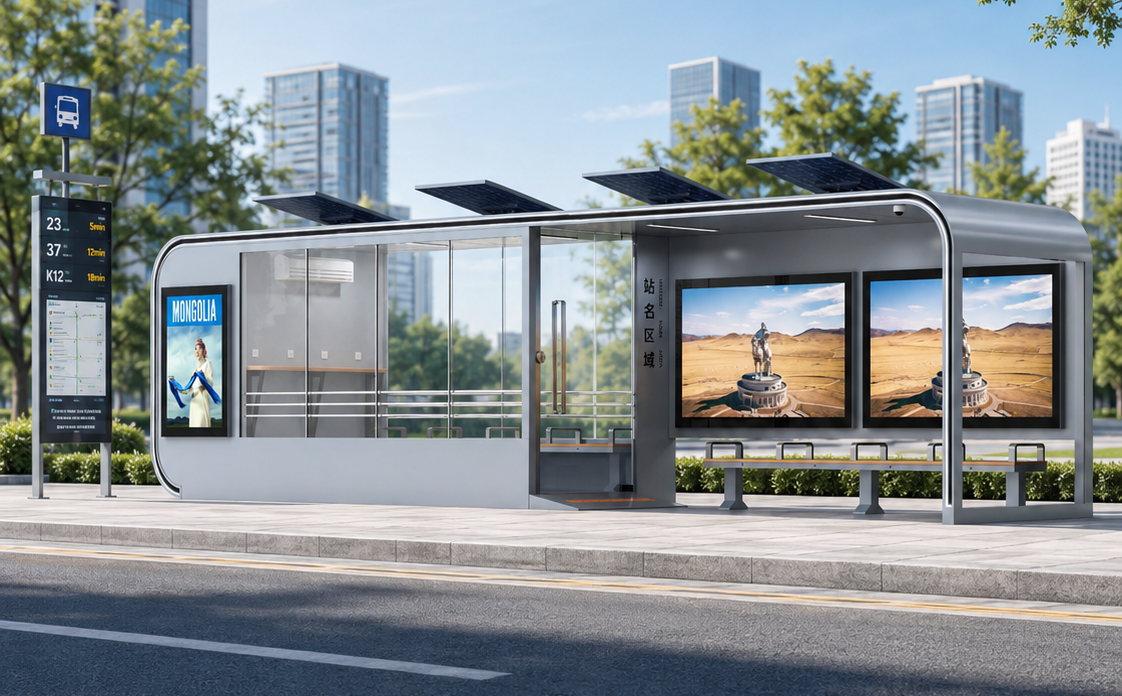
Whether the shelter is modular or permanent, accessibility cannot be treated as an optional feature. The shelter must work for wheelchair users, older adults, children, passengers with luggage, and people with visual or mobility impairments.
U.S. transit accessibility guidance specifies that new or altered boarding and alighting areas should have a firm, stable surface; a clear 96-inch minimum length perpendicular to the roadway; a clear 60-inch minimum width parallel to it; and an accessible connecting route. New or altered shelters must also provide clear floor or ground space within the shelter and an accessible route to the boarding area.
A practical bus shelter design review should check:
1. Clear passenger movement between the shelter, sidewalk, curb, and boarding area
2. Unobstructed wheelchair space inside or immediately adjacent to the shelter
3. Roof coverage without blocking bus doors, driver sightlines, or pedestrian routes
4. Non-slip, durable flooring and proper drainage
5. Adequate lighting for nighttime safety and route visibility
6. Transparent or open sightlines that improve security and help passengers see approaching buses
7. Appropriate seating and leaning rails for different users
8. Safe placement of screens, advertising panels, columns, and signposts
Good shelter placement also matters. Guidance from Project for Public Spaces recommends setting shelters near intersections back from the crosswalk by approximately 10 feet to reduce pedestrian conflict. It also advises avoiding curbside side panels unless needed and maintaining a sufficiently wide opening for bus access.
Many procurement decisions focus too heavily on initial unit cost. That is understandable, especially for large tenders. However, a bus shelter should be evaluated through its lifecycle value.
The lowest initial price can become expensive if the shelter needs frequent repair, has poor corrosion resistance, lacks standardized spare parts, or cannot be upgraded when passenger needs change.
- Structural material quality: Steel thickness, aluminum grade, corrosion protection, welding quality, and fastener durability
- Surface treatment: Powder coating, fluorocarbon coating, galvanizing, and resistance to UV exposure, humidity, salt spray, and pollution
- Glass and panel performance: Tempered glass, laminated glass, polycarbonate, perforated metal, anti-graffiti treatment, and impact resistance
- Electrical reliability: LED drivers, wiring protection, IP rating, surge protection, and maintenance access
- Replacement convenience: Standardized panels, roof units, seat modules, and electronic components
- Future compatibility: Space and load capacity for displays, solar panels, cameras, sensors, or advertising upgrades
- Cleaning and repair access: Designs that allow maintenance teams to work safely and efficiently
A modular shelter often provides an advantage because components can be repaired or replaced individually. A damaged side panel, roof section, or advertising light box does not necessarily require replacement of the full structure.
The following decision process helps project owners avoid choosing based on appearance alone.
- The city is expanding into new districts
- Bus routes may change during early development stages
- Many stops require a consistent design language
- Installation time is critical
- Passenger demand differs across locations
- Future smart-city upgrades are expected
- The project needs scalable advertising or digital-information capacity
- The city wants easier spare-parts management
- The location is a major transfer hub or terminal
- Passenger demand is consistently high
- The surrounding streetscape is already finalized
- A custom architectural statement is required
- Utilities and underground works are already coordinated
- The shelter will integrate with retail, ticketing, bike facilities, or larger transit infrastructure
- Long-term site stability is certain
- A city needs rapid coverage now but wants landmark facilities at key stops later
- New urban districts are still developing
- Main corridors have predictable demand while feeder routes do not
- The project combines public transport infrastructure with outdoor advertising operations
- Budgets need to be phased over several years
A hybrid strategy is often the most resilient approach. Standard modular shelters can cover the majority of stops, while permanent custom shelters are reserved for the highest-impact locations.
The most successful bus shelter programs are designed with an upgrade path from the beginning.
A basic shelter today may need solar power, a route-information screen, advertising display, CCTV camera, Wi-Fi device, passenger-counting sensor, or emergency communication button in the future. If the structure, wiring paths, mounting positions, and maintenance access are not planned early, retrofitting becomes more expensive and disruptive.
For example, a city may begin with a powder-coated steel shelter, LED lighting, a route map, and seating. Later, it can add:
- Solar panels and battery storage
- Real-time arrival information
- Digital advertising screens
- Environmental monitoring devices
- Smart lighting controls
- City emergency information displays
- Branded public-service messaging
This is where a manufacturer with integrated sheet-metal processing, coating capability, electrical testing capacity, and software-hardware development support can create measurable project value. The goal is not simply to supply a shelter. It is to supply a platform that can evolve with the city.
For rapid urban expansion, a modular bus shelter is usually the better starting point because it combines speed, repeatability, customization, and upgrade flexibility. It allows cities to provide passenger comfort across a growing transit network without waiting for every district to reach its final form.
A permanent bus shelter remains the better choice for high-profile, high-volume, and fully established locations where architecture, utility integration, and long-term capacity justify a more site-specific investment.
Ainl can help project owners develop a tailored shelter strategy that combines durable steel structures, custom dimensions, lighting, advertising media, solar power, smart displays, and city-branding elements. Whether you need standardized modular bus shelters for a fast-growing network or permanent transit facilities for signature locations, the right solution begins with a site-by-site assessment.
Contact Ainl to discuss your bus shelter project requirements, receive a customized design proposal, and build a scalable public-facility solution for your city.
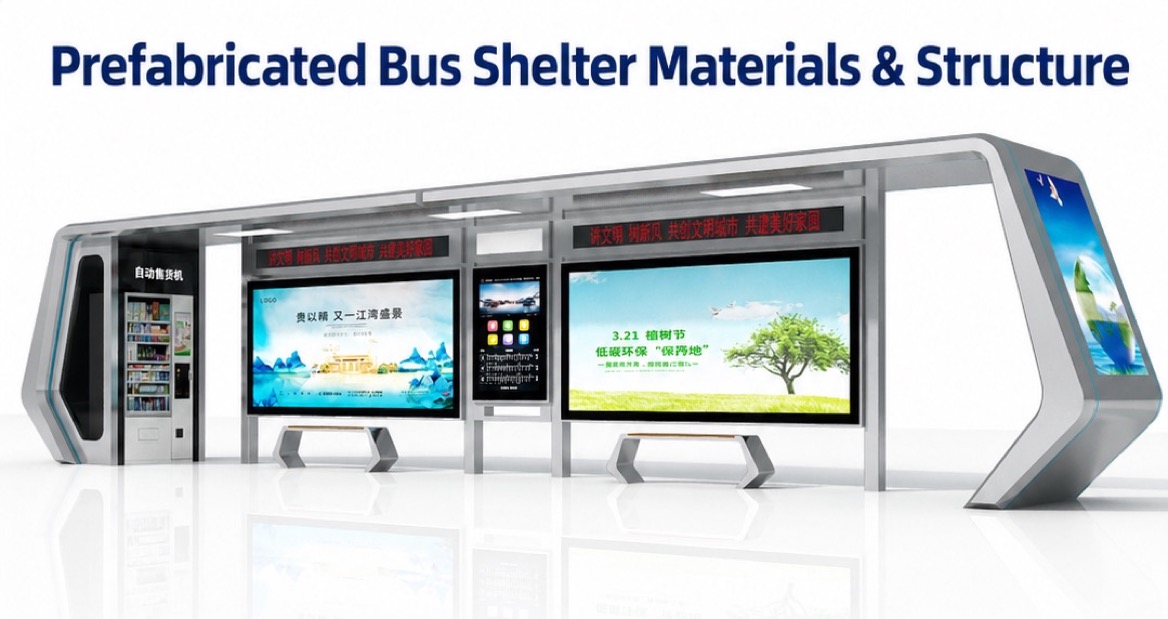
A modular bus shelter uses standardized components that can be configured, expanded, relocated, or upgraded more easily. A permanent bus shelter is typically designed as a fixed, site-specific installation with more customized civil works and architectural integration.
Yes. A modular bus shelter can be designed for long-term outdoor use when it uses properly engineered steel or aluminum structures, corrosion-resistant coatings, durable panels, reliable fasteners, and maintainable electrical components. Durability depends on the design and manufacturing quality, not whether the shelter is modular.
Yes. Modular shelters can be configured with digital advertising screens, LED route displays, passenger-information systems, CCTV, Wi-Fi equipment, charging ports, solar power systems, and other connected devices. The structural and electrical design should allow for these additions from the beginning.
A modular bus shelter is usually more suitable for a new residential development because route patterns, passenger volumes, and surrounding construction conditions may change. The shelter can be expanded or upgraded as the district matures.
The shelter should maintain a clear accessible route between the sidewalk, shelter, and boarding area. It should provide firm, stable surfaces, sufficient maneuvering space, safe lighting, unobstructed access, and layouts that do not interfere with wheelchair boarding or pedestrian movement.
Yes. Bus shelters can be customized in size, roof form, color, logo placement, advertising format, glass or metal panel selection, lighting design, digital-screen configuration, and local cultural graphics. A standardized modular platform can still support a distinctive city identity.
Solar power can be practical for shelters with efficient LED lighting, low-power displays, sensors, and communication devices, especially where grid access is difficult. The final system should be engineered according to local sunlight conditions, power demand, battery capacity, screen operating hours, and maintenance requirements.
2. [Skidmore, Owings & Merrill — Los Angeles Modular Bus Shelter Program]
3. [National RTAP — Vehicle and Facility Accessibility: Bus Stop and Shelter Requirements]
4. [Project for Public Spaces — Bus Shelters]
5. [Berkeley-Charleston-Dorchester Council of Governments — Transit and Bus Stop Design Guidelines]
6. [MODSTREET — Modular Bus and Transit Shelters]
7. [Metro Magazine — Designing and Building Accessible Bus Stops]


