
Email: ainlbusshelter@gmail.com | WhatsApp: +86-18800607527
Views: 220 Author: Ainl Bus Shelter Publish Time: 2026-09-15 Origin: Site


Content Menu
● Why Climate-Ready Bus Stop Shelters Matter
● Modern Bus Stop Shelter vs Traditional Shelter at a Glance
● Traditional Shelters: Simple but Limited
>> Common Limitations of Traditional Shelters
● What Makes a Modern Bus Stop Shelter Different?
>> Climate-Responsive Structural Design
>> Better Materials for Long-Term Outdoor Use
● Designing for Heat: Shade Is Essential, but It Is Not Enough
>> Practical Heat-Resilient Design Features
● Designing for Rain, Flooding, and Drainage
>> Rain-Ready Shelter Design Checklist
● Wind Resistance and Structural Safety
>> Engineering Priorities for Windy Locations
● Smart Features That Improve the Passenger Experience
>> Useful Smart Bus Stop Shelter Features
● Accessibility Should Be Built Into the Shelter
● A Practical Selection Framework for Buyers
>> 1. What Climate Risks Will the Shelter Face?
>> 2. What Is the Expected Passenger Load?
>> 3. What Functions Are Required Today and Later?
>> 4. Can the Shelter Be Maintained Locally?
>> 5. Can the Design Represent the City?
● Why Custom Manufacturing Creates Better Project Outcomes
● The Future of Bus Stop Shelter Design
● Build a Climate-Ready Bus Stop Shelter Project
● FAQ
>> What is the main difference between a modern bus stop shelter and a traditional shelter?
>> Can a bus stop shelter be customized for hot climates?
>> Which materials are best for an outdoor bus shelter?
>> Are solar-powered bus shelters practical?
>> How can a shelter reduce rain exposure?
>> Can bus stop shelters include outdoor advertising screens?
>> How should a city choose a bus stop shelter manufacturer?
A modern bus stop shelter is no longer just a roof and bench beside the road. In climate-exposed cities, it is becoming a carefully engineered public asset that must protect passengers from heat, heavy rain, wind, UV exposure, poor nighttime visibility, and changing operational needs.
By comparison, a traditional shelter may provide basic cover, but it often lacks the structural, environmental, accessibility, and digital features needed for today's public transport networks. For municipalities, project contractors, advertising operators, and transit authorities, the decision is not simply modern versus old-fashioned design. It is a decision about passenger comfort, safety, lifecycle value, city identity, and long-term resilience.
For more than 16 years, Ainl has focused on the research, manufacturing, sales, and customization of bus stop shelters, smart city public facilities, and outdoor advertising products. As a professional Chinese manufacturer and solution provider, Ainl supports municipal, transport, commercial, and smart city projects with customized OEM/ODM solutions designed around local climate, site conditions, branding requirements, and public-service goals.
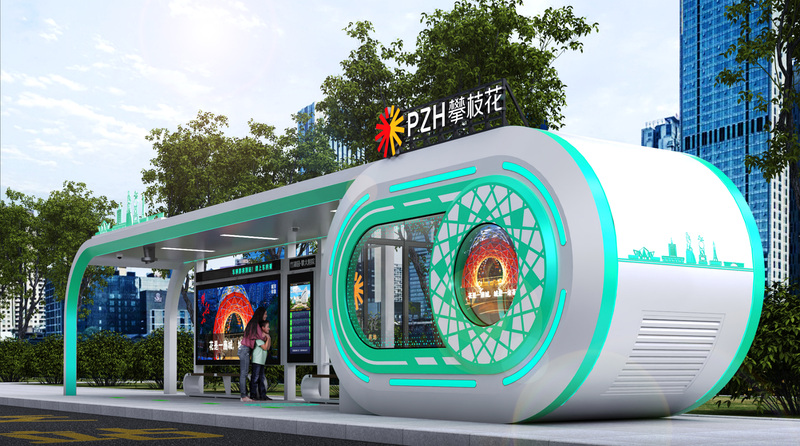
Public transport passengers are directly exposed to local weather while waiting. A short delay can become uncomfortable or unsafe when a stop has no shade, insufficient drainage, weak wind protection, or poor lighting.
Extreme heat, intense rainfall, stronger winds, and wider temperature variation are increasing the performance demands placed on street infrastructure. A shelter that was adequate ten years ago may no longer provide enough protection for modern urban conditions.
A climate-ready bus stop shelter should help cities achieve several goals:
- Reduce direct exposure to solar radiation
- Provide reliable rain and wind protection
- Maintain safe access during wet conditions
- Support passengers at night through effective lighting
- Protect electrical and digital equipment outdoors
- Remain stable and attractive over a long service life
- Accommodate passengers with different mobility needs
- Integrate with a city's visual identity and smart transport system
A shelter is often one of the first public facilities a resident, commuter, visitor, or investor sees. Its condition can influence how people perceive the quality of the whole transit network.
The difference between a modern bus stop shelter and a traditional shelter is not limited to appearance. The most important differences are found in engineering, customization, environmental performance, maintenance planning, and passenger experience.
| Feature | Modern Bus Stop Shelter | Traditional Shelter |
|---|---|---|
| Design approach | Site-specific, modular, climate-responsive | Standardized, basic, often fixed design |
| Structural materials | Galvanized steel, stainless steel, aluminum, tempered glass, engineered panels | Basic painted steel, thin sheet metal, or limited material options |
| Weather protection | Designed for solar shading, rain runoff, wind direction, drainage, and local exposure | Often provides only partial roof cover |
| Passenger information | Can integrate digital displays, real-time arrival information, route maps, and advertising screens | Usually static timetable or printed route information |
| Lighting | LED lighting, sensor-based control, illuminated advertising panels, solar options | Limited or no integrated lighting |
| Accessibility | Can include wheelchair-clearance areas, seating options, non-slip flooring, and visible markings | May not fully address inclusive access requirements |
| Branding | Colors, logos, graphics, screen content, and architectural elements can be customized | Limited visual identity options |
| Energy system | Can support solar power, batteries, smart lighting, and low-energy equipment | Usually dependent on basic external power supply |
| Maintenance | Modular components can simplify repair and replacement | Repairs may require more extensive on-site work |
| Lifecycle value | Higher initial specification but stronger long-term adaptability | Lower initial cost but may require earlier upgrades |
The right choice depends on the project's climate, passenger volume, budget, available space, transport technology, and maintenance capacity. However, a traditional shelter can become a false economy if it needs repeated repair, does not protect users adequately, or must be replaced when a city later upgrades to smart transport services.
Traditional bus shelters have an important place in transport history. Their purpose has generally been straightforward: provide a bench, a roof, and a visible boarding location.
For low-volume routes in mild climates, a simple shelter may still meet basic operational needs. It can be relatively quick to install and may require less up-front investment.
However, conventional designs often reveal limitations when weather conditions become more demanding.
A traditional shelter may struggle with:
- Narrow roofs that do not block low-angle sun
- Open sides that allow wind-driven rain to reach passengers
- Poor roof drainage during intense rainfall
- Inadequate airflow during hot weather
- Weak corrosion protection in coastal or humid locations
- Limited space for wheelchairs, strollers, or mobility aids
- Insufficient nighttime lighting
- No infrastructure for smart transport displays
- Minimal opportunity for city branding or outdoor advertising revenue
- Difficult retrofit work when new technology is required
The central issue is not that every traditional shelter is poorly made. The issue is that many older concepts were created for a simpler operating environment. They were not designed around the combination of climate resilience, digital service, universal access, commercial value, and visual identity now expected in public-space projects.
A modern bus stop shelter is a coordinated system rather than an isolated structure. It combines a durable frame, environmental protection, passenger amenities, information services, power management, and visual design.
At Ainl, shelter customization can cover dimensions, structural configuration, colors, screen specifications, lighting systems, solar power solutions, and city-brand elements. This is important because a bus stop in a coastal commercial district has different requirements from a rural route, a school zone, a downtown transport hub, or a high-temperature urban corridor.
A modern shelter starts with the physical conditions of the location.
Design teams should evaluate:
1. Sun path and peak waiting-time exposure
2. Prevailing wind direction
3. Annual rainfall and drainage intensity
4. Temperature range
5. Salt spray, humidity, or industrial corrosion risk
6. Passenger volume and queue length
7. Available sidewalk width
8. Vehicle approach and boarding geometry
9. Nearby trees, buildings, utilities, and advertising visibility
10. Local municipal standards and public-space requirements
This site-first approach helps prevent generic designs from being installed in locations where they perform poorly.
For example, a shelter in a hot climate may require a deeper roof overhang, side panels positioned to block afternoon sun, ventilation gaps, reflective roof finishes, and nearby landscaping. A shelter in a rainy region may require a larger roof catchment area, controlled runoff, properly sized gutters, durable seals, non-slip paving, and side protection against wind-driven rain.
The structural material selection strongly affects maintenance cost, safety, and visual quality.
Modern shelters commonly use combinations of:
- Galvanized steel for structural strength and corrosion resistance
- Stainless steel for exposed components or premium architectural finishes
- Aluminum profiles for lower weight and clean modular detailing
- Tempered or laminated safety glass for visibility and protection
- Powder-coated metal surfaces for durable color performance
- Weather-resistant electrical enclosures for outdoor systems
- High-quality fasteners and sealed joints for long-term reliability
Material selection should never be based on appearance alone. A visually attractive shelter can still fail early if coatings, fasteners, drainage details, or electrical housings are not suitable for the local environment.
Ainl's production capability includes a CNC sheet-metal precision processing center, a large coating center, and an electrical testing laboratory. This integrated manufacturing approach can help control the consistency of structural fabrication, surface finishing, electrical assembly, and product inspection before shipment.
Heat protection is one of the most important functions of a modern bus stop shelter. Waiting passengers may face direct sun, reflected heat from pavement, heat radiated from nearby buildings, and limited airflow.
A roof provides essential shade, but the quality of the shade matters.
A well-designed shelter for hot conditions can include:
- A wider roof canopy to increase the shaded waiting zone
- Roof geometry that reduces direct solar penetration
- Side panels placed according to morning and afternoon sun direction
- Ventilation openings that reduce trapped hot air
- Light-colored or reflective roof surfaces
- Low-heat materials and carefully selected glazing
- Integrated trees or planting where site conditions allow
- Seating materials that do not become excessively hot in sunlight
- Solar-powered lighting and information systems
- Clear passenger information that reduces unnecessary waiting time
Research on bus-stop heat exposure has shown that shade meaningfully reduces heat stress conditions, while tree canopy can provide additional cooling benefits. This supports a combined strategy: use an engineered shelter for predictable protection, then add landscape elements where maintenance and space allow.
A modern shelter should not become a closed hot box. In hot and humid areas, designers must balance solar blocking with airflow. Transparent glass can improve visibility and security, but its placement, roof coverage, ventilation, and orientation must be carefully considered.
Heavy rain tests every part of a bus stop shelter. A roof that appears large enough under normal conditions may still allow rain to enter when wind changes direction. Poor drainage can create slippery surfaces, puddles near boarding areas, corrosion at base connections, and unpleasant conditions for passengers.
A modern bus stop shelter should consider:
- Roof slope that directs water away from passenger areas
- Internal or external gutter systems
- Downpipes positioned to avoid pedestrian paths
- Waterproof roof joints and sealed electrical connections
- Raised or protected equipment locations
- Non-slip flooring or pavement treatments
- Drainage routes that do not obstruct wheelchair access
- Adequate clearance around the shelter for cleaning and maintenance
- Side panels that reduce wind-driven rain
- Corrosion-resistant steel and coating systems
The bus stop platform also matters. Shelter performance cannot be separated from pavement slope, curb design, surrounding drainage, and boarding access. A well-built shelter installed on a poorly drained platform will still deliver a poor passenger experience.
For flood-prone areas, project teams should assess whether electrical equipment, digital displays, battery systems, and structural base components need elevated mounting or additional protection. Climate adaptation is most effective when it is designed into the project early instead of added after recurring weather damage.
Wind creates both comfort and safety challenges. At a basic level, passengers need protection from cold gusts and wind-driven rain. At a structural level, the shelter must withstand local wind loads without excessive movement, panel failure, roof uplift, or damage to attached signs and screens.
A modern shelter design should consider wind as a system-level issue.
Important design decisions include:
- Appropriate structural member sizes
- Secure foundation and anchor-bolt design
- Wind-load assessment based on the installation region
- Balanced use of open and enclosed panels
- High-strength glazing or panel materials
- Reliable connections between roof, columns, and side panels
- Protected placement of advertising panels and digital screens
- Maintenance access for inspections after severe weather
Too much enclosure can trap heat. Too little enclosure can leave passengers exposed. The best design is usually a tailored combination of roof depth, rear protection, partial side screening, ventilation, and structural reinforcement.
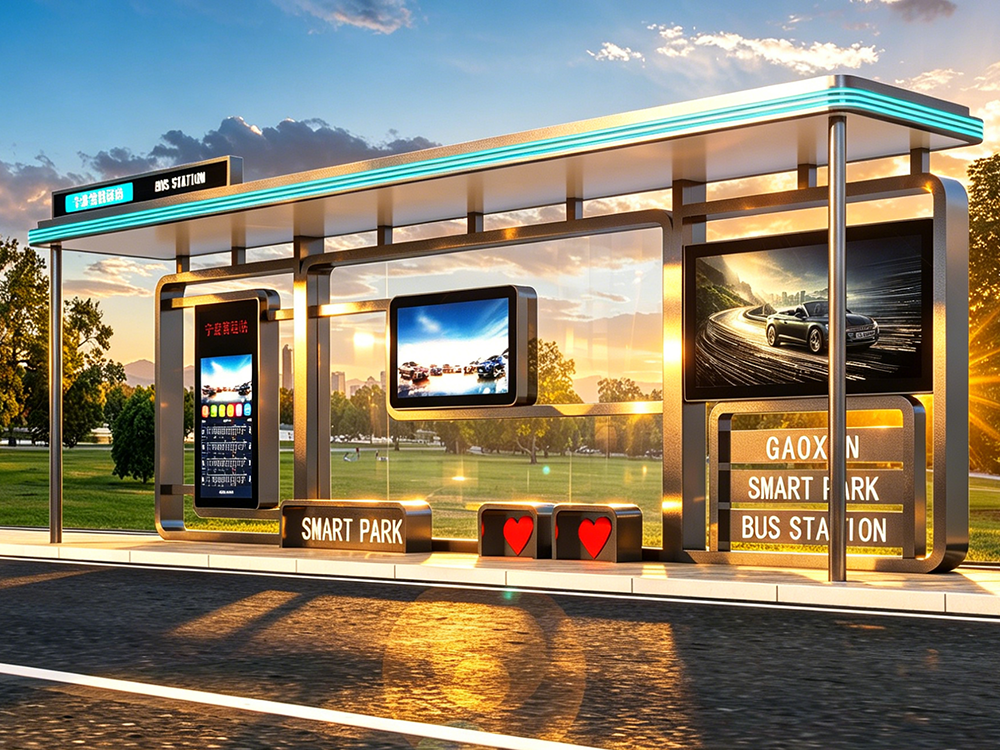
A modern bus stop shelter can serve as a small mobility information point. Smart equipment should not be added simply because it looks advanced. Every component should solve a real passenger, operator, or city-management problem.
- Real-time bus arrival displays
- Digital route maps and service updates
- LED lighting for visibility and safety
- Illuminated outdoor advertising panels
- Emergency communication or help buttons
- USB charging where appropriate
- Environmental sensors
- Solar-powered lighting systems
- Remote monitoring for lighting, screens, or power status
- Public information displays for weather alerts or city notices
Digital systems must be designed for outdoor reliability. This means considering heat dissipation, water ingress protection, anti-glare visibility, surge protection, wiring routes, maintenance access, and spare-part availability.
A poorly specified screen can become a maintenance burden. A well-specified system can improve passenger confidence, support operational communication, and create advertising opportunities that help cities fund public-space improvements.
A bus stop shelter is part of the public mobility chain. If the shelter is difficult to enter, has obstructed circulation, lacks seating support, or creates unclear boarding space, it can exclude the people who rely on public transport most.
An inclusive modern shelter should provide:
- Clear access paths
- Adequate internal circulation space
- Seating and leaning options
- Visible edges on transparent panels
- Readable route information
- Appropriate lighting levels
- Clear boarding-zone access
- Slip-resistant surfaces
- Space for wheelchairs, mobility devices, and strollers
- Avoidance of unnecessary level changes
Accessibility is not only a compliance matter. It improves usability for older passengers, parents with children, travelers carrying bags, people with temporary injuries, and anyone waiting during rain or crowded service periods.
A common mistake is selecting a bus stop shelter mainly from product photos or initial price. Public infrastructure should be evaluated by performance over time.
Before choosing a modern bus stop shelter manufacturer, buyers should ask the following questions.
Define the key local risks:
- Extreme heat
- Strong UV exposure
- Heavy rainfall
- Flooding
- Coastal salt spray
- High humidity
- Strong winds
- Snow or freezing conditions
- Dust and air pollution
High-volume stops need more than a narrow roof and one bench. Consider peak waiting numbers, passenger flow, wheelchair access, school traffic, tourist use, and transfer activity.
Plan for future needs such as:
- Digital passenger information
- Outdoor advertising displays
- Solar power
- Smart lighting
- CCTV integration
- Public announcements
- City emergency communication
Ask about:
- Coating specifications
- Replacement panel availability
- Electrical component standards
- Modular repair options
- Cleaning access
- Installation documentation
- Spare parts
- Warranty support
A bus stop shelter can carry local color schemes, patterns, logos, cultural motifs, district identity, or commercial advertising. Customization should be visually controlled so the shelter remains recognizable, practical, and consistent with the streetscape.
Every city has different road geometry, climate patterns, branding systems, budgets, and transport priorities. That is why off-the-shelf shelter designs are not always the best long-term option.
Ainl supports OEM/ODM customization across key project variables, including shelter dimensions, structural form, colors, LED lighting, advertising displays, solar systems, and city-brand features. This makes it possible to develop shelters for different project types, from compact roadside stops to larger smart transit stations and advertising-supported urban furniture programs.
With more than 260 mu of total site area and approximately 150,000 square meters of workshop space, Ainl combines research, precision metal processing, coating, electrical testing, and project-oriented manufacturing capacity. The company also holds relevant qualifications for steel structure and municipal construction contracting, along with management-system and safety-production certifications.
For procurement teams, the value of this type of manufacturing capability is practical: it can support better coordination between design intent, fabrication accuracy, coating quality, electrical integration, and delivery requirements.
The future bus stop shelter will be more adaptive, connected, and climate-aware. It will not replace the need for reliable buses, accessible pavements, or well-managed transit operations. But it can make waiting safer, more comfortable, and more predictable.
The most successful public transport projects will treat the shelter as part of a wider system that includes street design, pedestrian routes, trees, drainage, lighting, energy supply, information services, and local identity.
A modern bus stop shelter does more than protect passengers from rain. It communicates that a city values public transport, public safety, inclusive access, and long-term infrastructure quality.
If you are planning a municipal transport upgrade, smart city project, roadside advertising program, or custom public-facility installation, start with the real conditions at the site.
Share your project location, climate conditions, required dimensions, passenger volume, preferred materials, screen requirements, lighting needs, solar-power expectations, and branding references. Ainl can support the development of a customized bus stop shelter solution built around durability, passenger comfort, visual impact, and long-term operation.
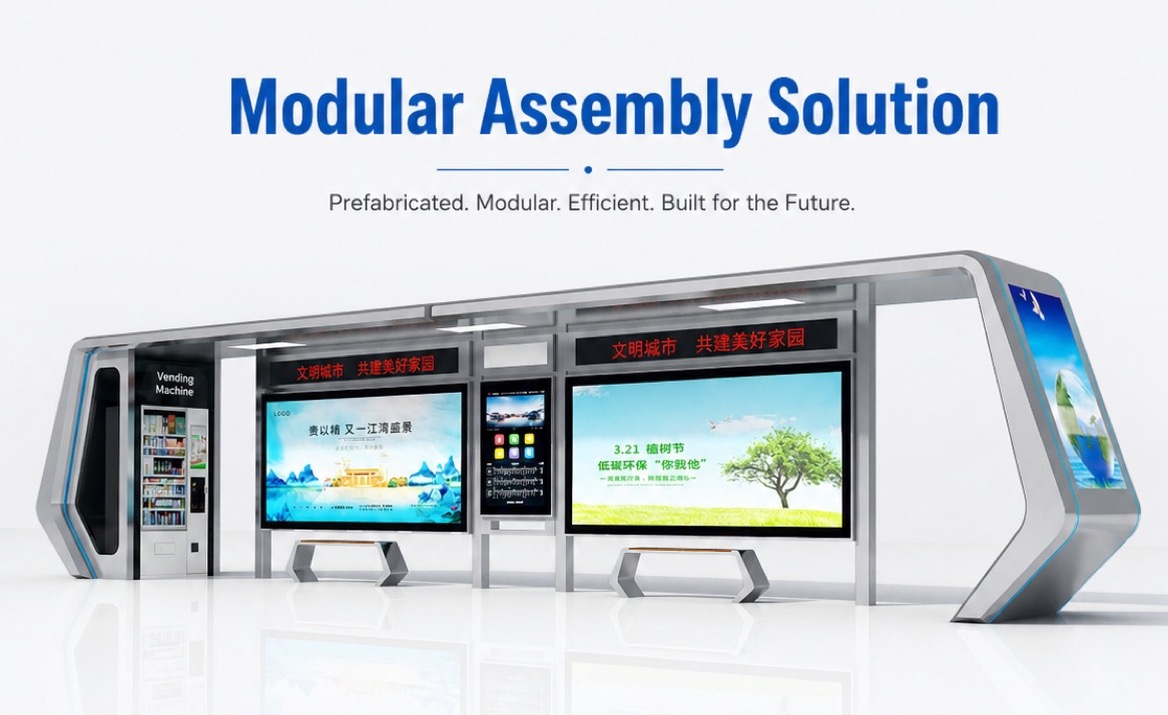
A modern bus stop shelter combines weather protection, durable materials, accessibility, smart technology, lighting, branding, and modular maintenance planning. A traditional shelter generally focuses on basic roof cover and seating.
Yes. A custom design can include wider roof overhangs, sun-oriented side panels, ventilation, reflective roof surfaces, heat-resistant materials, solar lighting, and space for nearby planting.
The best material combination depends on climate and budget. Galvanized steel, stainless steel, aluminum, tempered glass, weather-resistant coatings, and durable electrical enclosures are commonly used for long-term outdoor projects.
Solar-powered bus shelters can be practical where sunlight is sufficient and the electrical load is properly calculated. They are often used for LED lighting, low-power displays, sensors, and selected smart functions. Battery capacity, panel orientation, maintenance, and local weather conditions should be assessed before installation.
Effective rain protection requires more than a roof. A shelter should have adequate roof depth, correct slope, controlled drainage, weatherproof joints, side panels for wind-driven rain, and surrounding pavement that drains safely.
Yes. Modern bus stop shelters can be designed with static advertising light boxes or digital outdoor displays. The screen must be specified for outdoor brightness, heat management, water protection, power stability, maintenance access, and local advertising regulations.
Cities should evaluate design capability, customization options, materials, structural engineering, coating quality, smart-system integration, factory capacity, quality control, project experience, documentation, and after-sales support—not only the initial quotation.
1. [Ainl Bus Shelter — Custom Bus Shelter Manufacturer and Smart City Solutions]
2. [Ainl Bus Shelter — OEM/ODM Customization Services]
3. [Federal Transit Administration — Bus Stop Optimization Final Report]
4. [World Meteorological Organization — Extreme Heat]
5. [Transport for NSW — Bus Stop Urban Design Guideline]
6. [National Library of Medicine — Heat-Moderating Effects of Bus Stop Shelters and Tree Shade]
7. [Federal Transit Administration Climate Adaptation Research — Flooded Bus Barns and Buckled Rails]
8. [UTHealth Houston — Heat Stress Mitigation by Trees and Shelters at Bus Stops]


