
Email: ainlbusshelter@gmail.com | WhatsApp: +86-18800607527
Views: 241 Author: Ainl Bus Shelter Publish Time: 2026-09-20 Origin: Site


Content Menu
● Why Bus Shelter Material Selection Matters
>> Main Advantages of Glass Bus Shelters
>> Glass Bus Shelter Safety Considerations
>> Glass Bus Shelter Longevity
● Stainless Steel Bus Shelter Overview
>> Main Advantages of Stainless Steel Bus Shelters
>> Stainless Steel Bus Shelter Safety Considerations
● Glass Bus Shelter vs Stainless Steel Bus Shelter: Side-by-Side Comparison
● Which Material Is Safer for Passengers?
● Which Material Lasts Longer Outdoors?
>> 304 vs 316 Stainless Steel for Bus Shelters
● The Hidden Factor: Frame Design Determines Real Lifespan
>> Drainage and Water Management
● Practical Material Selection by Project Type
>> Downtown Commercial Bus Stops
>> Coastal or High-Salt Cities
● A Procurement Checklist for Buyers and Project Teams
● Final Verdict: Glass, Stainless Steel, or Both?
● FAQ
>> 1. Is a glass bus shelter safe?
>> 2. Is stainless steel better than glass for bus shelters?
>> 3. Which stainless steel grade is best for an outdoor bus shelter?
>> 4. Does tempered glass break easily in bus shelters?
>> 5. How long can a stainless steel bus shelter last?
>> 6. Are glass bus shelters difficult to maintain?
>> 7. Can a bus shelter include solar power and digital displays?
When planning a public-transit project, the choice between a glass bus shelter and a stainless steel bus shelter affects far more than appearance. It influences passenger safety, visibility, maintenance workload, vandal resistance, accessibility, advertising potential, and the long-term value of the infrastructure.
From my experience working with public-facility specifications, the best answer is rarely "glass or stainless steel." For most urban transit projects, the strongest solution is a hybrid bus stop shelter: a corrosion-resistant stainless steel or coated-steel structural frame combined with certified safety-glass panels. Glass delivers transparency, daylight, and visibility; stainless steel provides strength, structural stability, and a premium architectural finish. The correct material selection should always reflect the local climate, passenger volume, cleaning capacity, exposure to salt or pollution, and project budget.
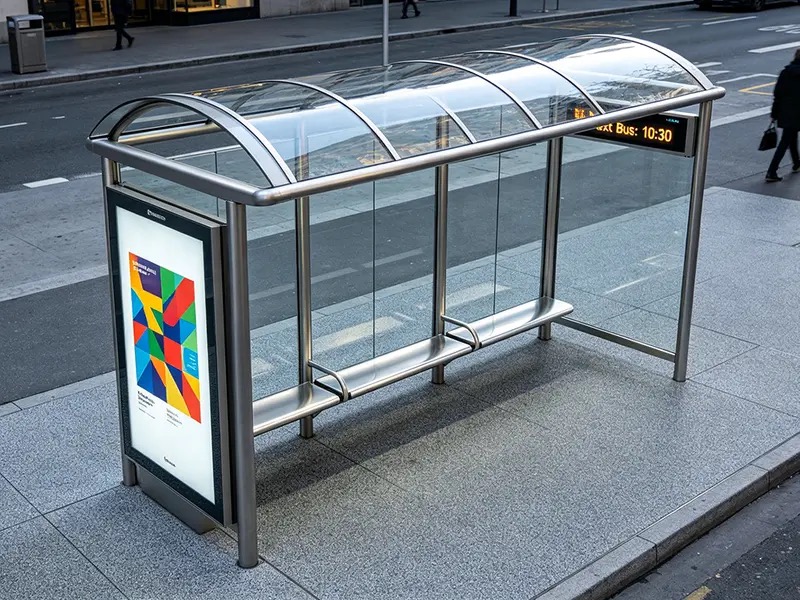
A bus shelter is a public asset that must perform every day in changing weather, high-traffic conditions, and sometimes challenging urban environments. It protects passengers from rain, wind, sunlight, and dust. At the same time, it must remain safe, easy to maintain, visually compatible with the streetscape, and durable enough to justify a municipality's investment.
For a manufacturer and solution provider such as Ainl, material selection is not limited to choosing a panel or frame. It involves coordinated design across the shelter structure, roof system, drainage, lighting, digital displays, advertising panels, seating, accessibility features, electrical systems, solar power equipment, and city-branding elements.
A poorly specified bus shelter may create avoidable problems:
- Reduced passenger visibility at night.
- Frequent corrosion or paint failure.
- Difficult graffiti removal.
- Unsafe breakage behavior.
- Poor resistance to wind load or impact.
- Higher maintenance costs.
- Reduced advertising value.
- An outdated or unattractive urban image.
A well-designed glass and stainless steel bus shelter can improve passenger comfort while becoming a recognizable component of a smart-city streetscape.
A glass bus shelter usually uses transparent side panels, back panels, roof panels, or advertising-display glazing. However, "glass" is not one single material specification. The safety and longevity of a glass bus shelter depend on the glass type, thickness, edge treatment, fixing method, frame design, and compliance documentation.
For public infrastructure, ordinary annealed glass should not be treated as equivalent to safety glass. A professional glass bus shelter should normally use tempered safety glass, laminated safety glass, or a carefully engineered combination of both.
Tempered glass is processed to improve its mechanical strength and to produce a safer breakage pattern. Standards such as EN 12150 define requirements for thermally toughened safety glass, including tolerances, edgework, fragmentation behavior, and physical-mechanical characteristics.
A glass bus shelter is often selected because it creates a modern, open, and passenger-friendly waiting environment.
- Excellent visibility. Transparent panels help passengers see approaching buses, surrounding traffic, and people nearby.
- Improved passive safety. Open sightlines can reduce the feeling of enclosure and make the shelter easier to monitor.
- Natural daylight. Glass reduces dependence on daytime artificial lighting.
- Modern visual appeal. Clear glass can complement commercial districts, airports, BRT stations, office parks, residential developments, and city-center streets.
- Advertising compatibility. Glass panels can be integrated with illuminated poster cases, digital signage, route information displays, and smart-city screens.
- Easy visual integration. Transparent panels can preserve streetscape views rather than create a heavy visual barrier.
Urban-design guidance has historically emphasized clear side panels, strong structural members, weather resistance, and materials that are easy to clean. It also notes that scratch-prone plastic panels can reduce visibility over time.
The main concern people raise about a glass bus shelter is breakage. This concern is reasonable, but it must be evaluated correctly.
Safety does not depend simply on whether the shelter has glass. It depends on whether the project specifies the right safety-glass system.
A professional specification should consider:
1. Glass type
Tempered glass offers higher impact resistance than standard glass and breaks into relatively small pieces when failure occurs. Laminated glass uses an interlayer that helps retain fragments after breakage.
2. Glass thickness
The required thickness depends on panel size, fixing method, wind pressure, impact exposure, roof loading, and local requirements. Larger panels are not automatically better; they must be correctly engineered.
3. Edge finishing
Glass edges are vulnerable areas. Proper grinding, polishing, drilling, and processing before tempering are important for performance.
4. Panel fixing system
Glass clips, clamps, structural channels, gaskets, and fasteners must distribute loads properly. Poor hardware selection can create stress concentrations.
5. Heat-soak considerations
For higher-risk applications, project teams may consider heat-soaked toughened glass to reduce the risk of rare spontaneous breakage associated with inclusions.
6. Replacement access
A shelter design should allow damaged panels to be replaced without dismantling the entire structure or disrupting electrical systems.
Glass itself does not rust. It does not fade like painted metal, and it can retain its transparent appearance for years when cleaned correctly. However, a glass bus shelter is only as durable as its frame, seals, fittings, drainage details, and maintenance plan.
The most common long-term issues are not usually the glass surface itself. They are often related to:
- Scratches from abrasive cleaning tools.
- Graffiti or adhesive residue.
- Loose fittings caused by vibration.
- Seal aging around roof panels.
- Poor drainage that allows water to collect around connections.
- Impact damage in high-vandalism locations.
- Inadequate glass thickness for local wind and impact conditions.
For this reason, glass works best when it is paired with a robust metal supporting structure.
A stainless steel bus shelter uses stainless steel as the primary visible frame material, structural trim, support columns, roof beams, handrails, benches, protective guards, or decorative architectural elements. In some projects, stainless steel is used for the entire exterior envelope, while in others it is combined with glass, aluminum, galvanized steel, or perforated metal panels.
A stainless steel bus shelter is valued for its durability, clean appearance, corrosion resistance, and premium image. It is particularly suitable for projects requiring a long service life, strong vandal resistance, easy surface cleaning, and consistent appearance across multiple stations.
However, stainless steel is not automatically "rust-proof" in every environment. Grade selection, surface finish, fabrication quality, drainage design, cleaning frequency, and exposure to chlorides all affect real-world performance.
- High structural durability. Stainless steel can provide excellent strength for columns, frames, roof supports, and protective elements.
- Corrosion resistance. Proper grades can perform well in outdoor, urban, industrial, and many coastal conditions.
- Strong vandal resistance. Stainless steel is difficult to crack, puncture, or shatter compared with brittle panel materials.
- Premium appearance. Brushed, satin, mirror, bead-blasted, or patterned finishes can support modern city branding.
- Long service potential. With correct grade selection and maintenance, stainless steel can deliver a long lifecycle.
- Easy integration. Stainless steel frames work well with glass, LED lighting, route maps, advertising panels, solar systems, USB charging modules, and digital passenger-information displays.
Industry guidance emphasizes that stainless-steel selection should account for the specific corrosion environment, including temperature, chemical exposure, pollution, and chloride exposure.
A stainless steel bus shelter is highly resistant to impact and does not create the same breakage concern as glass panels. It is especially valuable in locations with high pedestrian traffic, frequent vandalism, limited maintenance access, or exposure to public-service vehicles.
However, stainless steel has different safety and design considerations:
- Sharp edges must be avoided. Corners, cut edges, fasteners, and sheet-metal joints should be rounded, folded, welded, or protected.
- Surface heat must be managed. Dark or highly exposed metal surfaces can become hot under intense sunlight.
- Reflective finishes require caution. Mirror-polished stainless steel can create glare for drivers, cyclists, and passengers.
- Structural engineering remains essential. Strong material does not eliminate the need for wind-load, snow-load, seismic, foundation, and anchoring analysis.
- Electrical isolation may be required. Smart shelters with lighting, displays, charging points, or solar systems need safe electrical design and proper grounding.
For a public transport shelter, the frame should be designed as a complete engineered system rather than as decorative metal components assembled on site.
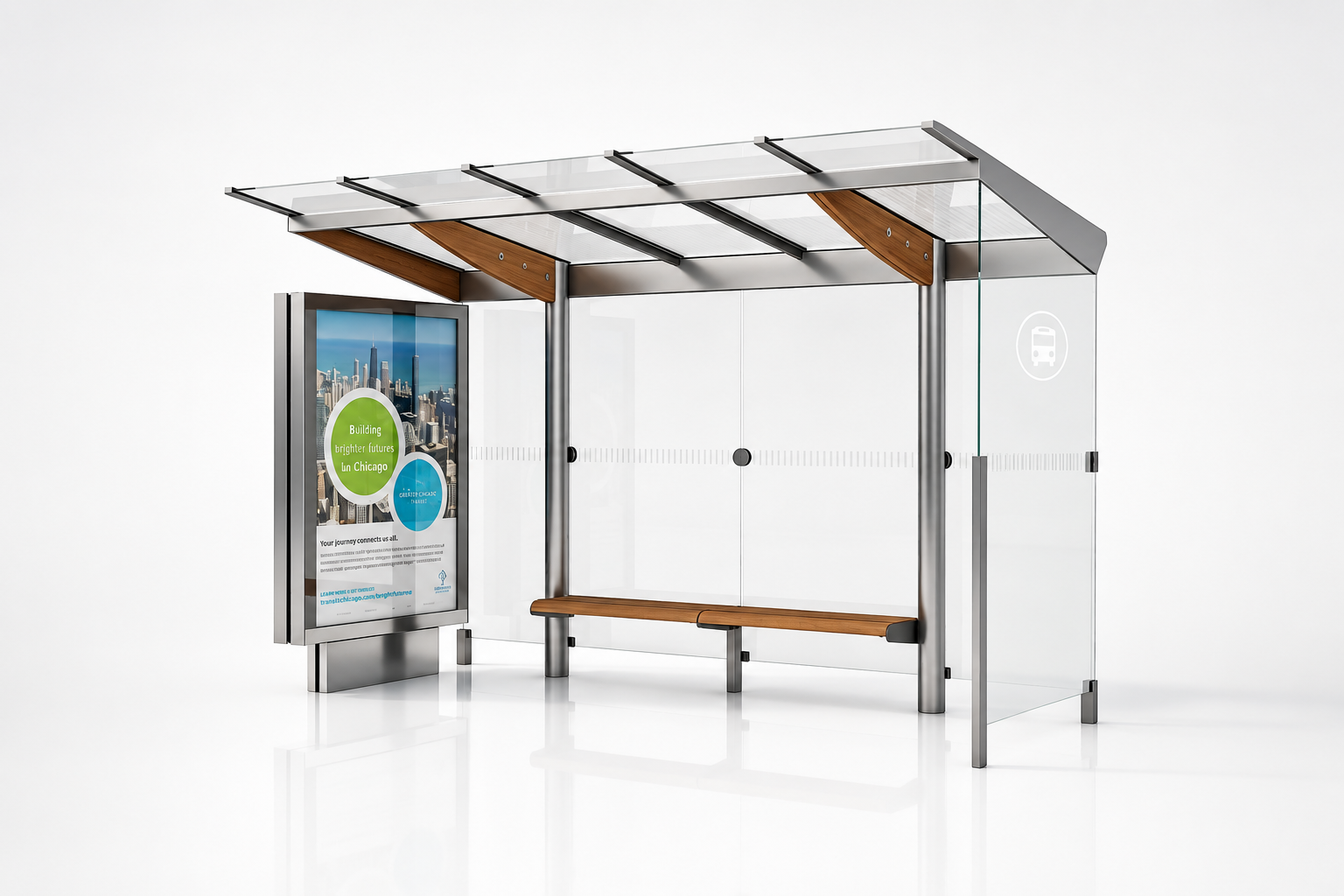
| Comparison Factor | Glass Bus Shelter | Stainless Steel Bus Shelter |
|---|---|---|
| Passenger visibility | Excellent. Clear panels allow passengers to see buses, traffic, and the surrounding area | Moderate to low when solid panels are used; best when combined with glass openings |
| Structural strength | Strong when supported by a properly engineered frame, but glass remains a breakable material | Excellent for frames, columns, beams, guards, and heavy-duty public infrastructure |
| Breakage behavior | Requires tempered or laminated safety glass to reduce injury risk | Does not shatter, but can dent, deform, or develop sharp damage if poorly fabricated |
| Corrosion resistance | Glass does not corrode; fittings and frames still require protection | High when the correct grade and finish are selected for the environment |
| Vandal resistance | Vulnerable to deliberate impact, graffiti, and scratching | Strong resistance to impact; can still receive graffiti, dents, and surface scratches |
| Cleaning requirements | Requires regular cleaning to maintain transparency and appearance | Usually easy to wipe down, but fingerprints, pollution film, and tea staining may require cleaning |
| Advertising integration | Excellent for illuminated displays, digital screens, and transparent visual design | Strong for framed advertising boxes and digital equipment housings |
| Visual style | Open, bright, contemporary, and less visually heavy | Premium, robust, architectural, and suitable for landmark-style stations |
| Initial investment | Can increase with thick safety glass, custom fittings, and replacement stock | Can increase due to material grade, fabrication complexity, welding, and finishing |
| Best use case | High-visibility urban stops, commercial areas, transit hubs, and smart shelters | Heavy-duty, vandal-prone, coastal, industrial, landmark, or long-lifecycle projects |
If the question is whether a solid stainless steel panel is less likely to break than a glass panel, stainless steel has the advantage. It is inherently more resistant to impact damage and is well suited for protective structural elements.
But passenger safety is broader than impact resistance.
A fully enclosed stainless steel shelter may create blind spots, reduce visual openness, and feel less welcoming. A properly designed glass bus shelter can improve visibility, surveillance, and passenger awareness. In many public settings, visibility is an important part of perceived and practical safety.
The best safety outcome usually comes from a combination of materials:
- Stainless steel or protected steel for the main frame and load-bearing structure.
- Tempered or laminated safety glass for side panels and back panels.
- Opaque stainless steel, aluminum, or composite panels where privacy, impact protection, branding, or equipment housing is needed.
- High-quality lighting for nighttime visibility.
- Rounded corners and concealed fasteners.
- Accessible entry space and seating layout.
- Clear sightlines to approaching buses and nearby public areas.
For example, a BRT station on a busy commercial road may use a stainless steel structural skeleton, thick safety-glass side panels, an aluminum roof, integrated LED route information, and lockable stainless steel cabinets for electrical equipment. This approach provides strength without sacrificing visibility.
For structural lifespan, stainless steel generally offers better long-term durability than glass when it is correctly specified, fabricated, and maintained. It is less vulnerable to impact breakage and can handle demanding public-use environments.
However, stainless steel performance is highly dependent on grade selection.
Grade 304 stainless steel is commonly used in many architectural and urban applications because it balances corrosion resistance, appearance, and cost. It can be a practical option for inland cities with moderate pollution and limited salt exposure.
Grade 316 stainless steel contains molybdenum and generally provides improved resistance in chloride-containing environments. It is often a more suitable choice for coastal cities, roads using de-icing salts, port areas, and heavily polluted industrial environments.
Guidance from stainless-steel organizations notes that higher pollution levels, coastal exposure, and de-icing salts should be considered during exterior stainless-steel specification.
A simple selection principle is:
- Choose 304 stainless steel for many inland urban projects with controlled exposure.
- Consider 316 stainless steel for coastal, marine, salt-spray, high-humidity, or de-icing-salt conditions.
- Use a more detailed corrosion assessment for extremely aggressive chemical, industrial, or marine environments.
- Design for drainage and avoid dirt traps, standing water, and crevices.
Even high-quality stainless steel can develop staining or localized corrosion when salt deposits and pollutants are allowed to accumulate. Cleaning remains part of lifecycle management.
Material comparison is important, but the true lifespan of a bus shelter is often determined by design details that are easy to overlook during procurement.
Water should never remain trapped in roof channels, base plates, joints, glass clamps, or enclosed structural tubes. Standing water accelerates deterioration, increases leakage risk, and can damage lighting or digital systems.
A high-quality bus shelter should include:
- Sloped roof surfaces.
- Defined drainage paths.
- Protected cable-routing channels.
- Sealed electrical enclosures.
- Accessible cleaning points.
- Corrosion-resistant fasteners.
- Proper separation between incompatible metals.
A high-grade stainless steel frame can still fail visually or functionally if it uses poor-quality bolts, incompatible metal fasteners, weak welds, or unprotected joints.
For long-term public projects, specify:
- Stainless steel fasteners compatible with the primary frame material.
- Smooth weld finishing where appearance matters.
- Hidden or tamper-resistant fasteners where vandalism risk is high.
- Isolation pads where dissimilar metals meet.
- Replaceable glass clamps and gaskets.
- Accessible inspection points for electrical and structural maintenance.
A brushed or satin stainless steel finish is often more practical for bus shelters than a mirror finish. It helps reduce visible fingerprints, minor scratches, and glare.
For glass, the project team should consider whether anti-graffiti coatings, easy-clean coatings, fritted graphics, city logos, or partial opacity are appropriate. These treatments can improve maintenance and branding, but they should not compromise passenger visibility or nighttime lighting performance.
A hybrid system is usually the strongest choice.
Use a stainless steel or coated-steel frame with clear safety-glass panels, illuminated advertising boxes, route maps, and integrated LED lighting. This creates an attractive and commercially valuable shelter while maintaining passenger visibility.
Prioritize corrosion resistance.
Use 316 stainless steel for exposed frame elements when the exposure conditions justify it. Pair it with properly sealed safety glass, corrosion-resistant fittings, and a maintenance plan that includes washing away salt deposits.
Prioritize impact resistance and repairability.
Use stronger stainless steel structural elements, minimize large unsupported glass panels, use laminated or thick tempered glass where appropriate, choose anti-graffiti surfaces, and make panels modular for quick replacement.
Prioritize integration and service access.
A smart shelter may include digital displays, real-time bus information, CCTV provisions, Wi-Fi equipment, charging modules, solar panels, and environmental sensors. Stainless steel is highly suitable for protective equipment cabinets and structural supports, while glass can preserve visibility and create a more open user experience.
Before approving a bus shelter supplier, ask these practical questions:
1. What glass type, thickness, safety standard, and test documentation will be provided?
2. Is the shelter frame made from stainless steel, galvanized steel, aluminum, or a mixed material system?
3. Which stainless steel grade is proposed: 304, 316, or another grade?
4. Has the design been adapted for local wind, snow, rainfall, temperature, and salt exposure?
5. Are roof drainage and cable-routing details clearly shown in the drawings?
6. Can damaged glass panels, LED modules, advertising panels, and electrical components be replaced independently?
7. What anti-corrosion treatment is used on hidden structural components and fasteners?
8. Are surfaces designed for graffiti removal and routine cleaning?
9. Can the shelter be customized for local branding, colors, route signage, screen configuration, solar power, and accessibility requirements?
10. Does the supplier have the manufacturing capacity, quality-control process, engineering support, and installation experience needed for the project scale?
A stainless steel bus shelter generally provides better impact resistance, structural strength, and long-term durability, especially in demanding public environments. A glass bus shelter provides better visibility, daylight, openness, and passenger comfort when high-quality safety glass is used.
For most municipal, transit, commercial, and smart-city applications, the most effective solution is not an either-or decision. It is a well-engineered hybrid shelter that combines:
- A durable stainless steel or corrosion-protected structural frame.
- Certified safety glass for visibility and weather protection.
- Modular panels for efficient maintenance.
- Strong drainage and electrical-protection details.
- Integrated lighting, advertising, wayfinding, and smart-city technology.
- Custom colors, dimensions, roof styles, branding, and solar solutions.
Ainl can support OEM and ODM bus shelter projects with customized shelter dimensions, structural configurations, colors, glass and screen options, lighting systems, solar power solutions, advertising modules, and city-branding elements. With integrated production capabilities covering metal fabrication, coating, electrical testing, and research and development, Ainl can help project teams create bus shelters that balance safety, durability, visual identity, and long-term operational value.
Contact Ainl to discuss your bus shelter project requirements and receive a customized material, structure, and smart-feature recommendation for your city, transit system, or outdoor advertising network.
Yes, a glass bus shelter can be safe when it uses properly specified tempered safety glass or laminated safety glass, secure fixings, engineered panel sizes, and a durable supporting frame. Ordinary non-safety glass should not be used for public bus shelter applications.
Stainless steel is better for structural strength, impact resistance, and long-term durability. Glass is better for visibility, daylight, and an open passenger experience. Most high-quality bus shelters use both materials together.
Grade 304 stainless steel is often suitable for inland urban environments. Grade 316 stainless steel is usually a stronger choice for coastal regions, areas exposed to salt spray, locations using de-icing salts, and high-humidity environments.
Tempered glass is stronger than ordinary glass, but it can still break under severe impact, edge damage, improper installation, or rare material defects. Correct thickness, edge finishing, panel support, and mounting systems are essential.
A properly designed and maintained stainless steel bus shelter can provide a long service life. Actual longevity depends on the material grade, local environment, fabrication quality, drainage, cleaning frequency, and whether the shelter is exposed to salt, pollution, or vandalism.
Glass bus shelters require regular cleaning to preserve transparency and remove dust, fingerprints, graffiti, adhesive residue, and pollution film. Using high-quality glass, anti-graffiti treatment, accessible panel design, and replaceable modular components can reduce maintenance difficulty.
Yes. Modern smart bus shelters can integrate solar panels, LED lighting, digital advertising displays, real-time passenger information systems, charging modules, CCTV provisions, Wi-Fi equipment, and environmental sensors. The structure and electrical system should be engineered for safe access, weather protection, cable routing, and maintenance.
1. [Outokumpu — Corrosion Tables and Charts for Stainless Steel]
2. [World Stainless — Corrosion Resistance of Stainless Steels]
4. [Project for Public Spaces — Bus Shelters]
5. [Nickel Institute — Design Guidelines for the Selection and Use of Stainless Steels]
6. [SIST — EN 12150 Thermally Toughened Safety Glass Standard Overview]
7. [ESG Glass — Toughened Glass Benefits, Uses and Safety Standards]


