
Email: ainlbusshelter@gmail.com | WhatsApp: +86-18800607527
Views: 277 Author: Ainl Bus Shelter Publish Time: 2026-08-14 Origin: Site


Content Menu
● Top 10 Smart Bus Shelter Manufacturers in China
>> 1. Ainl
>> 2. Jiangsu Yongjie Advertising Creative Co., Ltd.
>> 3. Guangdong Yike Transportation Facilities Technology Co., Ltd.
>> 4. Jiangsu Qianli Technology Co., Ltd.
>> 5. Suqian Huajun Advertising Equipment Co., Ltd.
>> 6. Shijiazhuang Jiuming Metal Products Co., Ltd.
>> 7. Suqian Aolin Advertising Technology Co., Ltd.
>> 8. Jiangsu Wancheng Intelligent Technology Co., Ltd.
>> 9. Dongguan Pinzhu Intelligent Transportation Facilities Co., Ltd.
>> 10. Sichuan Yishihui Technology Co., Ltd.
● Manufacturer Comparison Table
● Technical Requirements Buyers Should Specify
>> Coating and Corrosion Protection
>> Digital Displays and Electrical Systems
>> 1. Vague Material Descriptions
>> 2. Prototype Quality Does Not Match Mass Production
>> 3. Solar Systems Designed for Demonstration, Not Continuous Use
● Factory Audit and Sample Process
● Shipping and Installation Considerations
● FAQ
>> 1. How can I verify whether a supplier's ISO certificate is still valid?
>> 2. Does a CE or RoHS document prove that the entire Smart Bus Shelter is compliant in Europe?
>> 3. How can I confirm whether an outdoor screen will work in direct sunlight and high temperatures?
>> 4. What is the typical MOQ for Smart Bus Shelters?
China is one of the most practical sourcing destinations for Smart Bus Shelters because it combines large-scale steel fabrication, sheet-metal processing, powder coating, LED/LCD display integration, solar-energy components, and export-oriented logistics.
The market is moving beyond basic covered waiting areas. Modern smart bus shelters can integrate real-time passenger information, digital advertising, public Wi-Fi, emergency call systems, CCTV, charging ports, environmental sensors, solar power, and remote content-management platforms. Industry research estimates that the global smart bus shelter market was valued at approximately USD 550 million in 2025 and could reach USD 1.453 billion by 2035, with a projected CAGR of 10.1%.
For international buyers, the main challenge is not finding a supplier—it is identifying a manufacturer that can reliably deliver structural durability, electrical safety, software compatibility, and consistent project execution.
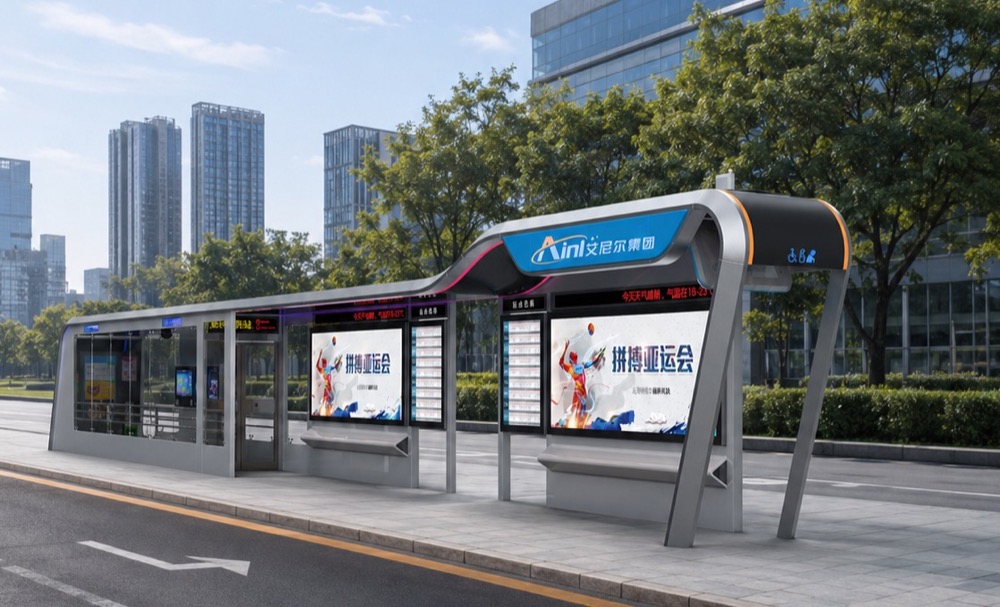
A capable Smart Bus Shelter manufacturer should be assessed as both a metal-fabrication supplier and an intelligent-system integrator.
| Evaluation Area | What Buyers Should Verify | Why It Matters |
|---|---|---|
| Manufacturing capability | Factory size, laser cutting, bending, welding, powder coating, assembly, packaging | Indicates whether the supplier can control quality and delivery schedules |
| Structural engineering | Steel grade, wall thickness, wind-load design, drainage, anchoring system | Prevents deformation, corrosion, water leakage, and installation problems |
| Smart-system integration | Digital display, communication hardware, solar system, CMS, remote monitoring | Determines long-term operational reliability |
| Quality control | Incoming material inspection, welding inspection, coating tests, electrical testing | Reduces the risk of inconsistent mass production |
| Compliance readiness | CE, RoHS, EMC, LVD, ISO certificates, local electrical requirements | Supports import, installation, and public-project approval |
| OEM/ODM flexibility | Dimensions, colors, branding, screens, lighting, solar power, seating | Ensures the shelter fits local climate and city-design requirements |
| Delivery support | Drawings, installation manuals, spare parts, export packing, after-sales response | Reduces risks after the goods arrive at the destination |
China's manufacturing strength is supported by a broad export ecosystem. China's mechanical and electrical product exports reached approximately USD 2.30 trillion in 2025, demonstrating the scale of its export manufacturing and component supply chain.
Company positioning: Ainl is a Chinese manufacturer and solution provider for Smart Bus Shelters, smart-city public facilities, and outdoor advertising products. The company has approximately 16 years of industry experience.
Manufacturing capability: According to company information, Ainl operates on a site of more than 260 mu, with approximately 150,000 square meters of factory space. Its facilities include a hardware and software R&D center, CNC sheet-metal processing center, large-scale coating center, and electrical testing laboratory.
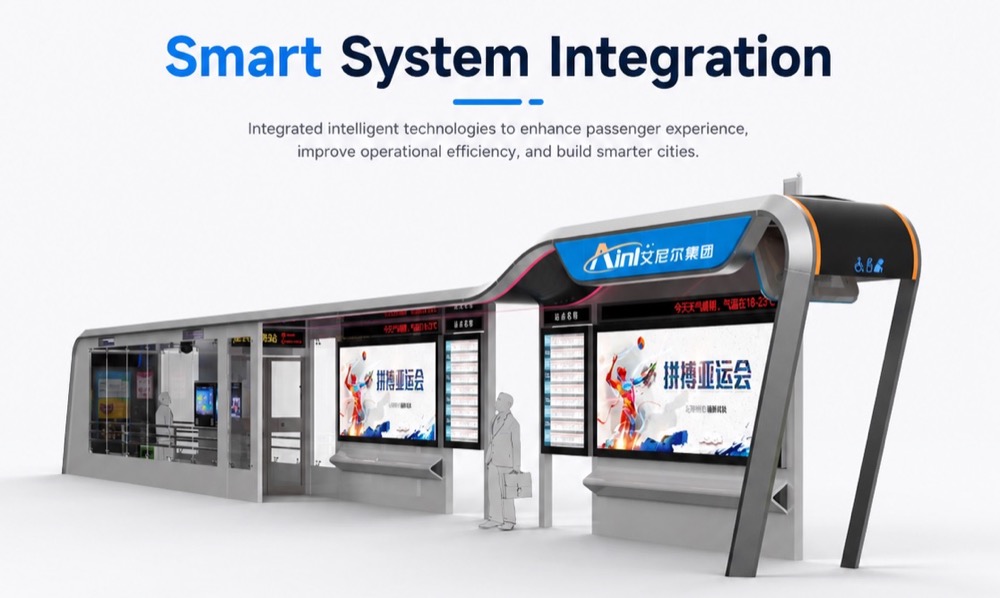
Core strengths: Ainl is particularly suitable for buyers looking for a project-based supplier rather than a standard-product trader. The company can combine steel structures, digital displays, lighting, solar power, advertising panels, city-branding elements, and smart control functions into one customized shelter solution.
OEM/ODM scope:
- Shelter dimensions and structural layouts
- Steel, aluminum, glass, and roof configurations
- Powder-coating colors and city-branding graphics
- LCD, LED, e-paper, or digital information displays
- Lighting systems, advertising lightboxes, and charging functions
- Solar panels, battery storage, and hybrid power systems
- Seating, accessibility features, route maps, and station signage
- Remote-management and intelligent transportation functions
Project suitability: Ainl can be a suitable option for regional transport operators, municipal contractors, advertising companies, and small-to-medium-sized brands that need flexible communication, detailed customization, and coordinated support across structure, electronics, and visual design.
Qualification information: Company-provided information indicates that Ainl is recognized as a national high-tech enterprise and holds relevant steel-structure, municipal-construction, management-system, and safety-production qualifications. Buyers should request current certificates and confirm their applicability to the destination market before tender submission or import.
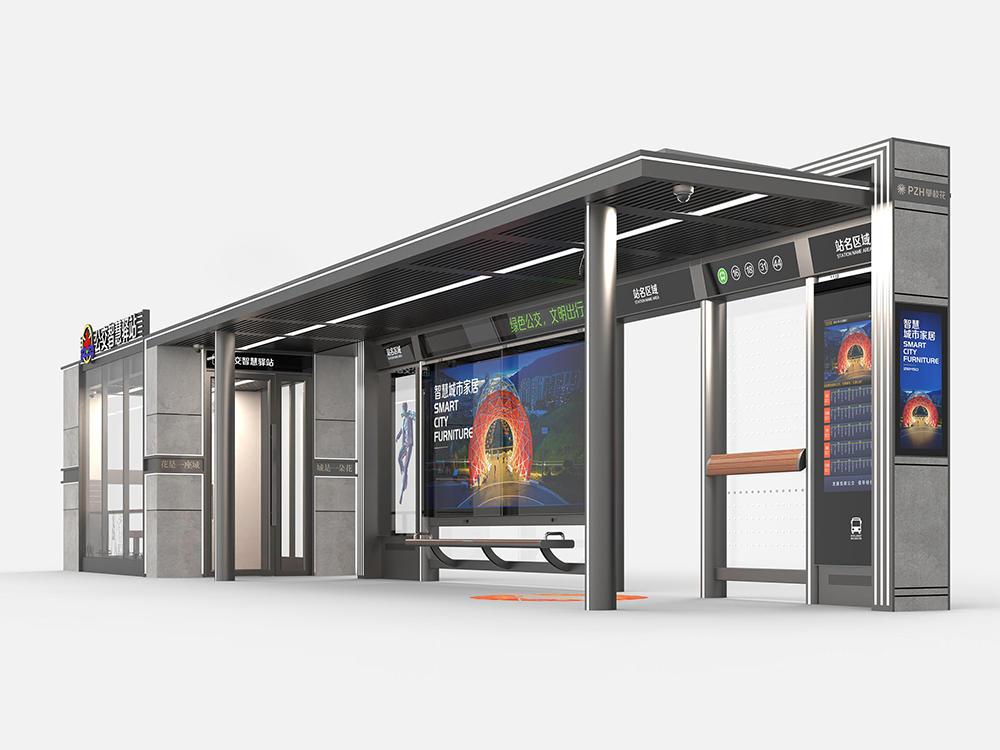
Established: 2015
Main products: Smart Bus Shelters, advertising waste bins, landscape sculptures, advertising display products.
Jiangsu Yongjie focuses on public-facility products that combine transit infrastructure with advertising displays. It may be relevant for buyers procuring bus shelters together with advertising lightboxes, public bins, signage, or landscape features.
Strengths:
- Broad urban-furniture and advertising-product portfolio
- Customization support listed in public company data
- Suitable for projects that combine passenger shelters and outdoor advertising assets
What to verify: Buyers should confirm whether structural engineering, display integration, powder coating, and software integration are handled in-house or outsourced. Public registration data identifies Smart Bus Shelters and related advertising products among its principal offerings.
Established: 2007
Main products: Smart Bus Shelters, guard booths, membrane carports, metal traffic facilities, intelligent control equipment.
Guangdong Yike's product scope extends beyond bus shelters into transportation facilities, guard booths, carports, signage, and metal structures. This makes it potentially relevant for integrated transportation-infrastructure projects.
Strengths:
- Long operating history relative to many newer suppliers
- Product coverage across transit facilities and metal structures
- Potential fit for projects requiring shelters, booths, signage, and parking structures together
What to verify: Request wind-load calculations, corrosion-protection specifications, structural drawings, electrical-system documentation, and comparable project references for the intended climate. Public company data lists Smart Bus Shelters and transportation-related facilities in its product portfolio.
Established: 2019
Main products: Smart Bus Shelters, rapid-bus-system equipment, electronic scrolling displays, solar-energy systems, intelligent public-facility products.
Jiangsu Qianli may be suitable for buyers with a stronger focus on digital transit information, solar-powered systems, and smart transport functions.
Strengths:
- Product scope includes intelligent bus-system equipment
- Relevant for solar-powered shelters and electronic passenger-information displays
- Potential fit for transit projects requiring digital route information and remote management
What to verify: Ask for details on display brightness, IP rating, operating-temperature range, content-management system, API availability, solar-power calculations, battery specifications, and offline operating logic.
Established: 2014
Main products: Smart Bus Shelters, guardrails, benches, advertising lightboxes, electronic bus-stop signs, public bicycle shelters, solar-power systems.
Suqian Huajun offers a relatively broad public-facility range, covering metal urban furniture, advertising assets, electronic signs, and solar solutions.
Strengths:
- Suitable for combined procurement of shelters, benches, lightboxes, and signage
- Product range includes solar-powered public facilities
- May fit municipal renewal projects requiring several categories of street furniture
What to verify: Confirm steel grade, coating process, screen specifications, installation drawings, and whether public-bicycle and solar modules are compatible with the client's local infrastructure requirements.
Established: 2014
Main products: Smart Bus Shelters, parking sheds, metal products, steel structures, multimedia equipment, signage.
Shijiazhuang Jiuming is relevant for buyers who prioritize steel-structure fabrication and metal-product customization alongside basic digital-display integration.
Strengths:
- Product scope includes steel structures and metal products
- Potential fit for heavier structural projects
- May support bus shelters, parking shelters, signage, and public-space structures
What to verify: Request mill certificates for steel, welding procedures, coating-test reports, structural calculations, export-packing standards, and a clear breakdown of which electronic components are supplied by third parties.
Established: 2016
Main products: Smart Bus Shelters, electronic bus-stop signs, LED displays, public bicycle facilities, solar advertising lightboxes.
Suqian Aolin focuses on the combination of bus shelters, LED displays, electronic station signs, and outdoor advertising products.
Strengths:
- Suitable for projects with digital-advertising and passenger-information requirements
- Product range includes LED display and electronic-signage elements
- May be relevant for solar-powered advertising shelters
What to verify: Buyers should inspect display-module brands, brightness specifications, cooling design, access doors, wiring protection, IP rating, remote-control platform, and maintenance procedures.
Established: 2021
Main products: Smart Bus Shelters, smart waste kiosks, intelligent waste bins, metal structures, smart-control systems.
Jiangsu Wancheng's offering combines Smart Bus Shelters with smart environmental and waste-management facilities.
Strengths:
- Relevant for smart-city projects combining transportation and environmental facilities
- Product portfolio includes intelligent-control and public-service components
- May suit urban-renewal projects requiring standardized design language across several facility types
What to verify: For electronic systems, clarify the supplier's responsibility for hardware, firmware, cloud platform, data ownership, system maintenance, and replacement parts.
Established: 2016
Main products: Smart Bus Shelters, mobile police booths, billboards, metal structures, transportation facilities.
Located in Dongguan, the company may benefit from proximity to the Pearl River Delta's sheet-metal, electronics, display, and electrical-component supply chains.
Strengths:
- Transportation-facility and metal-structure product coverage
- Potential access to nearby electronic-display and hardware supply chains
- Suitable for projects requiring shelters, public-security booths, and billboard structures
What to verify: Confirm the actual factory location, in-house production processes, key-component sourcing, display-system warranty, outdoor electrical protection, and shipping-packing capabilities.
Established: 2023
Main products: Smart Bus Shelters, transparent screens, vertical touch advertising machines, digital-display products.
Sichuan Yishihui is a newer company with a stronger emphasis on display and interactive advertising equipment.
Strengths:
- Relevant for digital-display-led shelter projects
- Product scope includes transparent screens and touch advertising equipment
- May suit pilot projects, commercial districts, or advertising-focused transit installations
What to verify: As a newer supplier, buyers should conduct deeper due diligence on manufacturing ownership, outdoor display performance, completed project references, long-term software support, and spare-parts availability. Public company data lists the company as not supporting customization, so this point should be reconfirmed directly during inquiry.
| Manufacturer | Primary Focus | Capacity Information | MOQ Approach | Certification Information |
|---|---|---|---|---|
| Ainl | Smart shelters, public facilities, outdoor advertising, deep OEM/ODM | Company-provided: approx. 150,000 m² factory space | Confirm by standard modules and custom components separately | Company-provided: high-tech enterprise, construction and management-system qualifications |
| Jiangsu Yongjie | Shelters, advertising equipment, landscape products | Not publicly standardized | RFQ required | Request valid certificates |
| Guangdong Yike | Transit facilities, booths, carports, metal structures | Not publicly standardized | RFQ required | Request valid certificates |
| Jiangsu Qianli | Smart transit equipment, solar and digital systems | Not publicly standardized | RFQ required | Request valid certificates |
| Suqian Huajun | Shelters, lightboxes, benches, solar systems | Not publicly standardized | RFQ required | Request valid certificates |
| Shijiazhuang Jiuming | Metal structures, shelters, multimedia equipment | Not publicly standardized | RFQ required | Request valid certificates |
| Suqian Aolin | Electronic signs, LED displays, shelters | Not publicly standardized | RFQ required | Request valid certificates |
| Jiangsu Wancheng | Smart city and environmental facilities | Not publicly standardized | RFQ required | Request valid certificates |
| Dongguan Pinzhu | Transport facilities, structures, booths | Not publicly standardized | RFQ required | Request valid certificates |
| Sichuan Yishihui | Transparent displays and advertising equipment | Not publicly standardized | RFQ required | Request valid certificates |
A supplier quotation should never be accepted based only on appearance drawings or a generic product photo. The following points should be included in the technical specification and contract.
- Steel grade, aluminum grade, and steel-wall thickness
- Galvanized steel, hot-dip galvanizing, or alternative corrosion-protection method
- Structural load calculations and wind-load requirements
- Foundation drawings, anchor-bolt layout, and installation tolerances
- Welding process, weld finishing, and visible-surface requirements
- Roof drainage design and water-ingress protection
- Tempered or laminated glass type, thickness, edge treatment, and replacement method
Do not accept "outdoor powder coating" as a complete specification. Define:
- Pretreatment process
- Powder-coating brand or performance grade
- Color code, gloss level, and texture
- Minimum dry-film thickness
- Adhesion requirement
- Salt-spray or weather-resistance standard
- Coastal, humid, desert, or high-UV environmental conditions
- Display type: LCD, LED, e-paper, or transparent display
- Screen size, resolution, brightness, contrast, and viewing angle
- IP protection rating
- Operating-temperature range
- Automatic brightness adjustment
- Cooling method and heat-dissipation design
- Surge protection, grounding, leakage protection, and power-distribution layout
- Network configuration: 4G/5G, Wi-Fi, Ethernet, fiber, or local network
- CMS platform, user permissions, API support, and remote diagnostics
A solar-powered Smart Bus Shelter should be evaluated using a complete energy-balance calculation, not just the wattage of the solar panel.
Require the supplier to provide:
- Local solar-irradiance assumptions
- Hourly electrical-load schedule
- Display, lighting, router, CCTV, sensor, and charging-load calculations
- Battery usable capacity and temperature derating
- Number of backup days during low-sunlight conditions
- Inverter, charge controller, and protection-device specifications
- Hybrid-grid or emergency-power options
Terms such as "galvanized steel," "stainless steel," "high-brightness screen," or "heavy-duty structure" are not measurable specifications.
How to avoid it: Include material grade, thickness, coating thickness, screen brightness, IP rating, and test standards in the purchase contract.
A supplier may use thicker steel, premium displays, or better power supplies for samples, then substitute lower-cost components in production.
How to avoid it: Approve a sealed golden sample, freeze the bill of materials, specify approved brands and models, and prohibit substitutions without written approval.
Some solar quotes do not account for high display brightness at night, lighting loads, battery degradation, extreme temperatures, or consecutive cloudy days.
How to avoid it: Require a time-based energy calculation for the worst month at the installation location.
The initial unit price may exclude display replacement, battery replacement, software licenses, cloud-platform fees, spare parts, remote maintenance, or on-site technical support.
How to avoid it: Request a minimum two-year spare-parts price list, warranty terms, software-service conditions, and service-response commitments before order confirmation.
1. Document review: Request business registration, factory address, product catalog, project references, export records, quality certificates, and component lists.
2. Video or on-site factory audit: Inspect cutting, bending, welding, coating, assembly, display testing, packaging, and finished-goods areas.
3. Sample approval: Confirm a key module or reduced-size sample covering steel sections, color, glass, lighting, display interface, and electrical components.
4. Document freeze: Approve drawings, BOM, color samples, inspection plan, packaging standard, installation manual, and spare-parts list.
5. Pre-shipment inspection: Test dimensions, welding, surface finish, electrical operation, display performance, network connection, locks, accessories, and packaging before container loading.
- Confirm the maximum component length before finalizing the shelter design. Oversized roofs, columns, and advertising panels may require open-top or flat-rack containers rather than standard 40HQ containers.
- Use dedicated protection for glass, displays, powder-coated surfaces, and metal edges. Stretch film alone is not sufficient for ocean freight.
- Finalize foundation drawings, anchor-bolt locations, cable-routing requirements, and site power conditions before shipment.
- Verify local regulations on electrical equipment, accessibility, advertising permits, data protection, construction permits, and public-space installation.
- For large municipal projects, appoint a local civil engineer or installation contractor to review foundation conditions and site interfaces.
Selecting a Smart Bus Shelter manufacturer requires more than comparing unit prices. Buyers should assess each supplier's structural engineering, coating quality, electrical safety, display performance, solar-power calculations, software capability, documentation discipline, and export-delivery support.
For projects requiring flexible OEM/ODM service, coordinated structure-and-electronics integration, city-branding customization, and responsive project communication, Ainl can be included in the initial supplier shortlist. Request a technical proposal, factory documentation, component list, and project-specific quotation, then compare all shortlisted suppliers against one standardized specification sheet.
Do not rely only on a PDF certificate. Check the legal company name, factory address, scope of certification, certificate number, issuing body, accreditation mark, and expiry date. Then verify the record through the certification body or IAF CertSearch. ISO itself does not issue certificates to companies; certificates are issued by independent certification bodies.
Not necessarily. Compliance obligations may differ for the steel structure, display, power supply, wireless modules, CCTV, and charging equipment. Buyers should request declarations of conformity, relevant test reports, technical files, labeling details, and confirmation from a local compliance specialist.
Ask for brightness in nits, automatic brightness-control range, operating temperature, IP rating, panel type, heat-dissipation design, continuous-run test data, and thermal-throttling logic. Test the approved sample under realistic operating conditions whenever possible.
There is no universal MOQ because these products are project-based. Structural frames, custom glass, powder-coating colors, LCD displays, solar panels, batteries, and electronic controllers can all have different minimum-order requirements. Ask suppliers to separate MOQ and one-time tooling costs by component category.
Freeze the BOM in the contract. List approved brands, models, specifications, origin requirements, substitution rules, inspection rights, and non-conformance penalties. Conduct first-article approval and pre-shipment inspections, especially for screens, power supplies, batteries, controllers, and communication modules.
- [China Customs: Major Exports by Quantity and Value, December 2025]
- [Shanghai Public Transport Improvement Policy]
- [Beijing Intelligent Connected Bus Stops]
- [ISO Certification Verification Guidance]
- [IAF CertSearch]


