
Email: ainlbusshelter@gmail.com | WhatsApp: +86-18800607527
Views: 220 Author: Ainl Bus Shelter Publish Time: 2026-08-20 Origin: Site


Content Menu
● What Is the Difference Between an Advertising Bus Shelter and a Standard Bus Shelter?
● Advertising Bus Shelter vs Standard Bus Shelter: Core Comparison
● Standard Bus Shelters: Reliable Infrastructure for Everyday Mobility
>> When a Standard Bus Shelter Works Best
>> The Value of a Well-Designed Standard Bus Shelter
● Advertising Bus Shelters: Turning Waiting Space into a Revenue Asset
>> Common Advertising Bus Shelter Formats
● Revenue Is About More Than Selling Poster Space
● Site Selection Determines Commercial Performance
● Accessibility and Safety Must Never Be Traded for Advertising Space
>> Essential Design Priorities
● A Practical Procurement Framework for Transit Operators
>> Step 1: Segment the Bus Stop Network
>> Step 2: Define the Revenue Model
>> Step 3: Specify Long-Term Durability
>> Step 4: Measure Both Public and Commercial Outcomes
● Choosing the Right Shelter Strategy
● Build Passenger-First, Revenue-Ready Bus Shelters with Ainl
● FAQ
>> 1. What is an advertising bus shelter?
>> 2. How does an advertising bus shelter generate revenue?
>> 3. Are digital bus shelter screens better than static advertising panels?
>> 4. Can advertising panels reduce passenger space?
>> 5. Can bus shelters use solar power?
>> 6. What should transit operators request from a bus shelter manufacturer?
>> 7. Can Ainl customize bus shelters for local city branding?
For transit operators and municipal project owners, the choice between an advertising bus shelter and a standard bus shelter is no longer only about providing rain protection and seating. It is a decision that affects passenger comfort, streetscape quality, maintenance responsibility, commercial income, and the long-term value of public infrastructure.
A standard bus shelter focuses on essential passenger needs. An advertising bus shelter adds a monetizable media asset—such as a static poster panel, digital display, or smart information screen—while still functioning as a safe and durable waiting facility. When planned correctly, it can help transit operators create recurring revenue without compromising accessibility, safety, or city identity.
At Ainl, we have seen that the best public-facility projects begin with a simple principle: passenger experience comes first; advertising value follows good design, visibility, and reliable operation.
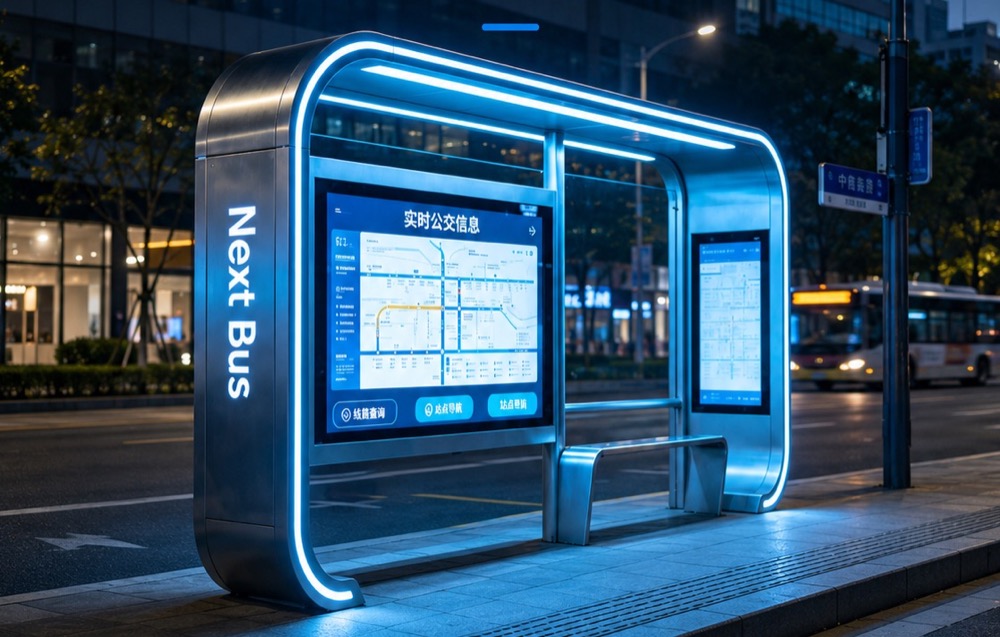
A standard bus shelter is built primarily to protect passengers from sun, rain, wind, and other weather conditions. It typically includes a steel or aluminum structure, roof, side panels, seating, route signage, lighting, and optional accessibility features.
An advertising bus shelter includes those same core functions but incorporates dedicated advertising space. This may be a backlit poster frame, a double-sided media panel, a digital out-of-home display, a city information screen, or an integrated smart screen.
The distinction is important because advertising shelters must meet two goals at the same time:
- Provide a comfortable, accessible, and safe passenger waiting area.
- Deliver a visible, reliable, commercially valuable advertising platform.
Transit shelter advertising is commonly used in high-footfall urban corridors because it reaches passengers, pedestrians, cyclists, and nearby vehicle traffic. One industry analysis citing a 2022 Solomon Partners study reported that transit shelters had an estimated median cost per thousand impressions of $2.18, among the lowest across surveyed media formats.
| Factor | Advertising Bus Shelter | Standard Bus Shelter |
|---|---|---|
| Primary purpose | Passenger service plus media revenue | Passenger comfort and weather protection |
| Revenue potential | Ongoing advertising, sponsorship, digital media, public-information partnerships | Usually no direct advertising income |
| Initial investment | Higher due to media panels, lighting, wiring, screen systems, and controls | Lower and structurally simpler |
| Design complexity | Requires media visibility, cable routing, maintenance access, and safety planning | Focuses on shelter size, materials, seating, and drainage |
| Power requirement | Often requires grid power, solar power, battery storage, or hybrid supply | May operate without power unless lighting is included |
| Maintenance needs | Structural upkeep plus display, lighting, software, and content management | Mainly cleaning, repair, repainting, and lighting maintenance |
| Best locations | Busy commercial districts, city centers, transport hubs, tourist areas, arterial roads | Residential areas, lower-traffic routes, rural stops, basic transit corridors |
| Commercial model | Advertising concession, revenue share, municipal media network, sponsorship | Public procurement, capital project, municipal maintenance budget |
The right model is not always "advertising everywhere." A transit authority should match shelter type to passenger demand, available right-of-way, local regulations, advertiser interest, and the city's maintenance capacity.
A standard bus shelter remains the correct choice for many transit stops. It provides a practical and cost-controlled solution where commercial advertising demand is limited or where site conditions cannot support a media installation.
A standard bus shelter is often the best fit when a project requires:
- Fast deployment across a large number of stops.
- Lower upfront cost per location.
- A design that prioritizes weather protection and seating.
- Installation in residential, suburban, rural, school-zone, or low-traffic locations.
- A citywide visual standard with limited operational complexity.
- Minimal electrical infrastructure.
For these sites, the focus should be on shelter durability, passenger circulation, visibility of route information, anti-corrosion performance, safe glass or panel materials, and easy cleaning.
A shelter should also support barrier-free access. Design guidance commonly emphasizes a direct accessible route, a firm and stable surface, unobstructed boarding access, and adequate clear space for wheelchair users.
A standard shelter does not generate advertising revenue directly, but it can still produce major public value:
- Better perceived service quality.
- Greater passenger comfort in rain, heat, and cold weather.
- Improved use of public transport.
- More consistent city streetscape design.
- Lower risk of informal, poorly maintained waiting areas.
- Easier long-term maintenance when using modular, standardized components.
For many local governments, this foundation should be established before advanced commercial or smart-city functions are added.
An advertising bus shelter is a passenger facility with a commercial layer. It can generate income through static poster sales, brand sponsorships, digital campaign inventory, public-service messaging, or a revenue-sharing agreement with a media operator.
The commercial opportunity comes from location, visibility, dwell time, and repeat exposure. Passengers often wait several minutes, while nearby pedestrians and road users may encounter the display repeatedly along their daily routes.
Advertising shelters can be configured in several ways:
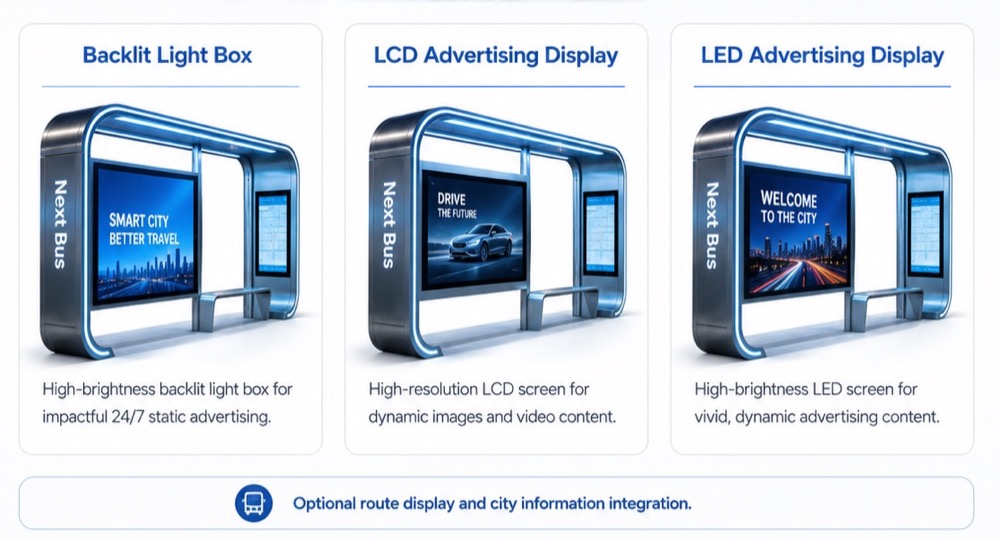
- Static advertising panels: Traditional printed posters in enclosed, weather-resistant display cases.
- Backlit lightbox panels: Illuminated poster displays that improve nighttime visibility.
- Digital advertising screens: Remotely managed displays that rotate multiple campaigns.
- Smart bus shelter screens: Digital displays combining advertising, route information, city announcements, weather, emergency alerts, or wayfinding.
- Sponsored shelters: A brand supports construction or maintenance in exchange for defined visibility rights.
- Hybrid solar bus shelters: Solar panels help supply lighting, USB charging, digital signs, or low-power media equipment.
Digital screens can offer more flexibility than static panels, but they also require stronger electrical design, content-management capability, heat dissipation, network connectivity, impact resistance, and a clear maintenance plan.
The strongest advertising bus shelter programs do not depend only on filling every panel with commercial campaigns. They create a balanced public-media system.
Transit operators can explore several models:
1. Direct media sales
The operator sells advertising inventory to local, regional, or national brands.
2. Advertising concession agreements
A media company installs, operates, and sells the advertising network under a defined contract.
3. Revenue-share partnerships
The shelter owner and media operator split income according to agreed performance terms.
4. Corporate sponsorships
Businesses sponsor individual shelters, route corridors, charging points, or public-information facilities.
5. Digital campaign rotation
One digital panel can display multiple advertisers, improving inventory flexibility compared with a single printed poster.
6. Public-information inventory
A defined percentage of screen time or display space can be reserved for transit updates, emergency notices, community campaigns, and city branding.
This approach protects the public purpose of the facility. It also reduces the risk that commercial content overwhelms passenger information.
Not every stop should receive an advertising bus shelter. In practical project planning, the site often determines commercial value more than the display technology itself.
A high-quality advertising shelter should be considered for locations with:
- Strong pedestrian volume.
- High passenger boarding and alighting activity.
- Long waiting times or frequent service.
- Proximity to retail streets, business districts, hospitals, schools, sports venues, airports, or tourist destinations.
- Good visibility from surrounding traffic without creating safety risks.
- Sufficient sidewalk width and clear boarding space.
- Access to electricity or feasible solar exposure.
- Local policies that permit advertising infrastructure.
For example, a busy downtown stop beside retail storefronts may support a digital advertising shelter because it offers a large recurring audience and nearby commercial demand. A lower-density residential stop may benefit more from a durable standard shelter with seating, lighting, and clear route information.
The most common mistake in advertising shelter planning is allowing the media panel to dictate the entire layout. A shelter is not simply an outdoor billboard. It is public infrastructure used by children, older passengers, people with disabilities, tourists, and commuters carrying bags or pushing strollers.
Industry guidance highlights the need for accessible routes, stable surfaces, clear passenger circulation, and sufficient boarding-area space. One transit design guideline notes that advertising shelters can require more boarding-area depth than non-advertising shelters because the added media element changes the physical layout.
Before approving an advertising bus shelter, project teams should verify:
- Clear pedestrian path: The shelter must not block the sidewalk or accessible route.
- Boarding-zone access: Passengers must be able to move safely between the shelter and bus door area.
- Sightlines: Advertising panels must not obstruct approaching buses, route signs, traffic signals, or pedestrian visibility.
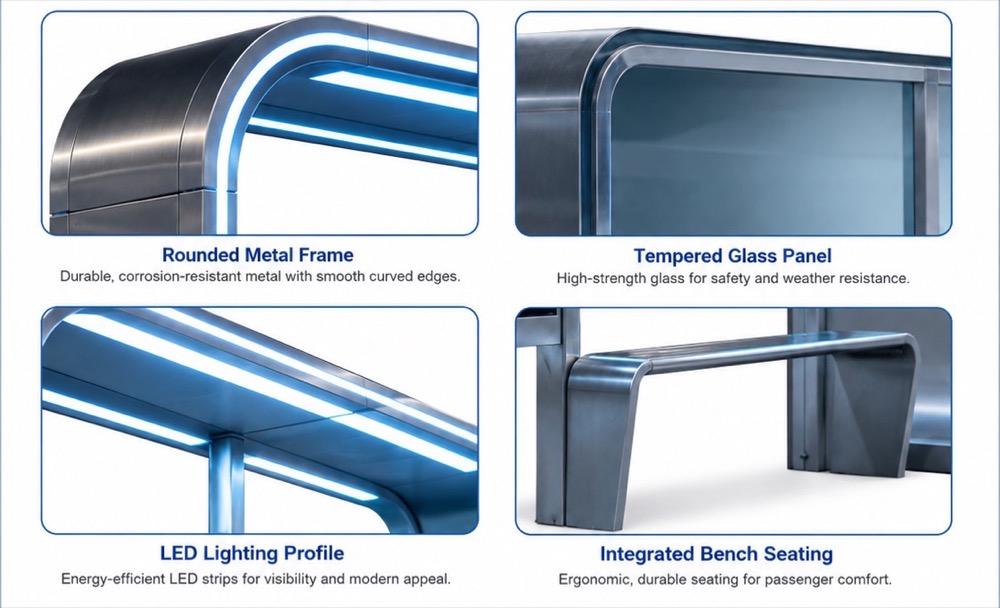
- Safe materials: Use tempered or laminated glass, durable metal framing, rounded edges, and vandal-resistant fittings.
- Lighting: Provide sufficient illumination for waiting, wayfinding, and personal security.
- Electrical protection: Screens, lightboxes, and wiring must be weatherproof and protected from tampering.
- Maintenance access: Technicians need safe access to media panels, power components, and control systems.
- Content governance: Public authorities should define acceptable advertising categories, brightness limits, animation rules, and emergency-message priority.
Ainl can support these requirements through customized shelter dimensions, structural configurations, colors, lighting systems, advertising panels, digital screen integration, solar-power options, and city-branding elements.
Before selecting an advertising bus shelter manufacturer or media partner, decision-makers should establish the project model clearly.
Classify stops by passenger volume, commercial potential, location type, available space, power access, and weather exposure.
A useful approach is to create three groups:
- Premium commercial stops: Digital or illuminated advertising shelters.
- Core transit stops: Standard shelters with optional static media panels.
- Basic coverage stops: Compact standard shelters, canopies, or seating solutions.
Decide whether the operator will sell media directly, lease space to an advertising company, establish a revenue-sharing arrangement, or use sponsorships.
The contract should specify:
- Asset ownership.
- Installation responsibilities.
- Advertising-sales rights.
- Revenue-sharing formula.
- Maintenance standards.
- Electricity and connectivity costs.
- Public-service message allocation.
- Content restrictions.
- Performance reporting.
- End-of-contract asset transfer.
A bus shelter should be engineered for local wind loads, rainfall, temperature changes, UV exposure, corrosion risks, and potential vandalism. Cheap materials can reduce initial spending but often create higher replacement and maintenance costs.
For export and municipal projects, a capable manufacturer should be able to customize structure, dimensions, finishes, screen systems, lighting, and power supply according to the destination environment and project requirements.
Do not evaluate a project only by advertising income. Track both passenger-service and commercial indicators:
- Shelter availability and uptime.
- Passenger satisfaction.
- Cleaning and repair response time.
- Advertising occupancy rate.
- Campaign delivery records.
- Energy consumption.
- Digital screen uptime.
- Public-information display time.
- Revenue per location.
- Maintenance cost per location.
This creates a more defensible investment case for future network expansion.
The best choice depends on the goals of the transit operator.
Choose a standard bus shelter when the main priority is broad passenger coverage, straightforward construction, lower capital cost, and easy maintenance.
Choose an advertising bus shelter when the site has strong audience value, commercial visibility, adequate physical space, and an operational plan for media sales and maintenance.
Choose a hybrid network when the city needs both. This is often the most practical model: high-value locations support advertising or smart shelter installations, while standard shelters provide reliable coverage across the rest of the network.
A well-designed bus shelter can improve daily mobility, strengthen a city's visual identity, and create a durable platform for public communication and commercial revenue. The key is to select the right configuration for each location—not to force one shelter model across every route.
With 16 years of experience in smart-city public facilities and outdoor advertising products, Ainl supports OEM and ODM bus shelter projects with customized structures, sizes, colors, lighting, advertising panels, digital displays, solar systems, and integrated city-brand elements.
Contact Ainl to discuss your bus shelter project, evaluate advertising-ready configurations, and develop a tailored manufacturing solution for your transit network.
An advertising bus shelter is a passenger waiting facility that includes dedicated space for static posters, backlit panels, digital displays, or smart screens. It combines weather protection and transit amenities with an outdoor media platform.
Revenue can come from direct advertising sales, media concessions, sponsorships, revenue-sharing agreements, or rotating campaigns on digital screens. The amount depends on location quality, traffic volume, market demand, and operating costs.
Not always. Digital screens can display multiple campaigns and update content remotely, but they require power, connectivity, content management, maintenance, and local regulatory approval. Static panels are simpler, lower-cost, and often suitable for smaller networks.
They can if the shelter layout is poorly designed. The media panel must be positioned so it does not block accessible paths, boarding areas, seating access, route information, or visibility of approaching buses.
Yes. Solar power can support LED lighting, USB charging, route displays, and some low-power smart functions. System feasibility depends on sunlight conditions, energy demand, battery capacity, local climate, and screen specifications.
Operators should request structural drawings, material specifications, corrosion-protection details, wind-load considerations, lighting and electrical plans, accessibility layout, maintenance access design, customization options, quality-control documentation, and project references.
Yes. Ainl can customize shelter dimensions, structure, colors, roofing, panels, seating, LED lighting, advertising display systems, digital screens, solar solutions, and visual elements that reflect local city branding.
1. Broadsign. [Transit Advertising: How to Reach Audiences on the Move with Out-of-Home]
2. Texas A&M Transportation Institute. [Guidelines for Planning, Designing, and Operating Bus-Related Facilities]
3. Intercity Transit. [Bus Stop Design Standards Manual]
4. Omnitrans. [Transit Design Guidelines: Bus Stop Types, Shelters and Construction]
5. Calvert–St. Mary's Metropolitan Planning Organization. [Overview of Existing ADAAG and PROWAG Bus Stop Guidelines]
6. AdQuick. [Bus Shelter Advertising: Plan, Buy & Measure]
7. Outdoor Advertising Association of America. [OOH Media Formats: Bus Benches]


